2027 Best Online Speech Pathology Master's Programs for Residents of Richmond, VA

Co-Founder and Chief Data Scientist

Reviewed by Rhea Paul, PhD
SLP Education & Research Expert
Richmond residents can pursue an online master's in speech-language pathology without relocating, but the decision is more complicated than choosing the lowest advertised tuition. A qualifying program must be CAA-accredited, authorized to enroll Virginia students, able to arrange appropriate clinical education, and compatible with Virginia licensure rules. This guide compares practical program models and explains how to verify the details that matter before you apply.
Key Things You Should Know
- A Richmond resident should prioritize a CAA-accredited master's program with written confirmation that Virginia residents may enroll and that its curriculum supports Virginia SLP licensure.
- Online SLP degrees are not fully remote: students generally complete at least 400 supervised clinical clock hours and may need to attend campus immersions, simulations, or assessments.
- The U.S. Bureau of Labor Statistics projects 17% employment growth for speech-language pathologists from 2025 to 2035, with median annual pay of $97,870 in May 2025, licensure eligibility is therefore more important than a program's marketing claims.
Which online speech pathology master's programs best serve residents of Richmond, Virginia this year?
The strongest online options for Richmond residents are programs that combine CAA accreditation, a viable Virginia enrollment pathway, structured clinical-placement support, and transparent residential requirements. "Best" depends on whether you need part-time pacing, lower travel demands, a shorter full-time sequence, or strong assistance finding clinical sites.
The comparison below identifies program models worth investigating. Enrollment authorization, tuition, clinical-site availability, and licensure disclosures can change, so obtain written confirmation from each school before paying an application fee or deposit.
| Program | Format and pacing | Richmond-relevant strength | Important trade-off to verify |
| Old Dominion University | Distance or hybrid graduate SLP study may include scheduled experiential requirements. | A Virginia public-university option can be especially practical for students who prefer in-state institutional familiarity and regional clinical networks. | Confirm the current online cohort format, campus attendance, Virginia eligibility, and whether clinical sites are arranged or student-supported. |
| Baylor University | Online MS in Communication Sciences and Disorders with structured clinical education and required in-person experiences. | Designed for students seeking a cohort-based online professional program with a defined clinical-training sequence. | Private-university tuition, travel for immersions, live-session expectations, and local placement availability may affect total cost and work compatibility. |
| Emerson College | Online MS in Speech-Language Pathology with full-time and extended pacing options. | May suit working adults who need a program built around online coursework and coordinated clinical education. | Ask how Virginia placements are sourced, how long clinical rotations last, and whether all required travel is included in planning. |
| New York University | Online MS in Communicative Sciences and Disorders with clinical placements and in-person learning components. | Can fit applicants seeking a large-university online pathway and broad clinical exposure. | Confirm current Virginia authorization, required New York or other travel, tuition by credit, and the schedule for synchronous activities. |
For a Richmond applicant, a nearby public option may make sense when regional faculty contacts and lower travel complexity matter most. A national private online program may fit better when it offers the pace, support structure, or admission cycle you need, but it should be compared on total educational cost rather than name recognition alone.
Do not confuse an online degree with an independent-study degree. A professional SLP master's typically has sequenced cohorts, supervised clinical requirements, fixed placement windows, and attendance expectations. If your primary goal is to start quickly, review how speech pathology 5 year programs compare with graduate-entry pathways; accelerated undergraduate-to-graduate routes are usually different from an online master's designed for applicants who already hold a bachelor's degree.
Which accredited online speech pathology programs meet Virginia SLP licensure requirements specifically for Richmond residents?
For independent SLP practice in Virginia, the critical credential is a qualifying graduate degree from a program accredited by the Council on Academic Accreditation in Audiology and Speech-Language Pathology, commonly called CAA. The degree is only one part of the pathway: applicants also need supervised postgraduate experience and must meet Virginia Board requirements, including the applicable examination requirement.
A school's statement that its curriculum "meets educational requirements" is helpful but is not the same as a license. Richmond residents should seek confirmation in writing that the school accepts Virginia students, has completed any required state authorization steps, and has evaluated its curriculum against Virginia's educational requirements.
Use this distinction when comparing program claims.
| Requirement | Why it matters in Virginia | What to obtain before enrolling |
| CAA accreditation | CAA accreditation is the principal educational quality and licensure-readiness benchmark for entry-level SLP graduate education. | The program's current accreditation status and effective dates, verified through CAA or the institution. |
| Virginia student authorization | A school may be accredited yet unable to enroll residents of a particular state because of state-authorization limits. | A written admissions or compliance confirmation that Virginia residents may enroll in your intended term. |
| Virginia licensure disclosure | Schools must make professional-licensure disclosures, but disclosures may distinguish "meets," "has not determined," and "does not meet." | The program's Virginia-specific disclosure, not a generic national licensure statement. |
| Clinical education plan | Clinical hours and supervision must be completed appropriately for graduation and later credentialing. | A description of how sites, supervisors, background checks, travel, and delayed placements are handled. |
| Postgraduate supervised experience | Graduation does not by itself confer an independent Virginia license. | Information on the program's support for clinical fellowship planning and documentation. |
A CAA-accredited online program can be a sound choice for a Richmond resident, but only after these separate items align. Avoid programs that use broad phrases such as "licensure-track" without naming the accreditor, the state, and the specific credential the curriculum supports.
Applicants with a non-CSD bachelor's degree should also confirm prerequisite requirements for online speech pathology programs. A program can be licensure-appropriate yet require additional coursework in communication sciences, statistics, biology, physical science, behavioral science, or anatomy before graduate enrollment.
How do online speech pathology master's programs compare for Richmond students on cost, time to degree, and flexibility?
Cost comparisons are difficult because schools may publish tuition by credit, by term, or as a program estimate, while travel, technology, background checks, clinical attire, and residency costs may be separate. The most useful comparison is the estimated total amount you will pay to complete required credits and experiences, not a single per-credit figure.
These cost and scheduling factors usually create the largest differences for Richmond students.
| Decision factor | Lower-cost or lower-disruption pattern | Potential trade-off |
| Tuition structure | Public-university resident pricing or a clearly published cohort tuition rate. | Lower tuition may come with limited admission cycles, fewer pacing options, or more campus attendance. |
| Time to degree | Full-time, lockstep cohorts can move students through coursework and placements efficiently. | Clinical terms may make full-time employment impractical even when lectures are online. |
| Part-time pacing | Extended programs can reduce course load during academic terms. | Longer enrollment can increase total fees and delay entry into the clinical fellowship stage. |
| Travel requirement | Programs with limited, predictable intensives reduce uncertainty for Richmond commuters. | Fewer campus visits do not eliminate travel for clinical placements if local sites are unavailable. |
| Clinical placement support | Programs that actively coordinate placements can reduce search burden. | Placement coordination does not guarantee a site near your home or preferred specialty. |
Time to degree is often described in terms or months, but the clinical sequence is the real constraint. A student may complete online coursework on a flexible schedule while still needing daytime availability for school, hospital, rehabilitation, or pediatric placements. Ask for a sample term-by-term plan that identifies which terms include clinic and whether placements can require standard business hours.
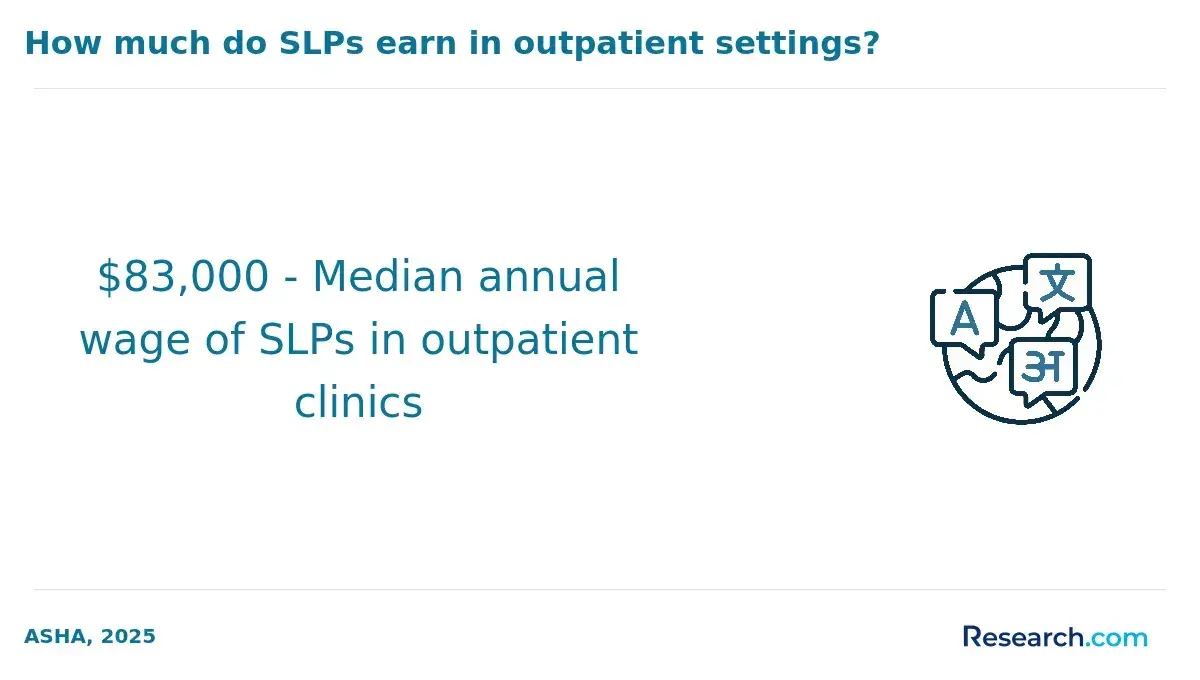
Do not base return-on-investment expectations on a single salary figure. Nationally, the median annual wage for speech-language pathologists was $97,870 in May 2025, but actual pay varies by setting, experience, hours, payer mix, and region. Use a current speech language pathology salary guide as context, then compare your likely debt, Virginia living costs, and early-career employment options.
Which online CAA-accredited speech-language pathology programs accept students from Richmond and surrounding Virginia counties?
Richmond-area applicants should not assume that a national online program is open to every Virginia county or every upcoming cohort. State authorization can change, and a school may pause enrollment while updating regulatory approvals. The practical question is whether the institution will admit you, at your Virginia address, into the exact program and start term you selected.
For Richmond, Henrico, Chesterfield, Hanover, Goochland, Powhatan, and nearby counties, use the same verification process. County location usually does not change authorization, but it can materially affect clinical-placement commuting distance and school-district access.
Before applying, ask each admissions office and clinical-education team these questions:
- Will you confirm in writing that my Virginia address is eligible for enrollment in the intended start term?
- Is the master's program currently CAA-accredited, and what is its current accreditation period or status?
- Does the institution state that the curriculum meets Virginia's educational requirements for SLP licensure?
- How are externship sites identified, approved, and supervised for students living in the Richmond area?
- What in-person intensives, assessments, orientation events, or simulation experiences are required, and where are they held?
- Can a student be required to complete a placement outside the Richmond metro area or outside Virginia?
Programs may not promise a placement at a particular hospital, school division, or private practice because affiliation agreements and supervisor capacity change. A credible answer explains the process, expected student role, minimum commute or travel expectations, and what occurs if an initial placement falls through.
Applicants worried about academic selectivity should separate admissions access from licensure quality. A school with a more accessible admissions profile can still require strong prerequisite performance, interviews, observation experiences, and a rigorous clinical curriculum. Review easiest SLP masters to get into information carefully, but never treat "easier" admission as evidence that a program is eligible in Virginia or less demanding after enrollment.
What telepractice, school-based, and medical SLP training do top online programs offer for Virginia practice settings?
Online SLP programs should prepare students for the settings in which Richmond-area clinicians commonly work, including public schools, early-intervention services, outpatient clinics, hospitals, rehabilitation facilities, skilled nursing settings, and private practice. Coursework delivered online does not replace hands-on training; students still need direct patient or client contact under qualified supervision.
Telepractice has become a meaningful component of contemporary SLP service delivery, particularly for access barriers and specialized services. It can be valuable training, but it should supplement rather than obscure the need for broad in-person clinical competencies. Ask whether telepractice experiences involve real clients, simulations, observation, or a combination of these methods.
The following training areas make a program more adaptable to Virginia practice settings.
- School-based assessment, individualized education program participation, language and literacy intervention, and collaboration with teachers and families.
- Medical and adult-focused exposure, including cognitive-communication, motor speech, voice, dysphagia education, and interdisciplinary care where available.
- Pediatric clinical learning involving speech sound disorders, language disorders, autism-related communication needs, fluency, and augmentative and alternative communication.
- Telepractice ethics, privacy, technology troubleshooting, culturally responsive care, documentation, and client engagement across remote settings.
- Clinical supervision that provides timely feedback, competency assessment, and exposure to varied age groups and communication needs.
Choose a program based on the type of clinician you want to become, not merely the course titles. A student interested in school employment should seek meaningful pediatric and educational placement exposure. A student aiming for medical SLP work should ask whether the program has sufficient adult and medically oriented experiences, recognizing that no program can guarantee a particular specialty placement.
How should Richmond residents evaluate online SLP program accreditation, ASHA CAA status, and institutional oversight?
Accreditation and oversight answer different questions. CAA accreditation evaluates the professional SLP education program. Institutional accreditation evaluates the college or university. State authorization addresses whether the institution may provide distance education to Virginia residents. A careful applicant verifies all three rather than relying on one logo on a program webpage.
CAA status deserves special attention. "Accredited" and "candidate for accreditation" are not interchangeable descriptions, and the implications can differ by graduation date and state requirements. If a program is in candidacy or transition, ask the school to explain in writing what status applies to your entering cohort and what happens if accreditation milestones change.
A reliable evaluation sequence is straightforward:
- Verify the program's current CAA listing and read the exact status rather than relying solely on promotional language.
- Confirm that the university holds recognized institutional accreditation and is authorized to provide distance education to Virginia residents.
- Read the program's Virginia professional-licensure disclosure for your intended degree, not for a related certificate or undergraduate major.
- Request the current student handbook, clinical-education manual, and total-cost estimate before accepting admission.
- Save written responses about authorization, required travel, clinical placement responsibilities, and Virginia licensure alignment.
One common mistake is assuming that ASHA certification, Virginia licensure, and school-based employment credentials are identical. They overlap but can involve separate applications and employer expectations. Graduates should plan for the degree, supervised postgraduate experience, examination, Virginia license, and any school-employer requirements as related but distinct steps.
Institutional oversight matters because an online student may need support with disability accommodations, grade appeals, refund policies, clinical-placement disputes, and consumer complaints. Review these policies before enrollment, especially when considering an out-of-state program.
What are the clinical placement options for Richmond students enrolled in out-of-state online speech pathology programs?
Clinical placements are the most location-sensitive part of an online SLP degree. Richmond has potential practice environments across schools, pediatric providers, hospitals, rehabilitation organizations, long-term care, and private clinics, but a program cannot ethically promise a particular site before an affiliation agreement and qualified supervisor are confirmed.
Most programs use one of three placement models. The right model depends on how much geographic flexibility and administrative work you can accept.
| Placement model | How it works | Best fit for | Risk to manage |
| Program-arranged placement | The university identifies and contracts with sites, often with student input. | Students who need significant administrative support and can be flexible about setting or commute. | Site availability can still delay timing or require travel. |
| Student-assisted placement | The student suggests potential sites while the university handles approval and affiliation requirements. | Students with local professional connections who understand that contacts are not guaranteed placements. | Approaching sites independently without program approval can create confusion or duplicate outreach. |
| Student-secured placement | The student carries most of the responsibility for locating an acceptable site and supervisor. | Students with substantial flexibility, networking capacity, and time to manage outreach. | This model can create the greatest risk of delayed graduation if a site is not approved. |
Ask whether the school has placed prior students in central Virginia, but treat a past placement as evidence of experience rather than a guarantee. Also ask about required background checks, drug screening, immunizations, liability coverage, fingerprinting, site-specific onboarding, supervision standards, and whether you must pay for commuting or temporary housing.
Do not resign from a job based only on an expected placement timeline. Wait until the program has explained when clinical participation begins, what daytime hours may be required, and how it manages placement delays. This is particularly important for students balancing caregiving or full-time employment.
How do online SLP programs support Praxis exam preparation and Virginia Board of Audiology and Speech-Language Pathology licensing?
A high-quality online SLP program should connect curriculum, clinical competency, Praxis preparation, graduation documentation, and clinical fellowship planning. It should not imply that passing one exam automatically completes Virginia licensure. The Virginia Board of Audiology and Speech-Language Pathology determines current licensing requirements and evaluates applications individually.
Praxis support can include embedded comprehensive examinations, practice questions, review workshops, faculty advising, and guidance on registration timing. These resources are useful, but they do not replace a study plan or guarantee a passing score. Ask whether review materials are included in tuition and whether the program publishes a clear process for verifying graduation and clinical requirements.
For Richmond residents, the licensing path should be planned early:
- Complete a CAA-accredited graduate program and all required clinical education for graduation.
- Follow the program's documentation process for transcripts, clinical records, and completion verification.
- Take the required national examination at the point recommended by your program and Virginia licensing rules.
- Apply for the appropriate Virginia credential or supervised postgraduate pathway before beginning work that requires it.
- Complete supervised postgraduate experience and submit required documentation for independent licensure when eligible.
Check the Virginia Board directly before each step because forms, fees, required scores, supervision rules, and processing procedures can change. Employers may also have their own onboarding rules, particularly school systems and medical organizations.
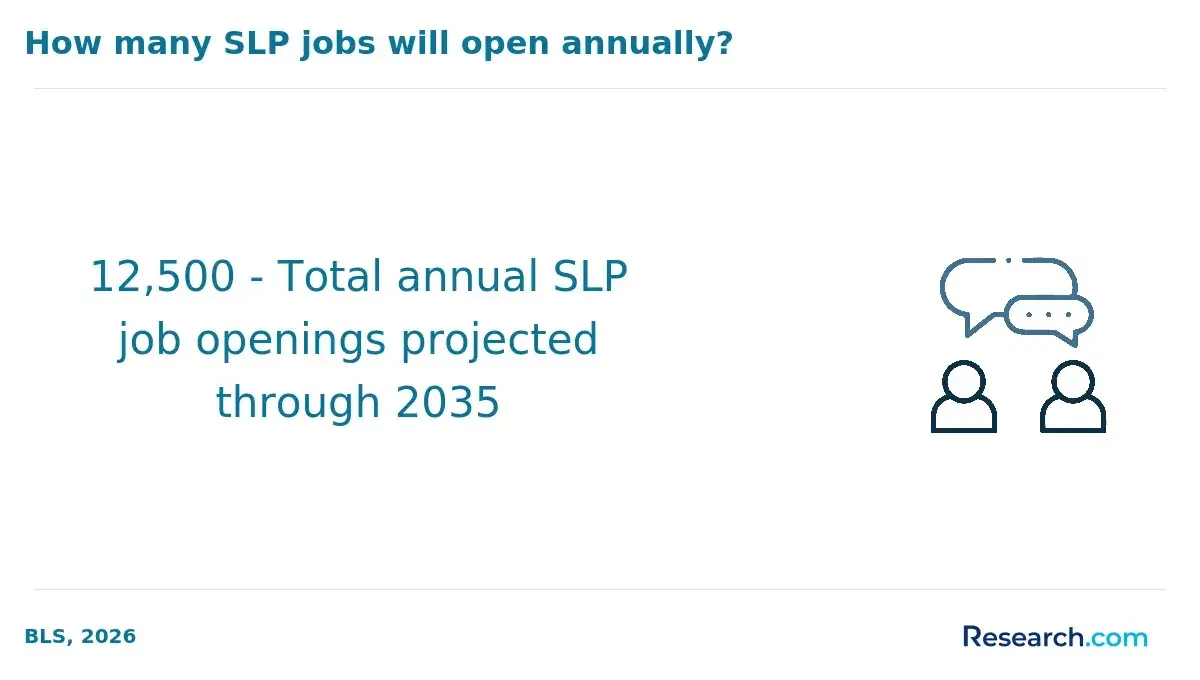
For career planning, remember that the national occupation outlook does not guarantee a local position or a specific starting wage. Still, projected 17% growth from 2025 to 2035 and approximately 12,500 average annual openings nationally indicate sustained demand for qualified clinicians. The practical advantage goes to graduates who finish an eligible program, maintain complete records, and can meet employer-specific requirements promptly.
What funding, tuition discounts, and employer or school-district support are available to Richmond-area online SLP students?
Funding for an online SLP master's program often comes from several sources rather than one large scholarship. Start with the federal aid process, then compare institutional aid, employer benefits, service-based opportunities, and repayment implications. Because clinical terms may reduce your work hours, build a monthly cash-flow plan rather than assessing tuition alone.
Richmond-area applicants should investigate these options before choosing a program:
- Federal student aid eligibility, including graduate borrowing options and the effect of prior undergraduate borrowing.
- University scholarships, tuition grants, alumni awards, and payment plans offered specifically to graduate or distance-learning students.
- Employer tuition assistance from healthcare employers, rehabilitation providers, education organizations, or large regional employers.
- School-district paraprofessional, teacher, or employee support programs that may help existing staff advance into shortage-area roles.
- Service-oriented scholarships, workforce initiatives, or loan-repayment programs for eligible practice settings, with careful attention to service commitments.
- Tax implications and reimbursement rules when an employer pays tuition, books, travel, or fees.
Ask each school for an itemized estimate showing tuition, university fees, technology charges, travel, clinical compliance expenses, textbooks, and graduation charges. If a program describes tuition as a flat amount, confirm whether that amount remains fixed if a placement delay extends enrollment.
The lowest advertised price is not always the lowest-cost option. A program with a higher tuition rate may be financially preferable if it offers a dependable placement process, requires less travel, and allows you to continue earning income longer. Conversely, a lower-tuition option may be the stronger choice when its schedule and clinical requirements fit your life without additional relocation or lost-work costs.
How can Richmond residents verify current authorization, complaints, and consumer protection records for online speech pathology programs?
Verification should happen before you enroll, not after a clinical placement problem or billing dispute arises. Keep a dated folder containing screenshots, catalogs, emails, financial-aid documents, licensure disclosures, and the student handbook that applied when you accepted admission.
Use the following process to protect yourself as an online student:
- Ask the institution's admissions or compliance office to confirm that it is authorized to enroll Virginia residents in the specific SLP program and term.
- Verify CAA status independently and save the current status information with your admission records.
- Read the Virginia licensure disclosure and request clarification if it says the institution has "not determined" whether requirements are met.
- Review the refund, withdrawal, leave-of-absence, complaint, grade-appeal, and clinical-placement policies before submitting a nonrefundable deposit.
- Identify the university office that handles distance-learning complaints and ask how unresolved issues are escalated.
- Check Virginia consumer-protection and higher-education oversight resources if you believe an institution made misleading claims or failed to follow its published policies.
Be wary of pressure to enroll immediately, vague answers about Virginia licensure, promises of guaranteed local placements, or a refusal to provide written policies. A legitimate program may not be able to guarantee a site, job, admission outcome, or license, but it should be able to explain its process, requirements, and escalation channels clearly.
If a school's answer conflicts with a written disclosure, rely on the most current official policy and request a correction or clarification. Do not assume a verbal assurance from a recruiter overrides the catalog, clinical handbook, or state licensing rules.
Other Things You Should Know About Speech Language Pathology
Yes, potentially. Many master's programs accept applicants from other fields, but they may require prerequisite coursework in communication sciences and related sciences before or during admission. Confirm the exact prerequisites, their acceptable grades, and whether they extend your timeline.
Some students work during early online coursework, especially in extended programs. However, clinical placements often require daytime availability and can make full-time work unrealistic. Ask for a sample clinical schedule before relying on employment income.
The delivery format itself is not the deciding factor. A CAA-accredited program that satisfies Virginia's educational requirements can support the same professional pathway, but you must also complete clinical, examination, and supervised postgraduate requirements.
Be cautious with any guarantee. Clinical sites depend on affiliation agreements, supervisor availability, and student needs. Prefer programs that clearly explain their placement process, prior regional experience, travel expectations, and contingency plan if a local site is unavailable.
References
- Online MS, Communicative Sciences and Disorders https://steinhardt.nyu.edu/degree/online-ms-communicative-sciences-and-disorders
- Speech Language Pathology (M.S.) Online - Overview https://www.jmu.edu/grad/programs/snapshots/csd-dlve-slp.shtml
- Best Online Speech Pathology Programs https://www.forbes.com/advisor/education/healthcare/best-speech-pathology-programs-online/
- Council on Academic Accreditation in Audiology and Speech-Language Pathology. (2025). Standards for accreditation of graduate education programs in audiology and speech-language pathology. American Speech-Language-Hearing Association. https://caa.asha.org/siteassets/files/accreditation-standards-for-graduate-programs.pdf
- American Speech-Language-Hearing Association. (n.d.). Council on Academic Accreditation accredited program listing. https://apps.asha.org/eweb/ashadynamicpage.aspx?caacat=slp&site=ashacms&webcode=caalisting
- American Speech-Language-Hearing Association. (n.d.). Certification standards for speech-language pathology: FAQs—Coursework and knowledge areas. https://www.asha.org/certification/certification-standards-for-slp-course-work-and-knowledge-areas/