2027 Best Online Speech Pathology Master's Programs for Residents of Grand Rapids, MI

Co-Founder and Chief Data Scientist

Reviewed by Rhea Paul, PhD
SLP Education & Research Expert
Grand Rapids residents can complete much of a speech-language pathology master's degree online, but "online" does not remove the requirements that matter most: CAA accreditation, Michigan authorization, supervised clinical training, and a licensure-ready curriculum. This guide compares leading distance-learning options through a Michigan-specific lens, explains what to verify before applying, and helps you weigh tuition, travel, scheduling, prerequisites, and clinical-placement responsibility. It is designed for aspiring SLPs who need a practical path to Michigan licensure rather than a generic list of online degrees.
Key Things You Should Know
- A Michigan licensure path generally requires a graduate degree from an ASHA Council on Academic Accreditation (CAA)-accredited program, supervised clinical experience, a passing Praxis score, and Michigan's separate licensing process.
- For Grand Rapids residents, the strongest online options are not necessarily Michigan-based: compare written Michigan enrollment authorization, clinical-placement policies, required immersions, live-class times, and whether the school - not the student alone - coordinates placements.
- SLP career demand remains substantial: the U.S. Bureau of Labor Statistics projects 17% employment growth from 2025 to 2035, with about 12,500 average annual openings; its May 2025 national median annual wage was $97,870.
Which online speech pathology master's programs best serve residents of Grand Rapids, Michigan?
The best online speech pathology master's program for a Grand Rapids resident is one that combines CAA accreditation, clear Michigan eligibility information, a realistic clinical-placement plan, and a format that works with the student's schedule. A school's geographic location is less important than whether it can legally enroll Michigan residents and support the in-person clinical experiences required for graduation and licensure.
The following comparison identifies strong programs to investigate first. Programs should be treated as finalists rather than automatic choices: state authorization, available cohorts, tuition, and placement capacity can change between admissions cycles.
| Program | Why it can fit a Grand Rapids resident | Format considerations | Important trade-off to verify |
| Emerson College, MS in Speech-Language Pathology | Established online SLP pathway with CAA accreditation and an online-focused model. | Online coursework paired with required clinical experiences and program-directed residency or immersion components. | Confirm Michigan authorization, current immersion travel requirements, and the school's placement process for West Michigan. |
| Baylor University, MS in Communication Sciences and Disorders | Online graduate pathway designed around synchronous and asynchronous learning with clinical education. | Distance coursework does not eliminate in-person practicum and externship obligations. | Ask for written confirmation of Michigan eligibility, expected travel, and who secures each placement. |
| University of Cincinnati, MS in Speech-Language Pathology | Public-university option with an online program structure and clinical training requirements. | Students should expect set course sequencing and fieldwork scheduling rather than fully self-paced study. | Verify cohort availability for Michigan, campus or intensive-session expectations, and resident versus nonresident pricing. |
| New York University, MS in Communicative Sciences and Disorders | Well-known online SLP option with a structured curriculum and clinical education. | Online delivery includes live-learning and clinical components that must be completed in approved settings. | Confirm Michigan participation for the intended start term and total tuition, including clinical and travel costs. |
These programs are best viewed as different fits, not as a universal ranking. Emerson or NYU may appeal to applicants seeking a mature online infrastructure; Baylor may suit students comfortable with a private-university price structure and scheduled online learning; Cincinnati may be worth evaluating for applicants who prefer a public-university model. Applicants who need the broadest price comparison should also review speech pathology online programs before narrowing their list.
A program is a better match when it answers four questions in writing: Can a Michigan resident enroll in this cohort? Does the curriculum meet or is it designed to meet Michigan's educational requirements? How are clinical sites and supervisors approved? What travel, live attendance, and out-of-pocket clinical costs should the student expect?
Which online speech-language pathology master's degrees meet Michigan CCC-SLP licensure requirements?
An online master's degree can support a Michigan SLP license and the Certificate of Clinical Competence in Speech-Language Pathology (CCC-SLP), but the degree itself does not confer either credential. The central educational safeguard is graduation from a program accredited by ASHA's Council on Academic Accreditation in Audiology and Speech-Language Pathology.
For a typical clinical SLP pathway, the degree must provide the academic preparation and supervised clinical education needed for certification and state licensure. Michigan applicants should separately verify requirements with the Michigan licensing authority because state rules, application forms, background-check processes, and supervision requirements can change.
The sequence below distinguishes the degree from the credentials that follow it.
- Earn a graduate degree from a CAA-accredited speech-language pathology program.
- Complete the program's supervised clinical education requirements, including the required practicum experiences.
- Pass the Praxis examination required for the CCC-SLP and commonly used for state licensure eligibility.
- Complete the post-graduate Clinical Fellowship under qualified supervision for ASHA certification and, where applicable, satisfy Michigan's supervised-practice requirements.
- Apply for Michigan licensure and, if desired or required by an employer, apply for ASHA CCC-SLP certification.
Do not confuse CAA accreditation with institutional accreditation, state authorization, or an individual supervisor's credentials. All matter, but they answer different questions. CAA accreditation addresses the professional educational program; state authorization concerns whether a school may provide distance education to a Michigan resident; licensure determines whether a graduate may practice in Michigan.
Michigan school-based positions may also involve educator credentialing rules beyond a health-professions license. Candidates who want to work in Grand Rapids-area public schools should ask prospective employers and the relevant state education office which credentials are required for the intended role.
How can Grand Rapids applicants verify that an online speech pathology program is properly accredited?
Applicants should verify accreditation directly through ASHA's CAA program directory and then confirm the exact status with the university. Do this before paying an application fee or accepting an admission offer. A school's marketing language - such as "accredited institution," "aligned with ASHA standards," or "licensure-track" - is not a substitute for CAA accreditation of the specific master's program.
Use this verification process to distinguish an established accredited program from a program that is newer, in candidacy, or not eligible for the credential path you need.
- Find the exact degree title and delivery pathway in ASHA's CAA directory, not just the university name.
- Check whether the status is accredited, candidate, or another designation, and read the effective dates.
- Ask the program whether its online cohort is covered by that accreditation status and whether any substantive changes are pending.
- Request the school's Michigan professional-licensure disclosure for the program and your intended start term.
- Save the written response, current catalog page, tuition worksheet, and clinical-placement policy with your application records.
CAA candidacy and accreditation can have different implications depending on a student's graduation timing and the applicable certification rules. Applicants considering a newer program should ask exactly how the status applies to their anticipated graduation date rather than relying on a general statement that approval is "in progress."
A second common mistake is checking accreditation once and never revisiting it. Reconfirm status shortly before enrollment, especially if you deferred admission or applied many months before the cohort begins.
What are the best ASHA CAA-accredited online SLP programs accepting Michigan residents?
Michigan residents should prioritize CAA-accredited programs that provide a current, written answer about eligibility in Michigan. Among widely considered online or distance-based options, Emerson College, Baylor University, the University of Cincinnati, and New York University are reasonable programs to screen because they offer structured graduate SLP pathways with distance-learning elements and clinical education. Enrollment authorization can be cohort-specific, so applicants should not assume that a program accepting students nationally accepts every state at every time.
This table shows the questions that most clearly separate a viable option from an attractive but impractical one.
| Program to screen | Accreditation question to ask | Michigan-specific enrollment question | Clinical-training question |
| Emerson College | Is the online MS-SLP pathway currently included under the program's CAA accreditation? | May a Michigan resident enroll in the next available cohort? | Which placements are arranged by the school, and are students expected to identify possible West Michigan sites? |
| Baylor University | Does the current CAA listing cover the intended degree and delivery format? | Does the university's licensure disclosure identify Michigan as eligible, pending review, or restricted? | What travel, simulation, and in-person practicum requirements apply? |
| University of Cincinnati | What is the current CAA status for the MS-SLP program? | Is the online cohort authorized for enrollment from Michigan for the intended term? | How does the clinical team assess and approve placement sites and supervisors? |
| New York University | Does the program's current accreditation status apply through the projected graduation period? | Can the university provide a Michigan licensure-curriculum disclosure in writing? | What is the timing of clinical placements, and could a student need to travel outside Grand Rapids? |
"Accepting Michigan residents" should mean more than receiving an application. The admissions office, distance-education authorization office, and program director should be able to confirm that Michigan enrollment is permitted and that the curriculum is intended to meet the educational requirements for the relevant professional pathway. If answers differ across offices, pause and request a consolidated written response.
Applicants should also ask whether the program has recently placed students in Michigan. A prior placement is useful evidence of operational experience, but it is not a guarantee that a site will be available near Grand Rapids for a future term.
How do Michigan state authorization and professional licensure disclosures affect Grand Rapids online SLP students?
State authorization and professional-licensure disclosure are consumer-protection issues. An institution may have a CAA-accredited SLP degree yet still restrict enrollment from a particular state because of authorization, clinical-placement, or licensing-disclosure requirements. Conversely, permission to enroll does not automatically mean the curriculum fulfills every Michigan licensing condition.
Grand Rapids applicants should request a disclosure that addresses Michigan specifically, the exact degree, and the planned mode of study. Generic language stating that a program "may meet requirements in many states" is not enough for a high-stakes professional degree.
Before submitting a deposit, obtain written answers to these practical questions.
- Is the university authorized to provide this online professional program to a student physically located in Michigan?
- Does the university state that the curriculum meets, is designed to meet, or has not been determined to meet Michigan educational requirements for SLP licensure?
- Can required practicum, externship, and Clinical Fellowship-related activities be completed in Michigan, and what approvals are needed?
- What happens if the student moves to another state during enrollment or clinical placement?
- Which office will assist if a Michigan placement site, supervisor, or licensing board requests documentation?
The key distinction is simple: authorization governs the school's ability to educate you where you live; licensure eligibility concerns your ability to practice after completing the degree. Verify both. Students who move during a program should notify the university before relocating because their new state may change the school's authorization obligations and their clinical-placement options.
Which online speech pathology programs offer Michigan-friendly clinical placements and supervision in West Michigan?
No online SLP program should promise a Grand Rapids placement unless it has confirmed a specific site for a specific student and term. Clinical education depends on site capacity, qualified supervisors, patient or student populations, affiliation agreements, and the timing of the placement. The most Michigan-friendly program is therefore the one with a transparent placement process, dedicated clinical staff, and a clear contingency plan.
Emerson, Baylor, Cincinnati, and NYU are worth asking about for Michigan-based placement support because each offers a structured distance-learning route with required clinical education. However, applicants should compare their actual placement policies rather than assuming a national online program has a standing relationship with every Grand Rapids health system, rehabilitation provider, early-intervention agency, skilled nursing facility, or school district.
Strong clinical-placement policies usually address the following operational details.
- Whether the program's clinical team identifies sites, approves student-suggested sites, or requires the student to find an initial lead.
- Whether the school executes affiliation agreements and how long that approval process can take.
- How supervisors are screened for credentials, experience, and required supervisory training.
- Whether students may need to travel within Michigan or to another state when local capacity is limited.
- How the program handles a canceled site, unavailable supervisor, delayed agreement, or unsuccessful placement match.
Ask each school for its clinical handbook and a sample placement timeline. A program can be academically online while requiring full-time daytime availability during practicum or externship periods. This is especially important for working adults: an evening lecture schedule does not mean clinical training can occur only on evenings or weekends.
Applicants with existing West Michigan professional connections can sometimes suggest potential sites, but they should never independently promise clinical services or begin an arrangement. The university must approve the site and supervisor before hours can count toward program requirements.
How do tuition, fees, and cost of attendance compare across top online SLP programs for Grand Rapids residents?
Cost comparisons are difficult because online SLP programs may publish per-credit tuition, per-term tuition, or annual estimates rather than one complete program price. The most responsible comparison uses the same categories for every school: required tuition, mandatory university fees, clinical fees, technology charges, books and testing, travel, and income potentially lost during full-time clinical rotations.
Do not compare a public university's in-state per-credit rate with a private program's all-inclusive tuition estimate as though they are equivalent. Ask each school for a written estimate based on the full required credit load and your Michigan residency status.
| Cost category | Why it matters for Grand Rapids applicants | What to request from each program |
| Required tuition | This is usually the largest direct cost, but residency treatment varies by institution. | Total tuition for all required credits, not merely one term or one credit. |
| Mandatory fees | Distance-learning, student-service, graduation, and clinical fees can materially change the estimate. | A term-by-term list of required fees and whether amounts are subject to increase. |
| Clinical education expenses | Background checks, immunizations, drug screens, liability coverage, uniforms, and parking may be required. | An estimated range and identification of costs paid directly to third parties. |
| Travel and lodging | Immersions, residencies, or out-of-area placements can create costs not captured in online tuition. | Number, location, length, and mandatory nature of all in-person requirements. |
| Living and opportunity costs | Daytime placements can reduce work hours even when classes are online. | Typical weekly clinical availability expectations by program phase. |
Federal financial aid may be available to eligible graduate students, but borrowing should be based on the net price and realistic ability to complete the clinical sequence, not just the first term's bill. Compare scholarships, employer assistance, institutional aid, and borrowing terms before accepting loans. An accelerated schedule can reduce the number of terms charged for some expenses, but it also compresses workload; review accelerated speech pathology programs only after confirming that speed will not make clinical scheduling or finances unmanageable.
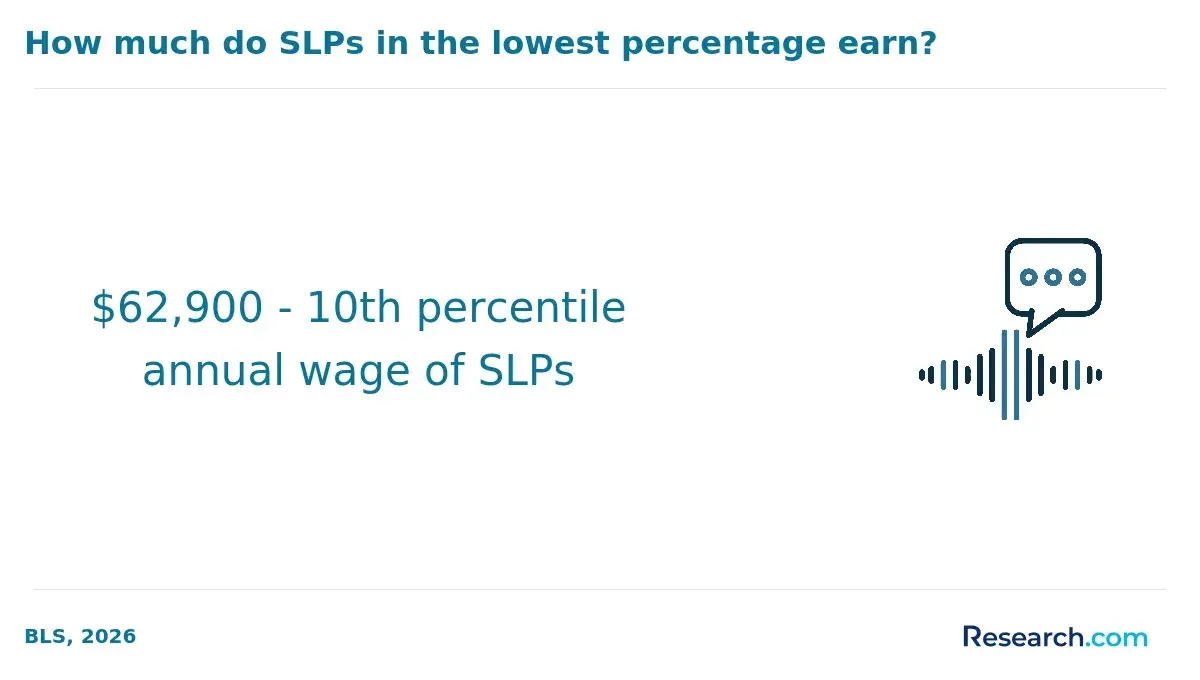
The BLS May 2025 national median annual wage of $97,870 provides useful career context, not a personal earnings promise. Local employer type, experience, setting, productivity expectations, and credentials affect pay. Prospective students weighing debt should compare the program's total net cost with their expected early-career circumstances rather than assuming a national median will apply immediately after graduation.
What admissions timelines and prerequisite coursework should Grand Rapids applicants expect for online speech pathology master's programs?
Online SLP programs often use cohort admissions and fixed course sequencing, so applying early matters even when a school offers multiple start dates. Applicants should expect to submit transcripts, a statement of purpose, recommendations, a résumé, and evidence of prerequisite coursework. Some programs use CSDCAS, while others use a university application system; follow the instructions for the exact program and cycle.
Applicants without an undergraduate communication sciences and disorders degree may need leveling coursework before admission or during an extended program pathway. Common prerequisites can include anatomy and physiology of speech and hearing mechanisms, phonetics, language development, speech and hearing science, audiology, aural rehabilitation, and speech or language disorders. ASHA certification standards also require coursework in biological sciences, physical sciences, statistics, and social or behavioral sciences; individual programs decide how applicants must document those foundations.
A practical preparation timeline gives applicants enough time to correct missing prerequisites rather than discovering them after a deadline.
- Start 12 to 18 months before the desired term by comparing Michigan eligibility, CAA status, prerequisites, cost, and clinical requirements.
- Request transcript evaluations from target programs and identify missing communication sciences and disorders or general education foundations.
- Complete prerequisites through an approved route early enough for final grades to appear on official transcripts.
- Prepare recommendations and a focused statement explaining clinical interests, academic readiness, and availability for fieldwork.
- Apply before priority deadlines when possible, then confirm whether offers are contingent on remaining coursework or documents.
- Before accepting, obtain written confirmation of Michigan authorization, licensure disclosure, clinical-placement expectations, and total expected charges.
Do not select a program because its admission label sounds easier. A less selective school may still be a poor fit if it cannot serve Michigan residents, requires unmanageable travel, or offers limited placement support. Applicants exploring broader admissions ranges can review easiest speech pathology programs to get into, but accreditation and licensure fit should remain nonnegotiable filters.
How do graduation rates, Praxis pass rates, and employment outcomes compare among leading online SLP programs?
Outcome data can help Grand Rapids applicants evaluate whether an online program is delivering on its educational model, but comparisons require care. Programs may report outcomes for all students, a campus cohort, an online cohort, a multi-year aggregate, or only graduates who responded to an employment survey. Ask for the reporting period and population before treating two published figures as comparable.
CAA-accredited programs generally publish student outcome information that can include program completion, Praxis examination performance, employment, and attrition. The most useful question is not simply "Which rate is highest?" but "Does this report describe students in my delivery format and show stable results over several reporting periods?"
| Outcome measure | What it indicates | How to use it responsibly |
| Program completion rate | Whether enrolled students finish within the program's reported time frame. | Ask about the cohort size, timeframe, leaves of absence, and whether online students are reported separately. |
| Praxis pass rate | How graduates performed on a key certification and licensure examination. | Confirm the testing window, number of test takers, and whether first-time or eventual passes are reported. |
| Employment rate | Whether graduates reporting outcomes obtained relevant work or further training. | Ask how employment is defined, how many graduates responded, and whether jobs were in Michigan or elsewhere. |
| Attrition rate | Whether students leave the program before completion. | Discuss major causes of attrition and support available for academic, financial, and placement challenges. |
Strong published outcomes are encouraging, but they cannot guarantee an individual result. They should be paired with questions about remediation, clinical-placement continuity, advising, and career support. The broader labor market is favorable: BLS projects 17% SLP employment growth from 2025 to 2035. That projection supports the field's overall demand, while local openings and compensation still vary by setting and employer. For a more detailed look at compensation differences by role and location, see where do SLPs make the most money.
Applicants should be cautious of outcome claims without a reporting year, sample size, or definition. A transparent program will explain its data source and provide its current required disclosures rather than relying on broad statements about graduate success.
What consumer-protection steps should Grand Rapids students take before enrolling in an online speech pathology program?
Before enrolling, create a written comparison file for each finalist. This protects you from the most expensive mistakes in online professional education: choosing a nonqualifying degree, underestimating clinical travel and availability, and relying on verbal assurances that are not reflected in the program's formal policies.
Use the following checks before paying a deposit or signing an enrollment agreement.
- Verify the exact master's program in the current ASHA CAA directory and save the result.
- Request a Michigan-specific state authorization and professional-licensure disclosure from the university.
- Ask for the complete curriculum plan, required credits, expected completion timeline, and all in-person requirements.
- Request a total cost worksheet that separates tuition, required fees, clinical expenses, travel, and estimated living costs.
- Read the clinical handbook to understand placement responsibility, supervision, site approval, attendance, remediation, and cancellation policies.
- Review published completion, Praxis, employment, and attrition disclosures with their dates and reporting definitions.
- Confirm refund, withdrawal, leave-of-absence, transfer-credit, and teach-out policies in the catalog.
- Keep copies of all written representations that influence your enrollment decision.
Red flags include a school that will not state its Michigan eligibility in writing, vague answers about who secures placements, a tuition quote that omits mandatory fees, or marketing that emphasizes "online convenience" while withholding residency requirements. Another warning sign is pressure to enroll before you have seen the clinical handbook or licensure disclosure.
If you are changing careers, be realistic about the time commitment. Clinical rotations often require daytime presence, and a program may be online only for didactic coursework. The safest choice is usually the program that gives the clearest, most documented explanation of how you will complete every requirement from enrollment through Michigan licensure.
Other Things You Should Know About Speech Language Pathology
You may complete much of the academic coursework online, but SLP preparation is not fully remote. You must complete supervised in-person clinical education, meet examination and post-graduate fellowship requirements, and satisfy Michigan's licensing rules. Choose a CAA-accredited program that confirms Michigan eligibility in writing.
Policies differ. Some programs manage placement matching, some accept student-suggested sites, and many use a shared model. Ask who initiates site outreach, who signs affiliation agreements, what happens if a site falls through, and whether a placement outside Grand Rapids may be necessary.
It may be possible during some academic terms, but it is often difficult during practicum and externship phases. Clinical hours may occur on weekdays and follow the site's schedule. Ask for expected weekly time commitments for every term, not only for online classes.
No. The CCC-SLP is ASHA's professional certification, while a Michigan license is issued under state authority. Employers may prefer or require the CCC-SLP, and Michigan has its own licensing process. Verify current requirements with the appropriate state licensing authority before planning your timeline.
References
- Master of Arts in Speech-Language Pathology https://calvin.edu/majors-programs/master-arts-speech-language-pathology
- Best Online Speech Pathology Programs https://www.forbes.com/advisor/education/healthcare/best-speech-pathology-programs-online/
- 2026 Most Affordable Online Speech Pathology Master's... https://www.onlineu.com/most-affordable-colleges/speech-pathology-masters-degrees
- Best Speech-Language Pathology Programs in America https://www.usnews.com/best-graduate-schools/top-health-schools/pathology-rankings