2027 Baylor vs Western Kentucky Online SLP Master's: Compare Cost, Cohorts, and Clinical Training

Co-Founder and Chief Data Scientist

Reviewed by Rhea Paul, PhD
SLP Education & Research Expert
Baylor University and Western Kentucky University offer accredited pathways to a master's degree in speech-language pathology, but their online programs differ sharply in tuition, cohort timing, program length, and clinical-placement support. This comparison is for prospective SLPs deciding whether Baylor's higher-cost, accelerated private-university model or WKU's lower-tuition public-university model better fits their budget, academic preparation, and licensure plans. Review the side-by-side details below before investing in either program.
Key Things You Should Know
- Baylor's 72-credit online SLP master's has advertised tuition of about $1,850 per credit, or approximately $133,200 in tuition before applicable fees, while WKU's 60-credit program has advertised tuition of about $755 per credit, or approximately $45,300 in tuition before applicable fees.
- Baylor generally uses multiple cohort entry points and an accelerated approximately 20-month format; WKU is typically structured as a full-time cohort program beginning in the fall and taking about two years.
- Both programs are CAA-accredited and must prepare students for at least 400 supervised clinical hours, but applicants should compare who arranges placements, required travel, and whether the program supports licensure in their intended state.
How do Baylor and Western Kentucky structure their online SLP master's cohorts and start dates?
Baylor and WKU use cohort learning, meaning students progress through a planned sequence of classes and clinical experiences with the same general group of peers. Cohort design can create stronger faculty and peer connections, but it also limits the ability to pause, skip courses, or substantially change pacing.
Baylor's online Master of Science in Communication Sciences and Disorders is designed as an accelerated, full-time sequence that has commonly offered more than one annual start opportunity. Its published program structure is approximately 20 months. This can suit applicants who want to enter practice sooner and can commit to a demanding year-round schedule.
WKU's online Master of Science in Speech-Language Pathology is generally organized around a fall-entry, full-time cohort. Its sequence typically spans six academic terms over about two years, including summer study. A fall-only structure makes early prerequisite planning especially important: missing the application cycle can delay entry by a full year.
The following comparison highlights the practical scheduling difference. Start dates and deadlines can change, so applicants should verify the next available cohort directly with each university before submitting an application.
| Factor | Baylor online MS | WKU online MS |
| Typical cohort pattern | Accelerated full-time cohort | Full-time cohort |
| Typical entry timing | Multiple entry points may be available | Typically fall entry |
| Advertised completion pace | About 20 months | About two years |
| Planning implication | Useful for applicants seeking a faster entry route | Useful for applicants comfortable with a traditional academic-cycle start |
Do not equate a faster calendar with a lighter workload. An accelerated schedule compresses coursework, simulation, clinical preparation, and placement requirements into fewer months. Applicants needing reduced course loads, extended leaves, or substantial employment flexibility should ask each program whether an alternative pace is actually available rather than assuming "online" means part-time.
What are the total program costs and per-credit tuition for Baylor and Western Kentucky SLP online?
Tuition is the clearest financial dividing line between these programs. Baylor's private-university tuition is substantially higher than WKU's published online graduate tuition, even before considering books, technology, travel, background checks, immunizations, clinical attire, and possible housing during required experiences.
This table compares tuition calculations using each program's published credit requirement and advertised per-credit rate. These are tuition estimates, not an all-in cost of attendance; fees and rates may change by cohort or academic year.
| Cost item | Baylor online MS | WKU online MS |
| Required program credits | 72 credits | 60 credits |
| Advertised tuition per credit | About $1,850 | About $755 |
| Estimated tuition calculation | 72 × $1,850 | 60 × $755 |
| Estimated tuition before applicable fees | About $133,200 | About $45,300 |
| Difference in estimated tuition | About $87,900 higher at Baylor |
The tuition gap does not automatically make one degree a better investment. Baylor may be compelling for an applicant who values its accelerated timeline and can finance the higher cost without excessive borrowing. WKU may offer a stronger cost case for a student whose main priority is minimizing tuition, provided its schedule, clinical-placement model, and state eligibility fit their circumstances.
Before accepting an offer, request a written estimate that separates tuition from mandatory fees and asks whether the rate is locked for the cohort. Compare federal borrowing limits, scholarships, employer support, and the cost of reduced work hours during clinical training. For broader cost comparisons, review speech pathologist masters online options rather than assuming these two programs are the only viable choices.
A common mistake is comparing Baylor's total tuition with WKU's per-credit rate, or comparing tuition alone with another school's tuition-plus-fees figure. Use the same calculation for every school: required credits multiplied by the applicable per-credit rate, then add every predictable program and travel expense.
How do clinical placement models differ between Baylor's and Western Kentucky's online SLP programs?
Clinical placement is often more important than the online lecture platform because it determines where students gain supervised patient experience, how much travel may be required, and whether they can remain near home. In both programs, clinical training occurs in real settings such as schools, medical facilities, private practices, and university clinics; it is not completed entirely online.
Baylor presents a structured clinical education model in which the program's clinical-placement personnel work to coordinate sites and supervisors for students. Students may still need to meet site-specific onboarding requirements and may need flexibility about location, schedule, patient populations, or commute. Placement support is valuable, but it is not the same as a promise of a placement at a particular employer, city, or distance from home.
WKU also uses supervised clinical education and provides guidance through the placement process. Applicants should ask specifically how site identification, affiliation agreements, supervisor approval, and relocation needs work for online students in their state. In some areas, placement availability can depend on local site capacity, school calendars, medical-system requirements, and the availability of ASHA-certified supervisors.
The comparison below identifies questions that materially affect an applicant's ability to complete the degree on time.
| Clinical-training consideration | Baylor | WKU |
| Clinical education | Supervised experiences integrated into the cohort curriculum | Supervised experiences integrated into the cohort curriculum |
| Placement support | Program-supported placement coordination model | Program guidance and approval processes should be confirmed for the applicant's area |
| Student responsibilities | Complete compliance tasks and remain flexible about site requirements | Complete compliance tasks and work within placement and affiliation requirements |
| Local-placement guarantee | Not assumed | Not assumed |
| Travel risk | Possible for clinical experiences or required program activities | Possible depending on placement availability and program requirements |
Ask admissions teams for answers in writing before enrolling: whether placements have recently been completed in your state, who contacts sites, what happens if a placement falls through, whether you can decline a distant site, and whether delayed placement delays graduation. These questions are particularly important for students with caregiving duties, full-time employment, or limited transportation.
What are the admission requirements and prerequisite expectations for Baylor vs Western Kentucky online SLP?
Both programs expect applicants to show they can succeed in graduate-level communication sciences and disorders coursework. A bachelor's degree in speech-language pathology or communication sciences and disorders is the most direct preparation, but applicants from other majors may be eligible if they complete required foundational coursework before enrollment.
Baylor generally requires a completed bachelor's degree, a competitive academic record, prerequisite coursework in communication sciences and disorders, letters of recommendation, a personal statement, and other application materials specified for the entering cohort. Baylor has commonly listed a minimum 3.0 GPA requirement. Applicants without a CSD major should carefully map every prerequisite rather than relying on course titles alone.
WKU similarly expects a bachelor's degree and prerequisite preparation in communication disorders or approved equivalent coursework. WKU has commonly used a 3.0 minimum GPA standard for graduate admission, though program-specific review can consider the full application. Requirements such as interviews, observation documentation, and standardized-test policies can change, so the current department instructions control.
The central issue for career changers is not simply whether a program says it accepts non-CSD majors. It is whether the applicant can complete all prerequisite science and communication-disorders courses before the cohort begins without adding enough time and tuition to erase the advantage of an accelerated program.
Before applying, complete this practical review:
- Request a prerequisite evaluation or compare your transcript against each program's current course list.
- Confirm whether missing courses must be completed before applying, before admission, or before the first term.
- Ask whether online prerequisite courses are accepted and whether there are grade minimums for them.
- Prepare observation, recommendation, and personal-statement materials early enough for the cohort deadline.
- Verify whether the program uses CSDCAS, a university application, or both.
Applicants should not choose a program solely because it appears less selective. The better fit is the program whose prerequisites, support model, calendar, and state-licensure pathway match the applicant's actual situation. Readers exploring admissions accessibility can compare speech language pathology programs while still prioritizing accreditation and licensure compatibility.
How do Baylor and Western Kentucky align with ASHA CAA accreditation and state licensure pathways?
Baylor's Master of Science in Communication Sciences and Disorders and WKU's Master of Science in Speech-Language Pathology are accredited by the Council on Academic Accreditation in Audiology and Speech-Language Pathology (CAA), the accrediting body recognized by the American Speech-Language-Hearing Association. CAA accreditation is a core safeguard because it indicates that the program is designed to meet educational and clinical standards used in professional credentialing.
Accreditation does not itself grant a license. To practice as a speech-language pathologist, graduates generally must meet their state board's education, supervised clinical fellowship, examination, and other requirements. Most states also use requirements that align closely with the Certificate of Clinical Competence in Speech-Language Pathology, but each licensing board can impose additional conditions.
Both programs can be appropriate pathways toward certification and licensure, but the applicant's intended state remains decisive. Distance education rules, state authorization, clinical-placement availability, background-check requirements, and state-specific coursework expectations can change. A program may be accredited yet unable to enroll students in every state or may disclose that its curriculum has not been determined to meet requirements in a particular jurisdiction.
Use this sequence before paying an enrollment deposit:
- Identify the state where you expect to complete clinical placements and seek your first license.
- Read the program's current professional-licensure disclosure for that state.
- Check the state licensing board's education and clinical-fellowship rules independently.
- Ask the university whether it can enroll you and arrange or approve clinical education in that state.
- Save written confirmations because rules and disclosures can change before graduation.
The avoidable mistake is treating "online" as nationwide eligibility. Accreditation answers whether the degree meets recognized academic standards; state authorization and board rules answer whether you can enroll, train, and eventually seek a license where you plan to live.
How many clinical hours, practica, and externships are required at Baylor versus Western Kentucky?
Both Baylor and WKU structure their curricula to meet the clinical education expectations associated with CAA accreditation and ASHA certification pathways. For the ASHA Certificate of Clinical Competence in Speech-Language Pathology, applicants need at least 400 total supervised clinical clock hours, including 375 direct client-contact hours and 25 guided observation hours.
The 400-hour standard is a minimum credentialing benchmark, not a guarantee that every student's experiences will look alike. The number of placements, practice settings, adult versus pediatric caseloads, and calendar timing can vary based on curriculum sequencing and site availability.
This comparison separates the shared minimum standard from program-level details applicants should verify.
| Clinical requirement | Baylor | WKU |
| Clinical-hour framework | Designed to meet CAA and ASHA clinical education expectations | Designed to meet CAA and ASHA clinical education expectations |
| Minimum supervised clinical clock hours for ASHA pathway | At least 400 total hours | At least 400 total hours |
| Direct client-contact minimum within that standard | 375 hours | 375 hours |
| Guided observation minimum within that standard | 25 hours | 25 hours |
| Exact practicum and externship sequence | Confirm with the current curriculum plan | Confirm with the current curriculum plan |
Do not focus only on the final hour total. Ask whether the program provides experience across the populations and settings you hope to explore, how supervisors are selected, how telepractice is handled, and whether a placement delay can affect graduation. Students interested in medical SLP, school-based practice, bilingual services, or a particular age group should ask whether those experiences are likely, rather than promised.
How do course formats, synchronous expectations, and part-time vs full-time options compare?
Online SLP master's programs are hybrid in the practical sense: academic coursework may be delivered remotely, but clinical education requires supervised work at approved sites. Neither Baylor nor WKU should be viewed as a self-paced degree. Students must meet scheduled classes, assessments, group work, clinical assignments, and placement hours.
Baylor's program is built around a full-time accelerated sequence. Coursework is delivered online, with scheduled learning activities and program requirements that may include in-person components. Its compressed pace can work well for students able to reduce outside work and maintain reliable availability across weekdays, evenings, and clinical hours.
WKU's online option is also cohort-based and full-time. Students should expect structured courses, live or scheduled learning expectations, and clinical obligations that do not necessarily align with a standard work schedule. The program's longer calendar may spread requirements across more months than Baylor's, but that does not automatically make it part-time compatible.
Applicants comparing delivery formats should use the following questions to expose the difference between "online" marketing and day-to-day feasibility:
- Which courses require live attendance, and in which time zone are sessions scheduled?
- Are recorded sessions available when a conflict occurs, or is live participation mandatory?
- How many daytime hours are expected during practicum and externship terms?
- Are campus immersions required, and what travel, lodging, and attendance costs apply?
- Can students take a leave of absence or reduce their load without joining a later cohort?
Students who need a shorter route may prefer an accelerated SLP master's program, but they should compare the intensity of clinical terms as carefully as the advertised completion date. A program is only truly flexible if its scheduled requirements fit the student's work, family, and transportation realities.
What do current students report about faculty access, advising, and cohort experience in each program?
Prospective students should be cautious with broad claims about "student experience." Neither program's public materials should be treated as a substitute for systematic, independently collected satisfaction data covering every cohort. Individual testimonials can be useful for generating questions, but they do not reliably predict a future student's experience.
What can be assessed more directly is the structure likely to shape support. Both programs use a cohort model, which can make it easier to build recurring relationships with classmates and faculty. Baylor's accelerated format may create frequent interaction and rapid progress, but also leaves less room to recover from missed work. WKU's longer cohort sequence may offer a more traditional graduate-school rhythm, though support quality can vary by instructor, adviser, and clinical semester.
During an information session or admitted-student conversation, ask for concrete examples rather than general assurances. Useful questions include how quickly faculty typically respond, whether students have a dedicated clinical coordinator, how advisers handle prerequisite or placement problems, and what occurs when a student fails a clinical competency assessment.
Also ask to speak with a current student or recent graduate whose circumstances resemble yours, such as a career changer, parent, out-of-state learner, or student completing placements in a rural area. Treat one person's report as context, not evidence that the same outcome will occur for you.
How do graduation rates, Praxis pass rates, and employment outcomes compare for these two SLP programs?
Graduation, Praxis, and employment outcomes are meaningful only when compared using the same reporting period and cohort definition. CAA program outcome reports can include completion rates, Praxis examination pass rates, and employment measures, but the reporting years, cohort sizes, and calculation methods may differ. Applicants should request each program's latest CAA outcomes disclosure and compare the same reporting cycle side by side.
Do not assume that a published 100% result from a small cohort is directly comparable with a rate calculated across several larger cohorts. Small graduating classes can make a percentage move sharply when only one or two outcomes differ. Ask for the number of graduates represented, not just the percentage.
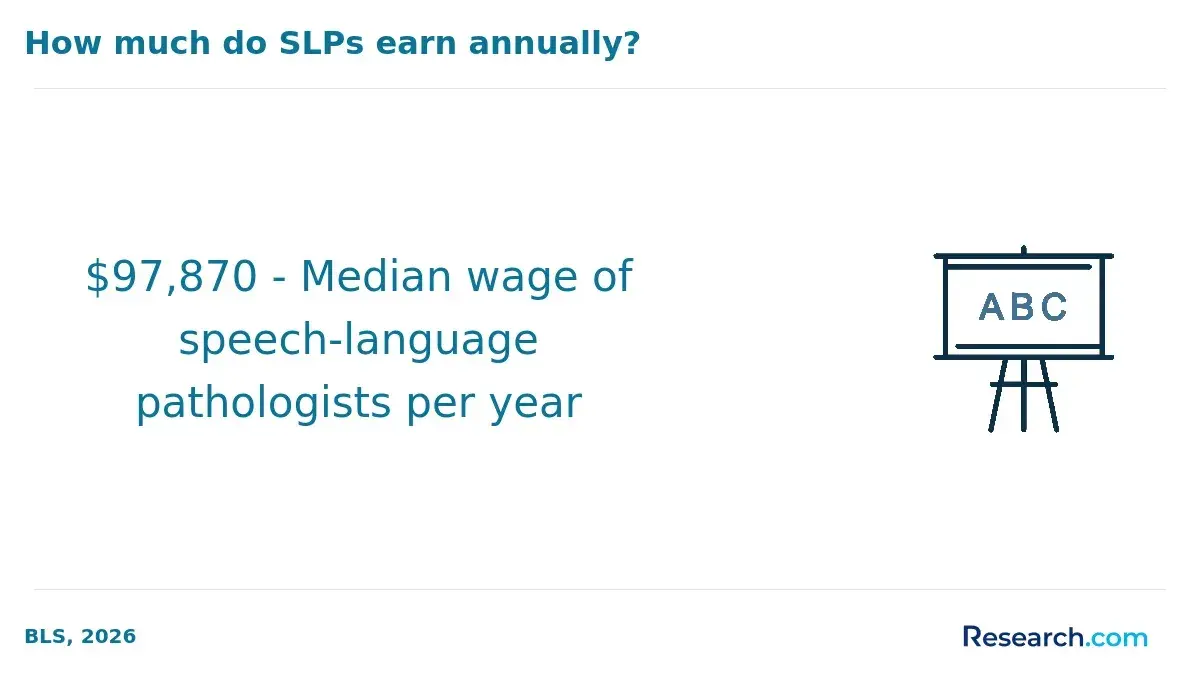
Labor-market conditions support careful evaluation of an accredited SLP pathway. The U.S. Bureau of Labor Statistics reports a median annual wage of $97,870 for speech-language pathologists in May 2025 and projects 17% employment growth from 2025 to 2035, with about 12,500 openings per year on average. These national figures describe the occupation, not an outcome guaranteed by Baylor or WKU, and pay varies by employer, setting, state, experience, and work schedule.
When evaluating return on investment, compare likely debt with the range of local opportunities rather than relying on national median pay alone. The profession's favorable projected demand can support long-term opportunity, but a higher tuition balance may still require more careful financing. For role and pay context, explore speech-language pathologist salary information alongside each program's verified outcomes.
Request the following evidence from both schools before deciding:
- The latest CAA outcomes report and the years it covers.
- The number of students included in each graduation, Praxis, and employment calculation.
- Whether employment data refers to graduates seeking work, all graduates, or graduates reporting employment.
- Career-support services available during the clinical fellowship search.
- Any known restrictions affecting employment preparation in your intended state.
Which prospective students are best served by Baylor's online SLP versus Western Kentucky's online SLP?
Baylor is likely the stronger match for an applicant who prioritizes an accelerated pathway, can handle a full-time year-round pace, values a program-supported clinical-placement structure, and has a realistic plan for the substantially higher tuition. Its approximately 20-month format may reduce the time before entering the clinical fellowship stage, but the shorter calendar does not eliminate the need for clinical availability or state-by-state planning.
WKU is likely the stronger match for an applicant whose first priority is lower published tuition, who can begin in the program's cohort cycle, and who is comfortable confirming placement logistics well before enrollment. Its estimated tuition is dramatically lower using published rates, which can materially reduce borrowing pressure. The trade-off is that a traditional approximately two-year cohort and placement process may be less convenient for applicants seeking multiple annual entry points or a highly compressed timeline.
Neither program is an ideal fit for someone who needs a truly self-paced degree, cannot make time for daytime clinical work, assumes a site will be available near home, or has not yet confirmed licensure compatibility in the intended state. In those cases, delaying application to complete prerequisites, stabilize finances, or compare additional accredited options may be the wiser choice.
A sound final decision weighs five factors in this order: eligibility to enroll and pursue licensure in your state, total borrowing needed, clinical-placement practicality, schedule feasibility, and verified outcomes. Brand recognition, a polished website, or one favorable testimonial should not outweigh any of those fundamentals.
Other Things You Should Know About Speech Language Pathology
Most students should not assume they can maintain full-time employment. Both programs use full-time cohort structures, and clinical placements may require daytime availability. Ask each program for a sample weekly schedule for academic and clinical terms before making employment commitments.
It can, if the program is CAA-accredited and the graduate completes all state-specific education, clinical fellowship, examination, and application requirements. The delivery format alone does not determine eligibility; the applicable state licensing board does.
No applicant should assume a local placement is guaranteed. Clinical sites depend on supervisor availability, affiliation agreements, compliance requirements, and local demand. Obtain clear information about placement procedures, travel expectations, and contingency plans before enrolling.
Lower tuition is a major advantage, but it should not be the only criterion. Choose the lower-cost option when it also supports enrollment in your state, a workable clinical-placement plan, required scheduling, and your career goals. A lower price is not helpful if placement or licensure barriers delay graduation.
References
- ASHA EdFind - Accredited Speech-Language Pathology Programs https://find.asha.org/ed/
- ETS Praxis - Speech-Language Pathology (5331) https://praxis.ets.org/test/speech-language-pathology-5331.html
- Master of Science in Speech-Language Pathology https://www.wku.edu/communicationdisorders/slpgraduateprogram.php
- Online Speech-Language Pathology Graduate Program https://csd.robbins.baylor.edu/graduate/online-csd-graduate-program
- U.S. Bureau of Labor Statistics - Speech-Language Pathologists https://www.bls.gov/ooh/healthcare/speech-language-pathologists.htm