2027 Best Online Speech Pathology Master's Programs for Residents of Cincinnati, OH

Co-Founder and Chief Data Scientist

Reviewed by Rhea Paul, PhD
SLP Education & Research Expert
Cincinnati residents considering an online speech-language pathology master's degree need more than a convenient class schedule: they need a CAA-accredited program that can support clinical training and align with Ohio licensure rules. This guide compares leading distance-learning options, explains what "online" really means in SLP education, and shows how to verify Ohio eligibility before paying an application fee. It is designed for future clinicians who want to balance professional preparation, cost, travel, and local practicum realities.
Key Things You Should Know
- A Cincinnati resident should prioritize a program's current CAA accreditation, Ohio enrollment authorization, and written Ohio licensure disclosure over a broad "online" label.
- Every entry-level SLP master's program includes supervised clinical education; online coursework does not mean clinical practica can be completed without local placement coordination, travel, or schedule flexibility.
- The U.S. Bureau of Labor Statistics projects 17% employment growth for speech-language pathologists from 2025 to 2035, with about 12,500 annual openings, but an Ohio license - not the degree alone - is needed to practice independently.
Which online speech pathology master's programs best serve residents of Cincinnati, Ohio right now?
The best online SLP program depends on a Cincinnati applicant's ability to enroll from Ohio, complete required clinical experiences, manage any campus travel, and finance the degree. There is no universally best option: a program with live online instruction and strong placement support may suit a career changer, while another applicant may prefer an Ohio campus-based program with more direct local relationships.
The programs below are prominent distance-learning options to investigate. Their suitability for an Ohio resident must be confirmed directly with each institution because state authorization, cohort availability, tuition, and licensure disclosures can change.
| Program to investigate | Distance-learning model | Why it may fit a Cincinnati resident | Important trade-off to verify |
| Emerson College, MS in Speech-Language Pathology | Online academic coursework with clinical education requirements | Designed for students pursuing an entry-level clinical master's degree through a distance format | Ohio enrollment eligibility, live-session schedule, travel, placement process, and current CAA status |
| Baylor University, MS in Communication Sciences and Disorders | Online/hybrid professional preparation model with clinical training | May appeal to students seeking a structured cohort format and clinical-practice preparation | Required immersions or travel, Ohio disclosure, placement responsibilities, and total charges |
| New York University, MS in Communicative Sciences and Disorders | Online graduate pathway with practical clinical components | Nationally recognized distance-learning option worth comparing for format and support | Ohio availability, in-person requirements, synchronous obligations, and clinical-site expectations |
These are comparison candidates, not automatic recommendations or guarantees of admission. Start by reviewing how these options differ from other online SLP master's programs, then request a program-specific Ohio eligibility confirmation in writing before applying.
A fully online academic format works best for applicants who can protect daytime availability for practicum, communicate early with placement staff, and tolerate some travel if required. Applicants who need a placement guaranteed near Cincinnati or who cannot attend daytime clinical hours should consider local campus-based CAA-accredited programs as well.
Which online SLP master's programs accept students from Ohio and the Cincinnati metro area?
"Accepts students from Ohio" has two separate meanings. A school must be authorized to deliver education to Ohio residents, and its SLP program must permit an Ohio resident to participate in the clinical and professional-practice components. An admissions office may accept an application while a particular cohort, clinical arrangement, or licensure pathway remains unavailable.
For Cincinnati-area applicants, ask each school to answer the following questions in a dated email. This creates a useful record if a disclosure page changes after you apply.
- Is the program currently accepting new Ohio residents into the specific online SLP cohort I am considering?
- Does the school's published professional-licensure disclosure state that the curriculum meets, is intended to meet, or has not been determined to meet Ohio SLP licensure educational requirements?
- Can the program arrange, approve, or support clinical placements in the Cincinnati metro area, Northern Kentucky, or nearby Indiana, and what remains the student's responsibility?
- What travel, synchronous instruction, daytime practicum, background-check, health-record, and technology obligations apply?
Do not confuse general online access with professional-program eligibility. Some schools limit enrollment by state, and others permit enrollment but disclose that they have not determined whether their curriculum meets a state's licensing requirements. Compare each answer with the admissions requirements of other SLP master's programs instead of selecting only on convenience or perceived admissions difficulty.
How do Cincinnati-focused online speech pathology programs compare on accreditation and ASHA CAA recognition?
For an entry-level clinical SLP degree, the central accreditation question is whether the specific degree program is accredited by the Council on Academic Accreditation in Audiology and Speech-Language Pathology (CAA), not whether the university as a whole is institutionally accredited. CAA accreditation is the standard most closely associated with ASHA certification eligibility and with state licensure pathways.
This comparison separates the accreditation question from the delivery-format question. A program can be CAA-accredited and still impose significant in-person clinical, residency, or travel expectations.
| Credential or status | What it tells a Cincinnati applicant | What it does not prove |
| CAA-accredited program | The degree program has met CAA standards during its stated accreditation period | That Ohio enrollment is open, local placement is assured, or all Ohio licensure steps are complete |
| CAA candidate program | The program is working through the accreditation process under CAA rules | That it has the same status or risk profile as a fully accredited program |
| Institutional accreditation | The college or university meets broader institutional standards | That the SLP degree satisfies professional accreditation expectations |
| ASHA certification eligibility statement | The curriculum may be structured toward ASHA certification requirements | That the graduate automatically receives ASHA certification or an Ohio license |
Verify the program's exact current status in ASHA's CAA or EdFind directory, then compare that result with the school's own catalog. Check the program name, campus or delivery location, accreditation dates, and whether any notation applies. Accreditation status should be checked again shortly before enrollment because this is a high-stakes professional credential.
Which online SLP master's programs align with Ohio licensure requirements for speech-language pathologists?
Ohio licensure is separate from graduation. An applicant planning to practice in Cincinnati should evaluate an online master's program against Ohio's educational, examination, supervised-experience, and application requirements. A CAA-accredited graduate program is generally the prudent educational starting point, but it does not remove the need to satisfy the Ohio licensing board's current rules.
The practical alignment test is straightforward: the school should provide a clear Ohio professional-licensure disclosure, and its curriculum should support the educational and clinical foundation needed for the next professional steps. Ask how the program documents clinical hours, supervision, and degree completion for graduates applying in Ohio.
| Licensure-related item | Why it matters in Ohio | What to request before enrolling |
| CAA accreditation | Supports a recognized educational pathway for clinical practice and certification | Current status and accreditation-period confirmation |
| Ohio licensure disclosure | Addresses whether the institution has evaluated its curriculum against Ohio requirements | A written disclosure specific to the online program and your cohort |
| Clinical education record | Documents supervised learning needed for graduation and later credential review | Clinical-hour, supervisor, and verification procedures |
| Praxis examination preparation | The Praxis is a key professional examination step in many SLP credentialing pathways | Current program guidance and pass-rate disclosure |
| Postgraduate supervised experience | Graduation alone is not the final step toward independent clinical practice | Guidance on the clinical fellowship or other supervised-experience process |
A common mistake is treating a school's statement that a program "prepares students for certification" as an Ohio licensing determination. Read the disclosure's wording carefully. "Meets," "intended to meet," and "not determined" carry different meanings, and the state board retains authority over individual licensure decisions.
Are any Cincinnati or Ohio universities offering accredited online speech pathology master's degrees?
Cincinnati and Ohio universities may offer CAA-accredited SLP master's education, but prospective students should not assume that every local program is an online entry-level degree. Many public-university SLP programs use campus-based, full-time clinical training because simulation, client contact, supervision, and cohort scheduling are integral to professional preparation.
The University of Cincinnati is an important local program to investigate for Cincinnati residents, while Ohio University, Kent State University, Cleveland State University, and other Ohio institutions may be relevant depending on current program format and admissions availability. Verify the delivery method in the graduate catalog rather than relying on a university-wide "online programs" page.
A local campus-based program may be the stronger choice when you want established regional clinical relationships, can attend daytime classes and clinics, or prefer face-to-face faculty access. A national online program may be the better fit when its schedule, prerequisite structure, and travel pattern work better for you - but only after it confirms Ohio eligibility and clinical-planning expectations.
How do tuition, fees, and total cost of attendance differ for Cincinnati residents in top online SLP programs?
Tuition comparisons can be misleading because online SLP programs may publish a per-credit rate, a term rate, or a program estimate that excludes fees, travel, health requirements, and clinical expenses. Cincinnati residents should compare the same cost category across every school: tuition and mandatory institutional fees for all required credits, plus realistic out-of-pocket program costs.
The cost categories below are more useful than a single advertised price because they reveal expenses that may differ sharply between programs.
| Cost category | What to compare | Why it changes the decision |
| Tuition | Required credits multiplied by the rate applicable to your cohort | Out-of-state, online, and private-university pricing may differ |
| Mandatory fees | Technology, clinical, student-service, graduation, and course-specific charges | Fees may not appear in a headline tuition figure |
| Travel and lodging | Residencies, skills intensives, orientation, and any required campus sessions | Travel can materially alter the value of a distance program |
| Clinical readiness costs | Immunizations, background checks, drug screening, liability coverage, equipment, and commuting | These requirements often begin before the first placement |
| Lost-work income | Reduced hours during daytime practica and full-time clinical terms | Schedule constraints can be as consequential as billed tuition |
Request an itemized cost-of-attendance estimate for the full degree, then ask whether the rate is locked for your cohort. Federal aid eligibility, scholarships, employer support, and borrowing limits are individual matters, so use the school's financial-aid office to model your own net cost. An accelerated SLP master's program can shorten time in school, but it may increase weekly workload and leave less room for paid employment or flexible clinical scheduling.
Do not choose solely on the lowest per-credit tuition. A slightly higher tuition rate may be financially preferable if it reduces required travel or supports a workable clinical-placement process; conversely, an inexpensive rate is not a bargain if hidden fees or delayed completion increase total cost.
What are the clinical practicum and placement expectations for Cincinnati-based students in online SLP programs?
Clinical practicum is the point at which an online SLP degree becomes locally demanding. Coursework may be delivered at a distance, but students still need supervised experiences with appropriate clients, qualified supervisors, university approval, and documentation that meets program standards. Cincinnati's large health-care, school, rehabilitation, and pediatric-service footprint may create opportunities, but no applicant should assume that an individual site will be available.
Schools use different placement models. The distinctions below affect whether an online program is realistic while working or living in the Cincinnati area.
| Placement model | School role | Student implication |
| School-arranged placement | Program identifies and contracts with sites when possible | May reduce administrative burden, but location and schedule still may not be guaranteed |
| Student-supported placement search | Student helps identify potential sites; program approves affiliations and supervision | Requires early outreach and a backup plan if a site cannot contract |
| Hybrid model | Program provides placement staff while asking students to use local contacts | Often practical, but responsibilities should be defined in writing |
| University clinic or residency requirement | Some clinical instruction occurs at a university-designated site | Travel, lodging, and time away from work may be required |
Before committing, get specific answers about the earliest possible practicum term, whether placements commonly require daytime weekday availability, who finds supervisors, what happens if a site withdraws, and whether Kentucky or Indiana placements may be permitted for a Cincinnati-area student. Cross-state clinical training can add authorization and supervision considerations.
Applicants should avoid contacting clinics as though they can independently finalize an affiliation. Many sites require a formal university agreement before accepting a student, and a program's clinical education office must approve the site, supervisor, and scope of experience.
How do online speech pathology programs handle state authorization and consumer protections for Ohio students?
State authorization governs whether an institution may provide distance education to residents of a state. Professional licensure disclosures address a related but different question: whether the curriculum is designed to meet a state's educational requirements for a regulated profession. Cincinnati applicants need both answers.
Consumer protections are especially important in clinical programs because restrictions can appear after a student moves, changes practicum locations, or enters the clinical phase. Keep copies of your enrollment agreement, tuition schedule, licensure disclosure, clinical-placement policy, refund policy, and written communications about Ohio eligibility.
Before accepting an offer, complete this short documentation check.
- Confirm that the school may enroll Ohio residents in your exact program and start term.
- Save the school's current Ohio professional-licensure disclosure and ask admissions to explain any qualifying language.
- Read policies on clinical placement, progression, dismissal, leaves of absence, refunds, and teach-out arrangements.
- Ask whether a future move to Kentucky, Indiana, or another state could change your eligibility or placement options.
Be cautious of verbal assurances that are not reflected in current institutional policies. State authorization and licensure disclosures can change, particularly when a program adds states, revises curriculum, or changes its clinical model.
What outcomes data - Praxis pass rates, graduation rates, employment - are available for leading online SLP programs?
CAA-accredited programs are expected to make student-outcome information available, commonly including Praxis examination performance, program completion, and employment data. These figures are useful when they are reported for a defined cohort and timeframe, but they should be interpreted carefully: small cohorts can produce volatile percentages, and schools may use different reporting windows.
The strongest use of outcomes data is comparison, not prediction. Ask every program for its latest public outcome table and review the definitions used for each measure.
| Outcome measure | What it can show | Question to ask |
| Praxis pass rate | How reported graduates performed on a required professional examination | What cohort, test window, and denominator does the school use? |
| Program completion rate | Whether students finished within the program's stated period | Does the figure include withdrawals, leaves, and part-time students? |
| Employment rate | How reported graduates were working in the profession or pursuing further training | What counts as employment, and when were graduates surveyed? |
| Clinical fellowship support | How the program assists graduates transitioning into supervised professional practice | What career, mentorship, and documentation help is available? |
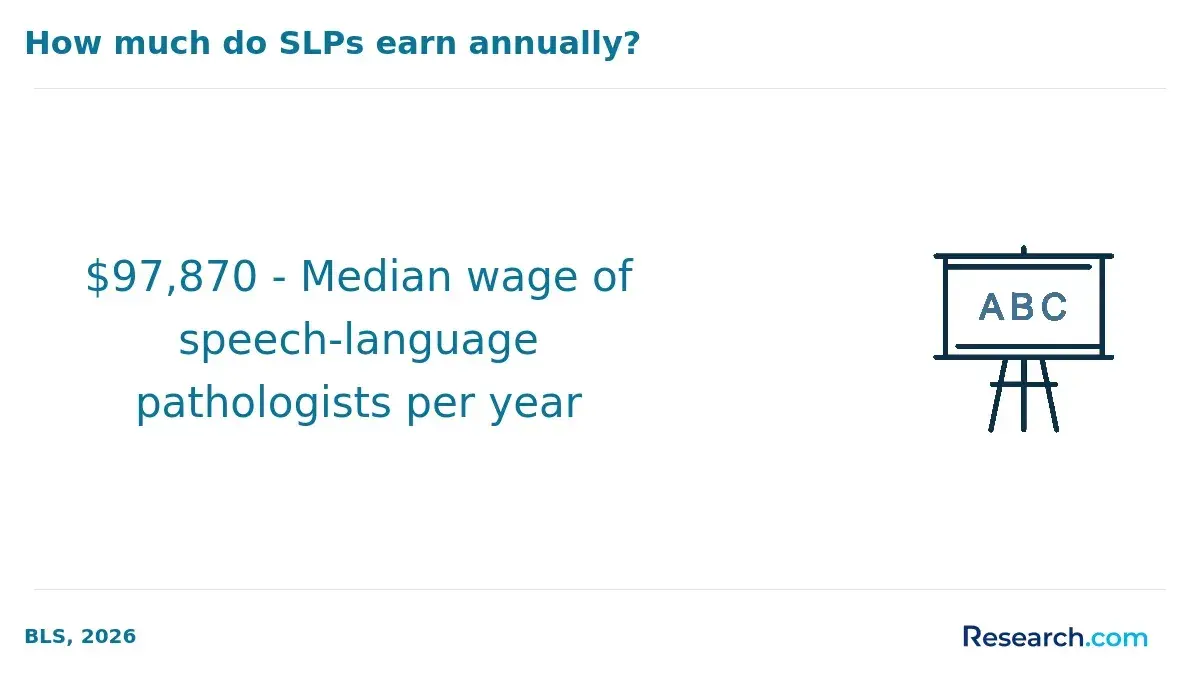
Labor demand supports careful investment in a qualifying degree: the BLS reports a May 2025 median annual wage of $97,870 for speech-language pathologists and projects 17% employment growth from 2025 to 2035. These national figures do not predict an individual graduate's pay in Cincinnati, which varies by setting, experience, employer, and hours worked. Review local career options and SLP salary factors alongside program debt and completion likelihood.
How can Cincinnati applicants verify an online SLP program's accreditation, licensure track, and current standing?
The safest way to choose an online SLP master's program is to verify the program yourself using current records, then obtain written answers to questions specific to Ohio. Accreditation, authorization, cost, and clinical policies are not static facts.
Use this verification sequence before submitting a deposit.
- Find the exact degree in the CAA directory or ASHA EdFind and confirm its current accreditation status, location, and dates.
- Read the university catalog, admissions page, clinical handbook, and Ohio professional-licensure disclosure for the same program - not a related campus or certificate.
- Request an itemized estimate of tuition, mandatory fees, travel requirements, and the full planned sequence of required credits.
- Ask the clinical education office, not only admissions, how Cincinnati-area placements are developed, approved, and supported.
- Check the Ohio licensing board's current requirements and retain written school responses showing how the program is intended to align with them.
- Compare the program's published Praxis, completion, and employment data using the same reporting period whenever possible.
Red flags include a missing CAA listing, vague answers about Ohio eligibility, no clear clinical-placement policy, a cost estimate that excludes required travel or fees, or outcome statistics without a cohort definition. If a school cannot document a key requirement, pause rather than assuming it will be resolved after enrollment.
Other Things You Should Know About Speech Language Pathology
Yes, an online or hybrid format can support the educational pathway if the specific program is appropriately CAA-accredited and you complete all Ohio licensure requirements. You must also satisfy examination, supervised-experience, and state application requirements; graduation alone does not create an Ohio license.
Do not assume so. Some programs arrange placements, some require substantial student participation, and many use a hybrid model. Ask for the written placement policy and whether the school can support sites in the Cincinnati region before enrolling.
Often, yes. Live classes may occur at scheduled times, and clinical practica commonly require daytime weekday availability. Review the sample course sequence and practicum calendar if you plan to work while enrolled.
Choose the option that best matches your clinical-placement needs, budget, travel tolerance, schedule, prerequisites, and Ohio licensure plan. A local program may offer regional familiarity, while a national program may offer a different delivery model; neither is automatically better.
References
- Online Speech-Language Pathology | University of Cincinnati https://www.cahs.uc.edu/academic-programs/graduate-programs/slp/online.html
- Best Speech-Language Pathology Programs in America https://www.usnews.com/best-graduate-schools/top-health-schools/pathology-rankings
- Online Master's in Speech Pathology Programs: 2026 Guide https://speechpathologymastersprograms.com/
- Best Online Speech Pathology Programs https://www.forbes.com/advisor/education/healthcare/best-speech-pathology-programs-online/
- Best Online Masters in SLP Programs | CAA-ASHA Included https://www.speechpathologydegrees.com/online/masters-slp
- Masters SLP programs - preferably online: r/slpGradSchool https://www.reddit.com/r/slpGradSchool/comments/s5p0p0/masters_slp_programs_preferably_online/