2027 Accounting Clerk Careers: Skills, Education, Salary & Job Outlook

Co-Founder and Chief Data Scientist
Becoming an accounting clerk is a practical entry point into finance for people who like organized work, clear procedures, and accuracy-driven tasks. The role does not usually require a long academic path, but it does require solid accounting basics, comfort with spreadsheets or accounting software, and the discipline to handle financial information carefully.
The decision is more nuanced in 2026 because routine bookkeeping work is increasingly shaped by automation. Employers still need people who can verify records, resolve discrepancies, communicate with vendors or internal teams, and understand how transactions affect financial reports. The best candidates are not just fast data-entry workers; they are detail-oriented problem solvers who can use technology without relying on it blindly.
This guide explains what accounting clerks do, the skills and education that matter most, realistic salary expectations, the job outlook, advancement options, and related careers to compare before you commit to this path.
Key Things You Should Know About Accounting Clerk Career
- The typical earning potential for an accounting clerk in the United States is around $47,440 annually, with some reports showing up to $49,210 as of recent data.
- Employment in bookkeeping, accounting, and auditing clerk roles is expected to decline by 6% between 2022 and 2032, mainly due to automation, though job openings will remain available to replace workers who leave.
- A high school diploma is the basic entry requirement, but many employers favor candidates who have completed postsecondary coursework or hold an associate degree in accounting or business.
- Success in this field depends on strong attention to detail, accuracy in data entry, proficiency with accounting software, organizational skills, and a basic understanding of accounting principles, along with good communication and customer service abilities.
- Advancement can lead to senior accounting clerk, staff accountant, or supervisory roles, and some may specialize further or pursue certification to become a full accountant.
What do Accounting Clerks do?
Accounting clerks support an organization’s financial operations by recording, checking, organizing, and updating financial transactions. Their work helps accountants, managers, payroll teams, and business owners rely on accurate numbers when they make decisions, prepare reports, pay bills, collect revenue, or respond to audits.
In practice, accounting clerks often handle a specific part of the accounting cycle. Some focus on accounts payable, making sure vendors are paid correctly and on time. Others work in accounts receivable, tracking customer payments and outstanding balances. In smaller organizations, one accounting clerk may handle several duties, including invoice processing, bank reconciliations, filing receipts, and helping with payroll documentation.
A Day in the Life of Accounting Clerks
A typical day is structured around deadlines, records, and verification. An accounting clerk may begin by reviewing invoices, entering transactions into accounting software, matching purchase orders to receipts, checking bank activity, responding to internal questions, and flagging discrepancies for review. During month-end, tax season, audits, or payroll cycles, the pace can become more demanding.
The role is usually office-based and detail-heavy. Much of the work is done independently, but accounting clerks also communicate with supervisors, accountants, vendors, customers, or other departments when information is missing or unclear. The strongest clerks are careful, consistent, and willing to investigate small errors before they become larger financial problems.
What are the key responsibilities of Accounting Clerks?
Accounting clerks are responsible for keeping financial records accurate, current, and easy to verify. The exact duties depend on the employer’s size, accounting system, and internal controls, but most roles combine transaction processing, record maintenance, and error checking.
- Enter and update financial transactions, including debits, credits, invoices, payments, and adjustments.
- Process accounts payable and accounts receivable documents, such as vendor invoices, customer payments, credits, and purchase records.
- Reconcile bank statements, ledgers, and account balances to identify missing, duplicate, or incorrectly coded transactions.
- Prepare basic financial reports and supporting documents, including income statement details, balance sheet schedules, aging reports, or transaction summaries.
- Maintain organized files for invoices, receipts, statements, purchase orders, tax documents, and other financial records.
- Assist with payroll processing, tax documentation, audit preparation, and internal reporting when required.
The Most Challenging vs. The Most Rewarding Tasks
The most challenging part of the job is often reconciliation. Finding the source of a mismatch can require patience, careful review, and communication with people who may not understand accounting procedures. Mistakes can affect cash flow, vendor relationships, payroll accuracy, or financial reporting, so the pressure to be precise is real.
The most rewarding part is that the work has a visible purpose. When accounts balance, invoices are paid correctly, and reports are supported by clean documentation, the accounting clerk has directly helped the organization avoid confusion and costly errors. For beginners who want a short training path, a 6-month online certification program that pays well may help build useful job-ready skills.
What are the key skills for Accounting Clerks?
Accounting clerks need a mix of technical accuracy, software fluency, ethical judgment, and dependable work habits. Employers value candidates who can enter information correctly, understand why it matters, and notice when something does not look right.
Key Hard Skills
- Accounting software proficiency: Use tools such as QuickBooks or SAP to enter, retrieve, classify, and review financial data.
- Spreadsheet skills: Work with formulas, sorting, filtering, basic reconciliations, and organized worksheets.
- Mathematical accuracy: Check totals, account codes, invoice amounts, payment records, and ledger entries.
- Financial recordkeeping: Maintain documentation that supports audits, reporting, compliance, and internal review.
- Data verification: Compare records across systems, statements, invoices, and reports to find inconsistencies.
Essential Soft Skills
- Attention to detail: Catch small errors before they affect reports, payments, or account balances.
- Dependability: Meet recurring deadlines for invoice runs, reconciliations, payroll support, and reporting cycles.
- Integrity: Protect sensitive financial, payroll, vendor, and customer information.
- Communication: Ask clear questions when documents are incomplete and explain discrepancies without creating confusion.
- Adaptability/Flexibility: Learn new systems, procedures, and regulatory requirements as accounting processes change.
The One Overlooked Skill That Separates the Good from the Great
Analytical problem solving is the skill that often separates a competent accounting clerk from a highly trusted one. Many people can enter transactions; fewer can recognize patterns, trace the source of errors, and suggest a better process.
For example, a clerk may notice that a certain type of invoice is repeatedly coded to the wrong account. Instead of correcting each entry in isolation, the clerk investigates the workflow, identifies the outdated instruction causing the issue, and recommends a fix. That kind of thinking reduces rework, improves reporting quality, and earns confidence from supervisors.
Understanding what employers look for in accounting clerks helps candidates prioritize their skill development, with 2025 hiring trends showing increased emphasis on technological proficiency, analytical thinking, and regulatory compliance knowledge alongside traditional bookkeeping abilities. Professionals who strengthen this broader skill set may qualify for better-paying industries, including Securities and Commodity Contracts.
If you are building credentials from the ground up, choosing the easiest online associates degree can be one way to develop accounting fundamentals while keeping the path manageable.
Accounting Clerk Careers: A Step-by-Step Guide to Getting Started
The path to becoming an accounting clerk is usually direct, but it works best when you combine basic education with hands-on software practice and real workplace experience. Employers often care less about prestige and more about whether you can handle financial records accurately and responsibly.
Here are the essential steps to become an accounting clerk:
- Complete the basic education requirement. A high school diploma or equivalent may be enough for some entry-level roles, but coursework in accounting, business math, spreadsheets, and computer applications can make you more competitive.
- Build accounting fundamentals. Learn debits and credits, invoices, ledgers, reconciliations, accounts payable, accounts receivable, and basic financial statements. A certificate or associate-level program can provide structure if you are new to the field.
- Practice commonly used tools. Develop confidence with spreadsheets and accounting software. Even if an employer trains you on its specific system, prior exposure helps you learn faster.
- Apply for entry-level finance support roles. Look for titles such as accounting clerk, bookkeeping assistant, accounts payable clerk, accounts receivable clerk, payroll clerk, or accounting assistant.
- Use on-the-job training seriously. Many employers provide 3-6 months of supervised training. During this period, focus on accuracy, documentation habits, internal controls, and deadlines.
- Consider a professional credential. Certification is not always required, but it may help you demonstrate commitment and qualify for better roles.
- Plan your next step early. After gaining experience, decide whether you want to specialize in payroll, payables, receivables, bookkeeping, auditing support, tax preparation, or move toward staff accounting.
A strong start comes from proving that you are accurate, trustworthy, and willing to learn. Those qualities matter in every accounting department, regardless of industry.
What education, training, or certifications are required?
Accounting clerk requirements vary by employer. Some positions accept a High School Diploma or GED, especially when the employer provides training. However, candidates with formal coursework or a postsecondary credential often have an advantage because they can show familiarity with accounting terminology, spreadsheets, software, and basic financial procedures.
Common education options include an Associate of Science (A.S.) in Accounting, an Associate of Applied Science (A.A.S.) in Accounting Technology, accounting certificates, and diplomas such as a Diploma in Accounting Clerk. These programs can be especially useful for candidates who have not worked in finance before.
Certifications may also strengthen a resume. Two common options are the Certified Bookkeeper (CB) credential from the American Institute of Professional Bookkeepers (AIPB) and the Certified Public Bookkeeper (CPB) credential issued by the National Association of Certified Public Bookkeepers (NACPB). These credentials are not mandatory for every job, but they can help signal professional knowledge and seriousness.
On-the-job training is standard and typically lasts 3-6 months under supervision. Training usually covers the employer’s accounting software, chart of accounts, approval procedures, documentation rules, internal controls, and reporting deadlines.
Are advanced degrees or niche certifications worth the investment?
For entry-level accounting clerk jobs, an associate degree, certificate, or bookkeeping credential often provides the most practical return. A Bachelor of Science (B.S.) or Master of Science (M.S.) in Accounting may be valuable if your goal is to move beyond clerical work into staff accounting, auditing, management, or roles that may require deeper accounting knowledge.
Specialized certifications such as Certified Management Accountant (CMA) or Certified Internal Auditor (CIA) can support advancement into management accounting or audit-related positions. However, they require more time, preparation, and financial investment, so they make the most sense when they align with a clear career plan.
If you are already working and want to continue your education, flexible options such as cheap masters degrees online may be worth comparing carefully. Before enrolling, check accreditation, total program cost, transfer policies, employer tuition benefits, and whether the credential supports the roles you actually want.
What is the earning potential for Accounting Clerks?
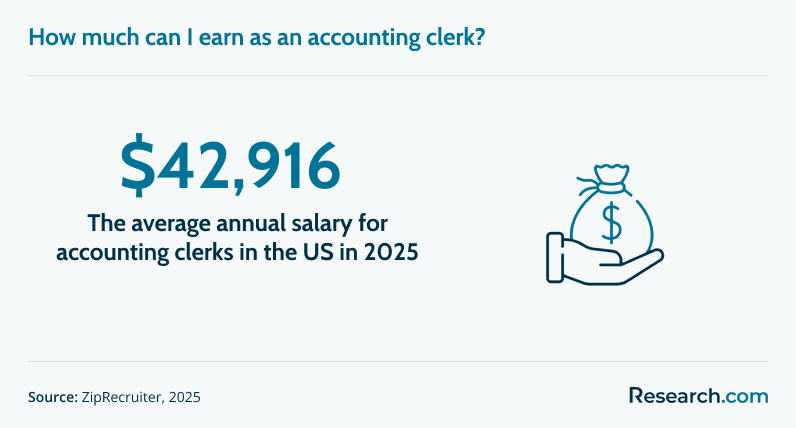
Accounting clerk pay depends on experience, location, employer size, industry, software skills, and the complexity of the role. Entry-level accounting clerks may start around $32,460 per year, while the median salary is $47,440 annually. Senior-level accounting clerks can earn up to $68,860 annually.
The average accounting clerk salary 2025 stands at about $47,440 per year, which gives job seekers a useful benchmark when comparing offers. A lower starting offer may still be reasonable for a first job if it includes strong training, exposure to accounting systems, and room to advance. A higher offer may reflect specialized duties, high-volume transaction work, industry demands, or a higher-cost location.
Industry can make a major difference. For example, sectors like the United States Postal Service can offer salaries as high as $78,530 per year. Geographic areas with higher living costs may also pay more, though higher pay does not always mean greater purchasing power.
To improve earning potential, accounting clerks should build skills that reduce employer risk: accurate reconciliations, strong spreadsheet ability, knowledge of accounting software, clean documentation habits, and the ability to solve discrepancies independently. Over time, specializing in accounts payable, accounts receivable, payroll, bookkeeping, auditing support, or reporting can also create stronger advancement opportunities.
What is the job outlook for Accounting Clerks?
The employment of bookkeeping, accounting, and auditing clerks, including accounting clerks, is projected to decline by 6% from 2024 to 2034. This is weaker than the average 3% growth expected across all occupations. The main reason is that routine transaction processing is increasingly handled by accounting software, automation, and artificial intelligence.
This does not mean accounting clerk jobs will disappear. It does mean the role is changing. Employers are likely to favor clerks who can do more than enter data: verify automated outputs, investigate errors, maintain documentation, support compliance, communicate with stakeholders, and adapt to new systems.
The Key Factors Shaping the Future Outlook
Automation is the biggest pressure on the field. Tasks such as invoice entry, payment matching, recurring journal entries, and basic report generation can now be completed faster by software. Organizations that are focused on efficiency may consolidate clerical roles or expect one employee to handle a broader set of finance support duties.
At the same time, businesses still need accurate financial records. Smaller companies, organizations with complex approval workflows, and employers in industries that adopt new systems more slowly may continue to rely on accounting clerks. Retirements and turnover can also create openings even when total employment declines.
For students planning their education, the safest strategy is to pair accounting basics with software fluency and broader business skills. If affordability matters, comparing the best affordable online schools that accept fafsa can help you find programs that support career mobility in a changing job market.
What is the typical work environment for Accounting Clerks?
Accounting clerks usually work in office settings, using computers, spreadsheets, accounting software, email, and document management systems throughout the day. Many are part of a finance or accounting team, though clerks in small businesses may work closely with an office manager, bookkeeper, controller, or business owner.
Common employment settings include professional, scientific, and technical services (13%), retail trade (11%), and health care and social assistance (10%). These figures show that accounting clerks are needed across many industries, not just accounting firms.
Most accounting clerks work full time during standard business hours. Overtime may occur during month-end close, year-end reporting, audits, payroll deadlines, tax season, or major billing cycles. The work is often predictable, but deadline periods can be stressful because errors must be corrected quickly.
Remote and hybrid work options are becoming more common, especially for experienced clerks who can work independently and handle digital records securely. However, many roles still require on-site work, particularly when paper documentation, in-person approvals, or secure internal systems are part of the process.
What are the pros and cons of Accounting Clerk careers?
Accounting clerk careers can be a good fit for people who value structure, accuracy, and steady administrative work. The trade-off is that the job can be repetitive and deadline-driven, especially when transaction volume is high.
Pros
- Accessible entry point: Many roles do not require a four-year degree, making the field approachable for career starters and career changers.
- Transferable skills: Experience with invoices, reconciliations, payroll support, spreadsheets, and accounting systems can apply across many industries.
- Clear routines: The work often follows predictable cycles, which can appeal to people who prefer organized tasks and defined expectations.
- Visible impact: Accurate records help prevent payment errors, reporting problems, audit issues, and cash flow confusion.
- Advancement potential: Clerks who build skills can move into bookkeeping, payroll, specialist, or staff accounting roles.
Cons
- Repetition: Data entry, filing, invoice review, and recurring reconciliations can feel monotonous over time.
- Error pressure: Small mistakes can affect payments, reports, and account balances, so careful review is constant.
- Deadline stress: Month-end, payroll, tax, and audit periods can create heavy workloads.
- Limited autonomy: Clerks often follow established procedures and approval rules, leaving less room for creative decision-making.
- Automation risk: Routine clerical duties are more vulnerable to software-driven change than higher-level accounting analysis.
If you are considering education for this path, review accreditation carefully. The best online colleges with national accreditation may offer relevant programs, but you should compare costs, transferability, employer recognition, and whether the curriculum includes accounting software and practical financial recordkeeping.
What are the opportunities for advancement for Accounting Clerks?
Accounting clerk roles can lead to stronger finance careers, but advancement usually requires more than time on the job. You need to show accuracy, learn the full accounting cycle, take on more complex tasks, and often add education or certification.
Clear Advancement Paths
- Start as an Accounting Clerk, then move into Senior Accounting Clerk or Bookkeeper roles after gaining experience with reconciliations, ledgers, and reporting support.
- Specialize as an Accounts Payable Specialist, Accounts Receivable Specialist, Payroll Clerk, or Payroll Specialist if you prefer a focused transaction area.
- Advance into Staff Accountant or Accounting Assistant roles by building stronger knowledge of journal entries, month-end close, financial statements, and accounting standards.
- With additional education or credentials, move toward Senior Accountant, Internal Auditor, Audit Manager, Accounting Manager, or Controller roles.
- At the highest levels, experienced accounting professionals may pursue leadership positions such as Controller or Chief Financial Officer (CFO).
Accounting clerk career advancement opportunities are strongest for people who use the role as a foundation, not a final destination. If you stay limited to routine data entry, growth may be slower. If you learn why transactions are recorded the way they are, your options expand.
Key Steps for Career Growth
- Pursue additional accounting education when it supports your target role, such as an associate degree, bachelor’s degree, or relevant professional certification.
- Develop deeper skills in payroll, tax accounting, bookkeeping, accounts payable, accounts receivable, audit support, or forensic auditing.
- Learn compliance, tax law basics, internal controls, and audit documentation so you can contribute beyond routine clerical tasks.
- Ask to help with month-end close, reporting schedules, reconciliations, or process improvement projects.
- Seek mentorship from accountants, controllers, payroll managers, or finance leaders who can explain what skills are needed for the next role.
- Track measurable accomplishments, such as reducing errors, improving filing systems, resolving old discrepancies, or speeding up invoice processing.
Promotion is more likely when supervisors see that you can handle confidential information, meet deadlines, solve problems, and understand the financial impact of your work.
What other careers should you consider?
If you are interested in accounting clerk work but unsure whether it is the best fit, compare it with nearby roles. Many use similar skills but differ in pace, responsibility, specialization, and advancement potential.
- Bookkeeper: Maintains financial records, categorizes transactions, reconciles accounts, and may prepare basic statements. This role is often broader than an accounting clerk position, especially in small businesses.
- Payroll Clerk: Focuses on employee compensation, time records, deductions, payroll documentation, and payroll-related questions. It may be a good fit if you like rules, schedules, and confidentiality.
- Accounts Receivable Clerk: Tracks customer payments, prepares invoices, monitors overdue accounts, and communicates about balances. This path can involve more customer interaction.
- Accounts Payable Clerk: Reviews vendor invoices, matches documentation, prepares payments, and helps prevent duplicate or incorrect payments. It suits people who like process control and documentation.
- Auditing Clerk: Reviews financial documents for accuracy, completeness, and compliance with procedures. This option may appeal to detail-oriented people who enjoy investigation.
- Accounting Assistant: Supports a wider range of accounting tasks, including coding documents, preparing schedules, helping with reports, and assisting accountants during close periods.
Choose based on the daily work you want to do. If you prefer predictable transaction processing, accounting clerk or accounts payable roles may fit. If you enjoy investigation, auditing support may be better. If you want a broader foundation for advancement, bookkeeping or accounting assistant roles may offer more exposure.
Here's What Professionals Say About Their Accounting Clerk Careers
- Jamal: "Being an Accounting Clerk means I am the backbone of my company's financial accuracy. When I reconcile accounts and catch discrepancies early, I know I'm preventing costly mistakes that could affect big decisions made later on. It's a responsibility I take pride in because even though I'm not in charge of strategy, my careful work keeps everything on track. Without attention to detail, those decisions wouldn't be possible."
- Alexa: "Handling endless data entry, especially at the end of the month, can be overwhelming, but I've learned to manage it with checklists and double-check systems. Maintaining accuracy under tight deadlines is tough, but having a routine reduces my stress and helps me avoid mistakes. It took time to develop these habits, but now, even when my workload spikes, I feel confident that everything will get done correctly. Focusing on detail is key in this role."
- Eli: "There's nothing quite like the satisfaction I get when I finally uncover a missing transaction that's been holding up an audit. It's like putting together a puzzle, and knowing my thorough reports helped the audit go smoothly makes the long hours worth it. Finding those discrepancies that others missed challenges me and keeps my work interesting. I feel proud that my effort ensures the financial records are reliable and complete."
Key Findings
- Accounting clerk careers are accessible, but employers increasingly prefer candidates with accounting coursework, software skills, and strong spreadsheet ability.
- The role centers on accurate financial recordkeeping, invoice processing, account reconciliation, documentation, and support for payroll, tax, reporting, or audits.
- Entry-level salaries are around $32,460 per year, the median salary is $47,440 annually, and senior-level accounting clerks can earn up to $68,860 annually.
- The employment of bookkeeping, accounting, and auditing clerks is projected to decline by 6% from 2024 to 2034, mainly because automation is reducing demand for routine clerical tasks.
- The best long-term strategy is to use an accounting clerk job as a foundation for higher-skill roles in bookkeeping, payroll, accounts payable, accounts receivable, staff accounting, auditing, or accounting management.
- This career is a strong fit for detail-oriented people who like structure, deadlines, and practical financial work, but it may not suit those who want high creativity or frequent strategic decision-making early in their careers.
Other Things You Should Know About Accounting Clerk
In 2027, the key skills for an accounting clerk include proficiency in accounting software like QuickBooks, strong numerical skills, attention to detail, and familiarity with digital collaboration tools. Employers also value adaptability and an understanding of data privacy and security regulations.
To become an accounting clerk in 2027, a high school diploma is generally required, though some employers may prefer candidates with an associate degree in accounting or a related field. Education in accounting software and basic bookkeeping can also enhance employment prospects.
References
- The Ultimate Accounting Clerk Career Guide https://www.4cornerresources.com/career-guides/accounting-clerk/
- Accountants and Auditors : Occupational Outlook Handbook: : U.S. Bureau of Labor Statistics https://www.bls.gov/ooh/business-and-financial/accountants-and-auditors.htm
- Accounting Clerk Salaries | Oct 11, 2025 https://www.readysethire.com/job-search/position-salary/accounting-clerk
- Career Development Guide: Progressing from Accounting Clerk to Senior Roles https://www.expertia.ai/career-tips/career-development-guide-progressing-from-accounting-clerk-to-senior-roles-29777b
- Accounting Clerk Job Duties A Practical Guide https://www.beyondhire.co/blog/accounting-clerk-job-duties
- accounting clerk https://www.randstadusa.com/job-seeker/career-advice/job-profiles/accounting-clerk/
- 47 Pros & Cons Of Starting An Accounting Clerk (2025) - Starter Story https://www.starterstory.com/ideas/accounting-clerk/pros-and-cons
- The Top Hard and Soft Skills Accountants Needâ https://www.ft-recruitment.com/news/the-top-hard-and-soft-skills-accountants-need
- Accounting Clerk Jobs & Salaries | Accounting.com https://www.accounting.com/careers/accounting-clerk/salary/
- Becoming an Accounting Clerk: Salary & Job Description https://learningpath.org/articles/Accounting_Clerk_Career_Summary.html