2027 Online SLP Master's Programs for Alabama Residents: Eligibility, Tuition, and Clinical Placements

Co-Founder and Chief Data Scientist

Reviewed by Rhea Paul, PhD
SLP Education & Research Expert
Alabama residents can pursue an online master's in speech-language pathology, but the right choice depends on more than online delivery. You must confirm CAA accreditation, Alabama enrollment authorization, clinical-placement support, travel requirements, and whether the curriculum supports Alabama licensure.
This guide explains how to evaluate eligible programs, estimate the real cost, plan required fieldwork, and avoid enrolling in a program that does not fit your professional goal.
Key Things You Should Know
- For initial SLP licensure, prioritize a master's program accredited by the ASHA Council on Academic Accreditation (CAA); an online format does not remove accreditation or clinical-training requirements.
- ASHA certification standards require at least 400 supervised clinical clock hours, including 25 guided-observation hours and 375 direct client-contact hours; placements may occur in Alabama but are not automatically guaranteed in every community.
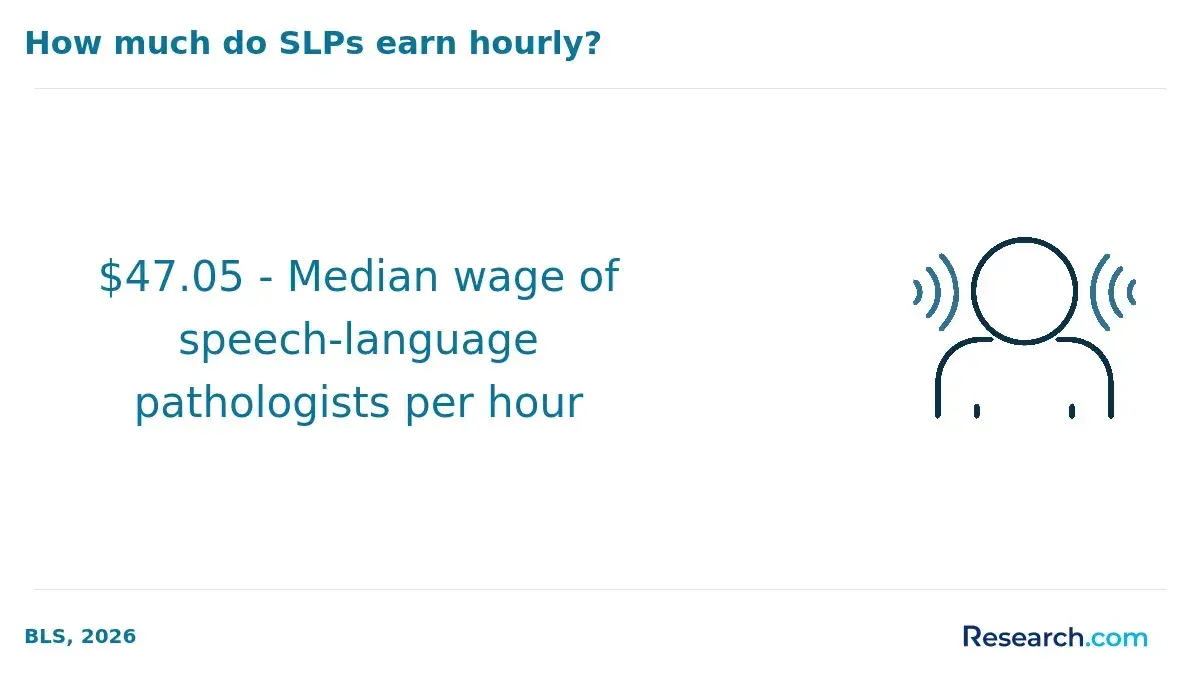
- The U.S. Bureau of Labor Statistics projects 17% employment growth for speech-language pathologists from 2025 to 2035, with median annual pay of $97,870 in May 2025; demand does not replace the need to meet Alabama's specific licensing rules.
Which online SLP master's programs accept Alabama residents?
Alabama residents should consider only programs that expressly accept applicants from Alabama or have no published Alabama restriction. State authorization, not merely a program's online marketing, determines whether a university may enroll a resident in a distance-learning professional program.
CAA-accredited online or hybrid SLP master's programs commonly considered by out-of-state applicants include programs offered by Baylor University, Emerson College, New York University, and the University of St. Augustine for Health Sciences. Availability, cohort start dates, and Alabama eligibility can change, so these names are starting points for verification rather than a permanent approved-program list.
The comparison below identifies the decision points that matter more than a broad "online" label. Ask each school to confirm the listed items in writing before paying an application fee or deposit.
| Program feature to verify | Why it matters for an Alabama resident | Best question to ask |
| CAA accreditation status | CAA accreditation is central to ASHA certification and commonly expected for state licensure. | Is the specific master's program currently CAA accredited, and does that status cover my expected graduation date? |
| Alabama enrollment eligibility | A school may offer online education nationally while limiting enrollment in certain professional programs. | Can the university enroll Alabama residents in this SLP cohort today? |
| Clinical-placement model | Programs vary in whether they locate sites, approve sites proposed by students, or use a shared process. | Who secures Alabama practicum and externship sites, and what happens if a site falls through? |
| Required travel | Online programs can include residencies, skills intensives, orientation sessions, or campus-based assessments. | How many required visits are there, where are they held, and are travel costs included in tuition? |
| Live class schedule | Evening sessions in another time zone can affect working students and caregivers. | Which classes meet live, on which days, and are recordings available? |
Students seeking lower published tuition should compare total required charges, not promotional claims alone. A review of cheapest online SLP master's programs can help frame that comparison, but Alabama eligibility and clinical support remain nonnegotiable filters.
What admission requirements do Alabama residents need for online SLP programs?
Admission to an online SLP master's program is usually competitive and requires both a qualifying bachelor's degree and prerequisite coursework in communication sciences and disorders. Applicants with a CSD major generally have the most direct path; career changers may need leveling courses before or alongside graduate study.
Most schools ask applicants to submit evidence in several categories. Requirements differ by institution, so applicants should treat a program's current graduate admissions page as controlling.
- A completed bachelor's degree from an institution recognized by the program.
- Official transcripts showing the required GPA and completion of CSD prerequisites or a documented plan to complete them.
- Prerequisite coursework that commonly includes phonetics, speech and hearing science, language development, anatomy and physiology of speech and hearing, audiology, and speech or language disorders.
- ASHA-required foundational coursework in biological sciences, physical sciences, statistics, and social or behavioral sciences, if not already completed.
- Personal statement, résumé, recommendation letters, and sometimes an interview or recorded response.
- Application materials submitted through CSDCAS or the university's own graduate application system, depending on the school.
A common mistake is assuming that "no GRE required" means admission is easy or that prerequisites are waived. It usually means the GRE is not part of the file; the school may still scrutinize academic preparation, communication skills, clinical exposure, and fit with its cohort model.
Applicants changing fields should ask whether the school admits non-CSD majors directly, offers a formal leveling sequence, and permits the required prerequisites to be completed before enrollment. Programs described as accelerated speech pathology programs online may still require extensive foundational coursework, so faster scheduling should not be confused with fewer academic requirements.
How much do online SLP master's programs cost for Alabama students?
Online SLP master's programs can be a substantial financial commitment because they combine graduate tuition with clinical education, technology, travel, and living costs. Schools often publish per-credit tuition, while the number of required credits, university fees, and clinical expenses vary; a per-credit figure alone is not a comparable total price.
Rather than relying on a single advertised number, Alabama applicants should request an official cost-of-attendance estimate for their intended cohort and pacing plan. The estimate should separate tuition from costs that may be billed or incurred later.
| Cost category | What to confirm | Why it can change the total |
| Tuition | Required graduate credits and rate per credit or term | Programs differ in credit requirements, and tuition rates may change between cohorts. |
| Mandatory university fees | Technology, student services, clinical, graduation, and distance-learning fees | These charges may be assessed per term, per credit, or once. |
| Clinical education expenses | Background checks, drug screening, immunizations, liability coverage, site onboarding, and testing | Requirements differ by placement site and may recur during the program. |
| Travel and lodging | Required immersions, intensives, campus visits, and out-of-area placements | Online delivery does not necessarily mean zero travel. |
| Lost work time | Whether practica and full-time externships can fit around employment | Clinical schedules can create a meaningful indirect cost for working students. |
Federal Direct Unsubsidized and Graduate PLUS loans may be available to eligible graduate students, but borrowing capacity is not a reason to skip cost comparison. Start with the school's financial-aid office, then compare employer assistance, scholarships, assistantships where available, and the timing of payments. A lower tuition rate can be outweighed by repeated travel or a placement model that forces reduced work hours.
For career context, the BLS reports a $97,870 median annual wage for speech-language pathologists in May 2025. That national median is useful for broad ROI planning, but it is not an Alabama starting-salary estimate and should not be treated as an expected personal outcome.
Which online SLP programs require Alabama-based clinical placements?
Nearly every entry-level SLP master's program requires clinical placements because clinical competence cannot be completed entirely through recorded lectures or simulations. For Alabama residents, the key question is whether the university can arrange, approve, and supervise placements that satisfy program standards within a reasonable travel distance.
Programs generally use one of three placement approaches. Understanding the model early can prevent a difficult surprise after admission.
| Placement approach | What the student does | Primary trade-off |
| University-arranged placement | The program works to identify and contract with sites and supervisors. | More structured support, but students may have limited control over location, population, or schedule. |
| Student-assisted placement | The student may identify local contacts while the program reviews and approves the site. | Can expand Alabama options, but the student must avoid making informal promises before approval. |
| Hybrid shared model | The program leads the process while students provide geographic preferences and local leads. | Often practical, but placement availability can still require travel or schedule flexibility. |
Alabama-based placements may be available in public schools, hospitals, outpatient clinics, rehabilitation facilities, early-intervention settings, skilled nursing facilities, or university clinics. Availability depends on affiliation agreements, supervisor qualifications, client populations, site capacity, and the placement calendar. A school should not promise a particular city, employer, specialty, or commute radius unless it can document that arrangement.
Before enrolling, ask for the program's written policy on placement timing, supervisor qualifications, affiliation contracts, travel expectations, remediation if hours are delayed, and responsibility for expenses. Students interested in a school-heavy or pediatric SLP career should also ask whether the program can provide appropriate child-language, school, and developmental clinical experiences rather than assuming a preferred site will be available.
How do CSWE, CAA, and state rules affect Alabama SLP enrollment?
CAA, state authorization, and Alabama licensure are separate compliance issues. They overlap, but one does not automatically prove the others.
CAA is the Council on Academic Accreditation in Audiology and Speech-Language Pathology, the ASHA accreditor for graduate professional programs in the field. CAA accreditation is the relevant accreditation term for an SLP master's degree. CSWE, the Council on Social Work Education, accredits social work programs and does not accredit speech-language pathology degrees. If an SLP program refers to CSWE as its professional accreditor, treat that as a serious red flag.
State authorization addresses whether an institution may provide distance education to an Alabama resident. It is an institutional compliance matter and does not establish that the degree meets Alabama licensing requirements. Alabama licensure is governed by the Alabama Board of Examiners for Speech-Language Pathology and Audiology, which determines the credentials and post-degree requirements for state practice.
The practical sequence is straightforward: choose a CAA-accredited degree, confirm that the university can enroll Alabama residents, obtain the program's Alabama professional-licensure disclosure, and verify current requirements directly with the Alabama licensing board. Students planning to work in schools should also check requirements that may be set by the Alabama State Department of Education or a local employer, because school credentials can involve additional rules.
Do not rely on a general statement that a curriculum is "designed for licensure." Ask whether the institution has determined that its program meets Alabama educational requirements, whether any state-specific coursework or documentation is needed, and whether the disclosure applies to online students and your intended graduation date.
Which online programs help Alabama residents meet licensure prerequisites?
An online program can help an Alabama resident meet educational prerequisites for licensure when it combines a qualifying graduate curriculum, supervised clinical education, and clear professional-licensure disclosures. It cannot replace the graduate's responsibility to complete Alabama's application, examination, and post-graduate requirements.
For students without an undergraduate CSD degree, the best program is not necessarily the one with the shortest advertised timeline. It is the one that clearly maps missing prerequisites, permits a realistic course sequence, and confirms how the graduate degree will support Alabama licensure and ASHA certification goals.
Use the following process before narrowing your applications:
- Confirm the program's current CAA accreditation in ASHA's accreditation or EdFind directory.
- Request written confirmation that Alabama residents may enroll in the exact online or hybrid cohort.
- Ask admissions to evaluate your transcript against CSD and ASHA foundational-course requirements.
- Read the university's Alabama professional-licensure disclosure and compare it with current Alabama board requirements.
- Ask how the program documents practicum hours, supervision, and clinical competencies for graduates.
- Plan separately for the Praxis examination, clinical fellowship, Alabama license application, and any school-employment credential requirements.
Applicants who want a faster academic pathway can investigate SLP accelerated programs, but they should confirm that an accelerated calendar still leaves room for clinical scheduling, remediation if needed, and the required supervised experiences. A compressed course sequence is usually a better fit for students with completed prerequisites and flexible work arrangements.
What fieldwork hours must Alabama SLP students complete online?
Online SLP students must complete supervised clinical education in addition to academic coursework. ASHA certification standards require at least 400 clock hours of supervised clinical experience: 25 guided-observation hours and 375 direct client-contact hours. Programs may require more hours or distribute them differently to meet educational objectives.
Direct client-contact hours involve real clinical service under qualified supervision, not merely watching recordings or completing classroom exercises. Telepractice can be part of clinical education when permitted by the program and placement setting, but it must be supervised and documented according to applicable standards.
The hour total is only one part of readiness. Programs also assess competence across client ages, communication and swallowing needs, and service settings. An Alabama student should review how each school sequences early practicum, later externships, and any full-time clinical terms because the schedule may affect employment, childcare, and travel plans.
Ask whether placements are typically daytime, whether an externship may require full-time availability, how missed hours are made up, and whether the school has recently placed students in Alabama. Never assume that a local job, volunteer role, or employer relationship can become a graduate practicum site without formal program approval and an eligible supervisor.
How do Alabama residents compare online SLP programs by format and support?
Format is not just a convenience feature in clinical graduate education. It affects whether you can attend live instruction, complete daytime placements, travel for required experiences, and access help when a clinical issue arises.
This comparison helps Alabama residents identify which format features deserve the most weight based on their circumstances.
| Decision factor | May fit best for | Question that reveals the real policy |
| Mostly asynchronous coursework | Students balancing predictable work or caregiving schedules | Which activities are truly self-paced, and which require live attendance? |
| Scheduled live online classes | Students who prefer structure, discussion, and real-time faculty access | Are live sessions mandatory, and what time zone governs attendance? |
| Full-time cohort | Students able to prioritize rapid academic progression | During which terms are daytime clinical commitments expected? |
| Part-time option | Students who need a slower academic pace before clinical immersion | Does part-time enrollment extend clinical placement timing or total tuition? |
| Strong placement team | Students without established health-care or school contacts in Alabama | What written placement assistance, escalation process, and travel policy does the school provide? |
| Campus immersion requirement | Students able to budget for planned travel and hands-on assessment | How many visits are mandatory, and what costs are not covered by tuition? |
Support quality matters most when problems arise. Ask about faculty access, disability accommodations, academic coaching, exam preparation, placement coordination, technical support during telepractice, and the process for changing a problematic clinical site. A polished virtual learning platform is useful, but it is not a substitute for reliable clinical education support.
Which tuition factors change the total price for Alabama residents?
Total price can vary materially even between programs with similar tuition rates. Alabama residents should compare the same measure for each school: estimated tuition and mandatory fees for all required credits, plus realistic travel and clinical costs.
The largest price changes usually come from factors that are easy to miss during the first admissions conversation.
- Whether the university charges one online rate for all students or a separate graduate, program-specific, or out-of-state rate.
- The number of required credits, including leveling coursework that may not be part of the master's credit total.
- Term-based fees that increase when a student chooses part-time enrollment or needs an additional term.
- Required residencies, skills labs, intensives, or clinical assignments outside the student's home area.
- Clinical onboarding expenses, including screenings, vaccinations, insurance, supplies, and professional examinations.
- The income impact of reducing work hours for daytime practica or a full-time externship.
- Tuition increases that can apply to later terms if the institution does not guarantee a cohort rate.
Request a written estimate that shows credits, tuition rate, known mandatory fees, and the assumptions used. Then ask whether tuition is locked for continuing students and whether a delayed placement could add a term of tuition or fees. This protects against the common mistake of comparing one program's tuition-only figure with another program's estimated cost of attendance.
How should Alabama students verify a program's current status before enrolling?
Program details can change between the time you research and the time you enroll. Accreditation status, state authorization, tuition, course sequencing, placement policies, and professional-licensure disclosures should be checked again shortly before you accept an offer.
Use this verification sequence to create a record of the answers that affect your decision:
- Check the program's current CAA status through ASHA's official accreditation resources and save the result.
- Review the university's current graduate catalog for required credits, prerequisites, completion rules, and clinical education requirements.
- Ask the admissions office to confirm in writing that Alabama residents are eligible for your intended start term and delivery format.
- Obtain the current Alabama professional-licensure disclosure and ask whether the school has identified any additional Alabama educational requirements.
- Request a program-specific tuition and fee estimate, including the number of required terms and any expected residency costs.
- Speak with clinical education staff about Alabama placement procedures, student responsibilities, likely travel expectations, and contingency planning.
- Confirm current licensing, clinical fellowship, and examination requirements directly with the Alabama Board of Examiners for Speech-Language Pathology and Audiology.
Keep copies of email confirmations, tuition estimates, and licensure disclosures. If a representative gives a broad verbal assurance such as "we place students everywhere" or "this works for licensure," ask for the applicable written policy. Clear documentation is especially important because professional programs, clinical sites, and state rules can change after admission.
Other Things You Should Know About Speech Language Pathology
Yes, if the degree and your post-graduate steps meet Alabama requirements. Choose a CAA-accredited program, complete required supervised clinical education, and verify current examination, clinical fellowship, and license-application rules with the Alabama licensing board.
Not always. Many programs consider applicants with other bachelor's degrees, but those applicants usually need prerequisite or leveling coursework in communication sciences and disorders before beginning or progressing through graduate clinical training.
It depends on the school. Some programs arrange placements, some require students to help identify sites, and many use a shared process. Obtain the placement policy in writing and ask about travel if an appropriate Alabama site is unavailable.
Coursework may be manageable for some working students, particularly in part-time formats, but practicum and externship schedules often occur during regular business or school hours. Review the clinical calendar before assuming full-time work will remain feasible.
References
- Masters in Speech Pathology | SLP Program in Alabama https://www.aum.edu/degree/ms-speech-language-pathology/
- Online Master's Program | Speech-Language Pathology https://www.csusm.edu/slp/programs/mastersonline/index.html
- Best Online MSLP Programs with No GRE Required for 2026 https://www.speechpathologydegrees.com/online/mslp-no-gre-required
- 2026 Most Affordable Online Speech Pathology Master's... https://www.onlineu.com/most-affordable-colleges/speech-pathology-masters-degrees