2027 Best Online Speech Pathology Master's Programs for Residents of Moreno Valley, CA

Co-Founder and Chief Data Scientist

Reviewed by Rhea Paul, PhD
SLP Education & Research Expert
Moreno Valley residents choosing an online master's in speech-language pathology need more than flexible coursework: the program must support California licensure, provide supervised clinical education, and clearly explain any travel obligations. This guide compares the decision factors that matter most, including CAA accreditation, California enrollment eligibility, practicum placement support, cost, admissions, and career value. Use it to narrow your shortlist before paying an application fee or committing to prerequisite coursework.
Key Things You Should Know
- A California-eligible, CAA-accredited master's program is the essential starting point because California SLP licensure depends on approved graduate education, supervised clinical experience, and post-graduate requirements.
- "Online" usually describes academic coursework, not the entire degree: Moreno Valley students should expect supervised practicum, possible campus immersions, and clinical placement travel within Southern California or another approved region.
- Speech-language pathology has strong national demand: the U.S. Bureau of Labor Statistics projects 17% employment growth from 2025 to 2035, with a May 2025 median annual wage of $97,870, but earnings and hiring vary by California setting and region.
Which online speech pathology master's programs accept Moreno Valley residents for California licensure?
The strongest options for Moreno Valley residents are programs that are accredited by the American Speech-Language-Hearing Association's Council on Academic Accreditation (CAA), permit enrollment from California, and provide a clear California professional-licensure disclosure. Acceptance of California residents can change with state authorization agreements, cohort capacity, and clinical-placement availability, so applicants should obtain written confirmation before enrolling.
Several established distance or hybrid graduate pathways commonly warrant investigation for California residents. They differ substantially in required visits, sequencing, placement models, and whether coursework is delivered asynchronously, live online, or in a blended format.
| Program to investigate | Format consideration | Moreno Valley decision point | Best fit |
| Emerson College, online M.S. in Speech-Language Pathology | Online academic delivery with required clinical education and immersion components | Confirm current California enrollment eligibility, immersion travel, and placement process | Students seeking a structured cohort-based online model |
| New York University, online M.S. in Communicative Sciences and Disorders | Distance coursework combined with clinical training and required program experiences | Ask whether California placements can be supported during each clinical phase | Students comfortable with a nationally delivered program and possible travel |
| Baylor University, online M.S. in Communication Sciences and Disorders | Online coursework with clinical placements and in-person program requirements | Verify California authorization, synchronous expectations, and placement geography | Students who want a cohort curriculum with a defined clinical sequence |
| Calvin University, online M.A. in Speech-Language Pathology | Distance academic instruction with clinical requirements that are not fully virtual | Confirm California availability and any residency or intensive-session obligations | Students prioritizing online academic coursework but able to travel when required |
| University of St. Augustine for Health Sciences, M.S. in Speech-Language Pathology | Hybrid-style professional preparation with online learning and clinical education | Review California campus, residency, and clinical-placement expectations carefully | Students open to a blended model rather than a purely distance-based curriculum |
These are not interchangeable programs, and this is not a guarantee that every listed institution is accepting new California applicants for every cohort. A school can hold CAA accreditation while temporarily limiting enrollment in a state or limiting placement capacity in a particular region. Request a dated response from admissions or the licensure-disclosure office that addresses California enrollment and California licensure preparation specifically.
Applicants comparing broader online SLP graduate programs should also distinguish between a program that is academically online and one that can realistically coordinate the clinical training needed near Inland Southern California.
How do online speech pathology programs meet ASHA CAA accreditation and California requirements?
CAA accreditation evaluates whether a graduate speech-language pathology program meets professional education standards. It applies to the program, not merely to the university. For aspiring California speech-language pathologists, graduating from a CAA-accredited program is a central safeguard because it supports the educational foundation commonly expected for state licensure and ASHA certification pathways.
An online program can meet CAA standards when it provides the same essential academic and clinical elements required of a campus program. Distance delivery does not eliminate faculty oversight, competency assessment, direct client contact, clinical supervision, or documentation of clinical hours.
The following distinctions help applicants interpret accreditation language correctly.
| Term | What it means | Why it matters in California |
| CAA-accredited | The program has been accredited by ASHA's Council on Academic Accreditation | This is the preferred status to verify before enrolling in a licensure-track master's program |
| CAA candidacy | The program is progressing through the accreditation process but does not have full accreditation status | Applicants should ask how candidacy affects their cohort and confirm treatment of graduates with the California licensing authority |
| Institutional accreditation | The university meets broader institutional standards | Important, but it does not substitute for specialized CAA accreditation for SLP preparation |
| State authorization | The institution is authorized to provide education to residents of a state | Authorization affects whether a Moreno Valley resident may enroll; it is not the same as professional licensure eligibility |
| Professional licensure disclosure | The institution's statement about whether its curriculum meets a state's educational requirements | This is the program-specific statement a California applicant should save and review |
CAA standards also require clinical education that develops competence across communication and swallowing disorders, populations, and service settings. Students should expect a combination of observation, direct clinical work, supervisor feedback, documentation, and formal evaluations. Telepractice may be part of training, but it does not mean every clinical requirement can be completed from home.
A common error is treating ASHA certification, CAA accreditation, and California licensure as identical. They are related but distinct. A degree program may prepare a graduate for multiple credentials, while the California licensing process has its own application, examination, supervised experience, and documentation rules.
What factors define the "best" online speech pathology programs for Moreno Valley residents?
The best program is not necessarily the lowest advertised tuition or the school with the most recognizable name. For a Moreno Valley applicant, the better choice is the one that combines California eligibility, sound clinical support, manageable travel, transparent cost, and a schedule that can be sustained through intensive clinical rotations.
Use the following criteria in this order rather than beginning with rankings or marketing claims.
- Confirm that the specific graduate program is CAA-accredited or understand the documented implications of candidacy for your cohort.
- Obtain written confirmation that California residents may enroll and that the curriculum is intended to meet California's educational licensure requirements.
- Ask how the school secures, approves, and supervises clinical placements in or near the Inland Empire.
- Calculate total educational cost, including tuition, university fees, clinical fees, travel, lodging, background checks, immunizations, technology, and lost work time during practicum.
- Compare required live sessions, course-load sequence, campus immersions, and the earliest point at which daytime clinical availability becomes necessary.
- Review admissions prerequisites before spending money on applications, especially if your bachelor's degree is outside communication sciences and disorders.
Placement support deserves particularly close attention. Programs vary from highly directed models, where the school actively assigns or arranges sites, to shared-responsibility models, where students identify potential sites but the institution must approve and contract with them. A program that works well for a student in a large metropolitan area may still require travel if a suitable supervisor or specialty placement is unavailable locally.
Another useful comparison is flexibility versus predictability. A primarily asynchronous program may suit a working adult during early academic terms, but required clinical rotations typically occur during business hours. A tightly sequenced cohort can feel less flexible, yet it may make planning prerequisites, placements, and graduation timing easier.
For applicants with an undergraduate degree in another field, accelerated or combined pathways can be appealing, but they are not automatically the least expensive route. Review the curriculum, prerequisites, and pacing of best 5 year speech pathology programs alongside standalone master's options before deciding whether a longer integrated path fits your background.
Which fully online CAA-accredited speech pathology master's programs enroll students from California?
In speech-language pathology, "fully online" should be interpreted carefully. A licensure-track master's program may deliver lectures, discussions, assignments, advising, and some simulations online while still requiring in-person clinical practica, local externships, skills assessments, or campus immersions. A program advertising online coursework is therefore not necessarily a zero-travel degree.
For California residents, the practical question is not simply whether classes are online. It is whether the school currently enrolls Californians, whether it can support the required clinical sequence, and whether its California disclosure aligns with the student's intended license. The CAA directory should be used to verify accreditation status directly, while each institution's official disclosure should be used to verify state eligibility.
The following comparison identifies the questions that separate a workable distance program from one that may create unexpected barriers.
| Question to ask the program | Why the answer matters | Potential red flag |
| Do you currently enroll new students residing in California? | State authorization can change independently of accreditation | An answer that refers only to national accreditation and avoids California enrollment status |
| Does your curriculum meet California educational requirements for SLP licensure? | Professional-licensure disclosures identify whether the curriculum is designed for the state | General statements about "preparing students for certification" without a California disclosure |
| How many required visits, immersions, or residencies are there? | Travel can materially change affordability and work planning | "Online" is emphasized, but required in-person dates are not provided in writing |
| Who identifies and contracts with practicum sites? | Clinical access is essential to graduation on time | The student is expected to guarantee sites or supervisors without institutional assistance |
| What hours are required for synchronous classes and clinical rotations? | Eastern or Central time scheduling can affect California working students | Live-session requirements are disclosed only after a deposit is paid |
Some programs admit students nationwide but use regional placement limits or require students to live within a defined service area. Others permit California enrollment but cannot promise a site within commuting distance of Moreno Valley. Treat the school's current written answer as more reliable than an old social-media post, a third-party directory, or a generalized statement from a recruiter.
Students looking for a more accessible admissions path should still verify every licensure element. Resources discussing speech pathology graduate programs can help applicants identify potential options, but lower admissions barriers do not remove the need for CAA status, clinical capacity, or California compatibility.
How do California's speech-language pathology licensing rules affect online program selection?
California licensure rules should shape program selection before an applicant accepts admission. The California Speech-Language Pathology and Audiology and Hearing Aid Dispensers Board regulates professional licensure. Applicants generally need an appropriate graduate degree, required supervised clinical experience, a passing national examination, and completion of the state's required supervised professional experience process before independent practice.
Because requirements and application forms can change, prospective students should verify current rules with the California licensing board rather than relying on a school's marketing page alone. The program should be able to explain how its degree, clinical documentation, and advising process support California applicants.
California preparation typically involves several stages, each of which affects the value of an online degree.
- Complete a qualifying graduate program with the academic and clinical preparation required for the profession.
- Maintain records of clinical experiences, supervisors, clock hours, evaluations, and required coursework.
- Apply for the appropriate California temporary or supervised practice status when eligible.
- Complete the required post-graduate supervised professional experience under an approved arrangement.
- Meet examination and application requirements for full California licensure.
The exact order and documentation requirements should be confirmed directly with the licensing board. Students should not assume that an ASHA certification pathway automatically completes a California application or that a supervisor in another state can always satisfy California supervision requirements.
Program selection also affects school employment. California public schools may have additional credentialing expectations beyond holding an SLP license, particularly for positions serving students through public education systems. Applicants interested in school-based practice should ask the program whether it includes school-focused practica and whether it provides guidance on California education credential requirements.
The safest approach is to save three records: the program's CAA status page, its California licensure disclosure, and the licensing board's current requirements. Keeping these records helps if policies change during a multi-year degree sequence.
What clinical practicum and placement arrangements can Moreno Valley students expect in online programs?
Clinical education is the least "online" portion of an online SLP master's degree. Students apply classroom knowledge with real clients under qualified supervision in settings such as schools, hospitals, rehabilitation facilities, outpatient clinics, early-intervention programs, and skilled nursing facilities. The number, sequence, and type of rotations vary by program.
A Moreno Valley student may complete some experiences in Riverside County, San Bernardino County, or the broader Southern California region, but no applicant should assume that a specific local placement will be available. Placement availability depends on affiliation agreements, supervisor capacity, client populations, program policies, and the student's progression through prerequisite coursework.
Before selecting a program, ask admissions and clinical education staff these practical questions.
- Does the university place students, approve student-identified sites, or use a shared-responsibility process?
- How far from the student's home may a placement reasonably be located, and is relocation ever required?
- Can students complete placements at their current employer, and what safeguards prevent conflicts of interest?
- What are the expected weekday hours, and can clinical rotations be completed while working full time?
- Who pays for background checks, drug screening, health clearances, liability coverage, transportation, and site-specific onboarding?
- What happens if a site withdraws, a supervisor becomes unavailable, or a student needs a specialty population that is not locally available?
Clinical placements are often the point at which students need to reduce work hours. Even when coursework is asynchronous, client schedules and supervisor availability usually are not. Applicants who need to maintain full-time employment should ask for a sample term-by-term schedule and identify the terms when daytime availability becomes essential.
Telepractice experience may be valuable because virtual service delivery is used in some healthcare and education settings. Still, telepractice does not eliminate the need for appropriate supervision, privacy safeguards, client access, and program approval. It should be viewed as one clinical modality, not as a substitute for comprehensive in-person professional training.
How do tuition, fees, and cost of living compare for Moreno Valley online students?
Online attendance can reduce relocation and daily campus commuting costs, but it does not make an SLP master's degree low-cost by default. The most meaningful comparison is total degree cost, not a single per-credit tuition figure. A lower tuition rate may be offset by more credits, mandatory immersions, technology fees, clinical fees, or travel.
For a Moreno Valley resident, living at home may reduce housing costs compared with relocating for a campus program. However, students should budget for regional driving, parking, clinical attire, health requirements, and travel to any required intensives. Clinical placement terms can also reduce the hours available for paid employment.
This cost framework helps applicants compare published prices fairly when schools use different billing systems.
| Cost category | What to collect from each school | Why it changes the comparison |
| Tuition | Required credits multiplied by the applicable per-credit rate, or the published program total | Programs may list annual, per-term, or per-credit figures that are not directly comparable |
| Mandatory institutional fees | Technology, student services, graduation, clinical education, and distance-learning fees | These can be charged per term, per credit, or per program |
| Travel and lodging | Required immersions, residencies, skills labs, and distant clinical placements | These expenses may not appear in tuition estimates |
| Clinical onboarding | Background checks, immunizations, fingerprinting, drug screening, liability coverage, and health insurance | Site requirements can differ by placement |
| Opportunity cost | Expected changes in work hours during practicum and externship terms | Lost earnings can be more consequential than a modest tuition difference |
| Financial aid and scholarships | Institutional awards, federal aid eligibility, assistantships, and payment plans | Availability may differ for online students and may change by cohort |
Ask each school for a written cost-of-attendance estimate that reflects the full expected enrollment period, not just the first semester. Then create a personal budget that includes housing, food, transportation, dependents, health insurance, and an emergency reserve. Do not assume that clinical sites reimburse travel or that scholarships will continue unchanged in every term.
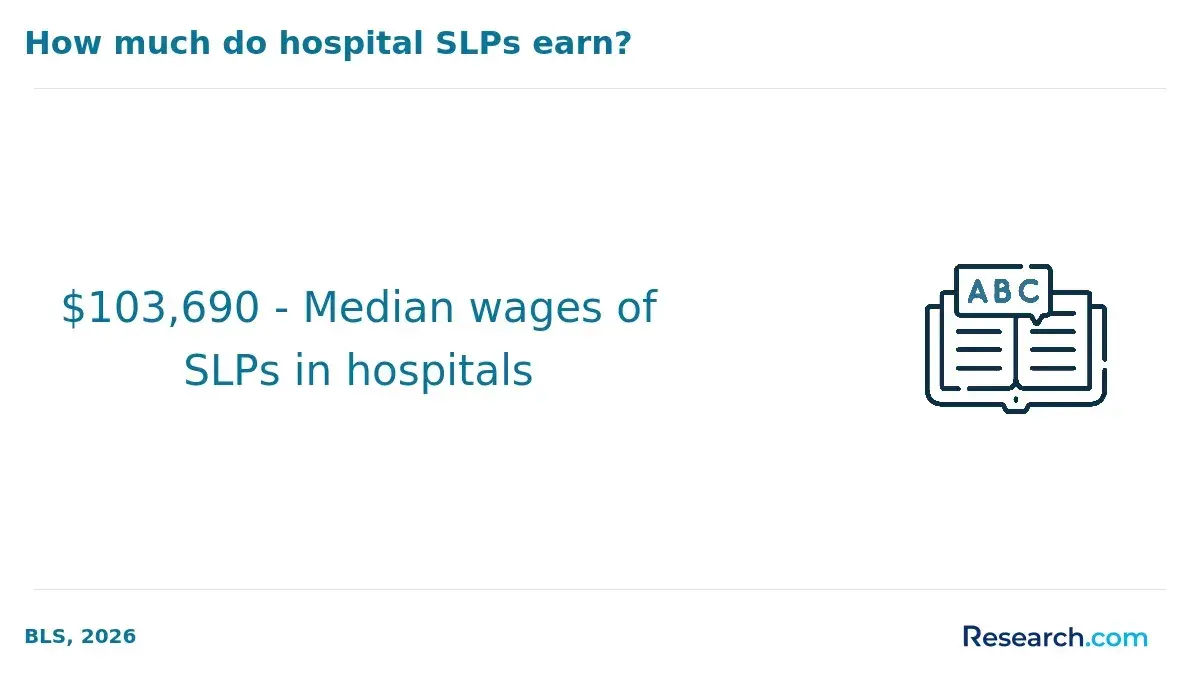
Career return should be evaluated realistically. The national median annual wage for speech-language pathologists was $97,870 in May 2025, according to the U.S. Bureau of Labor Statistics. That statistic is useful for broad career context, but it is not a starting-salary estimate, a California-specific wage, or a promise of individual earnings. Setting, experience, schedule, local labor demand, and benefits can produce very different results.
What admission prerequisites and competitiveness characterize top online speech pathology programs today?
Many online SLP master's programs admit students with communication sciences and disorders backgrounds, while some accept applicants from other majors who complete designated leveling coursework. Prerequisites commonly cover phonetics, speech and hearing science, anatomy and physiology of speech and hearing mechanisms, language development, audiology, speech disorders, language disorders, and research or statistics.
Admissions are competitive because programs must manage class size, clinical capacity, faculty supervision, and progression standards. A strong application usually demonstrates academic readiness, understanding of the profession, relevant observation or service exposure, thoughtful recommendations, and a credible plan for completing clinical obligations.
Applicants should compare published requirements rather than treating any one number as a universal standard.
| Application component | What schools commonly evaluate | What Moreno Valley applicants should do |
| Undergraduate record | Overall academic performance and performance in relevant prerequisite courses | Calculate both overall and prerequisite GPA if the school requests both |
| Prerequisite completion | Whether foundational CSD coursework is complete or can be completed before enrollment | Request a transcript review early; do not self-assume course equivalencies |
| Observation or field exposure | Knowledge of clinical practice and professional expectations | Document experiences accurately and follow each program's verification rules |
| Recommendations | Academic capability, communication skills, professionalism, and readiness for graduate work | Ask recommenders early and provide a résumé and goal statement |
| Personal statement | Career motivation, reflection, writing ability, and fit with the program | Address clinical realities and your plan for meeting in-person requirements |
| Interview or supplemental assessment | Communication, judgment, and program fit when required | Prepare to discuss ethics, teamwork, accessibility, and clinical scheduling |
The Graduate Record Examination is not uniformly required; schools set their own policies and may revise them. Likewise, a published minimum GPA is usually an eligibility threshold, not a prediction of admission. Ask whether the school uses holistic review, whether leveling students are evaluated separately, and whether admitted-student profile information is published.
Applicants changing careers should avoid rushing into a master's application without first mapping prerequisites. A deliberate sequence of leveling courses can strengthen readiness and reduce the risk of entering an intensive clinical program without the scientific and linguistic foundation needed for success.
How can Moreno Valley residents verify accreditation, state authorization, and consumer protections?
Verification should occur before applying and again before paying a nonrefundable deposit. Accreditation, state authorization, tuition, and program availability can change, especially when institutions revise distance-education agreements or clinical-placement policies.
Use this verification process to create a written record for every program on your shortlist.
- Search the ASHA CAA directory for the exact degree program, campus or delivery pathway, and current accreditation status.
- Read the university's professional-licensure disclosure for California and save a copy showing the date accessed.
- Ask admissions whether new applicants residing in California are currently eligible to enroll in your intended cohort.
- Contact clinical education staff to ask how placements are arranged, what travel may be required, and whether they currently support California placements.
- Review the university's refund, withdrawal, complaint, transfer-credit, and grievance policies before submitting a deposit.
- Check the California licensing board's current requirements independently and compare them with the school's disclosure.
- Keep all important answers in email or another written format, including the name and title of the school representative.
Consumer protection matters because a verbal assurance from a recruiter may not capture a formal policy. If an institution says it "prepares students for certification," ask the more precise question: "Does this specific program meet the educational requirements for California SLP licensure for a student beginning in my cohort?"
Be cautious when a school cannot identify required travel, does not explain who arranges placements, or uses broad language instead of a California-specific disclosure. Also avoid assuming that an out-of-state institution's authorization to teach online in California means that its SLP curriculum meets every California professional requirement.
For career planning beyond graduation, it can also help to understand where do SLPs make the most money. Use compensation information as a research tool rather than a reason to overlook licensure fit, clinical quality, or debt exposure.
What career outcomes and employment settings do California-trained online SLP graduates typically achieve?
Graduates of qualifying SLP master's programs may pursue work across healthcare, education, rehabilitation, and private practice after meeting applicable California licensure and employer requirements. The degree format itself should not define professional scope; the key considerations are accredited preparation, documented clinical competence, licensure, and the employer's hiring standards.
The national labor market supports careful investment in the profession. The U.S. Bureau of Labor Statistics projects 17% growth in speech-language pathologist employment from 2025 to 2035 and approximately 12,500 openings each year on average over the decade. For applicants, this signals sustained demand, but it does not eliminate regional competition or guarantee a specific job, schedule, or salary.
Common employment settings offer different trade-offs in client population, schedule, documentation, and compensation structure.
| Employment setting | Typical focus | Decision consideration |
| Public and private schools | Speech, language, social communication, literacy-related communication, and educational access | School calendars can be attractive, but California credential and district requirements may apply |
| Hospitals and medical centers | Acute care, swallowing, cognition, voice, neurological conditions, and discharge planning | May require comfort with medically complex patients and variable schedules |
| Outpatient clinics | Pediatric or adult therapy across communication and swallowing needs | Schedules can include afternoons or evenings, depending on client demand |
| Skilled nursing and rehabilitation facilities | Adult neurogenic communication, cognition, swallowing, and rehabilitation | Productivity expectations and caseload structure should be reviewed carefully |
| Early intervention and home-based services | Family-centered services for infants and young children | Travel time, contractor status, and caseload geography can affect take-home income |
| Private practice and telepractice | Direct services, consultation, specialized services, or business ownership | Requires attention to licensure, payer rules, privacy, business operations, and supervision requirements |
Technology is changing practice without replacing clinical judgment. SLPs increasingly use telepractice platforms, digital therapy materials, electronic health records, augmentative and alternative communication tools, and data-tracking systems. Graduates should be prepared to evaluate technology ethically, protect client privacy, and adapt treatment to each person rather than relying on automated tools.
Online graduates can be competitive when they can clearly explain their clinical preparation, demonstrate strong documentation and collaboration skills, and show readiness for the population or setting they seek. During school, prioritize diverse supervised experiences, professional references, and careful records of competencies rather than assuming the online format alone will determine employability.
Other Things You Should Know About Speech Language Pathology
Some students work during early academic terms, particularly when courses are asynchronous. However, practicum and externship terms commonly require daytime availability, preparation time, documentation, and travel. Ask each program for a term-by-term sample schedule before assuming full-time employment is realistic.
Not always. Some programs accept students from other majors, but they usually require leveling coursework before or during graduate study. The required courses, time, cost, and sequence vary by school, so request an official transcript evaluation.
No program can guarantee statewide employment. A qualifying degree is one part of the process; graduates must meet California licensing requirements and any employer-specific standards. School-based positions may involve additional education credential requirements.
Begin planning at least a year before the intended start term when possible. This provides time to finish prerequisites, arrange observations, request recommendations, compare California disclosures, and build a realistic plan for clinical-placement availability and financing.
References
- Best Online Master's in Speech-Language Pathology for 2026 https://healthscience.pepperdine.edu/online-masters-in-speech-language-pathology/article/best-online-masters-in-speech-language-pathology-programs-guide.htm
- Best Speech-Language Pathology Programs in America https://www.usnews.com/best-graduate-schools/top-health-schools/pathology-rankings
- 2026 Most Affordable Online Speech Pathology Master's... https://www.onlineu.com/most-affordable-colleges/speech-pathology-masters-degrees
- Online Master's in Speech Pathology Programs: 2026 Guide https://speechpathologymastersprograms.com/
- Best Online MSLP Programs with No GRE Required for 2026 https://www.speechpathologydegrees.com/online/mslp-no-gre-required