2027 Best Online Speech Pathology Master's Programs for Residents of Portland, OR

Co-Founder and Chief Data Scientist

Reviewed by Rhea Paul, PhD
SLP Education & Research Expert
Choosing an online speech-language pathology master's program from Portland is less about finding a school with "online" in its description and more about confirming Oregon eligibility, CAA accreditation, clinical-placement support, and licensure alignment before applying.
This guide compares practical options and explains the questions that matter most for Oregon-bound clinicians. It is designed for career changers, communication-sciences graduates, and working professionals who need a path to SLP practice without assuming an online format eliminates travel or clinical requirements.
Key Things You Should Know
- For Oregon SLP licensure, prioritize a master's degree from a program accredited by the ASHA Council on Academic Accreditation (CAA), then confirm the school's Oregon-specific professional-licensure disclosure before enrolling.
- Online SLP master's programs still require extensive supervised clinical education; Portland students should not assume a program can place them locally unless the school confirms its placement process and Oregon-site availability in writing.
- The U.S. Bureau of Labor Statistics reports a $97,870 median annual wage for speech-language pathologists in May 2025 and projects 17% employment growth from 2025 to 2035, but licensing and successful clinical training - not program convenience alone - determine whether the degree can lead to practice.
Which online speech pathology master's programs actually enroll Portland, Oregon residents?
Portland residents can consider established distance-delivery SLP programs, but enrollment eligibility can change with state authorization, clinical capacity, and a school's cohort policies. "Available online" does not automatically mean a program is currently accepting Oregon residents or can support Oregon-based practica.
The programs below are examples of nationally known online or distance-delivered master's pathways that prospective Oregon students commonly evaluate. Before submitting an application, ask each program to confirm in writing that it is accepting new Oregon residents for your intended start term and that it can support Oregon licensure planning.
| Program | Online-format consideration | Why a Portland applicant may consider it | Important confirmation before applying |
| Emerson College, MS in Speech-Language Pathology | Distance-delivery curriculum with clinical education and required experiential components. | Often considered by applicants seeking a structured online cohort model. | Current Oregon enrollment authorization, required immersions, live-session schedule, and clinical-placement process. |
| Baylor University, MS in Communication Sciences and Disorders | Online SLP pathway with synchronous and clinical-training expectations. | May fit students who want a cohort-based graduate experience and centralized clinical coordination. | Current Oregon availability, required travel, placement timeline, and prerequisite expectations. |
| New York University, MS in Communicative Sciences and Disorders | Online delivery may include live coursework, fieldwork, and program-specific experiential requirements. | May appeal to applicants seeking an academically intensive program with distance access. | Oregon professional-licensure disclosure, fieldwork arrangements, and total required travel. |
| University of St. Augustine for Health Sciences, MS-SLP | Hybrid or distance-oriented delivery may include hands-on sessions and clinical rotations. | May suit applicants who can accommodate scheduled immersive learning. | Whether Oregon residents are eligible for the selected cohort and where immersive sessions occur. |
These are not interchangeable choices. A school may be a stronger fit when its class times work in Pacific Time, its clinical office has experience coordinating Oregon placements, and its travel schedule is realistic for your employment and caregiving obligations. Explore broader online SLP programs after narrowing your list to schools that provide clear Oregon-specific disclosures.
A common mistake is applying only to programs with recognizable names and learning later that a cohort is closed to Oregon residents or that a required immersion conflicts with work. Ask about state eligibility before paying an application fee whenever possible.
How do Portland-eligible online speech pathology programs meet ASHA CAA accreditation standards?
CAA accreditation is the central quality and licensure-screening standard for entry-level SLP education in the United States. The Council on Academic Accreditation in Audiology and Speech-Language Pathology evaluates whether a program meets standards for curriculum, faculty, student assessment, resources, and clinical education.
For a Portland applicant, the critical distinction is between institutional accreditation and programmatic CAA accreditation. A university can be regionally or institutionally accredited while its specific SLP master's program is not CAA-accredited. That distinction can materially affect ASHA certification eligibility and Oregon licensure options.
| CAA-related item | What it indicates | Why it matters in Oregon |
| Accredited status | The program has met CAA standards and is subject to continuing review. | This is generally the most straightforward educational route for future Oregon SLP licensure and ASHA certification planning. |
| Candidacy status | A newer program is progressing through CAA review but is not the same as fully accredited status. | Applicants should ask how candidacy affects their graduating cohort and confirm the implications with the Oregon licensing board. |
| Accreditation decision date | The date through which a status or review decision applies. | Status can change, so applicants should check the current CAA listing rather than rely on an older program webpage. |
| Clinical education requirements | Standards addressing supervised learning and competency development. | They explain why an online degree still requires in-person client contact and qualified supervision. |
CAA standards do not mean every online program uses the same instructional design. One school may use frequent live classes, another may rely more heavily on asynchronous coursework, and another may require several campus immersions. Compare those delivery decisions separately from accreditation.
When evaluating ASHA accredited online SLP programs, verify the program's current listing directly through ASHA's CAA directory and ask whether accreditation applies to the exact degree format and cohort you would enter. Do not rely solely on a marketing statement that a school is "ASHA aligned."
Which online speech pathology master's programs best support Oregon SLP licensure and SLPA pathways?
An online master's degree is appropriate for an Oregon SLP licensure path only when its education and clinical-training structure supports the Oregon Board of Examiners for Speech-Language Pathology and Audiology requirements in effect when you apply. Programs can explain their curriculum, but the licensing board determines licensure requirements.
For the full SLP pathway, students generally need a qualifying graduate degree, supervised clinical education, the required examination, and post-graduate supervised professional experience or another board-accepted route. ASHA's Certificate of Clinical Competence is widely recognized by employers, but applicants should treat Oregon licensure and ASHA certification as related yet distinct processes with their own requirements.
SLPA is a different profession and should not be viewed as a shortened version of the SLP master's pathway. Oregon speech-language pathology assistants work within a supervised scope of practice and face separate education, registration or licensure, and supervision requirements. A person seeking independent diagnosis, treatment planning, and full SLP practice should plan for the CAA-accredited graduate-degree route.
| Goal | Typical education direction | Best program-screening question |
| Become an Oregon SLP | CAA-accredited entry-level graduate SLP degree plus applicable Oregon licensure steps. | Does the program's Oregon disclosure state that its curriculum is designed to meet educational requirements for Oregon SLP licensure? |
| Work as an Oregon SLPA | Board-accepted assistant preparation or qualifying academic pathway, depending on current state rules. | Does this course sequence meet Oregon's current SLPA educational and clinical requirements? |
| Build experience before graduate school | Relevant support, education, research, or rehabilitation roles that do not exceed an unlicensed scope. | Will this role provide useful exposure without being presented as a substitute for graduate clinical preparation? |
Applicants who already have an out-of-field bachelor's degree should compare prerequisite plans carefully. Some programs expect foundational coursework in phonetics, language development, anatomy and physiology, audiology, statistics, and related subjects before enrollment; others build some preparation into their curriculum. The latter can be convenient, but it may lengthen the degree and increase total cost.
How do leading online speech pathology programs differ in clinical placements near Portland?
Clinical placements are usually the deciding factor for Portland students. A school may deliver lectures online, but graduate SLP education requires supervised direct clinical work with clients. Those hours can occur in university clinics, schools, hospitals, early-intervention programs, skilled nursing settings, or other approved sites depending on the program and student's progression.
Programs generally use one of two models: the school identifies and approves placements, or the school asks students to help identify potential sites while retaining final approval authority. Neither model is automatically better. The safer choice is the one that clearly explains responsibility, contingency planning, travel expectations, and what happens if a site falls through.
| Clinical-placement model | Potential advantage for Portland students | Risk to investigate |
| School-coordinated placement | May reduce the burden of initiating site outreach and managing affiliation agreements. | Placement location may be outside Portland or Oregon if local capacity is limited. |
| Student-assisted placement search | May let a student suggest sites near home, work, or a target population. | Local contacts do not guarantee site approval, supervisor availability, or an executed affiliation agreement. |
| Hybrid placement approach | Combines student location knowledge with centralized review and contracting. | Responsibilities can be unclear unless the program provides a written timeline and escalation process. |
Ask each clinical education office for concrete answers before accepting an offer. The following questions help expose placement risk early.
- Does the program currently place students in the Portland metropolitan area or elsewhere in Oregon, without guaranteeing any individual location?
- Who contacts potential sites, secures affiliation agreements, and confirms that supervisors meet program requirements?
- How far might I be expected to travel, and could I need to complete a rotation outside Oregon?
- Can I keep a full-time job during external practica, or are daytime weekday hours normally required?
- What support is available if a placement is delayed, cancelled, or unavailable in my preferred specialty?
Do not select a program solely because it says placements are "supported nationwide." That phrase describes a process, not a promise of a Portland placement. A written answer from clinical education staff is more useful than a general admissions assurance.
What are the key admission requirements for Portland residents applying to online SLP master's programs?
Admission requirements vary significantly, especially for applicants whose bachelor's degree is not in communication sciences and disorders. Most competitive programs review academic preparation, communication skills, readiness for clinical work, and the ability to complete demanding supervised experiences - not just a cumulative GPA.
Common requirements include an undergraduate degree, transcripts, prerequisite coursework or a leveling plan, recommendation letters, a personal statement, résumé, and an interview or recorded response when requested. Programs may use CSDCAS, their own application system, or both. GRE policies vary and can change by admissions cycle.
| Application component | What Portland applicants should prepare | Frequent error |
| Academic prerequisites | Course descriptions and transcripts that show completed foundational CSD coursework and required general education subjects. | Assuming a psychology, education, linguistics, or healthcare degree automatically covers all prerequisites. |
| Personal statement | A specific explanation of clinical interests, readiness for graduate study, and fit with the program's delivery model. | Writing only about wanting to help people without addressing preparation, experiences, or professional goals. |
| Recommendations | Referees who can discuss academic ability, professionalism, communication, and follow-through. | Asking acquaintances who know the applicant personally but cannot evaluate graduate-level readiness. |
| Observation or exposure | Any program-required observation documentation and relevant ethical exposure to the profession. | Representing shadowing as hands-on clinical experience or relying on outdated observation records. |
| Interview readiness | Examples showing cultural humility, ethical judgment, adaptability, and realistic understanding of clinical training. | Focusing only on online convenience rather than client care and professional responsibilities. |
Apply early enough to resolve missing prerequisites, references, transcripts, and state-eligibility questions. Applicants changing careers often benefit from taking a formal post-baccalaureate sequence first when it creates a clearer academic record and avoids a rushed application.
If rapid completion is important, compare the calendar honestly rather than focusing on an advertised minimum. An accelerated speech pathology programs online may reduce time in coursework, but clinical rotations, prerequisite gaps, and required immersions can still limit how quickly an individual student finishes.
How do tuition, fees, and total costs compare across top online SLP programs for Portland students?
For Portland residents, the relevant cost is not simply tuition per credit. Compare the estimated full program cost after required fees, residency travel, technology, background checks, liability coverage, books, clinical supplies, health requirements, and possible income reduction during full-time practica.
Online SLP programs often publish tuition by credit, by term, or by academic year, while required credits and fees differ across schools. Because those figures are not directly equivalent, use each university's current tuition page and ask for a written cost estimate for your anticipated cohort rather than ranking programs by a single advertised rate.
| Cost category | Why it changes the comparison | What to request from the school |
| Tuition | Programs may charge by credit, term, or cohort and may change rates annually. | Total required credits and the tuition basis applicable to your expected entry term. |
| Mandatory university fees | Technology, student services, clinical, or graduation fees can add materially to tuition. | A list of recurring and one-time mandatory charges. |
| Travel and immersions | Flights, lodging, meals, and ground transportation may be student-paid. | Number, location, duration, and estimated timing of all required visits. |
| Clinical expenses | Compliance items and transportation can be substantial during practica. | Expected costs for screenings, immunizations, background checks, insurance, and site travel. |
| Opportunity cost | External placements may make full-time work impractical for part of the program. | A typical weekly clinical schedule and whether evening or weekend placements are realistic. |
Build a conservative budget that assumes at least one unplanned clinical or travel expense. Financial aid can include federal student loans for eligible students, scholarships, employer assistance, and service-related opportunities, but availability and eligibility vary. Compare borrowing needs against a realistic repayment plan rather than assuming future earnings will make any debt level manageable.
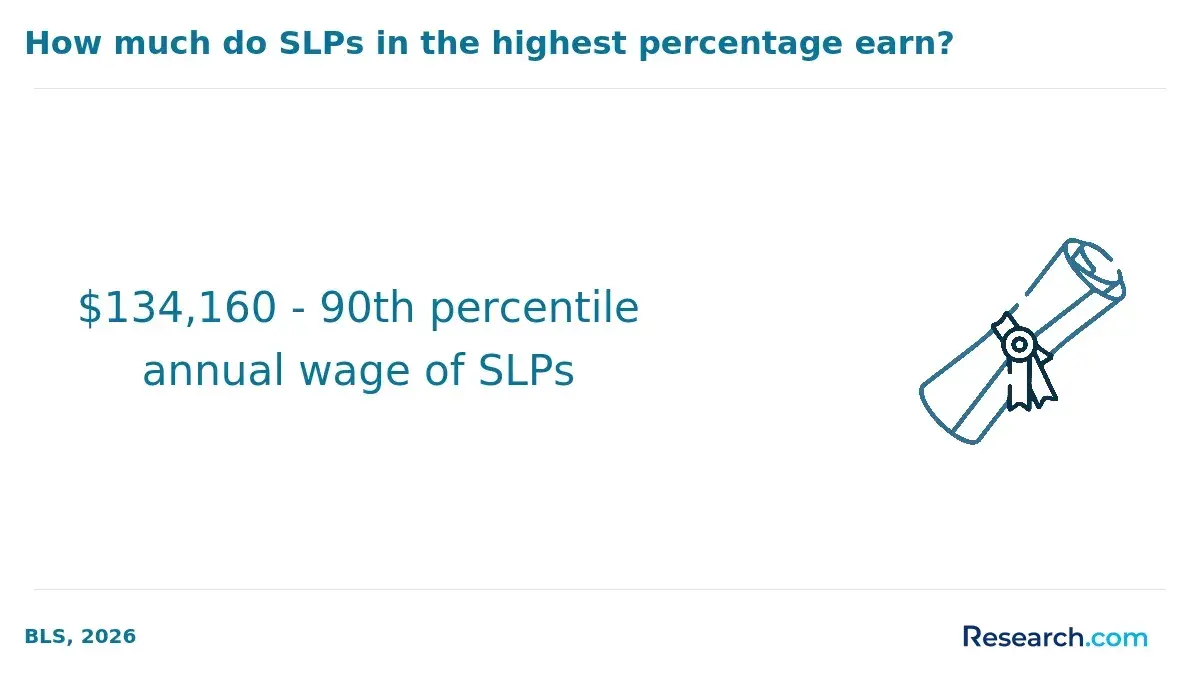
The national median annual wage for speech-language pathologists was $97,870 in May 2025, according to the U.S. Bureau of Labor Statistics. That is useful context for long-term earning potential, but it is not an Oregon starting-salary estimate and should not be treated as a personal salary guarantee. Readers evaluating return on investment can also review how much do speech therapists make across different work settings and career paths.
Which online speech pathology programs report the strongest Praxis pass rates and employment outcomes?
Praxis pass rates, completion rates, and employment outcomes can help distinguish programs, but only when the numbers are comparable. A single high percentage is less informative if the school does not identify the reporting period, cohort size, first-time versus eventual pass rate, or whether the figure includes all graduates.
CAA-accredited programs publish outcome information under accreditation-related reporting expectations. Portland applicants should review the most recent program-specific disclosures and use them to ask better questions rather than treating any outcome rate as a guaranteed result.
| Outcome measure | What to look for | How to use it |
| Praxis examination performance | Reporting period, number of test takers, and whether the figure reflects first-time or eventual passing. | Look for transparency and consistency over multiple reporting periods, not just a headline claim. |
| Program completion | Number starting, number completing, timeframe, and treatment of leaves or transfers. | Consider whether the schedule and support model appear workable for students with similar obligations. |
| Employment rate | Definition of employment, timing after graduation, response rate, and relevant job field. | Ask whether graduates commonly obtain clinical fellowship positions in Oregon or the Pacific Northwest. |
| Attrition information | How the program describes withdrawals, academic progression, and remediation. | Use it to ask about advising, clinical remediation, and contingency support. |
The broader labor market supports careful career planning. The BLS projects 17% employment growth for speech-language pathologists from 2025 to 2035 and about 12,500 openings per year on average over that period. Strong demand does not remove the need to obtain licensure, complete a clinical fellowship where required, and compete for positions in preferred settings.
Ask admissions or program-outcomes staff for the newest disclosure, not a verbal summary. If a school cannot explain how it calculates an outcome figure, treat that as a transparency concern rather than filling in assumptions yourself.
How do state authorization and distance-education reciprocity agreements affect Portland SLP applicants?
State authorization concerns whether a college is permitted to deliver distance education to residents of a state. Professional-licensure disclosures address whether a program's curriculum is designed to meet educational requirements for a regulated profession in a particular state. Portland applicants need both answers.
Distance-education reciprocity arrangements can make it easier for participating institutions to offer education across state lines, but participation does not replace a program's professional-licensure disclosure. It also does not obligate an Oregon clinical site to accept a student or guarantee that a school can arrange local supervision.
| Issue | What it does not establish | What to verify |
| School accepts online students nationwide | That Oregon residents are eligible for your program and cohort. | Oregon-specific enrollment eligibility for the intended start date. |
| Institution participates in reciprocity | That the SLP curriculum meets Oregon professional-licensure educational requirements. | The school's Oregon SLP licensure disclosure and any stated limitations. |
| Program is CAA-accredited | That every Oregon clinical placement can be arranged near your home. | The clinical education process, travel expectations, and supervisor requirements. |
| Graduate is ASHA-eligible | Automatic Oregon licensure. | Current Oregon board requirements at the time you seek licensure. |
Keep copies of the program's Oregon disclosure, catalog year, clinical handbook, and email confirmations. Rules, policies, and authorization status can change while you are enrolled, and contemporaneous written records make it easier to understand what the school represented for your cohort.
What should Portland residents verify about online SLP programs' accreditation, practicum sites, and supervision?
Before committing to an online SLP master's program, Portland applicants should complete a written verification process. This protects against the most expensive mistake in distance clinical education: enrolling before confirming that the program, state, and placement model work together.
Use the following checklist in conversations with admissions, clinical education staff, and the Oregon licensing board.
- Confirm that the exact master's program and delivery format have current CAA accreditation or clearly understood candidacy status.
- Ask the university to confirm that new Oregon residents may enroll in your intended cohort.
- Request the school's current Oregon professional-licensure disclosure and compare it with current Oregon board requirements.
- Obtain a written explanation of who secures clinical placements, whether students assist, and what geographic travel may be required.
- Ask whether the program has recently placed students in Oregon, while recognizing that past placements do not guarantee your placement.
- Identify every required campus visit, immersion, live class, and Pacific Time scheduling expectation.
- Request total estimated tuition, mandatory fees, clinical costs, and travel costs for your expected completion timeline.
- Review the latest published Praxis, completion, and employment disclosures with attention to cohort size and reporting definitions.
Red flags include vague statements that a school is "available everywhere," promises that you will definitely receive a nearby placement, missing professional-licensure disclosures, and outcome claims without dates or denominators. A responsive program should be able to explain its process even when it cannot promise a particular site or schedule.
How can Portland professionals choose between online speech pathology master's and local campus options?
Portland professionals should choose between an online program and a local campus option based on clinical logistics, not just commute time. Online learning can reduce relocation pressure and offer flexibility during didactic coursework. A local campus program may offer more direct access to university clinics, regional faculty networks, and established relationships with nearby practicum sites.
| Choose an online or hybrid program when | Choose a local campus option when |
| You need to remain in Portland and the program confirms Oregon eligibility and a workable clinical-placement plan. | You value regular in-person faculty access, on-campus clinic experience, or established local placement networks. |
| You can manage required synchronous sessions, immersions, and clinical rotations alongside your responsibilities. | You prefer face-to-face classes and can attend daytime campus-based learning consistently. |
| You have compared total travel and fee costs rather than assuming online delivery is less expensive. | The overall cost, commute, and local support make the campus pathway more practical. |
| You are comfortable with remote collaboration and proactive communication with faculty and clinical coordinators. | You learn best through frequent in-person interaction and immediate access to campus services. |
For many applicants, the best program is not the fastest or most recognizable one. It is the CAA-accredited program that will accept an Oregon resident, fits the student's prerequisite background and budget, clearly explains its clinical-placement responsibilities, and supports a credible Oregon licensure plan.
Make a final comparison spreadsheet using the same fields for every school: accreditation status, Oregon eligibility, prerequisite gaps, required travel, live-class times, clinical model, estimated total cost, outcomes disclosure, and application deadline. If one program cannot provide a clear answer to a field that matters to you, treat the uncertainty itself as part of the decision.
Other Things You Should Know About Speech Language Pathology
Potentially, but the degree must support Oregon's current licensing requirements, and you still must complete in-person supervised clinical education. Verify the program's CAA status, Oregon eligibility, and professional-licensure disclosure before enrolling.
Some programs coordinate placements, while others require students to help identify sites. No applicant should assume a Portland placement is guaranteed. Ask the clinical education office how sites are secured, what travel may be required, and whether it has recently supported Oregon students.
Not always. Career changers may be eligible after completing prerequisite or leveling coursework. Requirements differ by program, so compare the exact courses you need, how long they take, and whether they are included in the graduate curriculum.
Some students work during early coursework, but daytime clinical practica and external rotations can make full-time employment difficult later in the program. Ask for a typical weekly schedule by term and plan finances around the most demanding clinical periods.
References
- Master of Science in Speech-Language Pathology (M.S.) https://delval.edu/programs/graduate-programs/speech-language-pathology
- 2026 Most Affordable Online Speech Pathology Master's... https://www.onlineu.com/most-affordable-colleges/speech-pathology-masters-degrees
- Best Online Speech Pathology Programs https://www.forbes.com/advisor/education/healthcare/best-speech-pathology-programs-online/
- Online Master's in Speech Pathology Programs: 2026 Guide https://speechpathologymastersprograms.com/
- Best Speech-Language Pathology Programs in America https://www.usnews.com/best-graduate-schools/top-health-schools/pathology-rankings