2027 Best Online Speech Pathology Master's Programs for Residents of Little Rock, AR

Co-Founder and Chief Data Scientist

Reviewed by Rhea Paul, PhD
SLP Education & Research Expert
Little Rock residents can complete much of a speech-language pathology master's degree online, but the right program must do more than offer remote classes. It needs CAA accreditation, permission to enroll Arkansas students, a workable clinical-placement process, and a curriculum that supports Arkansas licensure.
This guide compares practical online and hybrid options, explains the checks that matter before applying, and helps you weigh travel, tuition, pacing, and local practicum realities before making a commitment.
Key Things You Should Know
Which online speech pathology master's programs accept Little Rock residents and deliver all coursework remotely?
Little Rock applicants should treat "online" as a delivery description, not a licensure guarantee. A strong candidate program should confirm in writing that it can enroll Arkansas residents for the intended start term, has CAA accreditation, and will support required clinical education in Arkansas or a mutually workable nearby location.
The following programs are commonly considered by students seeking distance-accessible CAA-accredited SLP education. Enrollment eligibility, tuition, curricular requirements, travel, and clinical-placement policies can change by cohort, so applicants should obtain current confirmation directly from each institution before paying an application fee or deposit.
| Program | Distance-learning model | What Little Rock applicants should verify | Potential fit |
| Emerson College - MS in Speech-Language Pathology | Online coursework with clinical experiences arranged in approved settings; program requirements may include live participation and clinical travel. | Arkansas enrollment authorization, current residency requirements, placement availability, total tuition and fees. | Students seeking a structured online cohort and willing to complete clinical experiences on the program's schedule. |
| New York University - MS in Communicative Sciences and Disorders | Online graduate coursework paired with supervised field placements and required program experiences. | Arkansas professional-licensure disclosure, immersion or travel requirements, placement process, live-session timing in Central Time. | Applicants who want an established online pathway and can plan early for clinical logistics. |
| Baylor University - MS in Communication Sciences and Disorders | Online academic content with clinical practica and internships completed in approved settings. | Arkansas eligibility, travel expectations, clinical-site coordination, whether personal work sites can be considered. | Students who value a cohort format and can accommodate intensive clinical scheduling. |
| Arkansas State University - MS in Communication Disorders | Distance-accessible coursework with clinical education requirements that may involve campus or regional obligations. | Current online availability by cohort, Jonesboro travel, clinical placement model, and Arkansas licensure alignment. | Arkansas residents who prefer an in-state institution and can meet any in-person requirements. |
None of these programs should be called universally "best." The best fit depends on whether the school can enroll you in Arkansas, whether its clinical model works with your life and employment constraints, and whether you can afford the total program cost rather than only the advertised per-credit rate.
Applicants comparing online masters speech pathology options should also separate published tuition from costs for background checks, technology, travel, housing during intensives, health documentation, liability coverage, and unpaid practicum time.
How do Arkansas licensure rules shape which online speech pathology degrees Little Rock students should choose?
Arkansas licensure should drive the program choice. For independent practice as a speech-language pathologist, a prospective applicant generally needs a qualifying graduate degree, supervised clinical education, a passing Praxis score, and completion of the post-graduate clinical fellowship requirements administered under Arkansas rules. Requirements can change, and the Arkansas Board of Examiners in Speech-Language Pathology and Audiology is the authority that determines eligibility.
CAA accreditation is particularly important because it supports the educational pathway commonly expected for ASHA certification and state licensure. A master's degree with a similar-sounding title, a general linguistics degree, or an unaccredited communication-disorders program may not satisfy Arkansas's professional preparation standards.
Before applying, ask every program for a current Arkansas-specific professional licensure disclosure. The answer should identify whether the institution has determined that its curriculum meets Arkansas educational requirements, whether it has made no determination, or whether it cannot enroll Arkansas residents. Do not treat a general statement that graduates "may pursue licensure" as a state-specific confirmation.
Applicants should also confirm how missing prerequisites will be handled. Students without an undergraduate degree in communication sciences and disorders often need leveling coursework before or alongside graduate study. That can add cost and time, so an apparently short program may not be the fastest route for a career changer. Readers focused on speed should compare the actual prerequisite sequence, cohort calendar, and clinical availability when reviewing accelerated speech pathology programs.
Which accredited online speech pathology programs offer clinical placements accessible from Little Rock and nearby communities?
A program may help identify clinical sites, require students to assist with site development, or use a shared model. The distinction matters in Little Rock, where school districts, hospitals, rehabilitation facilities, pediatric clinics, early-intervention providers, and skilled-nursing settings can be potential training environments but are not automatically available to every distant-learning student.
CAA-accredited online programs generally require supervised clinical education sufficient to meet professional standards, including a minimum of 400 total clock hours of supervised clinical experience across graduate preparation, with at least 375 hours at the graduate level. Programs determine when students are ready for each placement and must approve sites and supervisors; students cannot independently arrange an internship and assume it will count.
This comparison identifies the placement questions that reveal whether an online program is genuinely practical from central Arkansas:
| Clinical-placement question | Why it matters in Little Rock | Helpful answer | Red flag |
| Who secures placements? | Local demand for supervisors can make self-placement difficult. | The program explains its placement team's role, timelines, and contingency plan. | The school only says that students are "encouraged" to find sites. |
| Can placements occur in Arkansas? | Out-of-state placement can create travel, housing, and licensing complications. | The program confirms Arkansas placements are permitted when approved. | The school will not discuss geographic feasibility before enrollment. |
| Can a student use an employer site? | Working adults may hope to remain employed while training. | The site may be considered but must meet independence, supervision, and learning requirements. | Any promise that an employer site will automatically qualify. |
| Are placements full-time? | Internships can conflict with work and caregiving responsibilities. | The program provides expected weekly schedules and clinical-semester calendar dates. | Clinical workload is described only as "flexible." |
Ask for examples of the types of settings used for Arkansas learners, not names of facilities or promises of a particular site. Privacy, contracts, supervisor availability, and a student's readiness all affect assignment decisions. A school that transparently explains those limits is more credible than one that guarantees a convenient placement.
What institutional and programmatic accreditations must an online speech pathology master's hold for Arkansas SLP licensure?
The critical programmatic credential is accreditation by the American Speech-Language-Hearing Association's Council on Academic Accreditation in Audiology and Speech-Language Pathology, usually called CAA accreditation. Institutional accreditation also matters because it establishes that the university itself is recognized by an institutional accreditor accepted by the U.S. Department of Education or the Council for Higher Education Accreditation.
These credentials serve different purposes. Institutional accreditation supports the legitimacy of the university and federal-aid eligibility, while CAA evaluates the professional program's curriculum, faculty, assessment, clinical education, and resources. For a future Arkansas SLP, institutional accreditation alone is not enough.
Use the following distinctions when interpreting a school's claims:
| Credential or status | What it indicates | How to use it |
| CAA accredited | The graduate SLP program has been accredited by ASHA's specialized accreditor. | Usually the preferred status for students pursuing ASHA certification and state licensure pathways. |
| CAA candidacy | A developing program is working toward accreditation and is subject to CAA conditions. | Ask exactly how candidacy applies to your entering cohort and obtain the answer in writing. |
| Institutionally accredited university | The institution meets broad academic and administrative standards. | Necessary but not a substitute for CAA programmatic accreditation. |
| "Aligned with ASHA standards" | A marketing or curricular statement that may not indicate accredited status. | Verify the program in ASHA EdFind and do not rely on wording alone. |
A program's accreditation can be subject to reporting cycles, conditions, or changes in status. Check the CAA directory close to application submission and again before enrolling, especially if you are considering a new online track or a program described as "seeking" accreditation.
How do featured online speech pathology programs compare on cost, clinical hours, and time to Arkansas licensure?
Cost and completion time are most useful when they are compared on the same basis. Published tuition can exclude mandatory fees, leveling courses, travel, and the income lost or reduced during full-time clinical internships. Likewise, an advertised completion timeline begins only after prerequisites and does not include the post-degree clinical fellowship required for independent practice.
The table below compares the decision variables that matter most; where a standardized figure is not consistently published, applicants should request a written cost-of-attendance estimate for their cohort.
| Comparison factor | What to expect | Decision impact for Little Rock residents |
| Academic program tuition | Varies substantially by institution, residency classification, credit load, and annual tuition changes. | Request total required-program tuition, not only per-credit tuition. |
| Clinical education | CAA standards include at least 400 supervised clinical clock hours overall, including at least 375 graduate-level hours. | Confirm where hours may be completed and whether travel or temporary housing may be necessary. |
| Master's completion pace | Many cohort-based programs take roughly two years of continuous full-time study after prerequisites, though individual structures vary. | Part-time work may become difficult during practicum and internship semesters. |
| Post-degree clinical fellowship | A supervised fellowship is typically required before full independent practice and ASHA certification. | Plan for a separate employment and supervision search after graduation. |
| Licensure examination | Applicants must meet Arkansas requirements, which commonly include a qualifying Praxis score. | Confirm the current required score and application sequence with the Arkansas licensing board. |
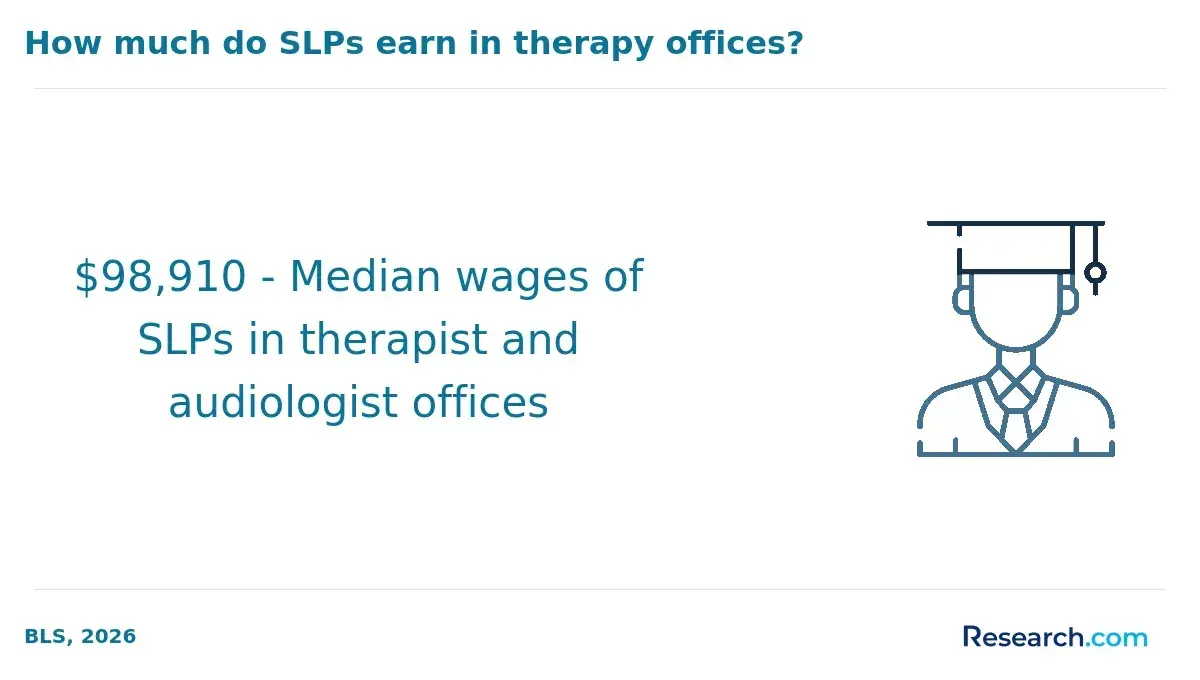
For career context, the U.S. Bureau of Labor Statistics reports a $97,870 median annual wage for speech-language pathologists in May 2025. That national figure is not a starting-pay estimate and does not predict pay in Little Rock; workplace, experience, setting, caseload, and benefits can produce meaningful variation. Specialized settings may pay differently, so prospective students can also explore how role selection affects a NICU SLP salary and other advanced-career compensation discussions.
The most economical option is often the one that avoids an extra semester, unsupported relocation, or a delayed clinical placement—not necessarily the program with the lowest listed tuition.
Which online speech pathology programs have state authorization or SARA approval to enroll Arkansas residents?
State authorization answers whether an institution may offer distance education to a resident of Arkansas. It is separate from CAA accreditation and separate from professional licensure eligibility. A university may participate in the State Authorization Reciprocity Agreement (SARA) and still limit enrollment in a particular clinical program because field experiences and professional licensing create additional requirements.
Arkansas participates in SARA, but applicants should not assume that a participating out-of-state institution can automatically place them in an Arkansas clinical site. Clinical placements may trigger site agreements, supervision requirements, background checks, or additional state approvals.
Request confirmation from the admissions or licensure-disclosure office in writing. The response should address your exact program, degree track, residency state, intended start date, and clinical-education location. A general university SARA statement is useful context, but it is not a substitute for program-level authorization confirmation.
If a school says its determination is pending or unavailable, pause rather than interpret silence as approval. Choosing a different program with a clear Arkansas disclosure is usually safer than enrolling while eligibility remains uncertain.
How can Little Rock applicants verify CAA accreditation status and ASHA exam eligibility for online programs?
Verification should occur before application, before accepting admission, and again shortly before graduation if a program is new or has changed status. ASHA certification, Praxis testing, Arkansas licensure, and school-based employment each have related but distinct requirements, so do not rely on a single verbal statement from a recruiter or admissions representative.
Use this sequence to build an evidence file for each program you are considering:
- Find the exact degree program in ASHA EdFind and confirm its current CAA accreditation or candidacy status, including the location and delivery track.
- Read the university's Arkansas professional-licensure disclosure and save a dated copy of the page or email confirmation.
- Ask whether graduates of the online track meet the academic and clinical requirements for ASHA certification and Praxis eligibility, subject to individual completion of program requirements.
- Ask the Arkansas licensing board which degree, supervised experience, examination, clinical fellowship, and application requirements apply when you expect to graduate.
- Keep written responses about Arkansas enrollment authorization, required travel, clinical placement responsibility, and any limitations affecting your cohort.
This process also helps applicants compare schools that use appealing but vague terms such as "licensure-aligned," "certification-ready," or "ASHA-informed." The important question is whether the specific degree and delivery format satisfy the requirements that apply to you.
Admission accessibility is a separate issue from professional eligibility. If you are exploring programs with different prerequisite or selectivity models, compare the required science and CSD coursework, observation hours, GPA expectations, and clinical standards rather than assuming that accelerated speech pathology programs online offer a reduced route to licensure.
What are realistic practicum and internship options in Little Rock for students in distant online SLP programs?
Potential practicum environments in the Little Rock area can include public schools, early-intervention programs, outpatient pediatric clinics, hospitals, rehabilitation settings, skilled-nursing facilities, university-affiliated clinics, and private practices. However, a realistic option is one the university has approved, can contract with if necessary, and can staff with a qualified supervisor - not simply a nearby organization that employs an SLP.
Clinical experiences should expose students to different populations, diagnoses, communication needs, and service-delivery settings. A convenient placement in one workplace may not provide the breadth, direct-contact hours, supervisor availability, or assessment experience required by the program.
Start discussing placements early, ideally before enrollment. Applicants should ask whether the program already has Arkansas affiliations, how far students may be asked to travel, whether temporary relocation is possible during an internship, and what happens if a proposed site declines or loses a supervisor. Do not resign from a job or assume a workplace accommodation until the program confirms your clinical calendar and placement plan.
Students already employed in education or healthcare may have useful local relationships, but they should disclose those relationships to the clinical-placement office rather than negotiate independently. The university must preserve appropriate supervision, evaluation, and learning independence.
How do online master's programs support Arkansas students with supervision, telepractice, and local school or healthcare settings?
Well-designed online SLP programs combine remote academic instruction with high-touch clinical oversight. Students may use learning platforms, live case conferences, recorded skill demonstrations, simulation, telepractice instruction, faculty advising, and site-based supervision. Remote coursework does not reduce the need for direct observation, feedback, competency assessment, and documented clinical hours.
Telepractice is increasingly relevant because it is used in schools, rural health access, and some healthcare settings. It can be a valuable training component when the university approves the service model, protects privacy, ensures appropriate technology, and provides qualified supervision. It should not be viewed as a shortcut around in-person clinical education or state and facility policies.
For an Arkansas student, the best support model is transparent about who does what. Faculty oversee academic and clinical requirements; the program approves sites and supervisors; the onsite supervisor provides direct clinical oversight; and the student completes compliance tasks and communicates early about barriers. Ask whether supervision occurs live, by recorded review, or both, and how quickly faculty respond if a site problem threatens progress.
Working in a school, clinic, or hospital can make local context familiar, but students should expect clinical semesters to follow program requirements rather than employer convenience. The strongest programs provide calendars early enough for learners to arrange work leave, transportation, childcare, and required health documentation.
What consumer-protection checks should Little Rock residents use to avoid unaccredited or non-qualifying SLP programs online?
The largest avoidable mistake is enrolling based on a school's marketing language without verifying CAA status, Arkansas eligibility, and clinical-placement realities. A legitimate online degree can still be a poor choice if the university cannot support your state, requires unmanageable travel, or leaves placement responsibility unclear.
Use these checks before committing funds or withdrawing from another program:
- Verify the exact master's program in ASHA EdFind; do not assume that institutional accreditation or a related undergraduate program proves CAA accreditation for the graduate SLP degree.
- Obtain a current Arkansas-specific licensure disclosure and written confirmation that the institution may enroll Arkansas residents in your intended program and cohort.
- Request the complete estimated cost of attendance, including tuition, mandatory fees, prerequisites, clinical costs, travel, technology, background checks, immunizations, and possible housing.
- Ask who obtains clinical placements, what happens if a local site is unavailable, and whether the program can require out-of-area travel.
- Confirm every required campus visit, synchronous class, practicum schedule, and internship expectation before deciding that a program is compatible with work or caregiving.
- Compare graduation requirements with Arkansas board requirements and remember that a degree does not itself grant a license.
Be cautious when a school promises fast licensure, guaranteed placements, guaranteed earnings, or "no clinical travel" without written details. Professional preparation is regulated for good reason, and a credible program will explain its constraints as clearly as its benefits.
Other Things You Should Know About Speech Language Pathology
Possibly. The degree can include online coursework, but it must meet Arkansas educational requirements and normally should be CAA accredited. You will still need approved supervised clinical education, a qualifying Praxis score, post-graduate clinical fellowship requirements, and Arkansas licensure approval. Confirm eligibility with both the university and the Arkansas licensing board.
Often, yes. Some students complete placements near home, but local availability is never automatic. Programs may require travel for an immersion, simulation activity, specialty placement, or internship if an approved site is not available in the desired area.
It may be manageable during some academic terms, but practicum and internship semesters can require daytime availability and substantial preparation time. Ask for a term-by-term clinical calendar before assuming a full-time job will remain compatible.
You may need prerequisite or leveling courses in areas such as phonetics, language development, anatomy, audiology, and speech science. Each program sets its own requirements, so compare the prerequisite list, timeline, cost, and whether courses can be completed before admission or within the program.
References
- Master of Science in Speech-Language Pathology Program https://healthprofessions.uams.edu/audiology-and-speech-pathology/programs/speech-language-pathology/
- Advance Your Career in Speech-Language Pathology with... https://online.uark.edu/blog/advance-your-career-in-speech-language-pathology-with-a-post-masters-certificate.php
- Top 10 Budget-Friendly Online Master's in Speech Therapy https://specialistlanguagecourses.com/top-10-budget-friendly-online-masters-in-speech-therapy-for-2024/
- Best Online Master's in Speech Pathology (SLP) Programs https://www.onlinemastersdegrees.org/best-programs/speech-language-pathology-slp/
- Online Master's in Speech Pathology Programs: 2026 Guide https://speechpathologymastersprograms.com/
- Fully online speech language pathology masters programs? https://www.facebook.com/groups/123939594310021/posts/26153063910970900/
- Masters SLP programs - preferably online: r/slpGradSchool https://www.reddit.com/r/slpGradSchool/comments/s5p0p0/masters_slp_programs_preferably_online/