2027 Best Online Speech Pathology Master's Programs for Residents of Cape Coral, FL

Co-Founder and Chief Data Scientist

Reviewed by Rhea Paul, PhD
SLP Education & Research Expert
Cape Coral residents who want to become speech-language pathologists need more than an online degree: they need a CAA-accredited master's program that can support Florida licensure and supervised clinical training. This guide compares the factors that matter most, including Florida eligibility, practicum placement responsibilities, travel requirements, admissions preparation, and tuition transparency. It is designed to help career changers, working adults, and recent graduates narrow their choices before applying.
Key Things You Should Know
- A Cape Coral resident should apply only to a master's program accredited by ASHA's Council on Academic Accreditation (CAA), because CAA accreditation is central to Florida SLP licensure and ASHA certification eligibility.
- "Online" does not mean fully remote: accredited SLP programs require supervised clinical experiences, and students may need to travel for campus immersions, skills assessments, or placements.
- The career outlook is favorable, but the commitment is substantial: BLS projects 17% employment growth for speech-language pathologists from 2025 to 2035, while Florida licensure still requires a qualifying graduate degree, supervised experience, and examination.
Which online speech pathology master's programs accept Cape Coral, FL residents without relocation?
The strongest options are not necessarily based in Southwest Florida. A suitable program must confirm that Florida residents may enroll, maintain CAA accreditation, and have a workable plan for clinical education. Admission and state-authorization rules can change, so applicants should obtain written confirmation before paying an application deposit.
The following universities are commonly considered by Florida residents because they offer distance-delivered SLP master's pathways and publish information about online or hybrid clinical education. "No relocation" means a student may complete most academic coursework from Florida; it does not mean travel-free training.
| University | Online delivery consideration | Florida-specific decision point | Likely trade-off |
| Emerson College | Online MS in Speech-Language Pathology with required clinical education and possible immersion activities | Confirm current Florida enrollment and placement support directly with admissions | Designed for distance learners, but clinical scheduling can limit work flexibility |
| Baylor University | Online SLP master's format with live learning and clinical education requirements | Verify Florida licensure disclosure, campus-visit expectations, and placement process | Cohort structure can offer support but may require fixed weekly availability |
| New York University | Distance-delivered MS in Communicative Sciences and Disorders with clinical training | Ask whether the current cohort is open to Florida residents and how placements are approved | High-touch clinical education may involve significant coordination and travel |
| James Madison University | Online graduate SLP pathway with required practicum experiences | Confirm authorization for Florida residents and whether the program can approve local sites | Program pacing and clinical sequence may not suit every full-time worker |
Start with programs that clearly state they serve Florida residents, then compare their clinical model rather than relying on "online" labels. A broader directory of online speech language pathology programs can help identify additional possibilities, but each school's current Florida disclosure remains the controlling information.
Do not assume a school will arrange a placement in Cape Coral, Fort Myers, or Lee County. Some programs identify and approve sites for students, while others require students to locate potential sites that meet faculty standards.
How do Florida licensure rules shape online speech-language pathology program choices?
Florida licensure should be the first filter, not a final checklist. The Florida Board of Speech-Language Pathology and Audiology sets the state's professional requirements, while school-based employment may involve additional expectations from a district or the Florida Department of Education. A master's degree alone does not authorize independent SLP practice.
For a typical clinical SLP path, an applicant should expect to complete a qualifying graduate degree, required supervised professional experience, a passing national examination, and the state application process. The precise requirements, documentation rules, and application procedures should be verified with the Florida board before enrollment because state rules can change.
CAA accreditation matters because it signals that the graduate program meets the academic and clinical education standards used for professional preparation. It is not a substitute for a Florida license, and it does not automatically resolve every state-specific requirement. Ask each university whether its curriculum is designed to meet Florida educational requirements and whether it has identified any limitations for Florida students.
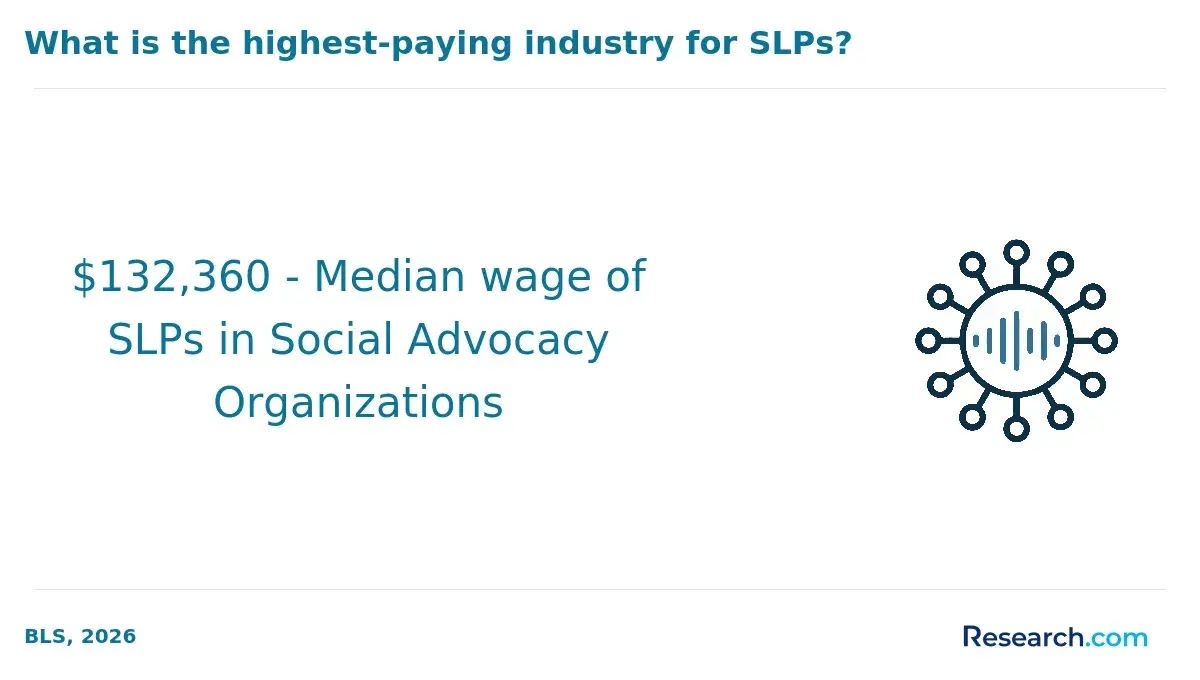
The BLS reports a median annual wage of $97,870 for speech-language pathologists in May 2025. That national figure is useful for evaluating the long-term value of graduate study, but it is not a Florida salary guarantee; pay varies by setting, experience, employer, specialty, and local labor conditions.
What accreditation and ASHA CAA recognition must Cape Coral online SLP programs have?
A Cape Coral applicant seeking clinical SLP licensure should prioritize a master's program accredited by the American Speech-Language-Hearing Association's Council on Academic Accreditation in Audiology and Speech-Language Pathology. CAA accreditation evaluates whether a program meets established standards for curriculum, faculty, assessment, and clinical education.
There are three terms applicants should distinguish. A regionally accredited university is institutionally recognized by an approved accreditor; a CAA-accredited program has professional accreditation specifically for SLP education; and a program seeking or holding candidacy status may have a different level of assurance than a fully accredited program. Read the program's exact CAA status rather than relying on broad claims about university accreditation.
Before applying, verify the following items in the university catalog, the school's licensure disclosure, and ASHA's CAA or EdFind listing:
- The specific master's program - not merely the university - holds current CAA accreditation or has a clearly stated accreditation pathway.
- The program's accreditation period covers the time you expect to enroll and graduate.
- The school confirms whether its curriculum is intended to meet Florida educational requirements for SLP licensure.
- The program accepts students physically located in Florida and is authorized to provide distance education there.
- The clinical education sequence supports the hours, competencies, and supervision documentation required for professional preparation.
A red flag is a program that promises preparation for "communication disorders careers" but does not clearly identify CAA accreditation. Such a degree may be valuable for adjacent roles, but it may not qualify a graduate for the licensed SLP pathway.
Which regionally accredited universities offer online CAA-accredited SLP master's for Floridians?
Several regionally accredited universities have distance-delivered SLP graduate options that may be relevant to Florida applicants. Availability is cohort-specific and subject to state authorization, so this is a shortlist for verification rather than a guarantee of admission or Florida eligibility.
This comparison emphasizes the factors most likely to affect a Cape Coral applicant: whether the online format is clinically realistic, how much travel may be required, and what should be confirmed before applying.
| Program option | What may appeal to Florida applicants | What to verify before applying | Best fit |
| Emerson College MS in Speech-Language Pathology | Distance-oriented curriculum and structured clinical education model | Florida availability, current CAA status, immersion requirements, live-session schedule, and placement process | Students seeking a nationally delivered cohort experience |
| Baylor University MS in Communication Sciences and Disorders | Online learning model with clinical preparation and cohort support | Florida licensure disclosure, synchronous expectations, travel, and clinical site approval process | Students comfortable with a sequenced, structured program |
| New York University MS in Communicative Sciences and Disorders | Distance pathway connected to a large health-professions university | Current state eligibility, required visits, tuition and fees, and local clinical placement feasibility | Students who value a university-based clinical education framework |
| James Madison University MS in Speech-Language Pathology | Distance coursework paired with required practicum experiences | Florida authorization, program calendar, practicum responsibilities, and any on-campus obligations | Students able to plan well ahead for clinical sequencing |
No program is universally best. A school with fewer required trips may be a better choice for a caregiver, while a program with more structured clinical coordination may be better for a student without professional contacts in local healthcare or school settings.
How do online speech pathology programs handle Florida clinical practicum and school placements?
Clinical training is the part of an online SLP master's degree that cannot be reduced to watching lectures from home. Students complete supervised experiences with real clients across settings such as schools, outpatient clinics, hospitals, rehabilitation facilities, early-intervention programs, and private practices. The university remains responsible for approving sites, supervisors, learning objectives, and documentation.
Programs generally use one of two models. In a university-coordinated model, clinical staff identify or help secure sites. In a student-assisted model, the student may suggest local sites, but the university must approve them and execute affiliation agreements. Neither model guarantees a placement in Cape Coral or at a preferred employer.
Ask clinical education staff these questions before you enroll:
- Will the program actively secure placements for Florida students, or must I locate possible sites?
- Has the program recently placed students in Southwest Florida or elsewhere in Florida?
- What happens if an affiliation agreement is delayed or a site withdraws?
- Can I complete clinical hours with my employer, and what conflict-of-interest restrictions apply?
- Which experiences require travel, how long are they, and who pays the related costs?
- Can a clinical assignment require weekday daytime availability outside Cape Coral?
Working students should plan conservatively. Even when coursework is asynchronous, practicum schedules usually follow the operating hours of schools and healthcare facilities. A program that appears flexible during the first academic term may become much less flexible once external clinical rotations begin.
What are the admission prerequisites for online SLP master's targeting nontraditional Cape Coral students?
Applicants do not always need an undergraduate degree in communication sciences and disorders (CSD), but they do need the foundational knowledge required for graduate clinical study. Career changers commonly complete prerequisite or leveling coursework before starting the master's curriculum, which can add time and cost.
Most programs review academic preparation, writing ability, recommendations, relevant experience, and capacity for graduate-level clinical work. Requirements differ by school, so applicants should not assume that one program's waiver or prerequisite list applies elsewhere.
Nontraditional applicants should expect some combination of the following admissions requirements:
- A bachelor's degree from an accredited institution, often with a stated minimum cumulative GPA.
- Foundational CSD coursework, such as phonetics, language development, anatomy and physiology of speech and hearing, audiology, aural rehabilitation, and speech science.
- Science prerequisites that may include biological science, physical science, statistics, and social or behavioral science, depending on the program and certification standards.
- Official transcripts, recommendation letters, a personal statement, and sometimes an interview or recorded response.
- Observation or relevant volunteer experience when requested; requirements vary by university.
- Proof that the applicant can meet technical, immunization, background-check, drug-screening, and clinical-site requirements.
A lower undergraduate GPA does not necessarily end the process, but it makes a strong prerequisite record and thoughtful application especially important. Applicants who need a more accessible admissions route should compare published GPA, prerequisite, and cohort requirements through resources on online speech language pathology programs, then confirm every requirement with the institution.
A common mistake is enrolling in unplanned prerequisites without checking whether the target graduate program accepts them. Send course descriptions or syllabi to admissions when a requirement is unclear, particularly if you completed classes many years ago or at multiple institutions.
How do tuition, fees, and Florida resident costs compare across leading online SLP programs?
Online SLP programs should be compared by total required cost, not by a single advertised per-credit rate. Private institutions often charge one rate regardless of residency, while public institutions may use different in-state and out-of-state structures. Florida residency does not automatically produce a discount at an out-of-state online program.
Because tuition schedules, credit loads, fees, and clinical charges change, applicants should request a written estimate for their entering cohort. The table identifies the cost components that commonly create meaningful differences between otherwise similar programs.
| Cost category | Why it matters | How to compare it |
| Tuition per credit or term | May exclude fees and may not reflect the full required credit load | Multiply only after confirming required graduate credits and whether prerequisite credits are separate |
| Mandatory university fees | Technology, student services, clinical, graduation, and distance-learning fees can add to billed cost | Request a cohort-level estimate that lists recurring and one-time charges |
| Travel and immersion expenses | Flights, lodging, meals, parking, and time away from work may be substantial | Ask for the number, location, and typical duration of required visits |
| Clinical compliance expenses | Background checks, immunizations, liability insurance, testing, and supplies may be required | Ask which items are billed by the university and which are paid directly by the student |
| Lost-work-time exposure | Daytime practicum can reduce employment hours even when classes are online | Map expected clinical terms against household income and caregiving responsibilities |
Federal financial aid may be available to eligible graduate students, but borrowing limits and interest costs deserve careful review. Compare scholarships, employer tuition assistance, payment plans, and the full borrowing amount - not only the first term's bill. Applicants focused on lowering the educational investment can also review cheapest SLP master's programs while still screening every option for CAA accreditation and Florida compatibility.
The least expensive tuition quote is not always the least expensive path. A moderately higher-priced program that offers a clearer clinical placement process or fewer mandatory trips may reduce indirect costs and enrollment risk for a Southwest Florida student.
Which online SLP programs best support working adults and caregivers in Cape Coral?
The best fit for a working adult is usually the program with the most predictable schedule, not simply the highest share of online coursework. Students should distinguish asynchronous lecture access from truly flexible progression. Clinical rotations, group assignments, examinations, live sessions, and campus activities can all create fixed obligations.
A working Cape Coral applicant should give extra weight to these program features:
- Part-time enrollment options that do not delay required clinical courses beyond a reasonable timeframe.
- Clearly published synchronous class times, including the applicable time zone and attendance expectations.
- A disclosed number of campus visits or immersion experiences, with dates provided far enough ahead for travel planning.
- Clinical education staff who explain how placements are secured, approved, and sequenced for Florida students.
- A cohort calendar that identifies when weekday daytime practicum becomes unavoidable.
- Student support for disability accommodations, academic advising, technology access, and leave or deceleration policies.
Accelerated pacing can be attractive for applicants trying to change careers quickly, but it usually increases weekly workload and leaves less room for a job or caregiving disruption. Explore accelerated speech pathology programs online only after confirming that the shorter timeline does not conflict with your clinical availability or financial plan.
For many caregivers, a slightly longer part-time route is the better decision. It can preserve income and reduce schedule strain, provided the program can maintain clinical continuity and the student understands any maximum time-to-degree rule.
How can Cape Coral applicants verify program accreditation, licensure alignment, and NC-SARA status?
Verification is essential because marketing language can be broader than a program's actual authorization or licensure disclosure. Complete this review before applying and repeat it before accepting an offer, especially if you move to a different state while enrolled.
Use this practical verification sequence to create a record of what the school represented to you:
- Find the program in ASHA's CAA directory or EdFind and confirm the exact degree, location or delivery pathway, and current accreditation status.
- Read the university's professional licensure disclosure for speech-language pathology and look specifically for Florida language.
- Ask admissions by email whether students physically located in Florida may enroll in your intended start term.
- Ask clinical education staff whether the program approves placements in Florida and whether the student is expected to locate potential sites.
- Review the institution's state authorization or NC-SARA information, while remembering that participation in NC-SARA does not by itself establish professional licensure eligibility.
- Check Florida Board of Speech-Language Pathology and Audiology requirements independently and save the current guidance for your records.
- Request a complete academic calendar listing live classes, immersions, practicum terms, and expected travel before making an enrollment commitment.
NC-SARA addresses interstate distance-education authorization for participating institutions; it is not professional accreditation and does not override state licensing rules. A school can be authorized to teach a Florida resident online while still making no representation that its program meets Florida SLP licensure requirements.
A serious red flag is an admissions representative who gives only verbal assurances about licensure or placements. Ask for the relevant disclosure page or an email confirmation, then compare it with Florida board requirements.
What alternatives exist if no online CAA-accredited SLP master's serves Cape Coral directly?
If no appropriate online program is available for your circumstances, delaying enrollment can be smarter than selecting a degree that does not support licensure. The licensed SLP route is regulated, and an unsuitable master's program may create expensive barriers later.
Consider these alternatives based on the problem you are trying to solve:
- Choose a campus-based or hybrid CAA-accredited Florida program if local access to faculty and established clinical affiliates matters more than remote coursework.
- Complete CSD prerequisites or a post-baccalaureate leveling sequence first if your academic background is the main barrier to admission.
- Expand the geographic search to programs that permit temporary travel for intensives while supporting Florida-based clinical education.
- Explore speech-language pathology assistant or related support roles if you want healthcare or school experience before committing to graduate school; scope-of-practice rules vary by state and employer.
- Consider adjacent careers such as special education, behavior analysis, occupational therapy assistance, hearing-health support, or healthcare administration if the SLP clinical pathway does not fit your schedule or financial situation.
Do not treat an adjacent credential as interchangeable with an SLP master's degree. Only a qualifying graduate degree plus the required licensure pathway supports work as a licensed speech-language pathologist. If your primary goal is earnings comparison across settings and specialties, reviewing pathways to becoming a highest paid SLP can clarify why work setting and advanced experience matter alongside degree choice.
The practical next move is to build a shortlist of three to five programs, obtain written Florida eligibility and placement answers from each, and eliminate any option that cannot explain its accreditation, clinical model, and total cost clearly.
Other Things You Should Know About Speech Language Pathology
Potentially, yes, if the degree is from a CAA-accredited program that accepts Florida residents and provides qualifying supervised clinical education. However, online coursework alone is insufficient. You must also meet Florida's current licensure requirements, including post-degree supervised experience and examination requirements.
Usually not for lectures, but you may need to travel for required immersions, assessments, or clinical activities. Clinical placements may occur in Florida if the university can approve an appropriate site, but applicants should never assume a Cape Coral placement is guaranteed.
Some students work during early academic terms, particularly in part-time programs. Full-time employment becomes harder when clinical practica require daytime hours, fixed schedules, and travel. Ask for a term-by-term clinical calendar before deciding that a program fits a full-time work schedule.
The timeline varies with prerequisite coursework, program pacing, clinical sequencing, and Florida's post-graduate licensure steps. Applicants without a CSD background may need additional leveling coursework before the master's program, while part-time study may extend the academic timeline further.
References
- Online Speech-Language Pathology Graduate Program https://csd.robbins.baylor.edu/graduate/online-csd-graduate-program
- Online MS in Speech-Language Pathology (SLP) | Pepperdine https://healthscience.pepperdine.edu/online-masters-in-speech-language-pathology/
- Best Online Speech Pathology Programs https://www.forbes.com/advisor/education/healthcare/best-speech-pathology-programs-online/
- 2026 Most Affordable Online Speech Pathology Master's... https://www.onlineu.com/most-affordable-colleges/speech-pathology-masters-degrees