2027 Best Online Speech Pathology Master's Programs for Residents of Naperville, IL

Co-Founder and Chief Data Scientist

Reviewed by Rhea Paul, PhD
SLP Education & Research Expert
Naperville residents seeking an online speech-language pathology master's degree need more than a flexible class schedule: they need a CAA-accredited program that can support supervised clinical education and align with Illinois licensure rules.
This guide compares practical online, hybrid, and low-residency options, explains the questions each school must answer before enrollment, and helps applicants weigh travel, tuition, prerequisites, placements, and remote-student support. The goal is to identify a program that fits both professional requirements and real-life logistics.
Key Things You Should Know
- A Naperville resident should prioritize a master's program accredited by the American Speech-Language-Hearing Association's Council on Academic Accreditation (CAA), because this is the standard educational foundation for Illinois licensure and ASHA certification.
- "Online" does not mean fully remote: CAA-accredited SLP programs require supervised clinical education, and students may need to attend campus immersions, complete local placements, or travel for specialty experiences.
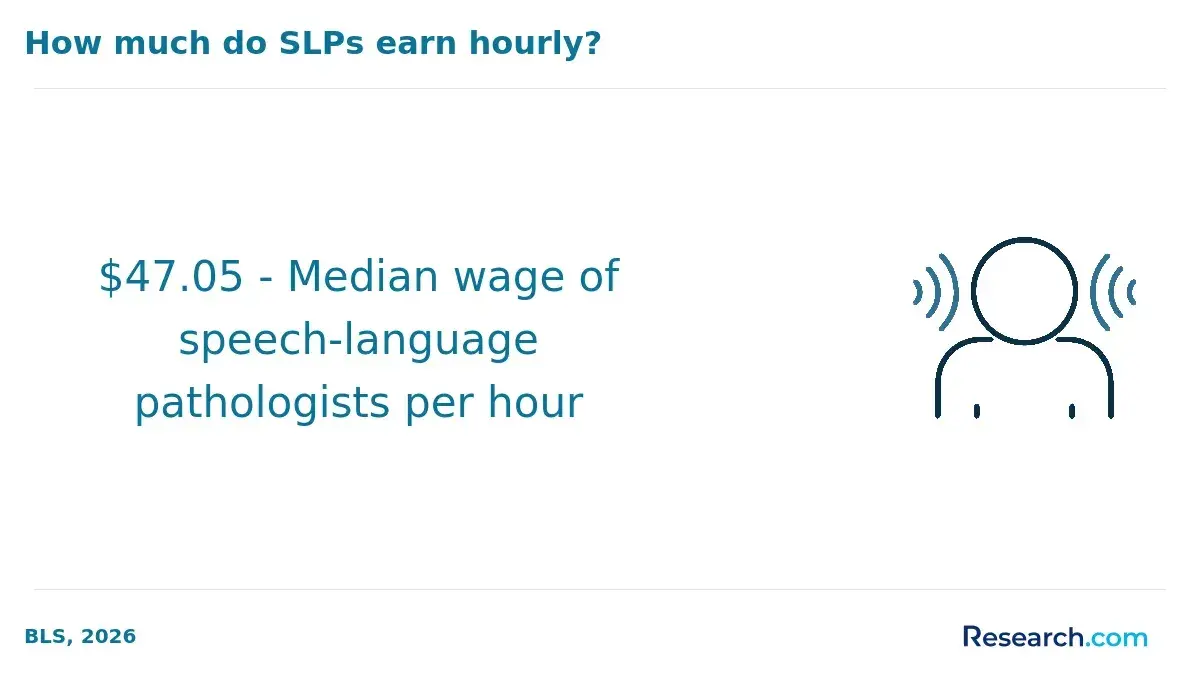
- Speech-language pathologists had a median annual wage of $97,870 in May 2025, and the occupation is projected to grow 17% from 2025 to 2035; those figures support demand but do not guarantee an individual job, placement, or salary outcome.
Which online speech pathology master's programs are most relevant for Naperville residents?
The strongest options are not necessarily the closest universities. For a Naperville applicant, the best fit is a CAA-accredited program that confirms Illinois enrollment eligibility, has a workable clinical-placement process, discloses required travel, and fits the applicant's prerequisite background and budget.
Programs commonly considered by Illinois residents include online or hybrid CAA-accredited pathways from Emerson College, New York University, Baylor University, and other schools that use distance learning with in-person clinical training. Availability, state authorization, cohort openings, and licensure disclosures can change, so applicants should obtain written confirmation from each institution before paying an enrollment deposit.
The comparison below identifies the decision factors that matter most. It is intentionally not a prestige ranking: a program is only "best" when its delivery model, clinical support, cost, and Illinois compatibility fit the individual student.
| Program option | Format to evaluate | Potential advantage for Naperville residents | Important trade-off to verify |
| Emerson College MS in Speech-Language Pathology | Online academic coursework with required clinical experiences and program-directed requirements | Designed for distance learners seeking a structured online SLP pathway | Illinois eligibility, current immersion expectations, placement process, and total tuition |
| New York University MS in Communicative Sciences and Disorders | Online coursework with clinical education requirements | Established distance-learning model and access to a large university support structure | Live-session schedule, travel, placement locations, and Illinois licensure disclosure |
| Baylor University MS in Communication Sciences and Disorders | Online coursework with in-person clinical components | May suit applicants seeking an online cohort format with planned experiential training | Required immersions, state eligibility, placement obligations, and mandatory fees |
| Illinois campus-based or hybrid CAA programs | Primarily in-person or mixed delivery, depending on the school | Potentially simpler access to local faculty, campus clinics, and regional networks | Commuting, daytime class requirements, and whether the program is truly compatible with employment |
Applicants with a bachelor's degree outside communication sciences and disorders should compare prerequisite policies before comparing brand names. Some speech pathology graduate programs offer leveling coursework or admit students conditionally, while others require all foundational courses before application.
A fully online option can make sense for a working adult who can manage live classes and travel. A local campus or hybrid program may be better for someone who values face-to-face faculty access, can attend daytime courses, or wants fewer uncertainties around arranging clinical education.
How do accredited online speech pathology programs affect Illinois licensure eligibility?
Illinois licensure is a separate decision from admission. A distance-learning master's program may accept Illinois residents, yet applicants still need to confirm that its curriculum, clinical education, degree award, and documentation meet the Illinois Department of Financial and Professional Regulation requirements in effect when they apply.
For the standard speech-language pathologist pathway, a student generally needs a qualifying graduate degree, supervised clinical preparation, post-graduate professional experience requirements where applicable, and successful completion of required examinations or credential steps. The precise sequence can vary by the license type sought and by regulatory updates. School-based practice may also involve Illinois State Board of Education credentialing requirements that differ from clinical licensure.
CAA accreditation matters because it indicates that the graduate program meets the profession's educational accreditation standards. It is not, by itself, an Illinois license, a guarantee of a clinical placement, or proof that every student's personal circumstances meet state requirements.
Before applying, ask each program for written answers to the following points. These questions reduce the risk of completing an expensive degree that creates a licensing gap.
- Is the program currently CAA-accredited, and what is its current accreditation status?
- Does the school permit new students who reside in Illinois to enroll in this specific delivery format?
- Does the program's Illinois professional-licensure disclosure state that the curriculum meets, is intended to meet, or has not been determined to meet Illinois requirements?
- How will the program document clinical clock hours, supervisors, and completed experiences for Illinois licensing and ASHA certification applications?
- Are there any restrictions for applicants who expect to work in Illinois schools, medical settings, or both?
Do not rely on a general statement that a program is "accredited" or "available online." The most useful confirmation is a dated written response from the school's licensure-disclosure or program office, followed by an independent check of current Illinois board requirements.
Which programs are actually available online, hybrid, or low-residency for Naperville students?
Online SLP master's degrees usually place coursework online but cannot eliminate in-person clinical training. Clinical simulation, telepractice, campus intensives, university clinics, and externships are all possible parts of the curriculum. The practical question is how much travel is required, when it occurs, and who is responsible for securing a placement.
This format guide helps distinguish labels that are often used loosely in marketing materials.
| Format label | What it usually means | Best fit | Primary caution |
| Online | Most lectures, assignments, and discussions are completed remotely; clinical training remains in person or supervised through approved methods | Students who need location flexibility and can manage independent study | May still include synchronous meetings, travel, and full-time clinical rotations |
| Hybrid | Instruction is divided between online learning and scheduled campus, clinic, or regional meetings | Students who want some face-to-face instruction and can travel predictably | Travel costs and mandatory attendance can affect work schedules |
| Low-residency | Most academic study is remote, with limited but required intensives or immersions | Students able to plan time off and travel several times during the program | "Limited" residency does not mean optional residency |
| Campus-based | Most instruction and university clinical experiences occur in person | Students seeking a local, traditional graduate-school experience | Less scheduling flexibility, especially during daytime clinics |
Naperville residents should look closely at Central Time scheduling. A program based in another time zone may hold required live classes, advising sessions, or clinical seminars at times that conflict with work, caregiving, or local placement hours. Ask whether synchronous attendance is mandatory and whether recordings are available when absences are approved.
Students comparing accelerated routes should also distinguish undergraduate-to-graduate pathways from graduate-entry online programs. 5-year speech pathology programs are generally designed for students who begin during or immediately after their undergraduate education; they usually are not a shortcut for a career changer who already holds an unrelated bachelor's degree.
What accreditation must a speech pathology master's program have?
A prospective speech-language pathologist should look first for accreditation by the Council on Academic Accreditation in Audiology and Speech-Language Pathology, commonly called CAA. CAA is the accrediting body associated with the American Speech-Language-Hearing Association and evaluates graduate programs preparing professionals in speech-language pathology.
Accreditation status should be checked for the exact degree program, not merely for the university. Institutional accreditation, regional recognition, state authorization, and CAA program accreditation are different concepts with different purposes.
The following distinctions help applicants avoid a common and costly error: assuming that any online communication-focused degree leads to clinical SLP licensure.
| Credential or status | What it indicates | Why it matters to an Illinois applicant |
| CAA accreditation | The graduate SLP program meets specialized professional accreditation standards | It is the central educational quality marker for ASHA certification and a key consideration for licensure preparation |
| CAA candidacy or developing status | A newer program is progressing through an accreditation process | Applicants should ask how status affects their graduating cohort and obtain clear documentation before enrolling |
| Institutional accreditation | The college or university meets broader institutional standards | Important, but it does not substitute for specialized SLP program accreditation |
| State authorization | The institution may offer education to residents of a state under applicable rules | It affects whether an Illinois resident can enroll but does not establish licensure eligibility |
Check current CAA records immediately before applying and again before making a final enrollment decision. If a program has candidacy rather than full accreditation, ask what the status means for your expected graduation cohort and whether the school will provide that explanation in writing.
Which programs best match Naperville students' clinical placement needs?
The best clinical-placement model depends on whether the student needs local coordination, can travel, and has flexibility for full-time externships. A program may assist with placements, require students to participate in finding sites, or use a mixed model. "Assistance" is not the same as a guarantee that a preferred site, specialty, commute distance, or schedule will be available.
Naperville's location in the Chicago metropolitan area may create access to a range of schools, health systems, rehabilitation providers, early-intervention organizations, and private practices. However, clinical sites have their own affiliation agreements, supervisor capacity, onboarding rules, and scheduling constraints. A university must confirm arrangements; applicants should never assume a nearby organization will accept a student.
Use the following questions to compare placement models before selecting a program. The answers are particularly important for students who must remain employed, have limited transportation, or need pediatric, medical, bilingual, or adult-neurogenic experience.
- Does the program secure clinical sites, approve student-identified sites, or use both approaches?
- Can placements be completed in the Chicago area, and is local placement availability guaranteed or only attempted?
- Who pays for background checks, drug screening, immunizations, travel, liability coverage, and site-specific onboarding?
- How many hours per week are expected during each practicum or externship, and can clinical rotations require daytime attendance?
- Can a student complete a placement at their employer, and what conflict-of-interest rules apply?
- What happens if a placement falls through or a site cannot accommodate the needed clinical population?
Telepractice experience can be useful because virtual service delivery is part of contemporary clinical practice, but it does not eliminate the need for supervised training that meets program and credential standards. Students interested in a specialized population should ask how the curriculum and placements build breadth across communication, swallowing, language, voice, fluency, and cognitive-communication needs.
How do tuition, fees, and residency rules change the total cost?
Published tuition is only one part of the investment. Online students may pay a flat online rate, a per-credit rate, or a rate that differs by program and residency classification. Private institutions often use one tuition rate regardless of state residency, while public universities may apply resident, nonresident, or online-program pricing rules. Each school's current tuition page and written financial-aid estimate should control.
When reviewing a speech pathologist online masters degree, compare the same cost unit across schools. A lower per-credit rate can still lead to a higher total if the program requires more credits, extra prerequisite courses, mandatory trips, or clinical expenses.
This cost checklist identifies expenses that are commonly omitted from initial comparisons.
| Cost category | What to request from the school | Why it changes the comparison |
| Tuition | Required-credit total and current per-credit or program rate | Allows an apples-to-apples baseline across programs |
| Mandatory university fees | Technology, student-services, distance-learning, graduation, and clinical fees | Fees can materially change the billed amount beyond advertised tuition |
| Travel and lodging | Number, location, and duration of required immersions or intensives | Low-residency formats can shift costs from commuting to flights, hotels, and missed work |
| Clinical compliance expenses | Expected costs for background checks, health requirements, insurance, and site onboarding | These costs are often paid directly by the student |
| Prerequisite coursework | Required courses and whether they are included in the master's tuition | Career changers may need additional credits before graduate enrollment |
| Lost income or reduced hours | Typical clinical schedule and whether placements are compatible with employment | Time-intensive externships can be a major indirect cost |
The federal financial-aid process, scholarships, employer tuition assistance, and graduate loans may help eligible students finance education, but borrowing should be based on a full budget rather than a tuition headline. Build a program-by-program estimate that includes clinical travel and the possibility of reduced work hours.
Career demand strengthens the case for careful planning, not automatic borrowing. The U.S. Bureau of Labor Statistics projects about 12,500 annual openings for speech-language pathologists from 2025 to 2035, but local opportunities, school calendars, healthcare reimbursement, specialty experience, and licensure timing can influence an individual job search. Review speech therapy salary information as labor-market context rather than a personal earnings promise.
What admission requirements do these programs typically set for applicants?
Admission requirements vary substantially, especially for applicants whose undergraduate major was not communication sciences and disorders. Most programs review academic preparation, ability to succeed in graduate-level clinical education, written communication, recommendations, and fit with the program's cohort and mission.
Common requirements include a completed bachelor's degree, official transcripts, prerequisite coursework in communication sciences and disorders, a personal statement, recommendation letters, and a résumé. Some programs require observation hours, while others accept applicants who will complete those hours before enrollment. GRE policies vary and should be checked for each application cycle rather than assumed.
Applicants should separate "minimum eligible" from "competitive." Meeting a stated GPA floor or submitting all prerequisites does not mean admission is assured, particularly when clinical cohorts have limited capacity.
Career changers should audit transcripts early. Frequently required foundations can include anatomy and physiology of speech and hearing mechanisms, phonetics, language development, speech science, hearing science, audiology, and speech-language disorders. Programs may also require science or statistics coursework and the ASHA basic science prerequisites in biological science, behavioral or social science, statistics, and physical science.
A strong application plan follows a practical sequence.
- Create a prerequisite inventory using each target program's official course list rather than relying on course titles alone.
- Ask admissions staff whether prior courses meet requirements and request written guidance when a course equivalency is unclear.
- Schedule observation or relevant experience early if it is required or strongly recommended.
- Tailor the personal statement to explain preparation, career goals, and readiness for intensive clinical education.
- Apply only after confirming Illinois eligibility, accreditation status, travel obligations, and the clinical-placement model.
How long do online speech pathology master's programs usually take to finish?
A CAA-accredited master's program in speech-language pathology commonly takes about two years of full-time study, though exact length depends on credit requirements, clinical sequencing, prerequisite completion, cohort design, and whether part-time enrollment is permitted. Students entering without the required communication sciences and disorders foundation may need additional time before the graduate sequence begins.
Completion speed should not be evaluated by coursework alone. Clinical education has sequence requirements, site calendars, supervisor availability, and full-time placement expectations that can limit acceleration. A program that advertises a concise academic timeline may still require students to arrange work and family commitments around external rotations.
For a Naperville resident, a longer part-time pathway may be preferable when steady employment or caregiving cannot be interrupted. A full-time online cohort can be a better fit when the student can prioritize live instruction and clinical rotations. The practical trade-off is often income stability versus time to graduation, not simply "online versus campus."
Ask each school for the sample plan of study for students beginning with your prerequisites, the expected clinical sequence, maximum time to degree, part-time policy, and leave-of-absence policy. Those details are more decision-useful than an advertised minimum completion time.
Which schools offer the strongest student support for remote learners?
Remote learners need support that extends beyond online lectures. In an SLP program, useful support includes clinical coordination, accessibility services, faculty advising, technology help, library access, placement compliance guidance, career services, and clear escalation procedures when a clinical site changes.
Rather than assuming that a well-known university automatically provides the best experience, compare the support available to the specific online SLP cohort. Ask to speak with the program office about how it handles clinical placement delays, disability accommodations during practica, academic remediation, and career preparation for students who live outside the institution's home state.
Programs are more likely to be a strong fit for remote students when they clearly explain the following services before enrollment.
- A named clinical education team and a transparent process for site selection, approvals, and contingency planning
- Regular faculty office hours, academic advising, and access to tutoring or writing support
- Reliable learning-platform training, technical support, and clear expectations for required equipment
- Career resources that address fellowship, licensure documentation, résumé preparation, and employer networking
- Accessible support for students who need accommodations in online coursework or clinical settings
- Detailed orientation materials covering travel, clinical compliance, professional conduct, and time management
Student support can be especially important in programs using a cohort model. Cohorts can build community and accountability, but they may offer less flexibility if a student falls behind in a sequenced clinical course. Ask whether courses are offered annually or more often and what happens if a student must pause progression.
How can Naperville applicants verify current program and licensure status?
Verification should happen before application submission and again before enrollment because accreditation actions, state authorization, tuition, program formats, and licensure disclosures can change. The reliable approach is to use official records and save written confirmations for your files.
Start with CAA's current program directory or ASHA EdFind to verify the exact program's accreditation status. Then review the university's official program page, graduate catalog, tuition page, and professional-licensure disclosure for Illinois. Finally, compare that information with current Illinois licensing guidance.
Use this short verification process to avoid the most common enrollment mistakes.
- Confirm the exact degree name and CAA accreditation status; do not assume another degree at the same university has the same standing.
- Ask the admissions or licensure-disclosure office whether Illinois residents may enroll in the intended start term and delivery format.
- Request a written Illinois licensure curriculum disclosure and ask whether any requirements are still undetermined.
- Obtain the current program-of-study, including credits, live-session expectations, clinical hours, immersions, and expected travel.
- Request an itemized tuition and fee estimate, then add your own estimate for travel, compliance, and reduced-work costs.
- Ask the clinical education office how placements are arranged for students in the Chicago area and what happens if local placement capacity is limited.
- Review Illinois licensure and, if applicable, school-service credential requirements immediately before graduation and application for credentials.
Red flags include vague answers about accreditation, no Illinois-specific licensure disclosure, promises of a local clinical site without written conditions, unexplained mandatory travel, and tuition estimates that exclude recurring fees—making it harder to evaluate program cost against your target speech therapy salary. A careful applicant treats each of these as a reason to ask follow-up questions, not as a reason to abandon all online programs.
Other Things You Should Know About Speech Language Pathology
Potentially, but the program must provide the required accredited graduate education and supervised clinical preparation, and you must meet Illinois licensure requirements in effect when you apply. Even an online program will require clinical training and may require travel or in-person intensives.
Not always. Many programs consider applicants with other bachelor's degrees, but they usually require prerequisite coursework before or during entry to the graduate program. This can add cost and time, so obtain a transcript evaluation from each target school.
It may be possible during some academic terms, but clinical practica and externships can require substantial daytime availability. Ask for the clinical schedule by term before assuming that an online format will support full-time employment.
No. ASHA certification and Illinois professional licensure are separate credentials with overlapping educational and clinical expectations. Some jobs may prefer or require ASHA certification, while Illinois practice authority depends on meeting the state's licensing rules.
References
- Speech Language Pathology Program, Downers Grove, IL https://www.midwestern.edu/academics/degrees-programs/college-health-sciences/master-science-speech-language-pathology-program/master-science-speech-language-pathology-downers-grove-campus
- Emerson College Online Master's in Speech Pathology https://speech.emerson.edu/