2027 Best Online Speech Pathology Master's Programs for Residents of San Bernardino, CA

Co-Founder and Chief Data Scientist

Reviewed by Rhea Paul, PhD
SLP Education & Research Expert
San Bernardino residents can complete much of a speech-language pathology master's degree online, but the degree is not fully remote: supervised clinical training, state authorization, accreditation, and California licensure rules all matter. This guide identifies the strongest decision criteria for comparing online options, explains what California requires, and shows how to verify whether a program can support your clinical path. The career outlook is favorable, but choosing the wrong program can delay licensure and add avoidable travel or placement costs.
Key Things You Should Know
- Choose a master's program accredited by the American Speech-Language-Hearing Association Council on Academic Accreditation (ASHA CAA), because California licensure and most employers expect a qualifying graduate degree.
- Online coursework does not eliminate in-person training: California applicants need supervised clinical education, and programs may require campus immersions, local placements, or travel outside San Bernardino.
- The U.S. Bureau of Labor Statistics reports a $97,870 median annual wage for speech-language pathologists in May 2025 and projects 17% employment growth from 2025 to 2035, but licensure - not online delivery alone - is what makes the degree professionally useful.
Which online speech pathology master's programs accept students living in San Bernardino, California today?
The most suitable online speech pathology master's programs for San Bernardino residents are generally CAA-accredited programs that explicitly authorize enrollment in California, arrange or approve California clinical sites, and provide a California licensure disclosure. "Online" usually describes academic coursework; clinical practica and internships remain face-to-face.
Enrollment authorization can change by term, cohort capacity, and clinical-placement availability. The programs below are examples of established distance-oriented CAA pathways that prospective students should investigate, rather than a guarantee that every program is accepting California applicants at every application cycle.
| Program type or example | Why it may appeal to a San Bernardino resident | Important trade-off to verify |
| Baylor University online MS in Communication Sciences and Disorders | Distance-oriented graduate study with required clinical education and a nationally recognized university structure. | Confirm current California eligibility, required immersions, placement support, calendar format, and total mandatory charges. |
| Emerson College online MS in Communication Disorders | Designed around online graduate coursework with clinical education components arranged through the program model. | Ask about California placement capacity, travel requirements, live-session expectations, and the exact clinical sequence. |
| NYU online MS in Communicative Sciences and Disorders | Offers an online pathway through a university with an established CSD department and clinical education requirements. | Confirm state authorization, intensives or in-person requirements, local-site availability, and whether the schedule fits Pacific Time. |
| University of Northern Colorado distance-oriented CSD graduate study | May fit students seeking a public-university distance format with structured professional preparation. | Verify current availability to California residents, any campus attendance, clinical-site approval process, and cohort schedule. |
Do not use a broad "online SLP" search result as proof that a school accepts California residents. Before paying an application fee, request a written answer from admissions or the program's licensure-disclosure contact addressing California enrollment authorization, clinical placement eligibility, and whether the curriculum is designed to meet California professional licensure requirements.
Admission competitiveness is separate from professional quality. Applicants comparing prerequisites, cohort sizes, and access-oriented options can review easiest online SLP programs to get into, but should never treat easier admission as a substitute for CAA accreditation and clinical-placement support.
What are the licensure requirements for speech-language pathologists in California and how do online programs meet them?
California speech-language pathologist licensure is regulated by the Speech-Language Pathology and Audiology and Hearing Aid Dispensers Board. A master's degree is only one part of the route. Applicants must complete qualifying academic and supervised clinical preparation, pass the required national examination, and finish the state's required supervised professional experience before independent practice.
An online program can support the path when it delivers the same core graduate education as a campus program and has a workable process for approving qualified in-person supervisors and sites. The program should document each clinical experience, supervisor credentials, direct-contact hours, and evaluation records.
| Licensure component | Why it matters in California | What an online applicant should confirm |
| Qualifying graduate degree | The degree must satisfy California educational standards for speech-language pathology. | Ask for the program's California professional-licensure disclosure and verify its CAA status. |
| Supervised clinical practicum | Clinical education creates the foundation for supervised post-graduate practice and national certification. | Confirm who secures sites, who approves supervisors, and whether sites near San Bernardino are realistic rather than merely possible. |
| National Praxis examination | California requires the national examination as part of the licensing pathway. | Ask how the program prepares students and review its most recent required outcome disclosures. |
| Required professional experience | California requires supervised post-graduate experience before full licensure. | Plan early for an employer and supervisor willing to support the required registration and supervision process. |
| Application and board review | The Board, not the university, decides whether an individual application meets state requirements. | Keep official transcripts, clinical-hour records, examination documentation, and supervisor records. |
ASHA certification and California licensure overlap substantially but are not identical credentials. ASHA's Clinical Fellowship framework commonly uses 1,260 supervised post-graduate hours, while California applicants should follow the Board's current registration and required-professional-experience rules. A school should explain both pathways without implying that one application automatically completes the other.
Students who hold a bachelor's degree outside communication sciences and disorders may need prerequisite or leveling coursework before graduate admission. That can extend the timeline and cost, so obtain a written prerequisite evaluation before assuming an advertised completion time applies to you.
How can San Bernardino residents verify that an online speech pathology master's is properly accredited?
The first accreditation check is programmatic: confirm the specific speech-language pathology graduate program is accredited by ASHA's Council on Academic Accreditation in Audiology and Speech-Language Pathology. Institutional accreditation alone does not establish that an SLP master's program meets the profession's academic and clinical standards.
Use ASHA EdFind and the CAA directory to look up the exact degree, campus or delivery pathway, accreditation status, and any public notices. Then compare that information with the university's current catalog. Names, modalities, and accreditation actions can change, so a school's general accreditation statement is not enough.
Use this sequence before applying:
- Locate the exact graduate program in the ASHA CAA directory and verify that its status covers the pathway you plan to enter.
- Read the school's California licensure disclosure, not just its general "online learning" page.
- Ask whether the school is currently authorized to enroll a California resident and request the answer in writing.
- Ask whether the program arranges, approves, or expects students to find clinical sites and supervisors.
- Confirm that any required campus visits, skills labs, assessments, or immersions fit your budget and work schedule.
CAA "candidate" status and full accreditation are not interchangeable. Candidacy may indicate that a new program is progressing through the accreditation process, but applicants should ask how that status affects their cohort, eligibility for certification, transfer options, and California licensing plans. If an admissions representative cannot explain the status clearly, contact the accreditor and California Board directly.
Which online speech pathology master's programs offer California-aligned clinical placements near San Bernardino?
No responsible program comparison should promise a placement in San Bernardino unless the university confirms it for the applicant's cohort. A program may have national placement processes yet still face limited availability in Inland Empire schools, hospitals, private practices, early-intervention settings, or skilled nursing facilities.
The strongest California-aligned option is not necessarily the school nearest to San Bernardino. It is the one that can document a workable clinical-placement model, accepts California students, and can approve a qualified local site without making the student absorb unreasonable placement risk.
| Clinical-placement model | What it can mean for local students | Question to ask |
| Program-arranged placements | The university takes primary responsibility for identifying and coordinating sites, though location cannot always be guaranteed. | "How many recent California distance students completed placements within commuting distance of home?" |
| Student-assisted placements | You may suggest employers or facilities, but the program must approve the site and supervisor. | "What happens if my proposed San Bernardino site is declined or has no availability?" |
| Student-secured placements | You have more responsibility for finding a site, which can be difficult in competitive local markets. | "What support, lead time, affiliation agreements, and contingency options do you provide?" |
| Hybrid or immersion-based model | Coursework may be online, but simulations, labs, assessments, or clinical intensives require travel. | "How many trips are required, where are they held, and are dates fixed before enrollment?" |
Ask for placement information early - ideally before accepting admission. A program should distinguish between introductory practicum, specialty placements, and the final full-time internship, because the final placement often creates the greatest schedule disruption. Working adults should also ask whether daytime availability is required; most clinical sites operate during standard school, clinic, or medical-facility hours.
Speed can be attractive, but an accelerated sequence leaves less room to recover from a delayed placement or a failed course. Review accelerated speech pathology programs online with particular attention to their clinical calendar, not just their advertised graduation date.
How do ASHA CAA accreditation and regional institutional accreditation each affect program quality and recognition?
Both forms of accreditation matter, but they answer different questions. Institutional accreditation evaluates the college or university as a whole, including governance, academic quality systems, financial stability, and student-support processes. CAA accreditation evaluates the speech-language pathology professional program itself.
| Type of recognition | Primary focus | Why a California SLP applicant needs it |
| Institutional accreditation | The university's overall academic and administrative quality. | Supports degree recognition, financial-aid eligibility, credit transfer considerations, and institutional accountability. |
| ASHA CAA accreditation | SLP curriculum, faculty, student outcomes, clinical education, assessment, and program resources. | Provides the central professional-quality signal for an entry-level SLP master's and supports the usual licensure and certification pathway. |
| California Board review | An individual applicant's compliance with California statutes and regulations. | Determines whether the person, not simply the school, qualifies for registration or licensure. |
A university can be institutionally accredited while its new or specialized SLP program lacks CAA accreditation. That does not automatically mean the institution is illegitimate, but it creates a major professional risk for a student seeking California SLP licensure. Conversely, CAA accreditation does not remove the need to meet California-specific application, examination, and supervised-experience requirements.
For a practical quality review, look beyond the accreditation label. Read the program's public student-outcome data, faculty and supervisor resources, clinical-placement policies, withdrawal and remediation rules, and state disclosures. These details reveal whether the delivery model is likely to work for a distance learner, especially one who needs local placements.
What state authorization rules govern California residents enrolling in out-of-state online speech pathology programs?
State authorization concerns whether an out-of-state university may provide education to a student located in California. It is separate from professional licensure. A school may be able to teach online in California while its program is not designed to meet California SLP licensure requirements; the reverse is also not something an applicant should assume.
California is not a State Authorization Reciprocity Agreement member state. As a result, an institution's participation in an interstate authorization arrangement does not by itself prove that it can enroll California residents. The school must evaluate its own California authorization obligations and disclose any restrictions that apply to distance education or clinical experiences.
Before enrolling, obtain direct answers to these questions:
- Does the university currently permit a student physically located in California to enroll in this exact online SLP program?
- Does the program's written California disclosure state that its curriculum meets, is intended to meet, or has not been determined to meet California SLP licensure requirements?
- Can the program place or approve students in California clinical settings, including sites requiring university affiliation agreements?
- Will any practicum, simulation, laboratory, or immersion requirement create an additional authorization or travel issue?
- If California rules or the school's authorization status changes during enrollment, what teach-out, refund, or transfer support applies?
Keep copies of the program's answers, catalog pages, and disclosures from the time you enroll. They are useful if policies later change, but they do not replace confirmation from the California licensing Board. The Board retains authority over individual licensure decisions.
How do leading online speech pathology master's programs compare on outcomes such as Praxis pass rates and employment?
Programs should be compared using the same outcome definitions and reporting period. CAA-accredited programs are expected to publish student-outcome information, commonly including Praxis examination pass rates, program completion, and employment rates. Those metrics are more useful than generalized marketing claims, but small cohorts can make annual percentages volatile.
The table identifies how to interpret the outcome categories when comparing programs. Request the latest published figures directly from each institution and confirm whether the numbers describe all graduates, first-time test takers, graduates seeking employment, or another narrower group.
| Outcome measure | What a stronger result may indicate | Limitation to consider |
| Praxis pass rate | Students are generally reaching the program's expected knowledge benchmark. | A high rate does not show how many students needed multiple attempts or whether the cohort was very small. |
| Program completion rate | Students are able to progress through the curriculum and clinical sequence. | Ask whether leaves, transfers, academic dismissals, and delayed clinical placements are included. |
| Employment rate | Graduates seeking work were able to obtain relevant positions within the reporting window. | Definitions, timing, geographic labor markets, and response rates vary among schools. |
| Time to completion | The curriculum may be efficiently sequenced for the intended cohort. | An advertised minimum time may exclude prerequisites, placement delays, or part-time enrollment. |
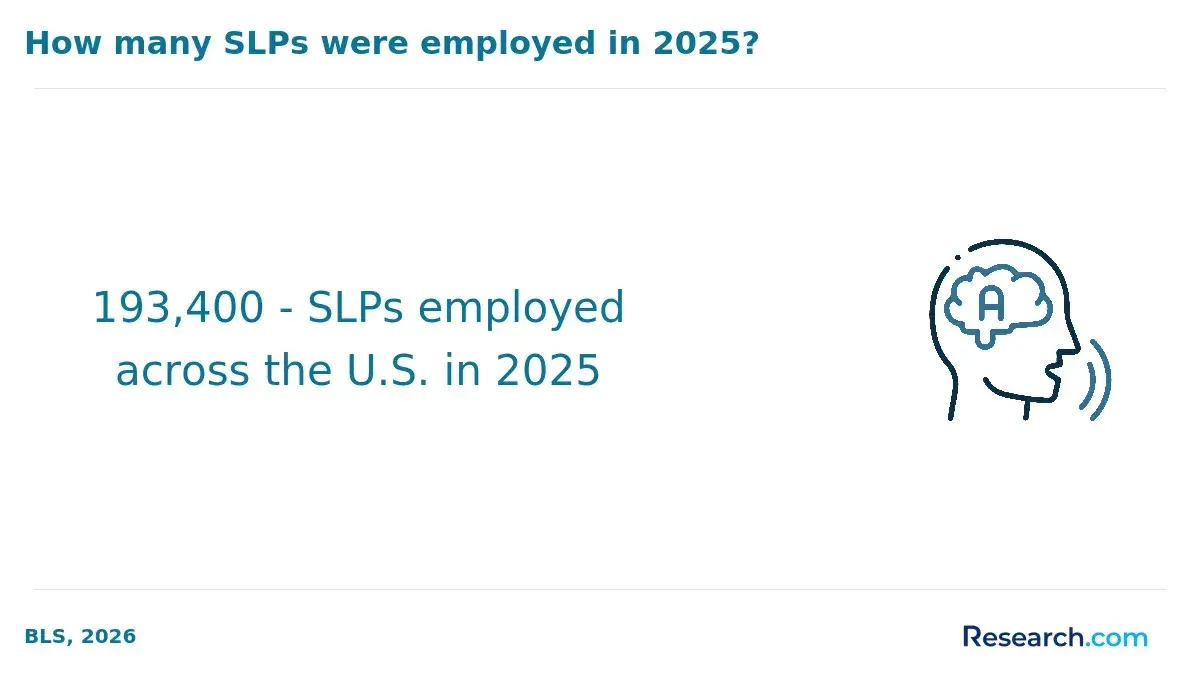
National labor demand supports careful investment in the field. The Bureau of Labor Statistics reports that speech-language pathologist employment is projected to grow 17% from 2025 to 2035, with about 12,500 openings annually on average. That outlook does not guarantee a job in a particular San Bernardino setting, but it indicates that a properly credentialed clinician is entering a growing occupation.
Income also varies by employer, setting, experience, and local demand. The national median annual wage was $97,870 in May 2025; prospective students can put that figure in context by reviewing how much does a speech therapist make and comparing earnings potential with their own tuition, forgone income, and commuting costs.
A program with slightly lower published outcomes is not automatically a poor choice, particularly if it serves working adults or students completing prerequisites. Ask for context, cohort size, and improvement plans. Avoid schools that refuse to provide current outcomes or report statistics without defining them.
What tuition, fees, and cost-of-attendance factors matter most for San Bernardino residents choosing an online program?
Online delivery can reduce relocation and daily campus commuting, but it does not make a clinical master's inexpensive. Compare the estimated total cost of attendance, not a single per-credit figure. Programs differ in credit requirements, tuition schedules, clinical fees, technology fees, travel, health requirements, and the cost of reduced work hours during full-time placements.
The cost categories below help San Bernardino applicants compare unlike price quotes on a more consistent basis.
| Cost factor | Why it changes the real price | What to request from the school |
| Tuition basis | Per-credit pricing, flat-term tuition, and annual tuition cannot be compared directly. | The required credits or terms and the estimated tuition for the full degree. |
| Mandatory fees | Technology, clinical, graduation, background-check, and student-service charges may not appear in tuition advertisements. | A fee schedule specific to distance graduate students. |
| Clinical travel and housing | Local availability is not guaranteed, and internships or immersions can require travel. | The number, location, and approximate timing of required in-person events. |
| Professional compliance costs | Immunizations, background checks, drug screening, liability coverage, equipment, and examination costs can recur. | A current student clinical-readiness checklist with estimated expenses. |
| Lost earnings | Daytime practica and internships may reduce paid work capacity. | The expected weekly commitment during each clinical phase. |
Federal financial aid eligibility, scholarships, employer assistance, and borrowing limits should be confirmed through the institution's financial-aid office. Do not assume an online program charges in-state tuition, even if you live in California, and do not assume a private program's higher posted price means your net cost will be higher after aid.
Students prioritizing budget should compare degree-wide tuition, required travel, and time away from work rather than searching only for a low sticker price. A broader comparison of easiest online SLP programs to get into can be useful for generating options, but each program's current fee schedule and California clinical-placement terms should drive the final decision.
How can prospective speech pathology students in San Bernardino protect themselves from low-quality or misleading online programs?
The most serious risk is enrolling in a program that uses "speech therapy," "communication disorders," or "online SLP" language without offering a degree that supports the California licensing pathway. Another common problem is assuming a school will arrange a local placement when its written policy places most of that responsibility on the student.
Watch for these red flags before submitting a deposit:
- The program cannot identify its exact ASHA CAA status or directs you only to the university's institutional accreditation.
- The school gives vague answers about whether California residents may enroll or whether the curriculum meets California licensure requirements.
- Clinical-placement language promises "support" but does not explain who secures sites, approves supervisors, or handles affiliation agreements.
- Published tuition omits required fees, travel, professional compliance costs, or the likely need to reduce work during placements.
- Outcome claims lack a reporting year, denominator, definitions, or a link to the program's required public disclosures.
- An admissions representative guarantees licensure, employment, salary, a local placement, or a specific graduation date.
Use a written comparison sheet for every program. Record accreditation status, California eligibility confirmation date, required travel, clinical-placement responsibility, total published cost, prerequisites, schedule, outcomes, and refund or teach-out policies. If a claim is important enough to influence your enrollment decision, ask for it in writing.
Applicants who are tempted by low barriers to entry should still compare prerequisites, clinical support, and accreditation carefully. Resources on easiest SLP programs to get into may help frame admissions options, but no program should be selected solely because it appears easier to enter.
What resources can San Bernardino applicants use to confirm current program status, accreditation, and board approvals?
Use primary sources and verify the same claim in more than one place when possible. A program website is useful for curriculum and admissions details, but the accreditor and licensing Board are better sources for professional standing and California requirements.
The following resources provide the most reliable verification path:
- ASHA EdFind and the ASHA Council on Academic Accreditation directory for the exact program's accreditation status and public outcome information.
- The California Speech-Language Pathology and Audiology and Hearing Aid Dispensers Board for current licensing, registration, examination, and required-professional-experience rules.
- The university's professional licensure disclosure page for its California-specific determination and state authorization information.
- The university's graduate catalog and official tuition page for credit requirements, mandatory fees, academic calendar, and graduation rules.
- The program's clinical education office for written confirmation of placement procedures, supervisor requirements, travel expectations, and California site approval.
- The Federal Student Aid office and the university financial-aid office for aid eligibility, loan counseling, and net-cost estimates.
Contact the California Board before enrollment if your situation is unusual, such as holding an international degree, completing a non-CSD bachelor's degree, having prior clinical hours from another program, or intending to transfer graduate credits. Individual circumstances can affect the Board's review even when a program is otherwise well matched.
Other Things You Should Know About Speech Language Pathology
You can complete much of the academic curriculum online, but a qualifying SLP pathway includes in-person supervised clinical education. Choose a CAA-accredited program that confirms California enrollment eligibility, supports approved clinical placements, and provides a California licensure disclosure.
Not always. Many programs admit applicants from other majors, but they commonly require prerequisite coursework in communication sciences and disorders. Those courses can add substantial time and cost before the graduate sequence begins.
Not necessarily. Some programs arrange placements, some use a shared-responsibility model, and others expect students to locate potential sites. Obtain the school's policy in writing and ask what happens if a local site is unavailable.
Graduation is followed by the required examination, California application process, and supervised post-graduate professional experience. The timeline depends on the program's clinical sequence, examination timing, employer availability, and the Board's current processing requirements.
References
- Master of Arts in Speech-Language Pathology https://catalog.csusb.edu/colleges-schools-departments/arts-letters/english/speech-language-ma/
- Best Online Master's in Speech-Language Pathology for 2026 https://healthscience.pepperdine.edu/online-masters-in-speech-language-pathology/article/best-online-masters-in-speech-language-pathology-programs-guide.htm
- Best Speech-Language Pathology Programs in America https://www.usnews.com/best-graduate-schools/top-health-schools/pathology-rankings
- 2026 Most Affordable Online Speech Pathology Master's... https://www.onlineu.com/most-affordable-colleges/speech-pathology-masters-degrees