2027 Online SLP Master's Clinical Placement Support: What Universities Arrange and What Students Find

Co-Founder and Chief Data Scientist

Reviewed by Rhea Paul, PhD
SLP Education & Research Expert
Clinical placement is the part of an online speech-language pathology master's degree that cannot be fully remote - and it is often the deciding factor in whether a program fits a student's location, work schedule, and licensure goal. This guide explains what universities typically arrange, where student responsibility begins, how affiliations and supervision work, and what to verify before paying a deposit. It is designed for prospective SLP students who need a realistic plan for completing required practicum hours without unexpected delays or travel costs.
Key Things You Should Know
- CAA-accredited SLP master's programs must provide sufficient supervised clinical education, but accreditation does not mean a university can promise every student a placement in a preferred city, school district, or medical setting.
- Students generally need at least 400 supervised clinical clock hours for ASHA certification, including 375 graduate-level hours; programs must document direct and indirect hours, supervisor qualifications, and competency outcomes.
- A placement model that appears inexpensive can become costly if it requires unpaid full-time rotations, background checks, travel, temporary housing, health clearances, or schedule changes that reduce work income.
How do online SLP master's programs structure and guarantee clinical placements for distance students today?
Online SLP master's programs typically combine virtual coursework with in-person clinical education. The word "online" usually describes the academic delivery format, not the practicum format. Students may complete some early client contact through university telepractice clinics or simulations, but they ordinarily must complete substantial supervised work with real clients in approved in-person or telepractice settings.
Programs use different placement models. The most supportive model assigns sites through a dedicated clinical education team; a shared-responsibility model asks students to suggest local sites while the program approves and contracts with them; and a student-led model expects students to initiate most local outreach. None of these models should be interpreted as a guarantee of a specific setting or commute distance.
The following comparison shows why applicants should ask about the actual placement process rather than relying on broad statements such as "clinical placement support provided."
| Placement model | What the university usually does | What the student usually does | Main trade-off |
| University-assigned | Matches students to available approved sites and manages most outreach | Meets compliance requirements, accepts reasonable assignments, and completes onboarding | More support, but less control over location, population, and schedule |
| Shared-responsibility | Approves sites, negotiates affiliations, and makes final assignments | Provides geographic preferences and may identify potential local sites | Can improve local fit, but a student's preferred site may not be approved |
| Student-initiated | Sets standards, approves sites, and verifies supervisors | Contacts organizations and identifies possible supervisors or facilities | Greater local flexibility, but higher risk of delay and more administrative work |
| Regional cohort or hub model | Uses established site networks around selected markets or campus regions | May travel or relocate temporarily for assigned rotations | More predictable network access, but limited geographic freedom |
Before applying, distinguish between a school's commitment to help and a contractual promise to place. Most programs promise to make reasonable efforts to secure qualifying experiences, not to provide a particular specialty, employer, school district, or start date. Applicants exploring online speech pathology programs should treat placement language as seriously as admissions selectivity, because an accessible application process does not make clinical scheduling easy.
Current capacity pressures also matter. Healthcare systems, schools, and private practices must balance patient care, staff workload, privacy rules, and supervisor availability. A program with a long-standing regional network may therefore offer more predictability than one that enrolls nationally but has few documented arrangements near a student's home.
What clinical placement responsibilities do universities formally assume versus leaving to online SLP students?
Responsibility is usually divided among the university, clinical site, supervisor, and student. The exact allocation appears in the clinical handbook, enrollment agreement, affiliation contract, and state authorization disclosures. Applicants should request these materials before committing, because marketing pages often summarize support without describing deadlines, contingency rules, or student obligations.
This table separates common institutional duties from responsibilities students should expect to manage themselves.
| Task | University or program role | Student role |
| Site approval | Determines whether the setting meets academic and accreditation standards | Supplies accurate site information when asked and does not begin hours before approval |
| Affiliation agreement | Negotiates and signs agreements with the organization | May introduce contacts or complete site paperwork, but normally cannot sign for the university |
| Supervisor review | Verifies credentials, experience, and supervisory eligibility | Provides documentation and alerts the program if supervision changes |
| Compliance onboarding | Defines required records and monitors completion | Completes background checks, drug screens, immunizations, training, and insurance requirements |
| Hour tracking and grading | Reviews records, competencies, and course performance | Logs hours accurately and submits evaluations by stated deadlines |
| Replacement after cancellation | Works to identify a viable alternative when possible | Remains flexible about schedule, site type, commute, and potential delayed graduation |
A major red flag is language that shifts all placement responsibility to the student while offering little detail about site approval, affiliation support, or backup plans. Another red flag is a program that will not state whether it has previously placed students in the applicant's state or region. A school cannot always disclose every partner site, but it should explain its process and the limits of its commitment clearly.
Students should not independently promise a site that a university will accept. A facility may be enthusiastic, yet the agreement process can fail because of legal review, insurance requirements, supervisor eligibility, capacity limits, or a mismatch between the facility's services and course objectives.
How does ASHA's CAA accreditation and state licensure influence clinical site approval for online SLP programs?
CAA accreditation is one of the most important safeguards for aspiring speech-language pathologists. The Council on Academic Accreditation in Audiology and Speech-Language Pathology sets educational standards for graduate programs, including clinical education processes, supervision, assessment, and recordkeeping. Graduation from a CAA-accredited program is generally central to pursuing the Certificate of Clinical Competence in Speech-Language Pathology and state professional licensure, but each state retains authority over its own license requirements.
Clinical sites must support the program's ability to document that a student has achieved required competencies and accumulated qualifying hours. Under ASHA certification standards, applicants need at least 400 supervised clinical clock hours, with at least 375 hours obtained at the graduate level. The hours alone are not enough: the experiences, supervision, evaluations, and records must also meet applicable requirements.
Licensure rules can affect placement choices before graduation. A state may impose requirements related to temporary student authorization, supervisor licensure, fingerprints, school-based credentials, telepractice, or out-of-state distance education. A program's approval in its home state does not automatically establish that it can enroll or place students in every other state.
Use the following checkpoints to evaluate whether accreditation and licensure information is decision-ready rather than merely reassuring.
- Confirm the program's current CAA status and review whether it is accredited, in candidacy, or subject to any published conditions.
- Read the institution's state authorization and professional licensure disclosures for the state where you intend to live during enrollment and seek initial licensure after graduation.
- Ask whether the school has restrictions on clinical placements, telepractice, or enrollment in your state.
- Verify that school-based placements align with the credential pathway required by the state education agency where you hope to work.
Accreditation should be treated as a baseline, not a substitute for state-specific planning. A CAA-accredited program can be academically sound while still being a poor operational fit for a student whose state, employer schedule, or geographic location creates placement barriers.
What types of clinical settings and caseloads are typical for online SLP master's placements across regions?
Online SLP students commonly complete placements in public schools, early-intervention programs, outpatient clinics, hospitals, skilled nursing facilities, rehabilitation settings, private practices, and university clinics. The mix varies by local labor market, site relationships, semester objectives, and patient access. A student should expect variety across placements, but should not assume access to a highly specialized medical setting, bilingual caseload, pediatric feeding clinic, or acute-care hospital.
Caseloads may include children with speech sound disorders, language disorders, autism-related communication needs, fluency disorders, voice disorders, dysphagia, cognitive-communication disorders, aphasia, motor speech disorders, or augmentative and alternative communication needs. Students may also observe assessment, documentation, interdisciplinary meetings, caregiver counseling, and telepractice. The exact activities depend on the supervisor, setting, client needs, and the student's demonstrated competence.
The table below summarizes typical setting differences that can help students decide which placement preferences are essential and which should remain flexible.
| Setting | Common client population | Potential learning strengths | Common limitation |
| Public school | Primarily school-age children and adolescents | IEP process, educational eligibility, classroom collaboration, group therapy | May offer limited adult or medical experience |
| Early intervention | Infants and toddlers with caregivers | Family coaching, development, natural-environment services | Schedules may include substantial travel and daytime availability |
| Outpatient clinic or private practice | Children and adults, depending on the clinic | Broad diagnostic and treatment exposure | Caseload mix can change quickly with referrals and payer rules |
| Hospital or rehabilitation setting | Adults and medically complex patients | Dysphagia, cognitive-communication, interdisciplinary medical care | Often competitive and may require strict onboarding or prior experience |
| Skilled nursing facility | Older adults and adults with rehabilitation needs | Adult neurogenic disorders, swallowing, documentation systems | Availability and supervision capacity can fluctuate |
Regional differences are meaningful. Large metropolitan areas may provide more site types but also more competition among universities for the same supervisors. Rural areas may have fewer organizations but can offer broad generalist experience. Students who want a narrow specialty should ask whether the program can support that interest without treating it as a guaranteed placement outcome.
The broader career outlook explains why clinical quality matters. The U.S. Bureau of Labor Statistics projects 17% employment growth for speech-language pathologists from 2025 to 2035, with about 12,500 openings per year on average. Demand can create opportunity, but it does not eliminate the need for competent supervised preparation across settings and populations.
How do programs handle clinical placements for students in rural, out-of-state, or underserved locations?
Students outside a program's core service area may face longer lead times because the university must confirm state eligibility, locate a qualified supervisor, negotiate an affiliation agreement, and ensure that the site meets course requirements. In rural communities, the closest suitable placement may be many miles away. In underserved areas, a local site may serve a broad population but lack enough clinician capacity to take a student every term.
Programs commonly use a combination of established partners, student referrals, temporary travel, and telepractice experiences. Telepractice can expand access to some supervised clinical activities, but it does not remove state rules, client privacy obligations, technology requirements, supervisor availability, or the need for an approved placement arrangement.
Applicants in geographically complex situations should take these steps before enrolling.
- Tell admissions and the clinical placement office the county and state where you expect to live during every practicum term.
- Ask whether the program has recently placed students in that state, without requesting confidential site names or student information.
- Ask whether temporary relocation, weekend travel, campus intensives, or full-time weekday availability may be required.
- Identify whether your current employer could potentially serve as a site, then ask the program whether employer placements are permitted and how conflicts of interest are handled.
- Create a financial reserve for travel or delayed placement rather than assuming every rotation will be local.
Out-of-state students should be especially cautious about starting coursework before confirming eligibility. A program may accept an application while later determining that it cannot place the student in a particular state or that a state's rules make the intended licensure path impractical. Written confirmation is more useful than a verbal assurance.
Students seeking a faster timeline should also be realistic about geography. Accelerated speech pathology programs can compress academic sequencing, but placements still depend on site calendars, compliance deadlines, and supervisor availability. An accelerated plan may be least suitable for someone who cannot travel, cannot reduce work hours, or needs a very specific local placement.
What support do universities provide for finding preceptors, securing affiliation agreements, and verifying supervision hours?
A strong clinical education office does more than send students a list of facilities. It maintains relationships with sites, evaluates potential supervisors, initiates affiliation agreements, sets placement objectives, tracks compliance, reviews hour logs, and intervenes when a site or supervisor becomes unavailable. The level of direct support varies considerably, so students should ask who owns each stage of the process.
"Preceptor" and "clinical educator" may be used interchangeably in program materials. The supervisor must meet the program's and applicable professional requirements, and the university must verify that supervision can be provided at the required level. Students should never assume that a licensed SLP is automatically eligible to supervise a graduate student for every purpose.
Applicants should look for concrete support indicators rather than general claims about partnerships.
- A named clinical placement office or coordinator with a published contact process and escalation path.
- A written timeline showing when site matching, compliance records, affiliation agreements, and final assignments occur.
- A documented policy for student-proposed sites, including who contacts the facility and how long legal review may take.
- Electronic clinical tracking that records direct and indirect hours, supervisor approvals, competencies, and evaluations.
- A stated contingency process if a clinical educator resigns, a facility closes, or a student does not meet site onboarding requirements.
Hour verification is particularly important because a placement may involve more than simply counting time in a building. Programs generally distinguish direct client contact from indirect clinical activities, require supervisor attestation, and use evaluations to determine whether students are progressing. Keep personal copies of approved logs, evaluations, onboarding confirmations, and supervisor contact information, while following privacy rules and never retaining protected client information.
Clinical educators are essential partners, not employees of the student. Professional communication, timely paperwork, and flexibility make it easier for coordinators to advocate for students when a schedule adjustment or replacement site is needed.
How do tuition, placement fees, travel costs, and lost income affect the real price of online SLP practicums?
The advertised tuition for an online master's degree is not the full cost of becoming placement-ready. Clinical education can add direct expenses and reduce earnings when rotations require daytime, full-time, or inflexible schedules. This matters because students often choose an online format to keep working, only to discover that practicum terms function more like on-campus professional training.
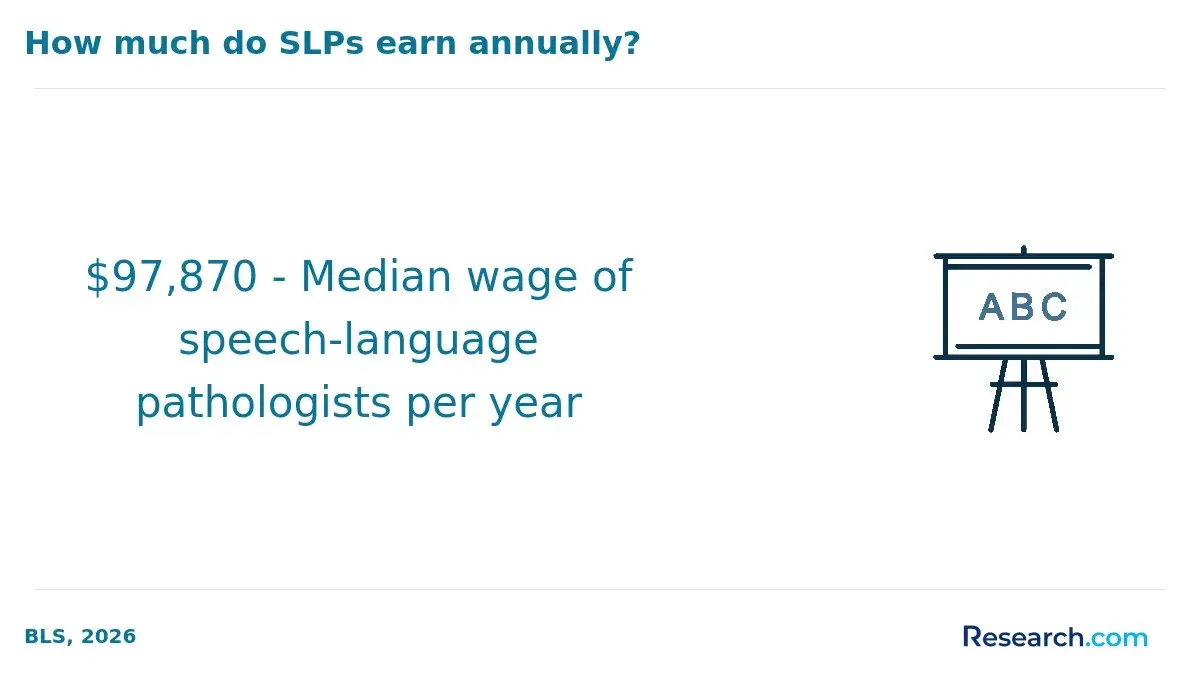
The Bureau of Labor Statistics reports a median annual wage of $97,870 for speech-language pathologists in May 2025. That figure is useful for long-term career planning, but it should not be used to justify any particular tuition level or debt amount: earnings vary by setting, state, experience, hours worked, and licensure status. Review the broader context of speech pathologist salary with a master's degree alongside your own borrowing and placement constraints.
This cost framework helps applicants estimate expenses that may not appear in a tuition calculator.
| Cost category | Why it occurs | Planning question |
| Tuition and program fees | Clinical courses may carry the same tuition rate as didactic courses, plus university fees | Are clinical-semester charges included in the published program estimate? |
| Compliance expenses | Background checks, immunizations, drug screening, CPR, liability insurance, and training may be required | Which items recur before each placement or academic year? |
| Travel and parking | Assigned sites may be outside the student's preferred commute area | What is the maximum commute or travel expectation stated in writing? |
| Temporary housing | Some rotations or immersions require short-term relocation | Could you afford housing while continuing to pay rent or a mortgage at home? |
| Lost wages | Clinical hours may conflict with a job's daytime schedule | Can you reduce work hours, use leave, or rely on savings during practica? |
| Delayed completion | A cancelled or postponed placement can extend enrollment and living costs | What happens financially if a placement must be repeated or rescheduled? |
Ask the financial aid office whether enrollment during clinical terms affects aid eligibility, loan disbursement timing, or part-time status. Also ask whether the university charges a separate placement, distance-learning, technology, or graduation fee. Avoid comparing one program's per-credit price to another program's total cost unless both calculations include the same required credits and mandatory charges.
What risks do online SLP students face when placements fall through, and how can they protect themselves?
Placements can fall through for reasons outside a student's control: a supervisor may leave, a facility may pause student training, an affiliation agreement may stall, census or caseload may change, or a student may not complete onboarding by the site deadline. These events do not necessarily indicate a poor program, but the program's response determines whether the disruption becomes a brief adjustment or a delayed graduation.
The highest-risk assumption is that a verbal "yes" from a local clinician equals a confirmed placement. A placement is not secure until the university has approved the site and supervisor, required agreements are complete, and the student has met all compliance conditions.
Students can reduce avoidable risk with a documented approach.
- Obtain the clinical handbook before enrollment and identify placement deadlines, travel expectations, student responsibilities, and withdrawal consequences.
- Complete health, background, CPR, insurance, and training requirements early, since some documents take weeks to obtain or process.
- Respond quickly to coordinator requests and disclose schedule, transportation, employment, and geographic limitations before matching begins.
- Keep written records of approvals and submit hour logs on time; do not rely on informal messages as proof of placement status.
- Ask what happens if a site cancels after a term begins, including whether the program can arrange a replacement, extend the term, or require a repeat placement.
Students should also avoid resigning from employment or signing a long-term lease based solely on an anticipated placement date. Wait for formal confirmation and maintain a backup financial plan. If a program cannot explain its cancellation policy, historical approach to out-of-area students, or expected student flexibility, treat that uncertainty as a material enrollment risk.
How can prospective SLP students compare clinical placement outcomes and disclosures across online programs?
The best comparison is not "Does the program arrange placements?" Nearly every legitimate program provides some level of oversight. The better question is how reliably the program converts a student's location, eligibility, schedule, and career goals into approved clinical experiences that permit timely progression.
Start with programs that can legally enroll students where they live and that hold appropriate accreditation status. Then compare the specificity of each school's placement disclosures. A program that states its process, timelines, travel expectations, and student responsibilities is easier to evaluate than one that offers only a broad assurance of support.
Use this comparison framework when speaking with each program. It focuses on information that directly affects completion risk and real-world fit.
| Comparison factor | Stronger disclosure | Questionable disclosure |
| Geographic eligibility | Lists state authorization and professional licensure information by state | States only that the program is online or nationally available |
| Placement process | Explains who finds sites, approval steps, and matching timeline | Says "placements are supported" without details |
| Travel expectations | States that travel or relocation may be required and explains how assignments work | Implied local access without a written policy |
| Student-proposed sites | Defines whether they are allowed and how affiliation review works | Encourages students to find sites but provides no approval process |
| Contingency planning | Describes procedures for cancellations, compliance delays, and replacement efforts | Does not address what happens when a site falls through |
| Cost transparency | Separates tuition, mandatory fees, and likely clinical requirements | Shows tuition only |
Do not select solely on rankings, brand recognition, or the shortest advertised completion time. A program with fewer local connections may be a worse fit than one with a longer schedule but a well-established placement process in your region. For applicants prioritizing affordability, compare total attendance costs and placement-related logistics while reviewing speech pathologist masters online options.
It is also reasonable to ask for aggregate information, such as whether students generally complete placements on schedule or whether the program has placed learners in your state. Schools may not be able to disclose site names, individual outcomes, or informal partner details, but they should be able to explain their systems and limitations honestly.
What questions should online SLP applicants ask admissions, clinical coordinators, and sites before enrolling?
Admissions representatives can explain program format, but clinical coordinators usually provide the clearest answers about placement operations. Ask questions in writing, especially if you have a location, employment, disability accommodation, caregiving, immigration, transportation, or licensure constraint that could affect clinical participation.
The questions below help applicants obtain usable commitments and identify where an answer remains uncertain.
- Is my state currently eligible for enrollment, clinical placement, and the licensure pathway I intend to pursue after graduation?
- Does the university assign placements, ask students to locate sites, or use a shared-responsibility model?
- Has the program recently placed students in my state or region, and what general travel flexibility should I expect?
- Can I request pediatric, adult, school, medical, bilingual, or telepractice experience, and which preferences cannot be guaranteed?
- When are placements usually confirmed, and what happens if a site cancels or an affiliation agreement is delayed?
- What credentials, training, and documentation must a clinical educator provide before a placement is approved?
- What clinical requirements may conflict with full-time employment, including weekday hours, campus visits, or intensive terms?
- Which placement-related expenses are mandatory beyond tuition, and which are paid by the student?
- Can my employer serve as a placement site, and how does the program manage supervision and conflicts of interest?
- Who can provide a written explanation of my responsibilities and the program's placement obligations before I enroll?
For a prospective site, the university - not the applicant - should ordinarily handle formal affiliation and academic requirements. Students can professionally ask whether the organization accepts graduate SLP trainees and whether it is open to contact from their program, but they should avoid pressuring a clinician to commit before the university completes its review.
The strongest applicant is not the one who demands a guaranteed specialty placement. It is the one who has a clear career goal, realistic geographic flexibility, a workable financial plan, and written confirmation that the program can support the required clinical pathway.
Other Things You Should Know About Speech Language Pathology
Usually no. Coursework may be online, and some telepractice may be possible, but clinical education requires approved supervised experiences with real clients. Requirements, site policies, and state rules determine which activities can be completed remotely.
Some programs allow students to suggest sites or introduce local contacts. However, the university must approve the setting and supervisor, complete any required affiliation agreement, and authorize the placement before clinical hours begin.
Most required graduate practica are unpaid educational experiences. A student should not assume compensation, even when completing substantial hours at a school, clinic, hospital, or rehabilitation facility.
It may be difficult during clinical terms because sites commonly operate on weekday schedules and may require a substantial time commitment. Ask each program for typical practicum scheduling expectations and plan for reduced work availability if needed.
References
- Online MA in Communication Sciences & Disorders https://onlinelearning.csuohio.edu/programs/online-masters-communication-sciences-disorders
- Speech-Language Pathology | PennWest Global Online https://online.pennwest.edu/programs/speech-language-pathology-grad/index.php
- Best Speech-Language Pathology Programs in America https://www.usnews.com/best-graduate-schools/top-health-schools/pathology-rankings