2027 Best Online Speech Pathology Master's Programs for Residents of Wichita, KS

Co-Founder and Chief Data Scientist

Reviewed by Rhea Paul, PhD
SLP Education & Research Expert
Wichita residents can complete much of a speech-language pathology master's degree online, but the degree cannot be evaluated like a typical online graduate program. Kansas licensure, ASHA CAA accreditation, supervised clinical hours, placement support, and required travel matter as much as tuition. This guide compares credible distance-learning options and shows how to verify whether a program can support your path from graduate student to Kansas speech-language pathologist.
Key Things You Should Know
- Choose an ASHA Council on Academic Accreditation (CAA)-accredited master's program first: this is the standard route to ASHA certification and is generally essential for Kansas licensure and employer confidence.
- Online SLP programs still require substantial supervised clinical education, including at least 400 practicum hours under ASHA standards; a Wichita placement is never automatic and should be confirmed in writing before enrollment.
- Career demand supports careful planning: the U.S. Bureau of Labor Statistics projects 17% employment growth for speech-language pathologists from 2025 to 2035, but tuition, travel, prerequisite courses, and clinical scheduling can materially affect the value of a program.
Which online speech pathology master's programs accept Wichita residents and offer distance learning?
For Wichita residents, the strongest starting point is a CAA-accredited program that offers distance-delivered academic coursework and has a clear process for arranging off-campus practicum. Enrollment permission can change by state authorization rules, cohort capacity, and clinical-placement availability, so applicants should obtain a Kansas-specific confirmation from each admissions office before paying a deposit.
The programs below are established distance-learning or hybrid-distance options worth investigating. They are not interchangeable: the amount of live instruction, travel, placement responsibility, and cost disclosure differs substantially. Compare them with broader best online speech pathology programs research, then confirm the details that apply to your individual Kansas enrollment.
| Program | Distance-learning model | Clinical-training consideration for Wichita residents | Best fit |
| Emerson College, M.S. in Communication Disorders | Online coursework with required clinical education and immersion-style components | Clinical sites are coordinated through the program process; ask whether local placement availability can affect progression | Students seeking a well-established online cohort model |
| New York University, M.S. in Communicative Sciences and Disorders | Online graduate coursework with clinical education requirements | Ask specifically about Kansas authorization, site approval, and any required in-person experiences | Students comfortable with a structured private-university online model |
| Baylor University, M.S. in Speech-Language Pathology | Distance-accessible coursework combined with required hands-on clinical preparation | Confirm how clinical placements, simulation, skills training, and travel are handled for a Kansas resident | Students wanting a cohort-based program with defined clinical expectations |
| University of Cincinnati, M.A. in Communication Sciences and Disorders | Online or distance-accessible academic components with clinical requirements | Verify current Kansas eligibility, placement procedures, and any campus or regional attendance requirements | Students comparing public-university and flexible-format options |
"Online" generally describes where lectures and coursework occur, not where all training occurs. A school may accept Kansas residents academically but be unable to promise a practicum site near Wichita for every cohort. Treat eligibility, accreditation, and clinical feasibility as separate questions.
How to narrow the list
Ask each school for a written answer to the same questions before applying. This avoids comparing marketing language rather than enrollment realities.
- Can a resident physically located in Kansas enroll in the next available cohort?
- Is the specific degree pathway currently CAA accredited, rather than merely offered by a university with another accredited SLP program?
- Does the school arrange, approve, or require students to find clinical placements?
- What travel, campus intensives, skills assessments, or synchronous class times are mandatory?
- Does the school state that its curriculum is designed to meet Kansas educational requirements for SLP licensure?
Which online speech pathology master's programs qualify graduates for Kansas SLP licensure?
A CAA-accredited master's degree is the safest educational foundation for a Wichita resident pursuing Kansas licensure and the Certificate of Clinical Competence in Speech-Language Pathology (CCC-SLP). Graduation alone does not create a license: candidates must also meet Kansas requirements, pass the Praxis examination when required, and complete the post-graduate supervised clinical fellowship requirements applicable to their credentialing path.
Use the term "qualify" carefully. A program can provide the education needed to pursue licensure, but the Kansas licensing authority - not the university - determines whether an individual applicant meets every requirement. Programs should provide a Kansas professional-licensure disclosure; if a school says it has not determined whether its program meets Kansas requirements, pause before enrolling.
When comparing asha accredited online SLP programs, verify the program's current CAA listing rather than relying on an institution's general accreditation or an older web page. Institutional accreditation permits a college to award degrees; CAA accreditation specifically evaluates professional preparation in speech-language pathology.
| Milestone | Why it matters for a Kansas applicant | Who verifies it |
| CAA-accredited master's degree | Provides the recognized graduate education framework for clinical SLP preparation | CAA and the university |
| Required supervised practicum | Documents hands-on clinical preparation, including direct client contact and observation requirements | University clinical program |
| Praxis examination | Is commonly part of the path toward national certification and state credentialing | Testing provider and licensing authority |
| Clinical fellowship | Provides supervised post-graduate professional experience before independent certification | Employer, supervisor, ASHA, and applicable state authority |
| Kansas license application | Authorizes practice in Kansas after the state reviews the applicant's credentials | Kansas Department for Aging and Disability Services |
A Kansas resident who expects to work in a school district should also check school-employment credential rules with the prospective employer or relevant education agency. A state professional license, national certification, and school hiring requirements can overlap without being identical.
How do Wichita-accessible online speech pathology programs differ in format, pacing, and clinical intensity?
The practical difference between online SLP master's programs is not simply asynchronous versus live classes. Because SLP is a clinical profession, the schedule usually becomes less flexible once practicum begins. A program may allow evening coursework early in the curriculum but require daytime client sessions, supervisor meetings, and fixed clinical deadlines later.
Students considering accelerated completion should distinguish a compressed curriculum from a manageable workload. 5-year accelerated speech pathology programs can make sense for undergraduates who commit early, but they are usually not a shortcut for career changers who still need prerequisite science and communication-disorders coursework.
| Format feature | What it can mean in practice | Who it may suit |
| Mostly asynchronous coursework | Recorded lectures and weekly deadlines may offer greater scheduling control, although group work and exams can still be timed | Working students with predictable schedules |
| Live online classes | Attendance may be required at set times, often on Central or Eastern Time schedules | Students who want regular faculty interaction and can protect meeting times |
| Full-time cohort | Courses follow a fixed sequence; falling behind can delay clinical progression | Students ready to prioritize school |
| Part-time pathway | May spread academic courses over more terms, but clinical placements can still require intensive availability | Students who need a slower academic pace |
| On-campus immersion or skills residency | Requires travel for assessment, simulation, lab instruction, or orientation | Students able to budget for travel and time away from work |
| Externship or practicum term | Often involves daytime hours at a school, hospital, clinic, or other approved site | Students with enough schedule flexibility for clinical training |
For a working Wichita applicant, the most important question is often not "Can I study online?" but "Can I reduce work hours when clinical assignments begin?" Programs that are academically flexible may still be clinically intensive. Ask for a term-by-term sample schedule and the typical range of weekly availability expected during practicum.
Which accreditors oversee online speech pathology master's programs and why does ASHA CAA matter?
Two types of accreditation matter, but they answer different questions. Institutional accreditation evaluates the college or university as a whole. Programmatic accreditation from the American Speech-Language-Hearing Association's Council on Academic Accreditation in Audiology and Speech-Language Pathology, commonly called ASHA CAA, evaluates whether a specific graduate program meets professional education standards.
CAA status matters because it is central to the conventional route toward ASHA certification and supports portability as graduates move among employers and states. It also signals that the program has been reviewed for curriculum, faculty, resources, student assessment, and clinical education. It does not mean every individual student is guaranteed certification, a job, a local placement, or a Kansas license.
| Recognition type | What it evaluates | Why Wichita applicants should care |
| Institutional accreditation | The institution's academic quality and governance | Can affect federal financial-aid eligibility and degree legitimacy |
| ASHA CAA accreditation | The specific graduate professional program in speech-language pathology | Is the key professional accreditation to verify before choosing an SLP master's pathway |
| CAA candidacy or developing status | A program's progress toward accreditation rather than full accredited status | Requires especially careful review of what status means for the cohort and certification pathway |
| Kansas licensure review | An individual applicant's compliance with state requirements | Determines authority to practice in Kansas; it is not replaced by accreditation |
A common mistake is assuming that a university's regional or institutional accreditation is enough. For someone whose goal is clinical SLP practice, selecting a master's program without confirming CAA status can create a costly barrier to certification and licensure later.
How can Wichita students verify a program's ASHA CAA accreditation and institutional recognition status?
Verification should take place before application fees, deposits, or loans are committed. Accreditation status can change, and a university may operate multiple locations or delivery pathways whose approvals are not identical. Check the exact degree name, campus or delivery location, and current cohort status.
Use this short verification process to create a record you can rely on if policies change or a future employer asks for documentation.
- Search the ASHA CAA program directory for the exact university, degree, and location or delivery pathway.
- Read the university's current catalog and program webpage for the degree title, accreditation statement, and any status limitations.
- Confirm that the university itself is institutionally accredited through its stated accreditor and recognized accreditation records.
- Request the school's current Kansas professional-licensure disclosure by email and save the response with the date and staff member's name.
- Contact the Kansas licensing authority if your prior degree, clinical history, international education, or planned practice setting creates an unusual situation.
Do not rely only on an admissions representative's verbal assurance, social-media posts, or a general statement that "graduates are prepared for licensure." A useful written disclosure identifies the state, the program, and whether the institution has determined that its curriculum meets, does not meet, or has not determined alignment with Kansas requirements.
What clinical placement arrangements do online SLP programs offer for students living in Wichita?
Online SLP programs generally use one of three models: the university places students, the university develops placements with student input, or the student identifies potential sites that the university must approve. The wording matters. "Assistance" does not necessarily mean a guaranteed clinic, school, hospital, or supervisor in Wichita.
CAA standards for SLP graduate education include at least 400 clock hours of supervised clinical practicum, including at least 375 hours of direct client contact and 25 hours of guided clinical observation. Those minimums explain why a fully remote academic curriculum still requires real-world training under qualified supervision.
| Placement model | Potential advantage | Potential risk or trade-off |
| University-arranged placement | Reduces the student's responsibility for initial site outreach | Location, population served, schedule, and travel distance may not be fully student-controlled |
| Collaborative placement development | May let a student suggest Wichita-area sites and leverage local contacts | Approval and contracting can take time; a suggested site may not be accepted |
| Student-identified placement | Can offer local flexibility when the student has professional connections | Places substantial administrative work and uncertainty on the student |
| University clinic or regional rotation | Provides access to established supervisors and clinical resources | May require travel, temporary housing, or time away from Wichita employment |
Before choosing a program, ask whether it has placed recent students in the Wichita metro area, whether students must travel for any rotation, who secures affiliation agreements, and what happens if a site withdraws. A school may be unable to disclose specific sites because contracts and capacity change, but it should clearly explain its contingency process.
Students should also plan for clinical scheduling realities. School-based practicum follows school calendars, while medical and outpatient settings may involve daytime hours, background checks, immunizations, drug screens, liability requirements, and unpaid clinical time. These costs and constraints belong in the decision alongside tuition.
How does Kansas state authorization affect enrollment in out-of-state online speech pathology programs?
State authorization is a consumer-protection issue: an out-of-state university generally needs permission to deliver distance education to a student located in Kansas. Kansas participation in interstate distance-education arrangements can simplify authorization for eligible institutions, but it does not automatically resolve professional licensure or clinical-placement questions.
For SLP students, there are three separate approvals to verify. The school must be permitted to enroll a Kansas resident, the school must be able to support clinical education involving Kansas sites or residents, and the curriculum must align with Kansas licensure requirements. A "yes" to the first question is not proof of the other two.
Ask admissions for the program's current Kansas enrollment status and ask the clinical education office whether it can approve Kansas practicum sites. Then compare that answer with the school's professional-licensure disclosure. If the disclosure says the institution has not made a determination for Kansas, request clarification before enrolling rather than assuming CAA accreditation alone settles the matter.
Students planning to relocate during the program should repeat this review for the new state before moving. The state where a student is physically located during distance education and clinical training can affect authorization, placement approval, and disclosure obligations.
What should Wichita residents know about tuition, fees, and residency-based costs for online SLP degrees?
Online does not necessarily mean lower cost. Private programs often use one tuition rate regardless of residence, while public universities may charge different rates for in-state, out-of-state, or distance students. Because online SLP programs vary in credits, prerequisite needs, fees, and travel, comparing only a posted per-credit rate can be misleading.
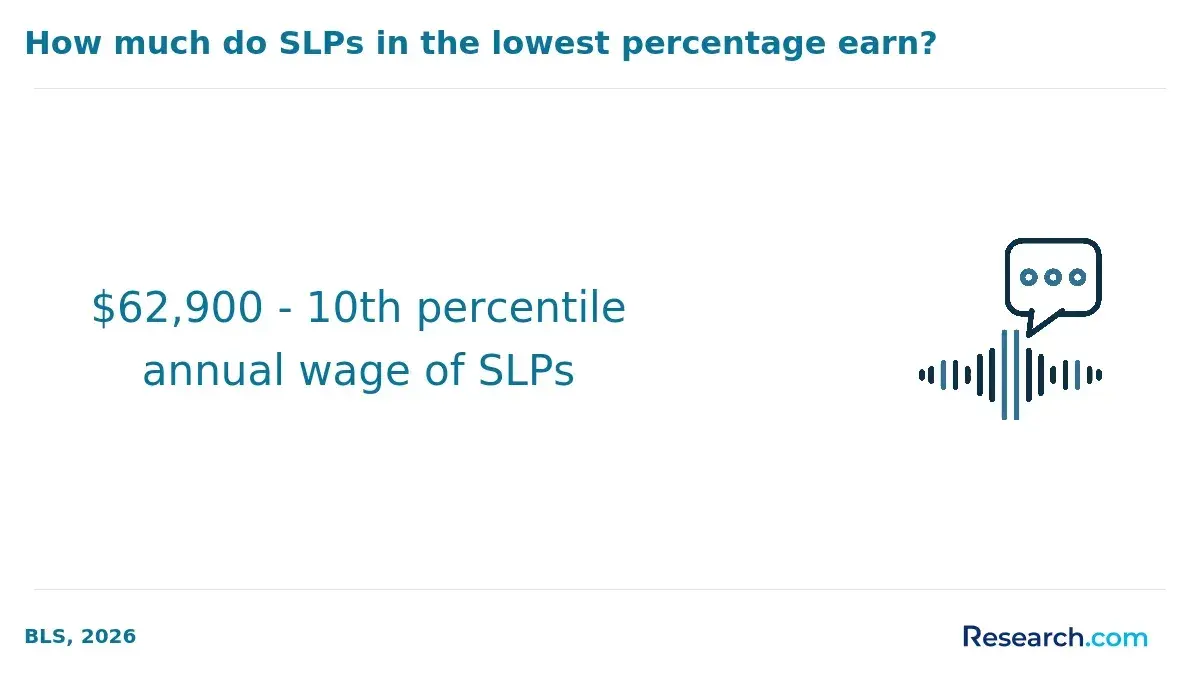
The financial upside should be considered realistically. The U.S. Bureau of Labor Statistics reports a median annual wage of $97,870 for speech-language pathologists in May 2025. That national figure is not a Wichita salary guarantee, but it helps explain why applicants should compare total borrowing against likely local earnings, repayment obligations, and time away from paid work rather than selecting a program solely on sticker price.
Use the speech pathologist salary context as a starting point, then check compensation in the Wichita settings you may actually enter, such as schools, hospitals, rehabilitation facilities, early-intervention providers, or private practices.
| Cost category | Why it may vary | What to request |
| Base tuition | May be charged per credit, per term, or as a cohort rate; residency rules differ | Total tuition for the required degree credits |
| University and technology fees | Online learning, student services, clinical administration, and graduation fees may be separate | A term-by-term mandatory-fee estimate |
| Prerequisite or leveling courses | Career changers may need coursework before admission or alongside the program | Required courses, provider options, and estimated added cost |
| Clinical and compliance costs | Background checks, health clearances, insurance, testing, and site requirements can be student-paid | A list of expected clinical expenses |
| Travel and lodging | Residencies, skills labs, and distant placements may require trips or temporary housing | Required travel dates and location assumptions |
| Lost earnings | Clinical schedules can limit employment, especially in later terms | Typical practicum availability expectations |
Apply for federal financial aid only after confirming the program's institutional eligibility and your likely enrollment intensity. Also ask about scholarships, employer tuition assistance, payment plans, and whether aid applies to prerequisite classes. Avoid interpreting an estimated cost of attendance as a bill: it may include living expenses that vary by student.
How do online speech pathology programs support Praxis exam preparation and first-time pass rates?
Praxis preparation is usually built into a CAA-accredited curriculum through comprehensive examinations, case-based coursework, faculty feedback, and review of professional standards. However, the quality and visibility of that support varies. Some schools publish outcomes and review resources; others provide individualized advising but do not publish a simple first-time pass-rate figure.
First-time pass rates can be useful only when interpreted in context. Ask for the reporting period, number of test takers, whether the figure is first-attempt or eventual passage, and whether it applies to the exact distance-delivery program. A small cohort can make a percentage appear unusually high or low, and a passing rate does not measure placement quality, debt, or readiness for every work setting.
Applicants should ask each program whether it offers structured Praxis review, practice exams, faculty advising for unsuccessful attempts, and outcome disclosures required through its accreditation process. The better question is not merely "What is your pass rate?" but "How will you identify and support me if I am not ready by graduation?"
Plan the examination timeline with the university and Kansas licensing authority rather than booking solely based on classmates' schedules. Testing, transcript, graduation, fellowship, and state application timing may not align automatically.
What consumer-protection steps should Wichita applicants take when comparing online speech pathology programs?
Applicants make the safest decision when they document the promises that affect licensure, clinical progression, and cost. This is especially important for an online clinical degree because a polished website may not explain state eligibility, placement contingencies, or fees in enough detail to support an enrollment decision.
Before accepting an offer, complete the following checks and retain copies of all responses.
- Verify current CAA status for the exact master's program and delivery pathway, not just the university name.
- Get written confirmation that Kansas residents may enroll and request the program's Kansas professional-licensure disclosure.
- Ask whether clinical placements are guaranteed, coordinated, student-sourced, or subject to geographic capacity limits.
- Request the full required-credit total, tuition schedule, mandatory fees, expected clinical expenses, and travel requirements in writing.
- Review the academic calendar for live class times, clinical availability, leave policies, deceleration options, and consequences of a delayed placement.
- Confirm prerequisite requirements and whether missing courses must be completed before admission, during enrollment, or through a separate provider.
- Compare refund, withdrawal, transfer-credit, remediation, and dismissal policies in the graduate catalog rather than relying on verbal descriptions.
Common red flags include vague answers about Kansas licensure, a promise that students "usually" find their own placements without a backup plan, and tuition estimates that omit clinical or travel costs. Another mistake is choosing a program based on speed while overlooking whether the clinical schedule is compatible with work and caregiving responsibilities. The best program is the one that provides a verified route through accreditation, training, affordability, and Kansas eligibility - not simply the one with the most online coursework.
Other Things You Should Know About Speech Language Pathology
Yes, potentially. Many programs consider applicants from other majors, but they commonly require foundational coursework in communication disorders, phonetics, language development, anatomy, audiology, and statistics. The amount of leveling work varies, so calculate its time and cost before comparing program length.
Often, yes. Requirements vary by program and may include orientation, simulation, clinical skills assessment, or intensive laboratory instruction. Obtain the required dates, location, and attendance policy before enrolling because travel is a meaningful cost and scheduling factor.
Some students work while completing early coursework, but full-time employment can be difficult during practicum and externship terms. Clinical education commonly requires daytime availability and may follow the schedule of a school, clinic, or medical setting. Review a sample term-by-term schedule before deciding.
The timeline depends on the program, Praxis timing, completion of supervised post-graduate fellowship requirements, and Kansas application processing. Ask the university how graduates sequence these steps, then verify current requirements directly with the Kansas licensing authority before making career or financial commitments.
References
- Master of Arts in Communication Sciences https://www.wichita.edu/slp
- Graduate Degree Programs | Speech-Language-Hearing https://splh.ku.edu/graduate-degree-programs
- 2026 Most Affordable Online Speech Pathology Master's... https://www.onlineu.com/most-affordable-colleges/speech-pathology-masters-degrees
- Best Online Speech Pathology Programs https://www.forbes.com/advisor/education/healthcare/best-speech-pathology-programs-online/
- Online Master's in Speech Pathology Programs: 2026 Guide https://speechpathologymastersprograms.com/
- Are there affordable online masters programs for SLP? https://www.facebook.com/groups/123939594310021/posts/26444501675160454/
- Masters SLP programs - preferably online: r/slpGradSchool https://www.reddit.com/r/slpGradSchool/comments/s5p0p0/masters_slp_programs_preferably_online/