2027 SLP Career Change After 40: Compare Training Time, Costs, and Program Formats

Co-Founder and Chief Data Scientist

Reviewed by Rhea Paul, PhD
SLP Education & Research Expert
Changing careers into speech-language pathology after 40 can be realistic, but it is a substantial education, financial, and scheduling commitment. Most career changers need prerequisite coursework plus a CAA-accredited master's degree, supervised clinical training, a post-graduate fellowship, and state licensure.
This guide helps you compare the time, cost, format, and career trade-offs before applying. It is designed to help you decide whether the SLP path fits your household responsibilities, finances, academic background, and long-term work goals.
Key Things You Should Know
- Most career changers need about 3 to 5 years from starting prerequisites to independent practice: commonly 1 to 2 years of leveling coursework, about 2 years for a master's degree, and a 36-week Clinical Fellowship.
- A CAA-accredited graduate degree is the safest route for national certification and state licensure; a program's online delivery does not remove clinical-placement, travel, or state-authorization requirements.
- The May 2025 median annual wage for speech-language pathologists was $97,870, while BLS projects 17% employment growth from 2025 to 2035; those figures support demand but do not offset an unaffordable debt load or guarantee an individual salary.
How realistic is an SLP career change after 40, and who is it best suited for?
An SLP career change after 40 is realistic for people who can commit to graduate-level science coursework, intensive clinical training, and a period of reduced earning capacity. Age itself is not a barrier to admission or licensure. The more important questions are whether you can meet prerequisite requirements, manage full-time clinical rotations, finance the degree responsibly, and tolerate a timeline that may extend beyond the master's program.
Speech-language pathologists assess and treat communication, speech, language, swallowing, cognitive-communication, and voice disorders. They work with children and adults in schools, hospitals, outpatient clinics, rehabilitation facilities, skilled-nursing settings, home health, and private practice. The work blends science, counseling, documentation, education, and one-to-one or small-group care.
This path tends to fit career changers who want a regulated clinical profession, enjoy direct service, and can handle a structured credentialing process. Former teachers, special educators, behavioral-health professionals, nurses, case managers, linguists, caregivers, and corporate trainers often bring transferable communication and relationship-building skills. Those strengths help, but they do not replace the required academic and clinical preparation.
The following comparison can help distinguish a promising career pivot from one that may create avoidable strain.
| Career-changer profile | Why SLP may fit | Important caution |
| Former teacher or special educator | Experience with learning differences, families, schools, and progress monitoring can transfer well. | School-based work may involve lower pay than some medical settings, and graduate practica may still require daytime availability. |
| Healthcare or rehabilitation professional | Comfort with documentation, patient care, anatomy, and interdisciplinary teams can ease the transition. | Check whether prior coursework satisfies communication-sciences prerequisites; professional experience usually does not substitute for them. |
| Business, communications, or nonprofit professional | Client communication, project management, advocacy, and presentation skills are valuable. | Expect more foundational science coursework and a longer pre-master's timeline. |
| Parent or caregiver seeking a flexible profession | Some settings offer predictable schedules, especially schools and outpatient practices. | Graduate clinic and externship schedules are often fixed, daytime, and difficult to complete around full-time work. |
| Person seeking a quick salary increase | National demand is favorable and the occupation has a strong median wage. | It is usually not a quick pivot; tuition, lost income, and licensing time can materially delay financial payoff. |
Before applying, test the fit through observation opportunities permitted by local providers, informational interviews, or related support roles. Ask practicing SLPs about paperwork, productivity expectations, family communication, medical documentation, and the emotional demands of treating people with progressive, developmental, or acute conditions. Do not base a decision only on the appealing parts of therapy sessions.
How long does it take to become a licensed SLP if you start after age 40?
For a career changer without a communication sciences and disorders background, a realistic planning range is about 3 to 5 years from the first prerequisite class to completion of a Clinical Fellowship. A person who already has most prerequisite courses may finish closer to the shorter end; someone studying part time, repeating science courses, or needing a longer leveling sequence may need more time.
The master's degree is not the entire timeline. A qualifying program includes academic coursework and supervised clinical education, after which most new graduates complete a paid Clinical Fellowship while moving toward independent practice and the Certificate of Clinical Competence in Speech-Language Pathology, commonly called the CCC-SLP.
This timeline separates stages that applicants often mistakenly combine when comparing programs.
| Stage | Typical planning range | What determines the length |
| Prerequisites or leveling coursework | About 1 to 2 years | Prior transcript, course sequencing, lab availability, and whether study is part time or full time |
| CAA-accredited master's program | Often about 2 years full time | Program calendar, cohort sequence, clinic requirements, and externship scheduling |
| National examination and graduation processing | Varies | Testing date, degree conferral, transcript timing, and state application requirements |
| Clinical Fellowship | At least 36 weeks and 1,260 hours for the CCC-SLP pathway | Work schedule, qualifying supervision, employer onboarding, and state rules |
| State license issuance | Varies by jurisdiction | Board processing, background checks, examination verification, fellowship documentation, and any temporary-license rules |
A so-called accelerated option can reduce calendar time only when it still includes all required academic and clinical components. Review any accelerated SLP master's program carefully for its course load, clinical-calendar expectations, required travel, and eligibility for your state. Accelerated does not necessarily mean part-time-friendly.
For many adults over 40, the practical bottleneck is not lecture coursework; it is the clinical schedule. Even online programs typically require supervised placements during conventional business hours. Build a household and employment plan around those periods before committing a deposit.
What are the all-in costs of SLP training after 40, from prerequisites to licensure?
The true cost of becoming an SLP is broader than graduate tuition. A useful budget includes leveling courses, application expenses, fees, travel, clinical clothing or equipment, lost work time, examination costs, licensure, and the financial effect of completing unpaid or low-flexibility clinical placements. Program prices vary widely by residency status, institution, credit requirements, and mandatory fees, so comparing a single advertised per-credit price can be misleading.
Use the following categories to construct an all-in estimate for each school. Request written figures from the university because published tuition may change by academic year and may exclude required charges.
| Cost category | What to include | Why it matters after 40 |
| Prerequisite education | Tuition, lab charges, textbooks, transcript evaluations, and any post-baccalaureate fees | These courses may not be eligible for the same aid structure as a degree program and can extend the timeline. |
| Graduate tuition and mandatory fees | Total required credits, university fees, clinical fees, technology fees, and graduation fees | Compare the full degree cost, not a single term or per-credit figure. |
| Clinical-placement expenses | Commuting, parking, housing if needed, background checks, immunizations, drug screening, liability coverage, and attire | Placement locations and schedules may change, creating costs that are hard to predict early. |
| Application and testing costs | Application-system charges, transcript requests, admissions testing if required, and national examination fees | Applying broadly can be useful but raises upfront spending. |
| Licensure and certification | State application, fingerprinting, initial license, temporary-license, and certification-related costs where applicable | These costs arrive around graduation, when savings may already be strained. |
| Opportunity cost | Reduced work hours, lost employer benefits, child care, and delayed retirement contributions | For midlife applicants, this can exceed smaller line items such as books or application fees. |
A sound comparison uses three numbers: total direct educational cost, expected borrowing, and the income reduction required to finish clinical training. Keep these separate. A lower-tuition program may be more expensive overall if it requires frequent travel, cannot be completed while employed, or delays completion because prerequisites must be taken elsewhere.
Also examine repayment risk before accepting loans. Federal graduate borrowing may include Direct Unsubsidized Loans, subject to annual and aggregate limits, and Grad PLUS loans up to the school's cost of attendance after other aid. Borrowing eligibility is not the same as affordability. Estimate a conservative repayment scenario using your expected setting, geographic area, taxes, household obligations, and retirement needs rather than assuming you will immediately earn the national median.
How do SLP master's program formats compare for midlife career changers, including online and hybrid options?
SLP master's programs are commonly campus-based, hybrid, or online with in-person clinical requirements. "Online" usually describes academic coursework, not the entire professional training experience. Students still need supervised client contact, external placements, and sometimes campus intensives or skills assessments.
The best format depends on your location, work flexibility, learning preferences, and ability to travel - not simply on whether you prefer remote classes. Review online speech therapy programs as options to investigate, then verify that each program accepts residents of your state and can support its required clinical education.
This comparison highlights the trade-offs that matter most for a midlife career transition.
| Format | Potential advantages | Common limitations | Best fit |
| Campus-based | Regular access to faculty, university clinics, classmates, and campus services | Relocation or commuting may be necessary; class and clinic schedules are often daytime | Students who live near the program and can prioritize an immersive full-time structure |
| Hybrid | May reduce weekly commuting while retaining scheduled in-person training | Can require intensives, travel, synchronous meetings, and local placements | Students within practical travel distance who need some remote coursework |
| Online academic coursework with local placements | May broaden geographic choices and reduce relocation pressure | Placement availability, state eligibility, travel requirements, and live class times remain critical | Self-directed students with schedule flexibility and a confirmed state-eligibility path |
| Part-time pathway | May spread coursework and support continued employment early in the program | Often lengthens total time and may still require full-time availability for later clinical placements | Students with stable employment or caregiving duties who can accept a longer timeline |
Ask each admissions office for a written schedule of synchronous sessions, campus visits, and clinical expectations. Also ask who identifies placements, what happens if a placement falls through, whether students may need to travel outside their area, and whether the program has restrictions for residents of your state. Never assume a local placement is guaranteed because a program advertises online classes.
Technology is increasingly embedded in telepractice, electronic documentation, and data collection, but it has not removed the need for human clinical judgment and supervised training. A strong program should teach ethical use of technology while maintaining direct observation, feedback, and patient privacy safeguards.
Which SLP graduate programs are properly accredited, and why does CAA recognition matter for licensure?
For most applicants seeking the broadest route to professional practice, the key accreditation question is whether the master's program is accredited by the Council on Academic Accreditation in Audiology and Speech-Language Pathology, known as the CAA. CAA accreditation evaluates whether a program meets educational standards for speech-language pathology preparation.
CAA status matters because graduation from a CAA-accredited program is generally central to eligibility for ASHA certification and is widely relied upon by state licensing boards and employers. A program may be accredited, in candidacy, or pursuing a different status; those categories have different implications. Do not assume that institutional accreditation alone makes a professional program eligible for SLP licensure.
Before enrolling, verify the program's current status directly in the CAA or ASHA program directory and compare it with your state board's requirements. Accreditation and licensure are related but separate: accreditation evaluates the educational program, while the state board decides whether an individual may practice in that state.
Use this screening framework before paying an application fee or accepting admission.
- Confirm the exact degree program and campus or delivery pathway in the current CAA listing; do not rely on an old brochure or a recruiter's verbal statement.
- Read the program's professional-licensure disclosure for your state, including any statement that it cannot determine eligibility or cannot enroll residents of certain states.
- Ask whether the curriculum includes the supervised clinical education needed for graduation and how the program manages placement assignment.
- Check your state board's current rules for degree accreditation, examination, Clinical Fellowship, supervision, background checks, and temporary practice authority.
- Keep written records of the school's responses, catalog year, tuition quote, and disclosures in case policies change before enrollment.
Candidacy can be appropriate in some circumstances, but it requires extra care. Ask what protections apply if accreditation is not achieved as expected, how graduates have been treated by relevant licensing boards, and whether the school will put its contingency policies in writing. Avoid any program that responds vaguely to direct questions about accreditation or state eligibility.
What prerequisite coursework and GPA do SLP bridge or leveling programs typically require from career changers?
Career changers usually need foundational coursework in communication sciences and disorders before beginning graduate SLP study. Requirements differ by institution, but common subjects include phonetics, speech and hearing science, language development, anatomy and physiology of speech and hearing mechanisms, audiology, speech and language disorders, research methods, and statistics.
Many programs also expect general science preparation. Applicants may need coursework in biological science, physical science, statistics, and social or behavioral science to meet certification-related standards. Schools evaluate transcripts differently, so a course title alone does not establish equivalency.
There is no universal GPA threshold for all SLP programs. Schools may set an overall undergraduate GPA, a prerequisite GPA, a recent-credit GPA, or a separate minimum for graduate admission. Competitive admission can require substantially stronger academics than the stated minimum. If academic history is a concern, resources on easiest SLP grad schools to get into can help identify programs to research, but applicants should still verify current prerequisites, cohort capacity, and outcome requirements directly with each school.
This table distinguishes the common preparation routes.
| Route | How it works | Main trade-off |
| Standalone undergraduate courses | You take only missing prerequisites at a college or university. | Can be flexible and targeted, but sequencing may take longer and advising may be limited. |
| Post-baccalaureate leveling program | A structured set of CSD foundation courses prepares non-majors for graduate applications. | Provides clearer sequencing, but it may not guarantee admission to a graduate cohort. |
| Integrated extended master's pathway | Some universities combine leveling work and graduate study in a longer sequence. | Can simplify progression, but may limit school choice and require a larger early commitment. |
| Second bachelor's degree | You complete a full undergraduate CSD degree. | May provide broad preparation but is often longer than necessary for a person who already has a bachelor's degree. |
Do not take a generic set of courses without first making a target-school matrix. List every prerequisite, required grade, expiration policy if any, lab requirement, and application deadline for the programs you may realistically attend. Then have each target program review your transcript when that service is available. This reduces the common mistake of paying for courses that do not satisfy a school's specific requirements.
How do graduate assistantships, loan options, and employer tuition benefits affect SLP training affordability after 40?
Financial aid can lower direct cost, but it rarely eliminates the need for a household cash-flow plan. Graduate assistantships, scholarships, federal loans, employer assistance, and careful work scheduling can each help. Their value depends on whether they reduce tuition, provide wages, preserve benefits, or merely defer payment through borrowing.
Graduate assistantships may offer tuition support, a stipend, or both, but availability varies by university and department. They can be particularly difficult to combine with dense clinic schedules. Ask whether an award is guaranteed for more than one term, whether it requires a specific workload, and whether clinical education limits eligibility.
Compare funding options by their practical impact rather than their label.
| Funding source | Potential benefit | Key question to ask |
| Graduate assistantship | May offset tuition or provide a stipend | Can the required work hours coexist with clinic and externship obligations? |
| Institutional scholarship | May reduce tuition without repayment | Is the award renewable, and what GPA or enrollment level must be maintained? |
| Federal Direct Unsubsidized Loan | Provides graduate borrowing access within federal limits | What will the projected balance and monthly repayment look like under a conservative income estimate? |
| Grad PLUS Loan | May cover remaining cost of attendance after other aid | Is borrowing the remaining amount financially sustainable, not merely permitted? |
| Employer tuition benefit | May reduce out-of-pocket tuition or preserve employment benefits | Does the employer require continued service, approved coursework, reimbursement after payment, or full-time employment? |
| Part-time work | Can support living costs and reduce borrowing | Will the schedule remain workable when clinical rotations become daytime and intensive? |
Employer assistance is most useful when it has no restrictive repayment clause and can be used for the prerequisite or graduate work you actually need. Workers in education, health systems, insurance, government, and large employers may have tuition benefits, but eligibility, annual caps, and continued-employment rules vary. Get the policy in writing before structuring your education plan around it.
A practical approach is to create a semester-by-semester cash-flow forecast. Include tuition due dates, reduced work hours during practicum, health insurance, child care, travel, and emergency savings. If the plan works only when every scholarship, placement, and salary assumption goes perfectly, it is too fragile for most midlife career changers.
What is the realistic timeline from starting an SLP program to full state licensure and CCC-SLP?
Full state licensure and the CCC-SLP do not always occur on the same day because state rules, application processing, and employer requirements differ. Still, many graduates follow a similar sequence: complete a qualifying master's degree and clinical practicum, pass the required national examination, obtain any state authorization needed to begin fellowship employment, complete the Clinical Fellowship, and submit final certification and license documentation.
ASHA's certification pathway includes at least 400 clock hours of supervised clinical experience, including at least 25 observation hours and 375 hours of direct client or patient contact, as part of professional preparation. Its Clinical Fellowship requirement is at least 36 weeks and 1,260 hours. States may impose additional requirements, so these national benchmarks should not be treated as a substitute for board rules.
The sequence below is a planning tool, not a universal legal checklist.
| Milestone | Typical action | Potential delay point |
| Enter graduate program | Meet admission and prerequisite conditions. | Missing courses, transcript review, or a waitlisted cohort |
| Complete academic and clinical requirements | Finish degree coursework and supervised practicum. | Placement availability, remediation, required travel, or clinical-schedule conflicts |
| Graduate and complete examination requirements | Ensure score reporting and final transcript processes are in order. | Testing dates, score transmission, and degree-conferral timing |
| Obtain authority for fellowship practice | Apply for temporary, provisional, or other authorization if your state requires it. | Background checks, supervisor approval, and board processing |
| Complete Clinical Fellowship | Work under qualifying supervision while documenting required experience. | Changing employers, inadequate supervision, incomplete documentation, or reduced hours |
| Apply for final credentials | Submit fellowship verification and any state-specific materials for CCC-SLP and independent licensure. | Incomplete files or differing state renewal and jurisprudence requirements |
Start licensure planning before your final clinical term. Contact the licensing board in the state where you expect to work, not just the state where the university is located. Ask whether you need an initial limited license before beginning a fellowship, whether a supervisor needs prior board approval, and how long the board currently takes to process applications.
A common mistake is accepting a fellowship job before confirming that its supervisor, work setting, workload, and documentation system will satisfy both employer and credentialing requirements. Get clarity before the start date, especially if you may relocate during or immediately after graduation.
How do SLP salaries, job stability, and work settings compare to common pre-40 careers like teaching or business?
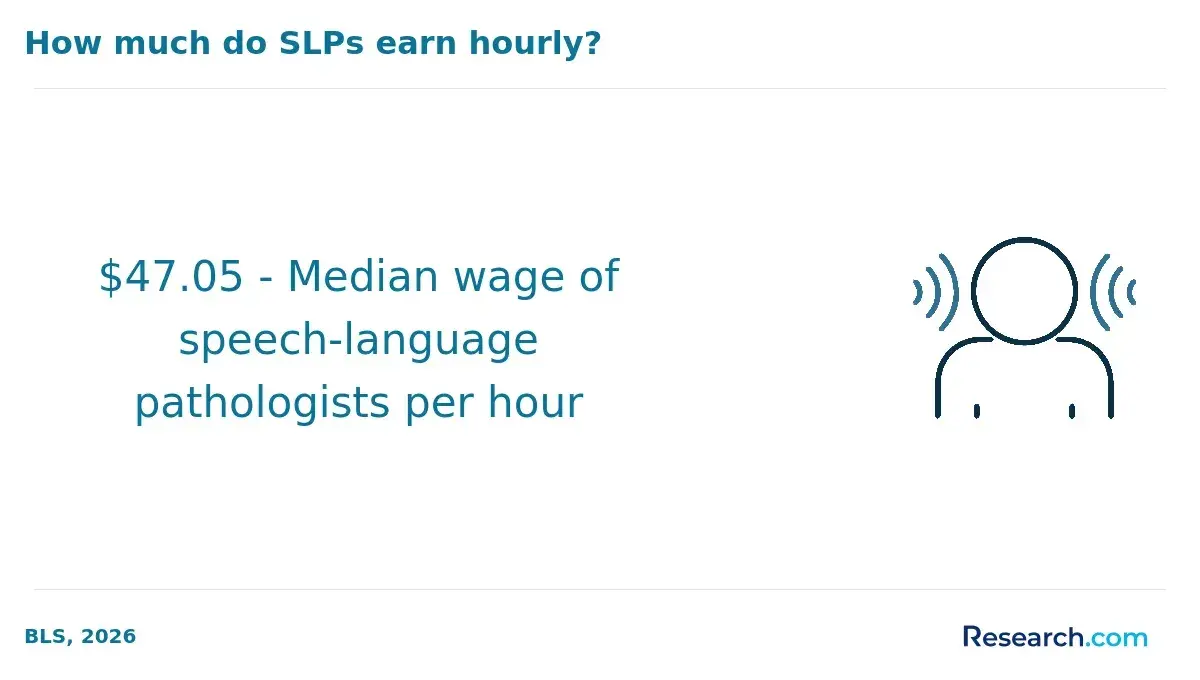
Speech-language pathology can offer a strong labor-market outlook, but salary and lifestyle vary substantially by setting, region, experience, productivity model, and caseload. The U.S. Bureau of Labor Statistics reports a median annual wage of $97,870 for speech-language pathologists in May 2025, or $47.05 per hour. That national median is useful as a broad benchmark, not as a personal salary forecast.
BLS projects 17% employment growth for speech-language pathologists from 2025 to 2035 and about 12,500 openings per year on average over the decade. For a midlife career changer, this suggests a favorable demand environment, but it does not eliminate local competition, licensure barriers, differences among employers, or the risk of taking on excessive education debt.
Compared with teaching or business roles, SLP work may provide more direct clinical specialization and healthcare-adjacent career mobility, while also introducing regulated practice requirements, documentation demands, and clinical productivity expectations. The most financially attractive setting is not always the best match for a person's schedule, tolerance for administrative pressure, or interest in children versus adults.
This setting comparison can help you identify the trade-offs behind salary discussions.
| Work setting | Typical appeal | Trade-off to investigate |
| Public schools | School calendars, interdisciplinary student support, and familiarity for former educators | Caseload size, paperwork, salary schedules, contract days, and whether summers are paid |
| Hospitals and rehabilitation | Medical collaboration and adult neurogenic, swallowing, or acute-care work | Weekend, holiday, productivity, and acute-care experience expectations |
| Outpatient clinics | Focused therapy relationships and varied pediatric or adult caseloads | Evening hours, cancellation policies, productivity targets, and benefit structure |
| Skilled nursing and home health | Adult and geriatric care, potentially flexible territory-based work | Travel, productivity standards, documentation burden, and pay model |
| Private practice or contract work | Potential autonomy and specialization | Business risk, variable referral volume, insurance billing, and self-funded benefits |
People leaving teaching should compare total compensation, pension implications, school-calendar preferences, and the cost of retraining - not only annual salary. People leaving business should compare the predictability of a salaried role with the lower autonomy that can come with clinical documentation and regulated care. For a closer look at setting-based earning possibilities, explore highest paying speech pathology jobs while remembering that higher-paying roles may require geographic flexibility, specialized skills, demanding schedules, or experience.
AI-enabled documentation, telepractice platforms, and digital therapy tools may change workflow, but they do not replace the licensed clinician's assessment, treatment planning, ethics, and clinical judgment. Career stability is better evaluated through local employer demand, state licensure portability, and the settings you are willing to consider than through a national salary figure alone.
What consumer-protection checks should career changers over 40 use to vet SLP programs and recruiters?
Career changers should treat SLP education as a regulated professional investment, not simply as an online degree purchase. The most serious mistakes occur when applicants rely on marketing claims, assume online programs work everywhere, or compare only the advertised tuition rate. Verify the facts that determine whether the degree can lead to your intended license.
Use the following checks before applying, accepting admission, or borrowing.
- Verify the exact program's current CAA accreditation status and confirm that it is the degree pathway you would attend.
- Read the school's state-authorization and professional-licensure disclosures for the state where you plan to complete clinical work and eventually practice.
- Request the total required credits, mandatory fees, estimated clinical expenses, travel expectations, and a catalog-year tuition estimate in writing.
- Ask whether courses are synchronous, whether campus intensives are required, and whether clinical placements may require daytime availability or travel.
- Clarify who is responsible for identifying clinical placements, what support is provided, and what happens if a placement is delayed or unavailable.
- Compare the required prerequisites against your transcript before paying for a long leveling package or a second bachelor's degree.
- Ask about attrition, completion, Praxis outcomes, and employment data using the school's defined reporting period and methodology.
- Confirm refund, withdrawal, leave-of-absence, transfer-credit, and teach-out policies before making a nonrefundable commitment.
Be cautious if a recruiter promises licensure, says accreditation is unimportant, avoids questions about your state, pressures you to enroll immediately, or describes placements as guaranteed without explaining the process. Similarly, be wary of claims that a non-clinical speech, language, communication, or education degree qualifies someone to practice as a licensed SLP. The licensed profession requires specific graduate education and supervised clinical preparation.
Finally, compare written answers from the program with the licensing board's published requirements. Admissions representatives can explain a school's program, but the state board determines license eligibility. If those answers do not align, pause enrollment until you have a clear written explanation.
Other Things You Should Know About Speech Language Pathology
Yes, many SLP master's programs admit students with unrelated bachelor's degrees. You will usually need communication-sciences prerequisite courses or a formal leveling sequence first. The exact courses, minimum grades, and GPA evaluation method vary by program.
Some students work during prerequisite courses or early online coursework, but full-time employment becomes difficult during clinic and externship terms. Clinical placements commonly require daytime availability and may involve commuting or travel. Ask each program for a sample weekly schedule for every term, not just the first semester.
Some do and some do not, but online programs still require in-person clinical education. A school may require campus intensives, skills assessments, synchronous sessions, or travel to placements. Confirm all travel requirements and whether the program accepts students in your state before applying.
State licensure is generally the legal requirement to practice, while the CCC-SLP is a professional certification that many employers value or require. Rules vary by state, employer, setting, and payer. Check the licensing board where you intend to work and review job postings in your target setting.
References
- American Speech-Language-Hearing Association. (n.d.). About speech-language pathology careers. https://www.asha.org/students/about-speech-language-pathology-careers/
- Speech-Language Pathologists https://www.bls.gov/ooh/healthcare/speech-language-pathologists.htm
- Bureau of Labor Statistics, U.S. Department of Labor. (2026). Speech-language pathologists. Occupational Outlook Handbook. https://www.bls.gov/ooh/healthcare/speech-language-pathologists.htm
- Council on Academic Accreditation in Audiology and Speech-Language Pathology. (2026). Programs. American Speech-Language-Hearing Association. https://caa.asha.org/programs/
- American Speech-Language-Hearing Association. (n.d.). 2027 certification standards in speech-language pathology. https://www.asha.org/certification/2027-slp-certification-standards/