2027 Public Health BS Timetables When Required Labs Are Held During Work Hours

Co-Founder and Chief Data Scientist
An online public health BS may let you study after work, but a required science lab or field experience can still meet when your employer needs you. For working students - especially those arranging caregiving - the decisive question is not whether lectures are online. It is whether every remaining requirement fits a workable calendar.
This guide explains where daytime obligations arise, how to verify evening or weekend options, and what to get in writing before committing to a program or changing jobs.
Key Things You Should Know
- Check the timetable for every required lab and field experience, not just public health lectures; an online BS does not establish that these activities are asynchronous.
- An evening section is useful only if it is offered when you need it, accepts your enrollment, and satisfies your specific degree requirement.
- Before enrolling, obtain a written degree audit and ask the program who approves outside labs, local placements, substitutions, and schedule changes.
What Are Public Health BS Timetables With Required Labs During Work Hours?
A public health BS timetable is the sequence of courses and scheduled activities a student must complete to graduate. "Required labs during work hours" usually refers to a science course with a separate, fixed lab meeting - such as biology or chemistry - or to scheduled applied work. Neither necessarily appears prominently in an advertisement for online or flexible classes.
The source of the conflict matters. These common scheduling patterns create different obstacles for an employed student.
| Requirement pattern | Likely scheduling issue | What could change the decision |
| Science lecture with a separate lab | The lecture may be online while the lab meets on campus during a weekday. | An approved evening section or equivalent transfer course. |
| Public health course with live activities | Attendance, group work, or presentations may occur at fixed times. | Another section or a genuinely asynchronous course offering. |
| Internship or community placement | Site hours may follow a health department's or nonprofit's business hours. | An approved site whose hours match the student's availability. |
Request a term-by-term plan showing the actual sections used by students, not just a catalog course list. Shorter terms can change sequencing without making a daytime lab flexible; compare public health BS programs with shorter academic terms against their lab and fieldwork schedules.
How Do Work-Hour Labs Affect Online Public Health BS Students?
Online delivery describes where some instruction occurs, not when every requirement happens. An online student may need to attend a campus lab, complete an approved lab at another college, join live sessions, or report to a field site. A take-home kit or virtual simulation is an option only when the program accepts it for the particular requirement.
The consequences go beyond missing a few work shifts. A lab that is offered only in certain terms can delay its prerequisite course and, in turn, graduation. For working parents, travel time and childcare coverage may make an otherwise manageable evening section impractical. Compare the online bachelor's public health education guide with each school's current degree audit and section schedule; a program's online label cannot answer the scheduling question for you.
Which Public Health BS Programs Offer Evening or Weekend Lab Options?
There is no dependable program-wide list to use without checking current section schedules: an institution may offer an evening biology lab one term but not the next, and an evening section may be unavailable to a particular student. Rather than treating an advertised evening option as a promise, ask the registrar and public health adviser for the sections planned during your expected enrollment terms.
For each candidate school, identify the exact lab course number, campus or online location, meeting dates, prerequisites, seat restrictions, and how often an evening or weekend section runs. Ask what happens if that section is canceled. A community college lab may be more accessible, but the BS institution must confirm that it will satisfy the requirement before you register elsewhere.
If you already hold a bachelor's degree and need specialized quantitative training rather than another undergraduate credential, the relevant comparison may be balancing employment with a biostatistics master's. That is a different academic route, however, and its own live-course requirements still need checking.
Requirements vary by institution and degree design. A BS may require laboratory science in its general education, prerequisite, or major curriculum; another may emphasize statistics, epidemiology, and community-based coursework without a separate public health lab. A capstone, internship, or service-learning course may involve scheduled participation but is not interchangeable with a science laboratory.
Ask which obligations require physical attendance, supervised hours, a specific site, or access to data. For field activities, distinguish ordinary course assignments from an approved placement with defined learning objectives and supervision. A job at a healthcare organization does not automatically count.
If your longer-term goal is specialization, public health graduate study areas and career outcomes can help clarify whether this BS curriculum supplies the preparation you need; it cannot replace the school's undergraduate requirement list.
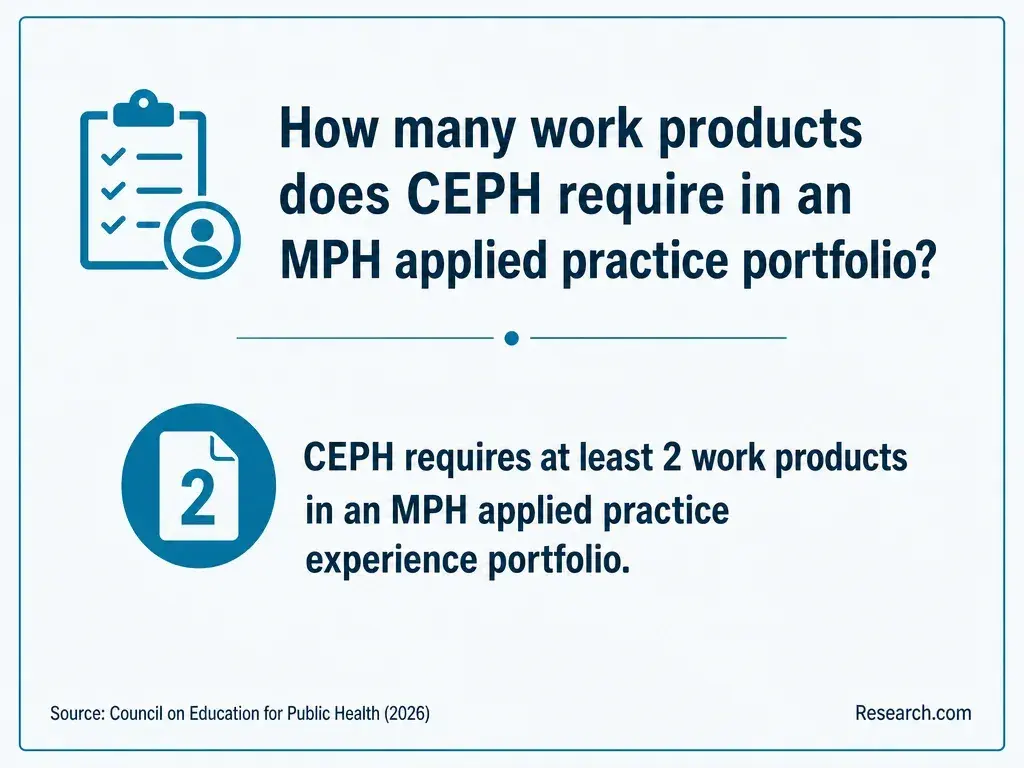
Check the institution's recognized institutional accreditation and separately check whether the public health BS is within the scope of Council on Education for Public Health (CEPH) accreditation. Accreditation of a school or a different public health degree does not, by itself, establish coverage of the BS. The accreditor's listing and the institution's current program documentation should identify the relevant school, unit, or degree.
For scheduling, obtain the catalog requirements for your entry term, a personalized degree audit, and the recent and planned course schedules. Then ask the public health department and registrar to confirm in writing which labs remain, which alternatives count, and who has authority to approve a substitution. Graduate-program information - including online public health PhD and DrPH comparisons - should not be used to infer an undergraduate program's accreditation scope or lab policy.
Sometimes, but "local partner" can mean two different things. A nearby college might provide an equivalent science lab for transfer credit. A health department or nonprofit might host an internship or community project. A placement site generally cannot substitute for a laboratory course simply because both involve hands-on work.
Before arranging either option, send the BS program the proposed course syllabus or a description of the site, activities, supervision, schedule, and assessment. Ask for written approval specifying the requirement it will satisfy. Also confirm any affiliation agreement, travel, safety training, privacy rules, or site-specific permission needed before work begins. Host willingness alone does not grant academic credit.
If you are considering graduate study instead of undergraduate completion, comparing accessible online public health master's options is a separate decision. Neither an MPH admission policy nor its fieldwork arrangements establish what a BS program will accept from a local partner.
Requirements depend on whether you are entering college, transferring, or returning to finish a degree. Admission to the university may be separate from admission to the public health major. Schools may review transcripts, prerequisite courses, minimum academic standing, and transfer eligibility; none of those decisions alone confirms that a previous lab satisfies the BS curriculum.
Transfer and returning students should supply official transcripts and, for uncertain lab equivalencies, the prior syllabus and evidence of completed lab work. Request a degree audit showing which credits apply to general education, prerequisites, the major, and residency requirements. If a course is accepted only as elective credit, ask about a formal equivalency review or appeal before planning your work schedule around an assumed exemption.
Students whose actual goal is later graduate admission face a different prerequisite decision. Guidance on starting public health graduate study with prerequisite gaps should not be read as a waiver of undergraduate admission or graduation requirements.
A bachelor's timetable depends on applicable transfer credit, remaining requirements, course rotation, and the number of courses you can take while employed. A single infrequently offered lab can determine the completion date even when most other courses fit your schedule. Do not rely on a quoted finish date until the school has evaluated your records and mapped the remaining courses by term.
Compare tuition and mandatory fees with lab charges, supplies, travel, parking, childcare, and any unpaid field hours. Then consider the income you might forgo to attend a weekday section. Ask financial aid staff how a slower course load or an outside lab would affect your aid; do not assume another institution's course is covered. For readers weighing a later degree, cost and duration of public health master's degrees are a separate investment from the cost of finishing this BS.
A public health BS can support applications for entry-level roles such as program assistant, outreach coordinator, community health worker, or research support staff, depending on the employer and the experience you bring. The work may involve scheduling services, communicating health information, maintaining records, or helping implement and assess programs. An internship or supervised project can provide concrete evidence of those skills.
Match job postings to tasks rather than relying on the degree title. Epidemiologist and senior research or management positions commonly require additional education, technical preparation, or substantial experience; a BS alone does not confer those responsibilities. If leadership or independent research is the eventual aim, an public health doctoral program selectivity overview concerns a much later decision - not a reason to accept an unworkable undergraduate timetable now.
What Salaries and Certifications Can Public Health BS Graduates Expect?
There is no single reliable "public health BS salary." Pay depends on the occupation, location, employer, and experience. The U.S. Bureau of Labor Statistics reports wages for defined occupations, such as community health workers and health education specialists, rather than for everyone holding a particular degree. Use the occupation that matches your target job, and do not treat its workforce-wide median as an entry-level offer.
Likewise, the BS does not automatically award a professional certification or clinical license. If a posting requests Certified Health Education Specialist (CHES) or Certified in Public Health (CPH), check the certifying body's current eligibility rules and the employer's actual requirement before choosing courses around it.
Graduate admissions conditions are another distinct issue: online graduate public health options without letters may matter for a future application, but they do not change certification eligibility or the return on a BS completed around work-hour labs.
Other Things You Should Know About Public Health
Ask the instructor about the course's attendance and make-up policy before the term starts. Approval for one missed session is not a substitute for a consistently conflicting schedule.
First obtain the school's likely lab schedule and ask how stable it is. If a change is needed, discuss a specific, time-limited arrangement with your employer rather than relying on an unconfirmed class time.
Contact the institution's accessibility office about your individual needs and available accommodations. Do not assume an accommodation will eliminate an essential in-person or supervised requirement.
Ask the department about waitlists, enrollment priority, and an approved alternative. Build a backup term into your plan if the section controls graduation timing.
- BS, Public Health Science - College Park https://sph.umd.edu/undergraduate-degrees/bs-public-health-science-college-park
- Flexible Learning (Online, Hybrid & Weekend) | Houston City College https://www.hccs.edu/programs--courses/flexible-learning-online-hybrid--weekend/
- The Types of Courses We Offer - Harvard Extension School https://extension.harvard.edu/student-experience/course-formats/
- Flexible Learning Options - Janesville | Blackhawk Technical College https://www.blackhawk.edu/Programs-Courses/Flexible-Learning-Options
- Program: Public Health, BS | csun.edu https://catalog.csun.edu/academics/hsci/programs/bs-public-health/
- Public Health | Division of Undergraduate Education College of Letters & Science https://uged.ucsb.edu/pre-health-tracks/public-health
- Program Prerequisites - Pre-Professional Programs https://preprofessional.osu.edu/prehealth/program-prerequisites
- University Scheduling Policy | University of Denver https://www.du.edu/registrar/faculty-staff-resources/course-scheduling-guide/university-scheduling-policy