2027 Online SLP Master's Programs for Wisconsin Residents: Eligibility, Tuition, and Clinical Placements

Co-Founder and Chief Data Scientist

Reviewed by Rhea Paul, PhD
SLP Education & Research Expert
Wisconsin residents can earn a speech-language pathology master's degree online, but an online format does not automatically mean Wisconsin licensure eligibility or a local clinical placement.
This guide explains how to screen programs for CAA accreditation, Wisconsin authorization, supervised practicum support, travel requirements, and total cost before applying. It is designed for prospective SLPs who need a master's degree that can support Wisconsin licensure and eventual ASHA certification—not simply a convenient online credential.
Key Things You Should Know
- Choose only a program with CAA accreditation or a status that the Wisconsin licensing authority confirms will satisfy its education requirement; institutional accreditation alone is not enough for clinical SLP licensure.
- Expect to document at least 400 supervised clinical clock hours for ASHA standards, including 375 direct client-contact hours and at least 325 hours earned at the graduate level.
- Cost, travel, and placement support vary more than online marketing suggests: compare the full required-credit total, fees, campus immersions, and the school's written Wisconsin clinical-placement policy before paying an enrollment deposit.
Which online SLP master's programs accept Wisconsin residents and meet licensure requirements?
Wisconsin residents should not assume that every online speech-language pathology program accepts applicants from Wisconsin or can place them in Wisconsin clinical sites. Eligibility is determined by a combination of the university's state-authorization status, its professional-licensure disclosure, clinical affiliation capacity, and whether its curriculum supports Wisconsin's licensing rules.
CAA-accredited distance or hybrid programs may be viable options, but availability can change by cohort, site capacity, or state policy. Programs commonly considered by distance learners include online or hybrid offerings from institutions such as Baylor University, Emerson College, New York University, the University of St. Augustine for Health Sciences, and other CAA-accredited schools that disclose Wisconsin eligibility. A school's inclusion in a general search result is not proof that it currently accepts Wisconsin students.
The comparison below shows the decision factors that matter more than a program's marketing label. Use it as a screening framework when reviewing ASHA accredited online SLP programs and speaking with admissions staff.
| Verification question | Why it matters for a Wisconsin resident | What to request from the school |
| Does the program accept Wisconsin residents for the intended start term? | State authorization and enrollment restrictions can change. | A written confirmation tied to the specific cohort and program format. |
| What is the program's CAA status? | CAA accreditation is central to ASHA certification and is commonly expected for state licensure. | The program's current CAA listing and accreditation dates. |
| Does the curriculum meet Wisconsin educational requirements? | A degree may be deliverable online without being designed for Wisconsin professional licensure. | A Wisconsin-specific professional-licensure disclosure. |
| Who secures clinical placements? | Placement availability is often the largest practical risk in distance clinical education. | A written explanation of site sourcing, approval, supervision, and contingency procedures. |
| Are campus visits required? | Immersions affect time off work, travel costs, and scheduling. | The number, location, duration, and estimated timing of required visits. |
Programs are strongest candidates when they provide direct, written answers to all five questions. If a representative says a program is "usually available" in Wisconsin, ask for confirmation from the program's licensure or compliance office rather than relying on a verbal assurance.
How do Wisconsin licensing rules shape online SLP program eligibility and curriculum?
Wisconsin licensure shapes program selection because the state regulates the professional practice of speech-language pathology, while universities control admission, curriculum, and clinical education. A master's degree alone is not the same as authority to practice independently after graduation.
In practical terms, an applicant should plan for three connected milestones: completion of a qualifying graduate degree, fulfillment of supervised clinical education requirements, and completion of the post-graduate supervised experience and application requirements required by the relevant licensing and certification bodies. ASHA's Certificate of Clinical Competence in Speech-Language Pathology, commonly called the CCC-SLP, is a national professional credential; Wisconsin licensure is a separate state authorization.
Wisconsin-focused licensure disclosures deserve special attention if the program includes courses that are delivered asynchronously, uses out-of-state supervisors, or expects the student to identify sites. The school should explain how it verifies that supervisors, sites, telepractice activities, and patient populations are appropriate for a student training in Wisconsin.
Admission prerequisites also influence eligibility. Applicants without a bachelor's degree in communication sciences and disorders may need leveling coursework in phonetics, anatomy and physiology of speech and hearing, language development, audiology, speech science, and statistics. A "career-changer friendly" program can be valuable, but it often extends the total timeline and cost.
Before applying, use this sequence to avoid enrolling in a program that cannot support your goal:
- Read the Wisconsin professional-licensure disclosure for the exact online or hybrid program, not only the university's general disclosure page.
- Confirm the program's current CAA accreditation status through ASHA's official directory.
- Ask whether Wisconsin practicum sites are available for your anticipated terms and whether the school, student, or both are responsible for securing them.
- Compare your undergraduate transcript with the program's prerequisite list and obtain a written evaluation if one is offered.
- Keep written records of every response about Wisconsin eligibility, clinical placement, and required travel.
What tuition, fees, and cost-of-attendance ranges do Wisconsin residents face in online SLP programs?
Tuition for online SLP master's programs is rarely comparable from a single advertised figure. One school may publish a per-credit rate, another may show a full-program estimate, and another may exclude clinical, technology, residency, background-check, health-compliance, and travel costs. For Wisconsin residents, the useful number is the estimated total cost to complete the degree under the intended pace.
Private online programs often charge one rate regardless of residency, while public institutions may apply resident, nonresident, or online-program rates. A lower tuition rate can still produce a higher final cost if the curriculum requires more credits, prerequisite courses, repeated travel, or a delayed clinical sequence. Review several online speech pathology programs to see how credit requirements and fee structures affect affordability.
This cost framework identifies the charges a Wisconsin applicant should place in a personal budget. Exact amounts should come from the institution's current tuition schedule and financial-aid office.
| Cost category | How it is commonly billed | Why it can change the decision |
| Required graduate credits | Per credit or as a program total | Programs with different credit totals cannot be compared using per-credit tuition alone. |
| Prerequisite or leveling courses | Separate undergraduate or graduate tuition | Career changers may need additional coursework before or during admission. |
| University and technology fees | Per term or per course | These fees can continue across clinical terms even when a student takes fewer academic courses. |
| Clinical education expenses | Variable | Background checks, drug screening, immunizations, liability coverage, testing, and site requirements may be out-of-pocket. |
| Travel and lodging | Variable | Required immersions, intensives, or out-of-area placements can materially increase total cost. |
| Lost work time | Opportunity cost | Full-time clinical rotations may limit a student's ability to maintain regular employment. |
Federal graduate borrowing can help with eligible costs, but it should be treated as financing rather than a discount. Eligible graduate students may generally borrow up to $20,500 per academic year through Direct Unsubsidized Loans, subject to federal aggregate limits; Graduate PLUS borrowing may cover additional eligible cost of attendance after other aid. Confirm current limits and eligibility with the school's financial-aid office because federal rules can change.
A prudent comparison asks each school for a term-by-term estimate showing required credits, mandatory fees, expected travel, and the timing of clinical placements. This makes it easier to assess whether an accelerated sequence is truly less expensive or merely concentrates expenses into fewer terms.
How do online SLP programs arrange local clinical placements for students living in Wisconsin?
Clinical placements are supervised experiences in settings such as schools, hospitals, rehabilitation facilities, outpatient clinics, and early-intervention programs. They are essential because SLP students must translate coursework into direct assessment and treatment work with real clients under qualified supervision.
Online programs use different placement models. Some maintain affiliation networks and actively source sites; others coordinate approvals after a student identifies a potential facility; many use a shared model. No model can responsibly promise a placement in a particular Wisconsin city before site and supervisor approvals are complete.
Ask programs for details about their clinical education model, particularly if you live in a rural area, need a pediatric or medical placement, or cannot travel. The following comparisons reveal the trade-offs:
| Placement model | Potential advantage | Primary risk to investigate |
| School-arranged placement | Centralized support and established affiliation processes. | Geographic choice may be limited, and placement timing can depend on site capacity. |
| Student-suggested placement | May help a student pursue a local site or specialized interest. | The site may not meet requirements or may decline affiliation and supervision. |
| Shared placement search | Combines student local knowledge with university approval systems. | Responsibility can be unclear unless the school documents deadlines and backup plans. |
| Out-of-area assignment | May provide access to a needed population or setting. | Housing, travel, work disruption, and state-specific site requirements can increase costs. |
Distance learners should also ask whether telepractice can count toward clinical education, how client privacy is protected, and whether telepractice experiences are supplemental or central to the curriculum. Technology-based service delivery is increasingly relevant to SLP practice, but it does not remove the need for approved supervision, appropriate client contact, and competency assessment.
Use the following questions during an admissions call or email exchange. They focus on operational commitments rather than broad assurances that placements are "supported."
- How many Wisconsin students in recent cohorts completed all required placements on schedule?
- Does the program guarantee an approved placement, or does it only provide assistance with a search?
- What happens if my proposed Wisconsin site cannot execute an affiliation agreement?
- Can the program require travel outside my region or outside Wisconsin for a placement?
- Who verifies that each supervisor meets university, ASHA, and site requirements?
- What costs related to site onboarding, travel, health records, or liability coverage are the student's responsibility?
Which accreditors and approvals must an online SLP program hold for Wisconsin licensure and ASHA certification?
For a Wisconsin applicant seeking clinical practice eligibility, the central programmatic credential is accreditation by the Council on Academic Accreditation in Audiology and Speech-Language Pathology, or CAA. CAA is ASHA's specialized accreditor for graduate programs in speech-language pathology and audiology.
Do not confuse CAA accreditation with regional or institutional accreditation. Institutional accreditation speaks to the university as a whole; CAA evaluates the professional graduate program. Both may matter for federal aid and transfer policies, but CAA status is the credential most closely connected to the educational pathway for ASHA certification and clinical SLP practice.
A careful review should distinguish among the following statuses and approvals:
- CAA accreditation: The program has current specialized accreditation; verify the program name, modality, campus, and accreditation period.
- CAA candidate status: The program is progressing through accreditation review but may carry additional uncertainty for an applicant; obtain written clarification about implications for your cohort.
- Institutional accreditation: The college or university meets institutional standards, but this does not replace CAA accreditation for an SLP graduate degree.
- Wisconsin professional-licensure disclosure: The institution's statement about whether its curriculum meets, does not meet, or has not determined Wisconsin requirements.
- State authorization: The institution's authority to enroll a Wisconsin distance-education student, which is separate from professional-licensure eligibility.
ASHA certification also involves requirements beyond the degree, including qualifying clinical education, passing the required national examination, and completing a clinical fellowship. Applicants should confirm the current requirements directly with ASHA and Wisconsin's licensing authority because standards and application procedures may change.
How do in-state, out-of-state, and private online SLP programs compare for Wisconsin students?
Wisconsin students can consider in-state public, out-of-state public, and private nonprofit online or hybrid programs. The best fit depends less on the institution's location than on CAA status, Wisconsin eligibility, clinical-placement support, predictable total cost, and the amount of travel a student can manage.
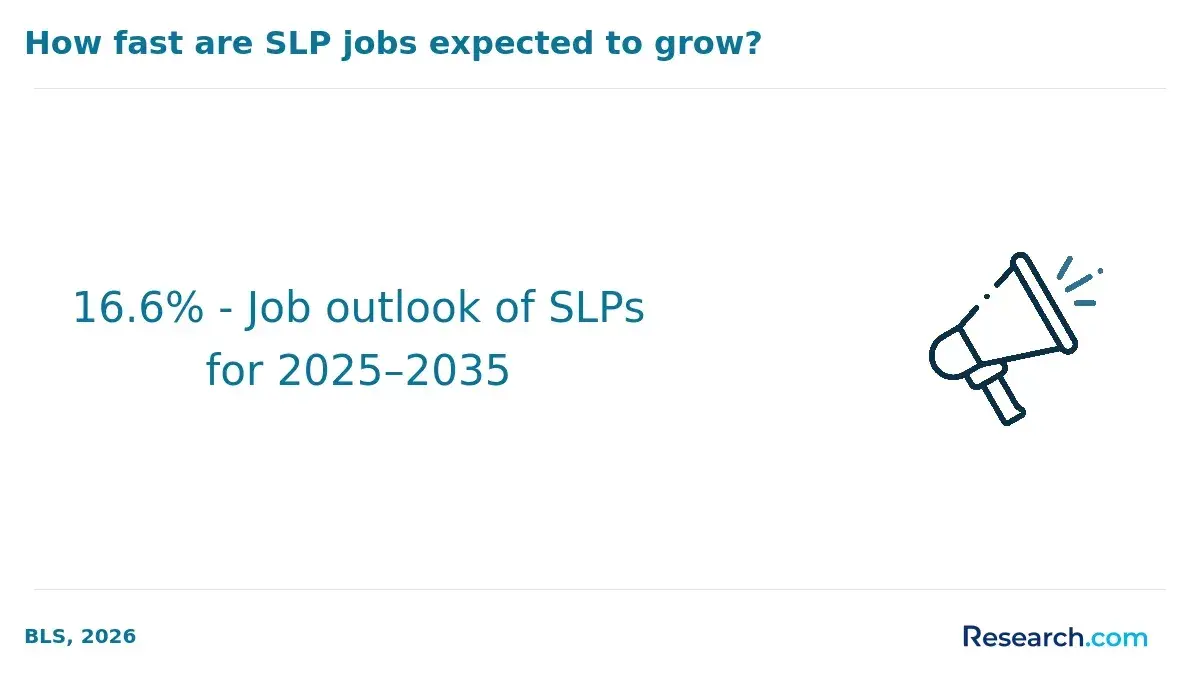
Employment demand supports careful investment planning. The U.S. Bureau of Labor Statistics reports a median annual wage of $97,870 for speech-language pathologists in May 2025 and projects 17% employment growth from 2025 to 2035, with about 12,500 openings per year on average. These national figures indicate sustained demand, but they do not predict an individual graduate's pay, hiring timeline, or Wisconsin-specific opportunities.
This comparison can help Wisconsin residents identify which institutional model best matches their constraints:
| Program type | Potential fit | Trade-off to evaluate |
| Wisconsin public or in-state option | Students seeking local connections, potentially familiar regional clinical partners, or public-university pricing. | May have limited online availability, campus requirements, or competitive admission. |
| Out-of-state public online or hybrid option | Students who want a public-university model and a specific delivery format. | Nonresident pricing, Wisconsin authorization, and clinical placement reach require confirmation. |
| Private nonprofit online or hybrid option | Students prioritizing a structured distance-learning format, multiple start options, or national placement processes. | Sticker price may be higher, and travel or fees can alter the total cost. |
| Accelerated pathway | Students with flexibility to handle an intensive, continuous sequence. | Compressed schedules can reduce work capacity and leave less room for placement delays. |
An accelerated program is not automatically the better financial choice. SLP accelerated programs may reduce time to graduation, but students should compare clinical scheduling, required course loads, and the likelihood that they can maintain employment during practicum terms.
Choose a lower-cost option when it has confirmed Wisconsin eligibility, a transparent clinical-placement process, and a realistic schedule. Consider paying more only when the added structure, lower travel burden, stronger placement support, or schedule compatibility clearly addresses a personal constraint that a less expensive program cannot solve.
What Wisconsin-specific state authorization and distance education rules apply to online SLP training?
State authorization and professional licensure are related but different safeguards. State authorization concerns whether an out-of-state institution may provide distance education to a Wisconsin resident. Professional licensure concerns whether the education and clinical preparation can support an application to practice as an SLP in Wisconsin.
Many institutions participate in interstate distance-education arrangements, but participation does not replace a program-specific professional-licensure disclosure. A school can be authorized to enroll a Wisconsin resident while still stating that it has not determined whether a particular clinical degree meets Wisconsin licensing requirements.
Wisconsin residents should also consider where clinical activity occurs. When a practicum, internship, or telepractice experience involves clients in Wisconsin, the school, site, supervisor, and student may all have responsibilities under institutional policies, clinical affiliation agreements, privacy rules, and professional standards. The university should manage these requirements rather than asking students to assume that an online course automatically authorizes clinical work.
Ask the school to identify the office responsible for state authorization and the office responsible for professional-licensure compliance. If those offices provide different answers, pause the application process until the discrepancy is resolved in writing.
How can Wisconsin residents verify that an online SLP program's clinical hours meet state and ASHA standards?
Clinical-hour verification should begin before enrollment and continue throughout the program. Students should understand the difference between an academic course, observation experience, direct client contact, simulation, and supervised clinical practicum because not every educational activity counts in the same way toward professional standards.
For ASHA's graduate clinical education standards, students generally need 400 total supervised clinical clock hours: 25 guided observation hours and 375 direct client-contact hours. At least 325 of the required hours must be completed at the graduate level. Programs must also assess clinical competencies; accumulating hours alone is not enough.
Use a written record system from the first clinical experience. The following steps help prevent missing documentation near graduation:
- Ask the program for its clinical-hour tracking process and a sample report before accepting admission.
- Confirm how the program categorizes observation, direct contact, telepractice, simulation, screening, assessment, treatment, and indirect activities.
- Verify that each placement supervisor and site receive university approval before clinical hours begin.
- Review your cumulative hour report after every placement rather than waiting until the final term.
- Save signed evaluations, supervisor information, site approvals, and final clinical-hour records in a secure personal file.
- Before graduation, ask the program to confirm in writing that your clinical record satisfies its degree requirements and supports the applicable certification and licensing pathway.
A program should be able to explain how it tracks hours by setting, age group, disorder area, and supervisor. Wisconsin may not require a student to personally create every category of report, but detailed records can be valuable if questions arise during certification, licensure, employment onboarding, or a later move to another state.
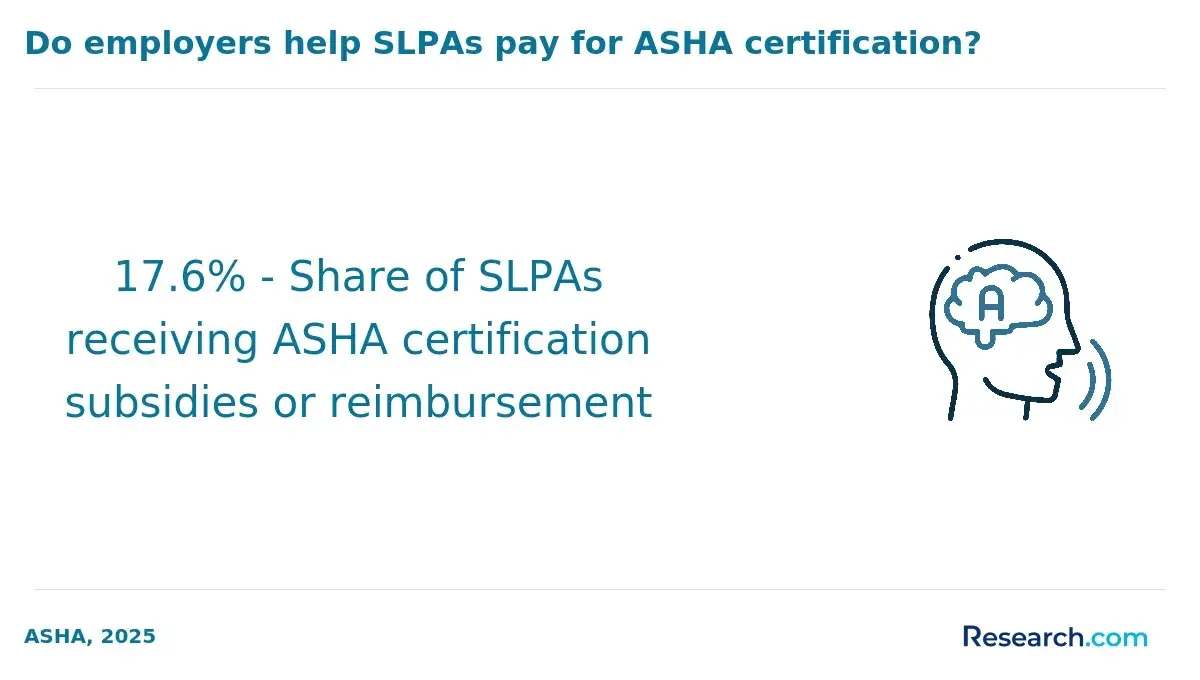
What funding options, loan programs, and employer tuition benefits commonly reduce costs for Wisconsin SLP students?
Financial planning for an online SLP master's degree should combine aid sources rather than relying on loans alone. Start with the Free Application for Federal Student Aid, then compare university scholarships, external awards, employer benefits, and work arrangements that remain realistic during clinical training.
School-based awards can be competitive and may require separate applications, early deadlines, or full-time enrollment. Employer tuition assistance can be useful for professionals already working in schools, health systems, or related support roles, but it may include repayment obligations if the employee leaves before a stated service period ends.
These funding approaches commonly reduce the amount a student needs to borrow:
- Federal Direct Unsubsidized Loans for eligible graduate students, within annual and aggregate federal limits.
- Graduate PLUS Loans for eligible borrowers who need financing beyond other aid and cost-of-attendance allowances.
- University scholarships, assistantships, and departmental awards, when available, to distance or clinical-program students.
- Employer tuition reimbursement or professional-development benefits, reviewed carefully for service commitments and taxable-benefit rules.
- External scholarships from professional associations, community organizations, foundations, and workforce-development groups.
- Part-time employment planned around academic terms, while recognizing that intensive clinical rotations may sharply limit work hours.
When comparing borrowing plans, focus on the amount actually needed after grants and benefits, not simply the maximum loan amount offered. The national wage data can help with broad career planning; readers considering repayment capacity can also review "How much do SLPs make?" while remembering that pay differs by setting, experience, geography, schedule, and employer.
What consumer-protection red flags should Wisconsin residents watch for in online SLP master's programs?
The most serious red flags are not necessarily low admission requirements or online delivery. They are missing documentation, vague statements about Wisconsin eligibility, and pressure to enroll before the school answers questions about accreditation, clinical placements, and total cost.
Be cautious when a program does any of the following:
- States that it is "accredited" but does not identify current CAA status for the specific SLP master's program.
- Claims graduates can work nationwide without acknowledging that state licensing requirements vary.
- Cannot confirm whether Wisconsin residents may enroll in the intended cohort.
- Describes clinical placement help without explaining who is responsible for finding, approving, and funding sites.
- Publishes only a per-credit tuition figure while withholding required credits, recurring fees, or residency costs.
- Promises a rapid completion timeline without explaining full-time course loads, clinical sequencing, or placement contingencies.
- Pressures applicants to pay a deposit before providing a Wisconsin-specific professional-licensure disclosure.
- Uses salary claims as if they were guaranteed outcomes rather than labor-market estimates.
A strong consumer-protection habit is to compare written answers from at least two programs using the same questions. If a school will not document its CAA status, Wisconsin enrollment eligibility, estimated total cost, and clinical-placement process, choosing a more transparent program is usually the safer decision.
Other Things You Should Know About Speech Language Pathology
Possibly, if the program is appropriately CAA-accredited, accepts Wisconsin residents, supports the required clinical education, and its curriculum is compatible with Wisconsin licensure requirements. "Fully online" may still include clinical placements and required campus immersions, so confirm the format in writing.
Not always. Some programs accept career changers, but they commonly require prerequisite or leveling coursework. Request a transcript review before applying so you understand added time, cost, and course requirements.
It depends on the program. Some arrange placements, some require students to suggest sites, and many use a shared process. Ask for the exact policy, whether out-of-area travel may be required, and what happens if a site is unavailable.
No. ASHA certification is a national professional credential, while Wisconsin licensure is state authorization to practice. They have overlapping educational and clinical expectations, but applicants should verify and complete each process separately.
References
- Master of Science in Speech-Language Pathology https://www.uwec.edu/academics/programs/graduate/master-science-speech-language-pathology
- Speech-Language Pathology | PennWest Global Online https://online.pennwest.edu/programs/speech-language-pathology-grad/index.php
- Masters Program - Communication Sciences and Disorders https://csd.wisc.edu/masters/
- Online Master's in Speech Pathology Programs: 2026 Guide https://speechpathologymastersprograms.com/
- Top 10 Budget-Friendly Online Master's in Speech Therapy https://specialistlanguagecourses.com/top-10-budget-friendly-online-masters-in-speech-therapy-for-2024/