2027 Online SLP Master's Programs for Iowa Residents: Eligibility, Tuition, and Clinical Placements

Co-Founder and Chief Data Scientist

Reviewed by Rhea Paul, PhD
SLP Education & Research Expert
Iowa residents considering an online master's in speech-language pathology need more than a flexible class schedule: they need a program that can support Iowa clinical placements and lead to state licensure. This guide explains how to evaluate eligible programs, confirm accreditation and authorization, estimate the full cost, and ask the right placement questions before applying. It is designed for future SLPs who want an online or hybrid route without making an expensive licensure mistake.
Key Things You Should Know
- An Iowa-eligible online SLP program should have current ASHA Council on Academic Accreditation (CAA) accreditation, disclose whether Iowa residents may enroll, and support a clinical plan that satisfies Iowa and ASHA standards.
- ASHA certification standards generally require at least 400 supervised clinical hours, including 375 direct client-contact hours, plus a 1,260-hour clinical fellowship; Iowa applicants should verify the state board's current rules separately.
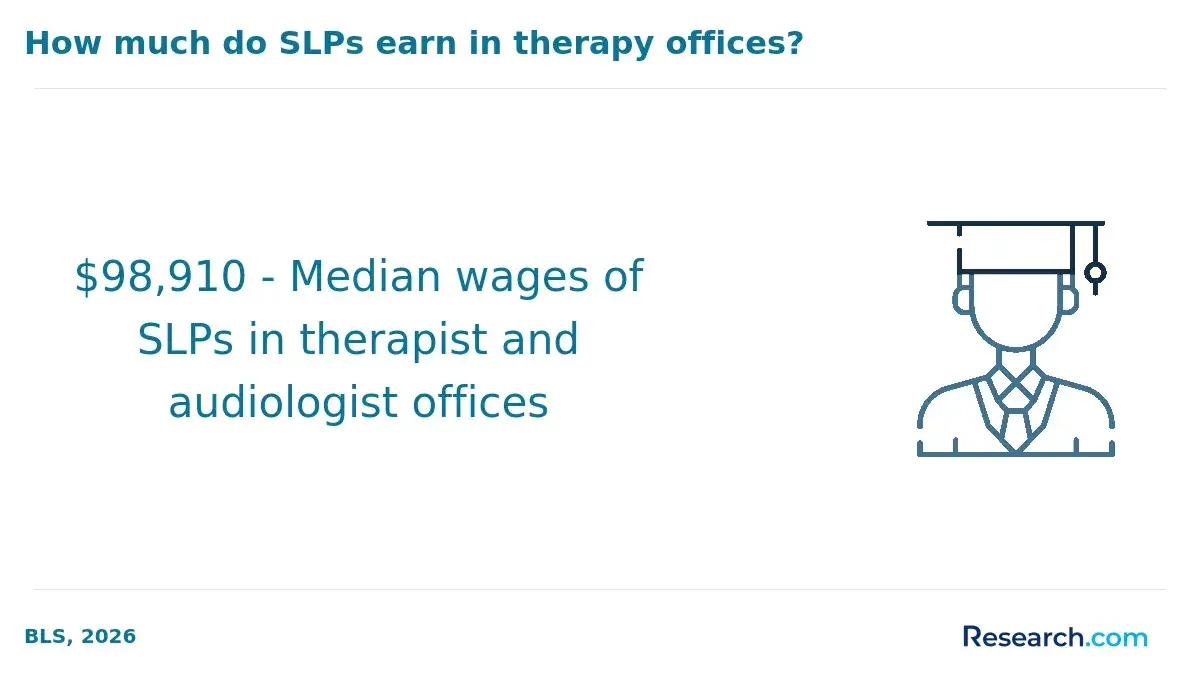
- The U.S. Bureau of Labor Statistics reports a $97,870 median annual wage for speech-language pathologists in May 2025 and projects 17% employment growth from 2025 to 2035, but a graduate degree alone does not confer Iowa licensure.
Which online SLP master's programs accept Iowa residents and meet licensure requirements?
Iowa residents can attend an online or hybrid SLP master's program only when the institution permits enrollment from Iowa, the degree is appropriately accredited, and the program can arrange or approve Iowa-based clinical education. "Online" rarely means entirely remote in this field; skills labs, simulations, assessments, and supervised practicum may require travel or in-person attendance.
Use ASHA's EdFind directory and each university's state-authorization and professional-licensure disclosure pages to screen options. Schools such as Emerson College, Baylor University, New York University, the University of St. Augustine for Health Sciences, and other CAA-accredited institutions may offer distance-oriented pathways, but availability for Iowa residents, travel expectations, and cohort openings can change. A school's general online availability is not proof that its SLP program can enroll Iowa students.
The comparison below shows the minimum questions that distinguish a workable option from an attractive but unsuitable one.
| Decision factor | What an Iowa applicant should confirm | Why it matters |
| CAA status | Current accreditation status for the specific master's program, not merely the university | CAA accreditation is the standard expected for ASHA certification and is central to licensure planning. |
| Iowa enrollment eligibility | A written confirmation that the program accepts students located in Iowa | State authorization restrictions can prevent enrollment or continuation. |
| Licensure disclosure | Whether the curriculum is designed to meet Iowa educational requirements | Disclosure language identifies known gaps or whether the school has not made a determination. |
| Clinical model | Who finds sites, who approves them, and whether Iowa placements are routinely feasible | Clinical education is required and can affect time to graduation. |
| Required travel | Campus intensives, live labs, orientations, and assessment checkoffs | Travel costs and time off work can materially change affordability. |
When reviewing online SLP programs, treat admissions accessibility as only one factor. A program is a stronger fit when its clinical-placement process, Iowa eligibility, and schedule are confirmed in writing before a deposit is paid.
What Iowa Board and ASHA eligibility rules apply to online SLP master's students?
Iowa licensure and ASHA certification are related but separate credentials. An Iowa license authorizes professional practice under Iowa law. The Certificate of Clinical Competence in Speech-Language Pathology (CCC-SLP) is a voluntary national credential that many employers prefer or require. School-based work may also involve Iowa Board of Educational Examiners requirements, depending on the position and employer.
For a typical path, a student completes a qualifying graduate degree and supervised practicum, passes the Praxis examination required for certification or licensure purposes, completes a supervised clinical fellowship after graduation, and then applies for the applicable credential. ASHA's current certification framework includes at least 400 clinical clock hours, of which at least 375 are direct client-contact hours and 25 are guided observation hours. Its clinical fellowship requirement is 1,260 hours completed over at least 36 weeks.
The following distinctions prevent a common planning error: assuming that meeting one organization's standard automatically completes every other requirement.
| Requirement source | Primary purpose | What the applicant should verify |
| CAA | Accredits graduate education programs | The program's current status and any public notices affecting accreditation. |
| ASHA | Sets CCC-SLP certification standards | Clinical-hour documentation, Praxis expectations, fellowship standards, and certification application procedures. |
| Iowa Board of Speech Pathology and Audiology | Issues and regulates Iowa professional licenses | Current education, examination, supervised-experience, application, and renewal requirements. |
| Iowa education authorities or employers | May govern school employment credentials | Whether a school setting requires additional educational authorization or endorsement. |
Requirements can change, and individual circumstances matter. Applicants with an out-of-field bachelor's degree, prior clinical hours, international education, or plans to work in schools should obtain current guidance directly from the relevant Iowa regulator and the prospective program.
How do Iowa residents verify institutional and CAA accreditation for online SLP programs?
Institutional accreditation and programmatic accreditation answer different questions. Institutional accreditation evaluates the college or university as a whole. CAA accreditation evaluates whether a specific graduate speech-language pathology program meets professional education standards. For an Iowa licensure path, verify both rather than relying on a school's broad accreditation statement.
A careful verification sequence reduces the chance of enrolling in a program whose status or state eligibility has changed.
- Find the exact degree in ASHA EdFind and review its CAA accreditation status, campus or delivery designation, and any published notes.
- Open the university's official program page and graduate catalog to confirm that the degree name, location, and format match the listing.
- Read the institution's professional-licensure disclosure for Iowa and save a dated copy or PDF for your records.
- Ask admissions to confirm Iowa eligibility, planned clinical-placement support, required travel, and whether any pending authorization issue affects your cohort.
- Contact the Iowa Board of Speech Pathology and Audiology if the school's disclosure is incomplete or says it has not determined Iowa eligibility.
Do not treat "accredited university," "ASHA-aligned curriculum," or "prepares students for certification" as substitutes for current CAA status. Candidates should also be cautious with programs that describe themselves as "SLP-related" but do not award the graduate professional degree needed for entry-level SLP licensure.
What tuition, fees, and residency-based costs do Iowa SLP students typically pay online?
Tuition is only one part of the financial decision. Distance SLP programs may charge a uniform online rate, a graduate rate, or a rate that differs by residency, while Iowa public institutions may use resident tuition rules that do not apply to students enrolled at out-of-state schools. The most useful comparison is the estimated total required educational cost, using the same assumptions for every program.
Ask each school for a written estimate based on the required number of credits and your intended pace. If a published price is per credit, multiply it by required program credits, then add known mandatory charges rather than comparing that figure with another school's annual tuition.
| Cost category | What it may include | How to compare it |
| Tuition | Per-credit, term-based, or cohort pricing | Calculate required credits at the rate applicable to an Iowa-based online student. |
| Mandatory university fees | Technology, student services, clinical education, graduation, or distance-learning fees | Request whether fees are charged per term, per credit, or once. |
| Travel and lodging | Campus immersions, labs, assessments, or orientation | Estimate trips separately; they may not appear in a tuition calculator. |
| Clinical expenses | Background checks, drug screening, immunizations, liability coverage, onboarding, parking, and local travel | Ask for the clinical compliance checklist before enrollment. |
| Living and opportunity costs | Reduced work hours, child care, technology, and commuting to placements | Build these into a personal cash-flow plan, especially during full-time practicum terms. |
Federal financial aid eligibility depends on the institution, enrollment status, and student circumstances; submit the FAFSA and ask about scholarships, assistantships, employer support, and payment plans. Comparing online speech pathology programs can help establish a cost baseline, but the lowest advertised tuition is not necessarily the lowest total cost when travel and placement delays are considered.
A practical rule is to compare net cost, schedule risk, and completion support together. A program with a higher tuition rate may still be financially preferable if it has transparent Iowa placement support and fewer required trips; the reverse can also be true.
How do online SLP programs structure clinical placements for students living in Iowa?
Online SLP programs generally deliver academic coursework through asynchronous modules, live online classes, or a combination of both. Clinical education remains in person because students must demonstrate assessment and intervention skills with clients under qualified supervision. Programs may secure placements, use a shared-responsibility model, or ask students to suggest local sites while retaining final approval authority.
For Iowa residents, the key question is not simply whether the school "helps" with placements. Ask what happens if an Iowa site cannot be found by the planned term, whether a placement can be outside your community, and whether a delay changes tuition, graduation timing, or financial-aid status.
The table summarizes common models and their trade-offs.
| Placement model | How it works | Best fit | Main risk |
| Program-arranged | The university identifies and contracts with sites. | Students who need the most administrative support. | Site location and timing may be outside the student's preferred area. |
| Student-assisted | The student identifies possible sites; the university approves and finalizes agreements. | Students with local professional contacts and flexibility. | A suggested site may not meet requirements or may decline affiliation. |
| Hybrid network model | The school uses existing partners when available and seeks new sites as needed. | Students open to travel within Iowa or nearby regions. | Network availability can vary by term and specialty need. |
Students considering accelerated speech pathology programs should be especially cautious about clinical sequencing. A shorter academic calendar can be appealing, but it leaves less room to absorb delayed site contracts, compliance issues, or a missed practicum rotation.
What supervision, site approval, and caseload requirements must Iowa clinical placements satisfy?
A clinical site and supervisor must satisfy the university's requirements, and the resulting experience must also support the student's eventual certification and licensure plan. The program - not the student or site alone - determines whether a proposed placement is academically acceptable. Students should not begin counting hours until the program has approved the site, supervisor, client population, and documentation process.
ASHA clinical education standards provide a useful national baseline. Graduate students pursuing certification typically document at least 400 total clock hours, with at least 375 hours in direct client or patient contact. Hours must cover appropriate scope and be supervised by professionals who meet applicable qualifications. Individual programs may require more hours, specific settings, or competency assessments.
Before accepting a site, obtain answers to the following practical questions.
- Will the supervisor hold the required Iowa license and credentials, and does the supervisor meet the university's training and experience criteria?
- Does the site serve clients whose ages, diagnoses, languages, and service needs support the learning objectives for that rotation?
- What level of direct and indirect supervision will occur, and how will observations, feedback, competencies, and hours be documented?
- Who completes the affiliation agreement, liability coverage, background checks, immunization review, and other onboarding requirements?
- Can the site provide the required hours within the academic term, and what is the contingency plan if client cancellations reduce caseload?
Do not assume a supervisor with extensive experience can automatically supervise for every university. Programs may require supervisor orientation, a current credential, specific years of experience, or signed agreements before the placement begins.
How do interstate compacts, SARA, and state authorization affect Iowa SLP enrollment?
State authorization determines whether an out-of-state institution may provide distance education to a student located in Iowa. The State Authorization Reciprocity Agreement, commonly called SARA, can simplify authorization for participating institutions and states, but it does not replace professional-licensure review. A SARA-participating school may still have to make program-specific disclosures and may limit enrollment in certain regulated programs.
For Iowa applicants, three concepts should be checked independently: institutional authorization, professional-licensure disclosures, and clinical-site legality. A school may be authorized to offer online coursework in Iowa while still being unable to confirm that its SLP curriculum meets every Iowa licensing requirement or unable to secure an acceptable local clinical site.
| Issue | What it controls | Applicant action |
| SARA or other state authorization | Whether the institution may deliver distance education to an Iowa-based student | Confirm the school's current Iowa authorization status with the institution. |
| Professional-licensure disclosure | Whether the school states that its curriculum meets, does not meet, or has not determined Iowa requirements | Read the Iowa-specific disclosure and retain a copy. |
| Clinical affiliation agreement | Whether a particular site can host a student for that university | Ask when agreements are initiated and whether approval is guaranteed. |
| Interstate practice rules | Whether a licensed clinician can provide services across state lines | Let the program and site determine telepractice compliance; do not assume a compact removes all requirements. |
Interstate licensure compacts and telepractice developments may improve mobility over time, but they do not eliminate the need for a graduate degree, supervised education, state licensure, or employer-specific credentialing. Confirm current rules at the point of application and again before clinical fellowship or employment.
Which Iowa school districts, hospitals, and clinics commonly host online SLP practicum students?
Iowa practicum opportunities commonly arise in public school districts, hospital rehabilitation departments, outpatient therapy clinics, early-intervention programs, skilled nursing facilities, university clinics, and pediatric specialty settings. Availability changes with staffing, supervisor capacity, affiliation agreements, and the needs of each cohort. No school district, hospital, or clinic should be assumed to host a student merely because it employs SLPs.
In larger Iowa service areas, applicants may explore potential settings such as school districts in the Des Moines, Cedar Rapids, Iowa City, Waterloo-Cedar Falls, Sioux City, Council Bluffs, and Quad Cities regions; hospital systems; pediatric therapy practices; and regional education or early-intervention providers. These are location categories for outreach, not a list of guaranteed university partners.
A placement is more likely to be useful when the setting aligns with the student's learning needs rather than merely being close to home. For example, a school placement may develop language, articulation, and educational collaboration skills, while medical or rehabilitation settings can provide exposure to adult neurogenic disorders, dysphagia, and interdisciplinary care when available.
Before approaching a possible site, ask the university whether students may make first contact. Some programs prohibit independent outreach because affiliation agreements, supervisor approval, and site relationships must be managed centrally. If outreach is permitted, identify yourself as a prospective student, avoid promising university approval, and provide the clinical education office's contact information.
How can Iowa residents compare outcomes, Praxis pass rates, and employment data across programs?
Outcome data can reveal whether a program supports students through the parts of training that matter most: completing the degree, passing the Praxis examination, obtaining clinical fellowship positions, and entering the profession. However, outcomes should be compared cautiously because programs may use different cohort sizes, reporting periods, definitions, and methodologies.
The Bureau of Labor Statistics reports that speech-language pathologists had a median annual wage of $97,870 in May 2025, with projected employment growth of 17% from 2025 to 2035. This indicates strong national demand, but it is not a prediction of an individual graduate's pay. Location, setting, experience, hours, and employer all affect compensation. For role and setting context, review how much does a speech therapist make.
Ask every program for the same outcome information so the comparison is meaningful.
| Outcome measure | What to request | How to interpret it |
| Praxis pass rate | The reporting period, number of test takers, and first-attempt versus eventual pass rate | Small cohorts can make one year volatile; examine multiple reporting periods when available. |
| Program completion | On-time and overall completion figures with the cohort definition | Look for transparency about leaves, part-time enrollment, and placement-related delays. |
| Employment or fellowship placement | Definition of employment, survey response rate, timeframe, and geographic reach | A high figure is more informative when the school explains who was counted and when. |
| Student support | Advising, tutoring, clinical coordination, accessibility services, and career support | These services may be especially important for distance students balancing work or family obligations. |
A strong program is not necessarily the one with the highest isolated metric. Prefer a transparent school that can explain its data, Iowa placement process, student supports, and any limitations rather than one that makes broad outcome claims without context.
What consumer-protection steps should Iowa SLP applicants take before enrolling in an online program?
The largest avoidable error is enrolling before receiving clear answers about Iowa eligibility and clinical education. Marketing pages can be useful introductions, but the documents that protect applicants are the official catalog, tuition schedule, CAA listing, state-authorization disclosure, and written communications from the program.
Use this pre-enrollment checklist to create a record of the commitments that matter to your decision.
- Confirm that the exact SLP master's program has current CAA accreditation and save the program's official status information.
- Request written confirmation that Iowa residents may enroll in your intended start term and that no state-authorization restriction applies.
- Read the Iowa professional-licensure disclosure and compare it with current Iowa Board requirements.
- Obtain a total-cost estimate that identifies tuition, mandatory fees, travel, clinical compliance expenses, and likely schedule length.
- Ask who is responsible for locating placements, whether Iowa placements have been used recently, and what happens if a placement is delayed or unavailable.
- Confirm live-class times, required campus visits, leave policies, withdrawal and refund rules, and whether the pace is realistic alongside work or caregiving.
- Keep dated copies of disclosures, cost estimates, emails, and any placement-related assurances.
Be wary of vague promises that a program "meets all state requirements," guarantees a local placement, or can be completed entirely online without discussing hands-on clinical training. A legitimate program can explain what it controls, what depends on site availability, and what the student must do to remain eligible.
Other Things You Should Know About Speech Language Pathology
Yes, potentially. The degree must satisfy applicable educational requirements, the program should have appropriate CAA accreditation, and you must complete required clinical education, examination, and post-graduate supervised experience requirements. Verify Iowa eligibility with both the program and the Iowa licensing board before enrolling.
Usually, yes. Even when academic courses are online, practicum and externship experiences are normally completed in person at approved sites. Some programs also require campus immersions, skills labs, or assessments, so ask for the full travel calendar.
It depends on the program pace and clinical schedule. Coursework may be flexible, but clinical placements commonly follow daytime site hours and can require substantial weekly availability. Part-time study may be a better fit for working students, though it can extend total time and costs.
Ask for its written contingency process, typical placement radius, student responsibilities, and whether delayed placement affects tuition or graduation. If the answers are unclear, compare programs with more established clinical coordination or consider a campus-based Iowa option.
References
- Master of Science in Speech-Language Pathology https://csd.uiowa.edu/graduate/ms-speech-language-pathology
- Online SLP Master's Program https://www.misericordia.edu/speech-language-pathology/online-slp-masters-program