2027 UW-Eau Claire vs Idaho State Online SLP Master's: Compare Pace, Tuition, and Campus Visits

Co-Founder and Chief Data Scientist

Reviewed by Rhea Paul, PhD
SLP Education & Research Expert
Choosing between UW-Eau Claire and Idaho State for an online speech-language pathology master's is primarily a decision about schedule realism, travel tolerance, and total educational cost - not simply which school offers online classes. Both programs are designed to prepare future speech-language pathologists for graduate clinical training, but their course sequencing, required in-person experiences, state eligibility, and student responsibilities can differ. This comparison explains what to verify before applying so you can choose a program that fits your work, family, financial, and licensure plans.
Key Things You Should Know
- Both schools use cohort-based graduate education, so students should expect a prescribed course sequence rather than a fully self-paced online degree.
- Tuition comparisons require more than a per-credit rate: account for graduate fees, travel to required intensives, clinical-placement costs, technology, and the income impact of full-time clinical semesters.
- CAA accreditation, clinical-hour completion, Praxis requirements, and state-specific licensing rules matter more than the word "online" when choosing an SLP master's program.
How do UW-Eau Claire and Idaho State structure the pace and format of their online SLP master's?
UW-Eau Claire and Idaho State offer distance-oriented pathways intended for students who need to complete substantial graduate coursework away from the main campus. Neither option should be understood as an independent, on-demand degree. SLP education combines sequenced academic courses, faculty-directed skills instruction, supervised practicum, and full-time clinical experiences that must meet professional standards.
The practical difference for applicants is usually not whether lectures are delivered online, but how frequently students must attend live sessions, how the cohort moves through the curriculum, and when clinical training makes outside employment difficult. Ask each program for the current cohort calendar before paying an application fee.
| Comparison factor | UW-Eau Claire online SLP pathway | Idaho State distance/online SLP pathway | Why it matters |
| Academic model | Cohort-based graduate curriculum with online learning and required clinical education | Cohort-based graduate curriculum with distance learning and required clinical education | Students generally cannot accelerate simply by taking extra courses. |
| Course timing | Students should confirm current live-session and attendance expectations with the program | Students should confirm current live-session and attendance expectations with the program | Live classes can conflict with work shifts and time-zone differences. |
| Clinical progression | Moves from academic and skills preparation into supervised practicum and externship work | Moves from academic and skills preparation into supervised practicum and externship work | Clinical semesters commonly require substantially more daytime availability. |
| Self-paced flexibility | Not a self-paced professional degree | Not a self-paced professional degree | A structured sequence protects prerequisite and clinical competency progression. |
For a working adult, UW-Eau Claire may be a better fit if its current cohort schedule aligns with your availability and travel budget; Idaho State may be a better fit if its current delivery pattern and clinical network work better in your region. Neither is automatically the "more flexible" choice without comparing the actual calendar for the entering class.
Students looking broadly at accelerated speech pathology programs should be cautious about equating a shorter advertised timeline with an easier workload. A faster sequence can reduce time out of the workforce, but it can also concentrate clinical and academic obligations into fewer semesters.
How does total tuition and per-credit cost compare between UW-Eau Claire and Idaho State online SLP programs?
A defensible cost comparison starts with each school's current graduate tuition schedule and a written program estimate. Published rates can change by academic year, residency classification, course level, and fee category. Because a per-credit figure does not capture travel, clinical expenses, or required fees, applicants should not treat it as the total program price.
This cost checklist shows the items that should appear in a side-by-side comparison. Request that both admissions or student-financial-services offices identify which items are mandatory for the specific online SLP cohort.
| Cost item | UW-Eau Claire | Idaho State | How to use it |
| Graduate tuition | Confirm the current program-specific or graduate per-credit rate | Confirm the current program-specific or graduate per-credit rate | Multiply only by required degree credits, not by a guessed credit total. |
| Mandatory university and program fees | Request a term-by-term estimate | Request a term-by-term estimate | Fees can materially change an apparently lower tuition rate. |
| Travel and lodging | Budget for required campus or intensive experiences | Budget for required campus or intensive experiences | Use realistic airfare, mileage, hotel, meals, and missed-work estimates. |
| Clinical expenses | Ask about screening, health, insurance, background-check, and placement costs | Ask about screening, health, insurance, background-check, and placement costs | These costs are often paid before placement begins. |
| Financial aid | Ask whether the sequence supports at least half-time federal-aid enrollment each term | Ask whether the sequence supports at least half-time federal-aid enrollment each term | Enrollment intensity affects borrowing and cash-flow planning. |
The safest approach is to compare two written totals using the same assumptions: required credits, all institutional fees, expected travel, health-related compliance costs, books, and a contingency amount. If one school quotes a total and the other quotes only tuition, they are not directly comparable.
A lower upfront tuition estimate is not always the lower-cost choice if it requires more travel or forces you to reduce work hours earlier. Conversely, paying more for a schedule that lets you retain stable employment may improve your personal financial outcome. Review online SLP masters programs more broadly if neither school's all-in estimate fits your budget.
Federal financial aid and private borrowing can help eligible students cover educational costs, but loan eligibility does not make a program affordable. Before enrolling, estimate the amount you would need to borrow and compare that obligation with a conservative post-licensure budget rather than assuming immediate earnings.
What campus visits, clinical intensives, or in-person requirements does each online SLP program expect?
"Online" in a clinical master's degree normally means that much of the didactic coursework is delivered at a distance; it does not eliminate in-person training. UW-Eau Claire and Idaho State applicants should expect the possibility of required on-campus or faculty-directed intensive experiences, plus in-person clinical education at approved sites.
Required residencies may be used for orientation, simulation, clinical skills assessment, faculty observation, specialty training, or cohort-based learning. Dates, duration, and the number of visits can change with curriculum updates, so an applicant should obtain the current entering-cohort calendar directly from each program.
| In-person requirement to verify | Questions for UW-Eau Claire | Questions for Idaho State |
| Campus intensives | How many visits are required, when do they occur, and how many days should students reserve? | How many visits are required, when do they occur, and how many days should students reserve? |
| Clinical skills training | Which assessments must be completed face-to-face with faculty or standardized patients? | Which assessments must be completed face-to-face with faculty or standardized patients? |
| Externships | Will the placement require commuting, relocation, or weekday daytime attendance? | Will the placement require commuting, relocation, or weekday daytime attendance? |
| Travel expenses | Are lodging, meals, parking, and local transportation included in any program estimate? | Are lodging, meals, parking, and local transportation included in any program estimate? |
A common mistake is budgeting only for an annual trip to campus and overlooking the final clinical placement. An externship can be local, but "local" is never guaranteed unless the school confirms an approved site arrangement in writing. Keep enough savings and schedule flexibility for compliance appointments, travel, and an unexpected placement commute.
How do UW-Eau Claire and Idaho State meet ASHA CAA accreditation and state licensure requirements for SLP?
For most prospective speech-language pathologists, the central accreditation question is whether the master's program is accredited by the American Speech-Language-Hearing Association's Council on Academic Accreditation in Audiology and Speech-Language Pathology (CAA).
CAA accreditation is a key educational requirement for the ASHA Certificate of Clinical Competence in Speech-Language Pathology, commonly called the CCC-SLP, and is widely important to employers and state licensing boards.
Applicants should verify the current CAA status of the specific graduate program and modality in the official CAA directory before enrolling. Accreditation status can include accredited, candidate, or other designations, and the designation applicable to a student's graduating cohort matters.
Do not rely on an old webpage, an institution-wide accreditation statement, or an unrelated campus program.
Graduation is only one step toward practice. State rules generally require an accredited graduate degree or equivalent qualifying education, supervised post-graduate clinical experience, a passing Praxis examination score, and an application to the state licensing board. Requirements and terminology vary by state, particularly for school-based credentials.
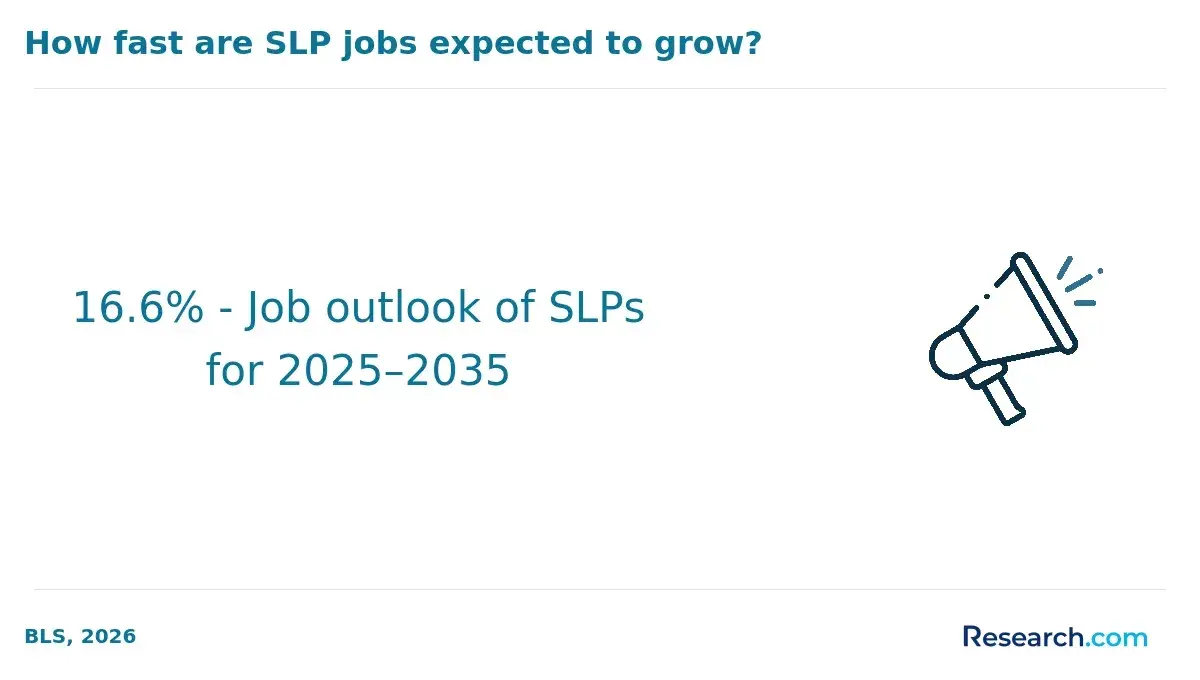
The career case for careful licensure planning remains strong: the U.S. Bureau of Labor Statistics projects 17% employment growth for speech-language pathologists from 2025 to 2035, with about 12,500 openings per year on average. That demand does not override state licensing rules, so use it as labor-market context rather than as a guarantee of a job or a license.
Before choosing either program, complete these checks in writing.
- Confirm the program's current CAA status and whether it applies to your expected graduation cohort.
- Read the program's professional-licensure disclosure for the state where you plan to live and practice.
- Contact your intended state licensing board about education, supervised fellowship, examination, and application requirements.
- Ask whether the program has identified any state-specific enrollment or clinical-placement restrictions for your location.
If you expect to work in schools, also check the state education agency's credential rules. A clinical SLP license, an ASHA credential, and a school-service credential often overlap, but they are not always identical.
In what ways do clinical placements and supervision differ between the two online SLP master's programs?
Clinical placement is often the most consequential difference between distance SLP programs because it determines where you train, how much commuting or relocation is possible, and how quickly you can begin seeing clients. Both UW-Eau Claire and Idaho State require supervised clinical education, but students should not assume that an online program can place every student at a preferred facility near home.
Programs generally coordinate, approve, and monitor placements while requiring students to participate in the process. The exact balance varies by site availability, state rules, affiliation agreements, supervisor qualifications, and a student's location.
A facility cannot be used simply because a student works there or knows a clinician; it must meet program and professional requirements.
| Placement question | Why it changes the decision |
| Who identifies prospective sites? | It clarifies whether the school leads the search, the student assists, or both share responsibility. |
| Can placements be guaranteed near home? | Most programs cannot guarantee a specific city, medical setting, age group, or commute distance. |
| Who approves supervisors? | Supervisors must meet program and professional standards before hours can count. |
| Can a current employer serve as a site? | Potential conflicts, supervisor independence, and affiliation agreements may prevent this arrangement. |
| When is full-time availability needed? | Final externships can limit paid employment and should shape your financial plan. |
The professional benchmark is substantial. ASHA certification standards include a minimum of 400 supervised clinical practicum hours, including at least 375 direct client/patient contact hours and 25 guided observation hours.
A program may require more than the minimum or structure hours differently, so students should confirm how each school documents and evaluates clinical competencies.
Ask both schools for their current placement handbook, a clear explanation of student responsibilities, and the typical lead time for securing sites. A red flag is any vague answer suggesting that placement availability is automatic without discussing location, affiliation agreements, supervision, or student readiness.
How long does it typically take to graduate from UW-Eau Claire vs Idaho State's online SLP programs?
Distance SLP master's pathways are commonly organized over roughly three academic years because the curriculum must accommodate sequenced coursework, skill development, practicum, and externship experiences. The exact completion time at UW-Eau Claire and Idaho State should be confirmed using the curriculum plan for the cohort you would enter, not a generalized estimate from another graduate program.
Completion time can increase when a student defers a required course, takes an approved leave, cannot complete an intensive requirement, or encounters a clinical-placement delay. In professional programs, missing one prerequisite course may postpone multiple later courses because cohorts move through a fixed sequence.
| Timeline factor | Effect on graduation timing | What to ask |
| Cohort start date | Determines when the required course sequence begins | Is there one start date each year, and can students begin in another term? |
| Part-time early coursework | May support work initially but extend the academic sequence | Which terms are compatible with full-time employment? |
| Summer enrollment | Can be required to maintain progression | Are summer courses or intensives mandatory? |
| Clinical externship | Often requires weekday availability and may control the final graduation date | When does the final placement begin, and may it require relocation? |
| Leave or course failure | Can move a student to a later cohort | What is the formal progression and remediation policy? |
Choose a program based on the calendar you can actually sustain. Someone needing to keep a predictable job for two years may prefer a program whose earlier terms are compatible with that goal, while someone able to prioritize school may value the most direct available sequence.
Do not resign from a job until you understand the timing and attendance demands of the clinical phases.
What are the admissions prerequisites and cohort profiles for UW-Eau Claire and Idaho State online SLP?
Applicants from communication sciences and disorders backgrounds usually have the most direct path, but applicants with other bachelor's degrees may need prerequisite or leveling coursework.
Typical prerequisite areas include phonetics, speech and hearing science, language development, anatomy and physiology of speech and hearing mechanisms, audiology, speech and language disorders, and statistics. Exact courses, grades, recency rules, and substitutions are program-specific.
UW-Eau Claire and Idaho State should each be asked to complete a transcript review or provide written guidance before a career changer commits to coursework. Do not assume that one university's "equivalent" prerequisite will be accepted by the other.
| Admissions item | What applicants should verify with both programs |
| Degree background | Whether a CSD bachelor's degree is expected or whether a non-CSD degree plus prerequisites is acceptable. |
| Prerequisite courses | Required subjects, minimum grades, accepted institutions, and any expiration or recency expectations. |
| Grade-point average | Minimum GPA, whether it applies to all coursework or a subset, and whether meeting it guarantees consideration. |
| Application materials | Transcript requirements, essays, recommendations, résumé, observation documentation, and any interview process. |
| Testing and preparation | Whether standardized testing is required, optional, or not considered for the applicable cycle. |
| Residency and location | Whether the school can enroll and place students in your state at the time you would start. |
Neither program should be treated as an "easy" admission route simply because it is delivered partly online. Cohort programs have finite clinical capacity and assess academic readiness, communication skills, professionalism, and fit with the program model.
Applicants seeking programs with different selectivity or prerequisite structures can compare easiest online SLP programs to get into, then verify each school's official requirements for the current cycle.
A strong application plan includes a prerequisite audit, a realistic timeline for completing missing courses, and early conversations with admissions staff about state eligibility. Applying before resolving a major prerequisite gap is a common and avoidable mistake.
How do technology platforms, course delivery, and student support services compare between these two online SLP programs?
Technology matters in an online clinical degree because students may participate in live classes, submit recorded clinical work, complete secure documentation, access digital course materials, and communicate with clinical educators. The better fit is the school whose current technology and support model works reliably with your equipment, internet connection, time zone, and learning needs.
Ask UW-Eau Claire and Idaho State for their current technical requirements rather than assuming that ordinary video-conferencing capability is sufficient. Programs may require a webcam, microphone, updated operating system, high-speed internet, secure testing tools, and privacy-conscious workspace practices.
| Support area | What to compare |
| Learning platform | Where coursework, recordings, assignments, feedback, and grades are housed. |
| Live learning | Whether synchronous attendance is required and whether sessions are scheduled in Central or Mountain time. |
| Clinical technology | Requirements for video recording, telepractice exposure, secure storage, and clinical documentation. |
| Academic support | Faculty office hours, advising, writing support, tutoring, disability accommodations, and library access. |
| Clinical support | Placement coordination, compliance tracking, supervisor communication, and escalation procedures. |
| Career preparation | Praxis preparation, fellowship guidance, résumé support, and licensure advising boundaries. |
Telepractice, electronic records, and digital communication are increasingly relevant to SLP workplaces, but technology exposure does not replace supervised clinical competence. Ask how the curriculum addresses confidentiality, informed consent, accessibility, and professional conduct when using digital tools.
A practical test is to attend an information session or request a demonstration of the learning environment. Confirm response times for technical support, whether support is available during evenings or weekends, and what happens if an internet outage affects required live attendance.
What are the residency restrictions, state authorization limits, and out-of-state enrollment rules for each program?
State authorization and professional licensure disclosures are essential for applicants living outside Wisconsin or Idaho. A university may be authorized to provide distance education in a state while still being unable to support clinical placements there, and a program may state that its curriculum meets educational requirements in one state but not another.
UW-Eau Claire and Idaho State should each provide current disclosures identifying where they can enroll students and whether they have determined that the curriculum meets, does not meet, or has not been determined to meet educational requirements for licensure in a particular state.
These determinations can change, especially when boards revise regulations or clinical affiliations change.
| Question | Why it is important |
| Can the program enroll residents of my state? | State authorization rules can affect eligibility before admission. |
| Can the program arrange or approve clinical education in my state? | Enrollment approval does not ensure a viable practicum location. |
| Does the curriculum meet my state's educational licensure requirements? | State boards, not universities, make final licensing decisions. |
| What if I move during the program? | A move can affect authorization, placement options, tuition classification, and licensure planning. |
| Can I complete a placement across state lines? | Supervision, affiliation agreements, and board rules may limit this option. |
Get answers by email and save them with your application records. If you may move because of military service, a partner's employment, or family responsibilities, disclose that possibility early. Waiting until a placement term to raise a state-authorization issue can create avoidable delays.
How do graduation outcomes, Praxis pass rates, and employment results differ between UW-Eau Claire and Idaho State?
Outcome data should be compared only when the schools report the same measure for the same reporting period. Graduation rate, Praxis pass rate, employment rate, cohort size, and reporting window can all differ. A high rate can be meaningful, but it does not tell you whether graduates practiced in your state, found work in your preferred setting, or carried manageable debt.
Request each program's most recent CAA-required outcome disclosures and compare the definitions before drawing conclusions. If one school reports a three-year aggregate and the other reports a single graduating class, the figures should not be treated as equivalent.
| Outcome measure | How to interpret it | Question to ask |
| Program completion rate | Shows the share of students who finished within the school's stated reporting framework. | How many students entered, graduated, withdrew, or took longer than planned? |
| Praxis examination pass rate | Indicates performance on a licensure-relevant examination but depends on cohort and reporting rules. | Which test-takers and attempts are included in the published figure? |
| Employment rate | May reflect graduates working in SLP or pursuing a fellowship, depending on the disclosure definition. | What counts as employed, and when were graduates surveyed? |
| Setting and geography | Helps identify whether outcomes match your desired work environment. | Where do recent graduates complete fellowships and obtain initial positions? |
Nationally, the Bureau of Labor Statistics reports a median annual wage of $97,870 for speech-language pathologists in May 2025. That figure is a national occupation-wide median, not a starting salary, a graduate outcome, or a prediction for either university's alumni. Pay varies by state, setting, experience, schedule, and employer type.
Use outcome disclosures alongside your own career plan. If you hope to work in a medical setting, early intervention, schools, or a rural community, ask each program how its clinical opportunities and alumni pathways relate to that goal.
For broader compensation context, review the available guide to speech language pathology salary while recognizing that pay should not be the sole enrollment criterion.
Other Things You Should Know About Speech Language Pathology
Some students may work during earlier coursework, depending on the cohort schedule and live-session requirements. Full-time employment is often much harder during intensive practicum and externship terms, which may require weekday clinical availability. Ask each program for a term-by-term workload estimate and plan finances before starting.
Not always. Many applicants with other majors can qualify after completing required prerequisite or leveling courses. The specific courses accepted, required grades, and application timing differ by program, so obtain a transcript evaluation from UW-Eau Claire and Idaho State.
No. Licensure is controlled by individual states. You must verify the program's CAA status, the school's state-specific licensure disclosure, clinical-placement availability, and the licensing rules in the state where you intend to practice.
Ask for a written tuition-and-fee estimate, the full cohort calendar, required travel dates, clinical-placement policies, state authorization confirmation, the latest outcome disclosure, and the consequences of delaying a course or placement. Those answers are more useful than a general statement that the program is online.
References
- Speech-Language Pathology Online Graduate Program https://www.uwec.edu/speech-language-and-hearing-sciences-department/graduate-program/speech-language-pathology-online
- Find the Best Speech Pathology Schools for You | 2026 Edition https://speechpathologymastersprograms.com/speech-pathology-programs/
- 2026 Most Affordable Online Speech Pathology Master's... https://www.onlineu.com/most-affordable-colleges/speech-pathology-masters-degrees