2027 Online MLIS Programs With No Group Projects: Does the Format Fit Working Adults?

Co-Founder and Chief Data Scientist
Working adults may want an online MLIS they can complete around unpredictable hours - without coordinating group assignments. But "online" does not mean asynchronous, and a program rarely guarantees that every course is free of group projects. The distinction matters when choosing a degree that must fit both a schedule and a career goal. The U.S. Bureau of Labor Statistics reports a May 2025 median annual wage of $68,270 for librarians and media collections specialists. This guide shows how to check coursework, accreditation, time demands, and costs before committing.
Key Things You Should Know
- "No group projects" is usually a course-level question, not a verified program-wide feature; request recent syllabi for required courses and planned electives.
- Asynchronous classes may still require live meetings, timed work, or an in-person practicum; check each requirement against your work schedule.
- BLS projects 2.6% employment growth for librarians and media collections specialists from 2025 to 2035, so weigh the degree's cost against the jobs you intend to pursue.
What are online MLIS programs with no group projects?
An online Master of Library and Information Science (MLIS) is a graduate program delivered primarily through online courses. "No group projects" describes a desired assignment format, not a standard degree designation. A program may use individual papers and projects in its core courses but assign collaborative work in an elective, capstone, or practicum.
Program names also vary: an MLS, a Master of Science in Library Science, or an institution-specific information degree may prepare students for similar work. Judge the specific program and curriculum rather than its abbreviation. Likewise, an individual research project is not proof of a formal independent-study track.
Before applying, define what you need to avoid. A shared presentation with one grade, a discussion board with required replies, and a supervised placement involve different kinds of interaction. Schools can answer a precise question about each more reliably than a broad request for a "group-project-free MLIS."
Do online MLIS programs without group projects fit working adults?
They can, especially when coursework is asynchronous and major assignments are individual. Removing group projects eliminates coordination with classmates, but it does not remove weekly deadlines or the need to collaborate with instructors and library staff. A predictable workload matters more than the online label alone.
Ask for recent syllabi for every required course and the electives you are likely to take. Check whether lectures are recorded, participation has fixed-time requirements, exams have narrow windows, and courses are offered often enough to support your intended pace. Also ask whether a practicum needs daytime hours or an approved local site. If speed is a priority, compare those constraints with the fast online library science masters options rather than assuming an accelerated schedule will be easier alongside full-time work.
A solo-project format is a strong fit if you need control over when you study and can manage independent deadlines. If you learn best through scheduled conversation - or want structured practice coordinating services with others - some collaborative coursework may be a benefit rather than a drawback.
How can you verify an online MLIS program's ALA accreditation?
For many U.S. professional librarian positions, accreditation by the American Library Association (ALA) is an important screening criterion. It applies to the graduate program, not automatically to every degree offered by an institution. A university's institutional accreditation alone does not establish that its MLIS or equivalent LIS master's program is ALA-accredited.
Use this sequence before relying on an accreditation claim:
- Find the specific master's program in the current ALA directory of accredited programs; check its exact name and institution.
- Confirm with the university that the online route leads to that accredited degree, particularly if several information-related master's degrees are offered.
- Ask the program how its accreditation status applies to your expected enrollment and graduation dates if a review or change is pending.
ALA accreditation does not verify that a course is asynchronous, excludes group work, or meets a state's school librarian licensing rules. Those are separate checks.
What courses do online MLIS programs typically require?
Core LIS study commonly addresses information organization, reference and research services, information seeking, collections, and professional ethics. Requirements differ by program. Depending on career goals, students may choose electives in areas such as metadata, archives, digital collections, information technology, or instruction.
Course titles alone reveal little about assignment format. A metadata course might assess students through an individual description project, while another course with the same subject could require a team-built collection. A catalog listing also does not establish that an elective runs every term.
Compare the degree audit with recent syllabi. Identify required courses, available electives, and any capstone or fieldwork; then ask which assessments are individual and whether an independent project is permitted. For a portfolio, an individually produced finding aid, metadata sample, or information-literacy lesson can demonstrate relevant skills - but only if the course actually offers that work and permits you to retain a shareable version.
What are the admission requirements for online MLIS programs?
Applicants generally need a bachelor's degree and must follow the individual program's graduate admission process. Schools may request transcripts, a statement of purpose, recommendations, or a résumé; prerequisites, testing policies, and minimum academic standards vary. Library employment can strengthen an application but should not be assumed to replace a stated degree requirement.
Ask admissions whether the online option has the same entry requirements as the campus option, whether prior graduate coursework can transfer, and when an applicant with an unusual academic record should request an individual review. Graduate transfer credit is governed by the receiving program's policy, not by undergraduate transfer rules. If you are missing a published requirement, review a library science admissions pathway and obtain the school's decision in writing before planning around an exception.
How long do online MLIS programs take, and how much do they cost?
Completion time depends on required credits, course load, course sequencing, and whether fieldwork or a capstone is required. Part-time enrollment can make weekly study more manageable, but an elective offered infrequently may extend the timeline. Ask an adviser for a term-by-term plan based on the hours you can realistically study.
Without a program's current tuition schedule and degree requirements, a responsible total-cost estimate is not possible. Compare the required credits multiplied by the tuition rate applicable to you, then add mandatory fees, books and equipment, and any travel or placement costs. Confirm whether online students pay a different rate and whether tuition may change before graduation. A cheapest online MLIS tuition comparison is a starting point, not a substitute for a school-specific total.
Keep gross program cost separate from your out-of-pocket cost after any employer assistance or grants, and from the amount you would borrow. Ask financial aid staff which aid applies to your enrollment period and course load. The financial case is strongest when the credential is relevant to positions you intend to seek and the required schedule will not force unplanned extra terms.
How do online MLIS programs compare with campus-based programs?
Delivery format affects when and where you participate, not whether the degree is academically demanding. This comparison highlights scheduling trade-offs; neither format guarantees individual assignments.
| Feature | Online program | Campus-based program |
| Class participation | May be asynchronous, live online, or a mix | Usually includes scheduled in-person meetings |
| Group assignments | Possible even in fully asynchronous courses | Possible during or outside class hours |
| Applied experience | May require an approved local site or scheduled hours | May offer nearby sites, but placements can still conflict with work |
| Travel and access | May reduce routine commuting; verify any campus visits | Requires access to campus for scheduled activities |
Choose based on the actual timetable and support available to you. An online course with live sessions across time zones may be less workable than a nearby evening class. Conversely, an asynchronous course with clear weekly deadlines may offer a working adult more control than a campus commute.
What library careers can an online MLIS degree lead to?
An appropriately accredited online LIS master's can support applications for public and academic librarian roles, subject to each employer's requirements. Public librarians may provide reference help, develop collections, and coordinate community services. Academic librarians may teach information literacy, support research, or manage scholarly resources. Both settings require communication and coordination, even when a student's coursework is largely individual.
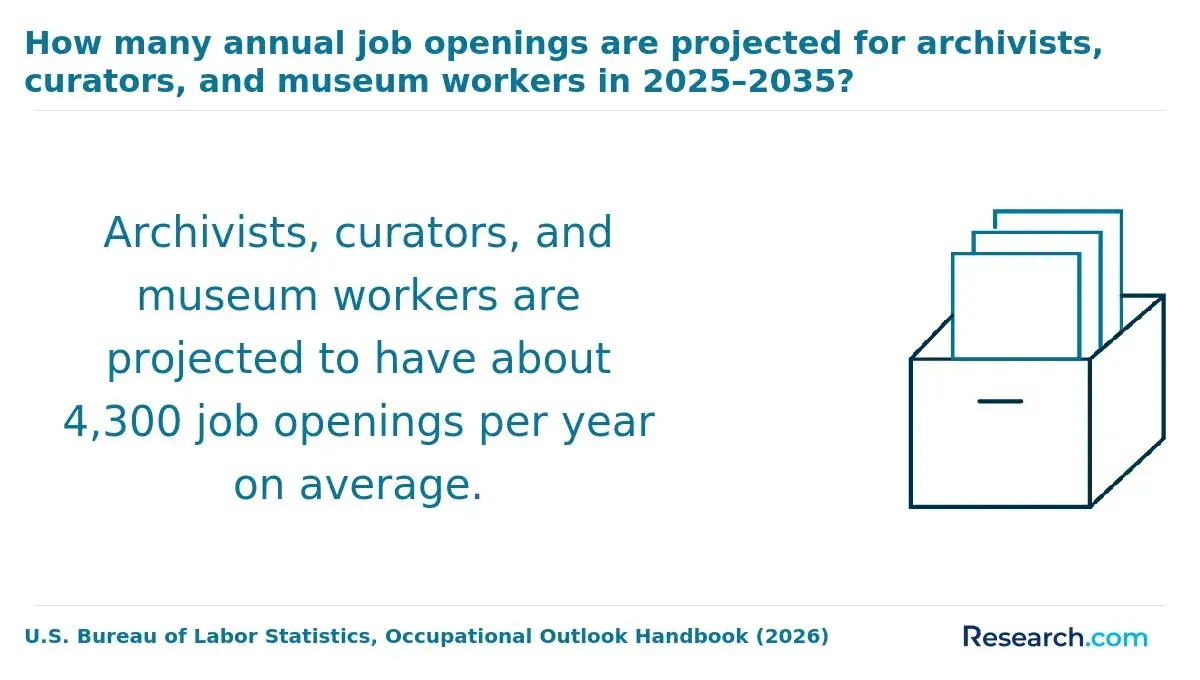
Other paths include archives, metadata, digital collections, and information management. These positions may call for distinct experience: an archivist might describe collections and create finding aids, while a metadata specialist might organize records so digital resources can be discovered. Some adjacent information roles accept other degrees or substantial relevant experience, so an MLIS is not the only route. For management or specialist ambitions, examine the qualifications behind advanced librarian roles and salary rather than treating the degree alone as sufficient preparation.
Match electives and individual portfolio work to job descriptions in your target setting. Library assistant or technician experience can also help you test the work before enrolling, although those positions are not interchangeable with professional librarian roles.
What salaries and job outlook can MLIS graduates expect?
BLS occupational figures describe workers in a job category, not outcomes for graduates of a particular MLIS program. The figures below provide a U.S. benchmark for comparing career paths; pay and hiring prospects vary by location, employer, experience, and role.
| BLS occupation | Median annual wage, May 2025 | Projected job growth, 2025-2035 |
| Librarians and media collections specialists | $68,270 | 2.6% |
| Archivists | $64,550 | 3.4% |
| Library technicians | $44,580 | −6.4% |
The librarian median is a useful benchmark, not an expected starting salary or a guaranteed return on tuition. The technician category also illustrates why a current library job and a prospective professional librarian job should not be treated as the same financial outcome. Compare local postings and their stated qualifications; for a state-specific example, the Illinois library science salary outlook can help frame further location-based research.
Do MLIS graduates need state licenses or professional certifications?
There is no single state license that every U.S. MLIS graduate needs for every library job. Requirements depend on the position and jurisdiction. School librarian roles are a particularly important exception: a state may require educator licensure, a school library endorsement, supervised experience, or other preparation beyond an LIS degree.
If you want to work in a school, check the state education authority's current requirements and ask the MLIS program whether its specific pathway prepares students for that state. Do not assume that ALA accreditation or online availability establishes school librarian eligibility. For public, academic, law, medical, and other specialized libraries, check individual job postings for required degrees, experience, or additional credentials; an employer preference is not necessarily a legal licensing requirement.
Other Things You Should Know About Library Science
Usually not: they are often individually graded participation. If interaction itself is difficult to schedule, ask whether replies must be posted by a specific time.
Possibly, but do not count on an exception. Ask about alternatives before enrollment; if you need an accommodation, contact the school's accessibility office for its process.
Yes. Individual conversations with instructors, placement supervisors, classmates, and local library professionals can help you learn about the field without a shared graded project.
Often, if you have permission to share it. Remove private patron or organizational information and explain your own methods and decisions when presenting the work.
References
- Library and Information Science, MLIS (Online) | Southern Connecticut State University https://www.southernct.edu/academics/programs/library-and-information-science-mlis
- What's the Difference Between Asynchronous and Synchronous Learning? | Ohio State Online https://online.osu.edu/content-hub/blogs/whats-the-difference-between-asynchronous-and-synchronous-learning/
- Library Science Master's Online - UW Information School https://ischool.uw.edu/programs/mlis/degree-options/online
- MLIS Master of Library and Information Studies - UA Online https://online.ua.edu/degrees/mlis-master-of-library-and-information-studies/
- The difference between a synchronous and an asynchronous class | Boise State Online https://www.boisestate.edu/online/2024/10/25/the-difference-between-a-synchronous-and-an-asynchronous-class/
- Calculating contact hours in online and hybrid classes | usc.edu https://annenberg.usc.edu/faculty-and-staff-resources/calculating-contact-hours-online-and-hybrid-classes
- Accreditation Frequently Asked Questions | ALA https://www.ala.org/educationcareers/accreditedprograms/faq