
2027 MLIS Programs for Business Information Centers

Co-Founder and Chief Data Scientist
A business-focused MLIS is worth considering if you want to turn complex market, company, and industry information into research that organizations can use. But the degree alone does not establish that a program teaches business research or offers relevant work experience.
The U.S. median annual pay for librarians and media collections specialists was $68,270 in May 2025, a useful career benchmark, not a promised salary in a corporate role. This guide helps prospective students compare programs, build evidence of their skills, and decide whether an MLIS is the right investment.
Key Things You Should Know
- Choose an ALA-accredited master's program if you want to preserve eligibility for librarian roles that request that credential; verify business-related courses and applied opportunities separately.
- Business information jobs span research, competitive intelligence, and knowledge management. An MLIS can help, but many adjacent roles also accept other degrees and relevant experience.
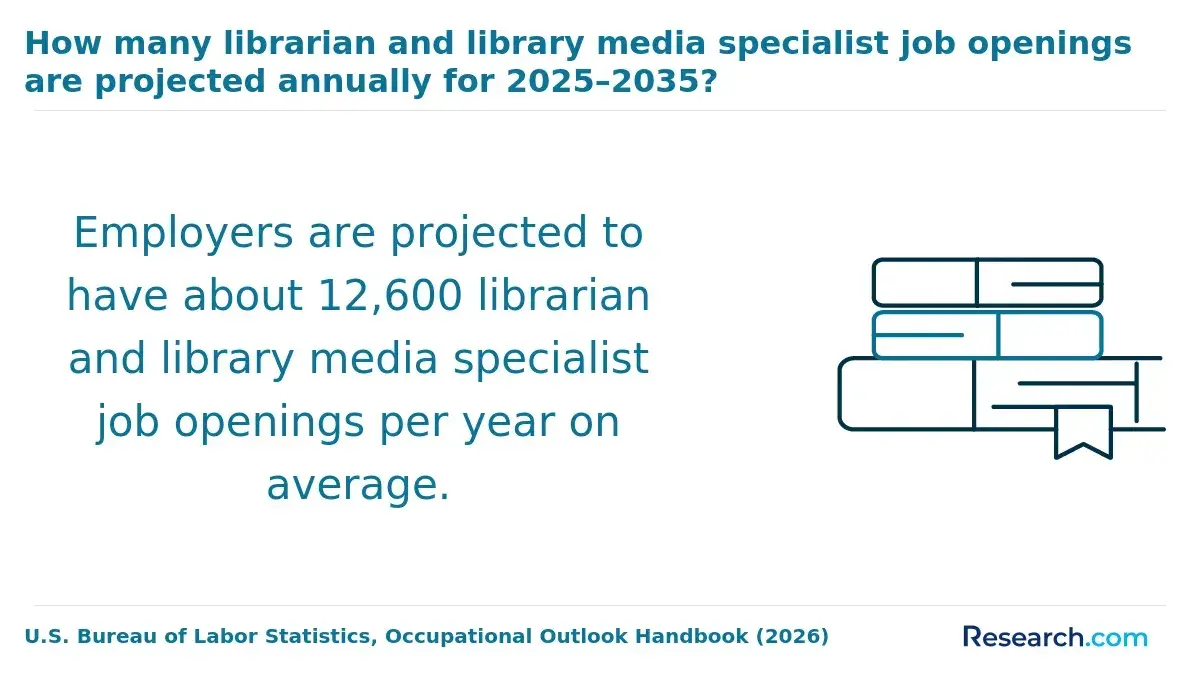
- The broader librarian occupation is projected to grow 2.6% from 2025 to 2035. Compare actual job postings with each program's full cost before borrowing for a specialized career goal.
What are MLIS programs for business information centers?
These are master's programs in library and information science that a student can use to prepare for research and information-service work in companies, industry associations, consulting firms, and similar organizations. A business information center may maintain licensed databases, answer employee research requests, organize internal knowledge, or support market and competitor research. The work emphasizes finding reliable information and explaining its limitations to people making business decisions.
"Business information centers" is usually a career goal, not the name of a degree or a guaranteed concentration. Institutions may award an MLIS, MLS, Master of Science in Library Science, or another LIS degree. Compare the documented curriculum rather than relying on the degree's name. A general library information science degree can provide a foundation, but business preparation depends on the electives, projects, and experience you can actually obtain.
Which accreditation should business-focused MLIS programs have?
If you may apply for professional librarian positions, check whether the specific master's program is currently accredited by the American Library Association (ALA). Employers sometimes specify an ALA-accredited degree. Institutional accreditation is a separate consideration and does not establish ALA program accreditation.
Use the current ALA directory to confirm the program's status, then check the university catalog for the credential and curriculum that apply to your intended enrollment. ALA accreditation does not certify a business concentration, confirm that an elective will run during your studies, or promise an internship. If your goal is an adjacent corporate research or intelligence role rather than a librarian position, review job postings before treating ALA accreditation as an employer requirement.
What careers can an MLIS prepare you for in business information centers?
Job titles vary more than the underlying work. This comparison shows how the same research training can lead to different responsibilities - and where an MLIS may compete with other qualifications.
| Role | Typical work | Credential consideration |
| Corporate librarian or information specialist | Answers research requests, manages sources, and trains employees to find information | An MLIS or related LIS master's may be requested, particularly for librarian-titled positions |
| Business research analyst | Researches markets, companies, customers, and industries for defined questions | Employers may consider business, economics, or other research backgrounds alongside an MLIS |
| Competitive intelligence analyst | Monitors competitors and develops sourced briefings for decision-makers | Industry knowledge and analytical experience can matter as much as degree title |
| Knowledge management specialist | Organizes internal information so staff can find and reuse it | Information architecture, systems, and organizational experience may be valued |
A corporate librarian opening and a competitive intelligence opening should not be treated as interchangeable. Check each posting for required education, subject expertise, software, and evidence of applied research. If the positions you want consistently favor financial analysis or data modeling over information services, a business, analytics, or subject-specific pathway may be a better fit than an MLIS.
What do students learn in a business information and special librarianship curriculum?
A useful curriculum combines LIS fundamentals - reference, information organization, search strategy, and evaluation of sources - with opportunities to apply them to business questions. Relevant electives might address special libraries, business information, data analysis, information architecture, licensing, or knowledge management. An elective's appearance in a catalog does not mean it is required or offered often enough to fit your schedule.
Look for a project in which you define a client's question, select appropriate sources, document your search, and produce a concise briefing with citations and caveats. A business research portfolio could include a market landscape or company profile built entirely from information you have permission to use. Ask whether a practicum can take place with a corporate, nonprofit, or other special-library partner - and who is responsible for finding the placement. Coursework, an approved placement, and a self-directed project are distinct forms of preparation; confirm which are available before enrolling.
Are online or campus-based MLIS programs better for business careers?
Neither format is inherently better. An online program may let you keep a relevant job while studying; a campus-based program may make particular local placements or in-person activities easier to access. In either format, the stronger choice is the one that lets you complete suitable courses and demonstrate business research skills without an unmanageable schedule or cost.
Ask whether classes are asynchronous or held at set times, whether business-related electives are offered online, and whether any practicum requires travel or daytime availability. Also ask how often the courses you need run: online delivery does not guarantee that every elective fits your degree plan. If you are comparing best accredited online MLIS options, confirm both the program's current accreditation and the availability of the particular experiences you want.
What are the admission requirements for business-focused MLIS programs?
Requirements vary by institution, but applicants should expect to check for a completed bachelor's degree, transcripts, a statement of purpose, recommendations, and any program-specific application requirements. Business experience may strengthen an application or help explain a career goal; it should not be assumed to replace a published academic requirement.
In your statement, connect a concrete research problem you want to solve with the program's documented courses or applied opportunities. If your academic history does not neatly match published criteria, contact admissions for an individual assessment rather than assuming you are ineligible or automatically eligible. Applicants looking for library degree application support should still verify the selected university's current rules and deadlines directly.
How long do MLIS programs take, and how much do they cost?
Completion time depends on required credits, the number of courses you take each term, course sequencing, and whether a practicum or project has prerequisites. Ask for a degree plan showing when your preferred electives are expected to run. A nominally short path is less useful if a key course is unavailable when you need it.
Calculate gross tuition by multiplying the applicable tuition per credit by required credits, then add mandatory fees. Budget separately for books, equipment, travel, and any expenses associated with an unpaid placement. Confirm whether online tuition depends on residency and whether additional terms change your fees. Employer reimbursement or scholarships can reduce personal cost if you qualify; borrowing changes when you pay, not the program's price.
Published prices change, so compare current university tuition schedules rather than an undated headline figure. A guide to cheapest online library science masters that pay well can help frame the comparison, but no occupational median establishes what a particular program's graduates will earn. Weigh total cost against the qualifications in jobs you would realistically pursue - and against lower-cost ways to gain missing skills.
What skills are required for business information and competitive intelligence roles?
The central skill is turning an ambiguous request into a defensible answer. That means clarifying the decision a client needs to make, searching across suitable sources, evaluating coverage and reliability, and communicating findings without overstating what the evidence proves. Licensed business databases can be valuable, but their coverage, permitted uses, and access terms must be understood.
Competitive intelligence also calls for ethical collection of information and careful separation of evidence from inference. Knowledge-management work adds skills in organizing documents, designing findable categories, and respecting confidential information. Where a workplace uses AI-assisted search or summarization, the professional still needs to check sources, protect restricted material, and correct unsupported conclusions. Before enrolling, compare several target job descriptions with your existing skills; a supervised project, relevant work experience, or focused training may address a gap more directly than a second degree.
How much do business information professionals earn?
There is no single reliable salary figure for "business information professional" because the title spans librarian, analyst, and knowledge-management jobs. The U.S. Bureau of Labor Statistics reports a May 2025 median annual salary of $68,270 for librarians and media collections specialists. That is a benchmark for the broader occupation, not a corporate-librarian salary or an MLIS graduate outcome.
Pay for a particular opening can depend on its duties, location, industry, and required experience. Compare the compensation in current postings for your intended title and market, then evaluate it against your current earnings and likely education costs. A library degree salary comparison can provide context, but avoid using a broad median as a forecast of your personal return.
What is the job outlook for MLIS graduates in business information services?
The BLS projects 2.6% U.S. employment growth for librarians and media collections specialists from 2025 to 2035. That projection covers the broader occupation; it does not measure demand specifically for business information centers or guarantee openings for MLIS graduates.
For a more useful local outlook, track openings under several titles, including corporate librarian, information specialist, business research analyst, and competitive intelligence analyst. Note which qualifications recur and whether the work is genuinely research-focused. If suitable librarian jobs are scarce where you can work, an MLIS with transferable research and information-organization experience offers more flexibility than a plan built around one narrow title. If the roles you find rarely ask for an LIS degree, test a shorter training or work-experience path before committing to graduate tuition.
Other Things You Should Know About Library Science
Yes. Try answering a defined market or company question using sources you can legally access, then document where the evidence is strong or incomplete. The exercise can help you judge whether you enjoy the work.
Only if you have permission to share it. Otherwise, create a new sample using public information and remove confidential client, employer, and licensed-database content.
They may use different definitions, sources, update schedules, or company and industry coverage. Check each source's methodology before combining figures or presenting one as definitive.
No. Vendor training can demonstrate familiarity with a particular tool, while an MLIS is a graduate degree covering broader information principles and practice. Choose based on the qualifications your target roles request.
References
- Types of Financial Aid: Grants, Work-Study, and Loans | studentaid.gov https://studentaid.gov/understand-aid/types
- Cost of Attendance (Budget) | 2025-2026 Federal Student Aid Handbook https://fsapartners.ed.gov/knowledge-center/fsa-handbook/2025-2026/vol3/ch2-cost-attendance-budget
- Internships | U.S. Department of Commerce https://www.commerce.gov/work-with-us/internships
- Business Databases & Datasets - Research Guides https://libguides.stanford.edu/az/databases
- Economic Development Strategies for Michigan Small Towns | gvsu.edu https://scholarworks.gvsu.edu/cgi/viewcontent.cgi
- What Can You Do With a Library Science Degree? | Syracuse University Online Master's Programs https://onlinegrad.syracuse.edu/information-science/mslis/library-science-careers/
- Business Databases by Name | UCLA Anderson School of Management https://www.anderson.ucla.edu/rosenfeld-library/databases/business-databases-by-name
- Master of Library and Information Science | St. Catherine University https://www.stkate.edu/academics/academic-programs/gc-library-and-information-science
- MLIS Degree Options: FAQ - UW Information School https://ischool.uw.edu/programs/mlis/degree-options/faq
- MLIS Curriculum, Specialties & Courses | University of Arizona College of Information Science https://infosci.arizona.edu/ma-library-information-science/curriculum-specialties-courses


