2027 Legal Studies Master's Programs With Mentoring for Nonlawyer Students

Co-Founder and Chief Data Scientist
A legal studies master's can help a nonlawyer handle legal and regulatory issues at work, but a program's promise of "mentoring" may mean anything from occasional advising to sustained, one-to-one guidance. That difference matters if you need help applying unfamiliar legal concepts to your career. This guide explains what these degrees can and cannot do, how to compare mentoring across online and campus programs, and which costs and outcomes to check before committing.
Key Things You Should Know
- Choose a program with a named mentor, a published meeting schedule, and guidance relevant to your work - not one that uses "mentoring" to describe general student services.
- A legal studies master's does not qualify a nonlawyer to practice law; compare its career value with shorter training before paying for a graduate degree.
- The U.S. median pay for compliance officers was $80,730 in May 2025, with 4% projected job growth from 2025-2035. Those figures describe the occupation, not the earnings of degree graduates.
What is a master's in legal studies for nonlawyer students?
A master's in legal studies is a graduate degree designed to help people understand and apply legal concepts without training them to practice as attorneys. Schools may use names such as Master of Legal Studies (MLS), Master of Studies in Law (MSL), or Master of Jurisprudence (MJ). Names alone do not establish that programs have identical curricula or admission rules.
For a nonlawyer, useful mentoring connects coursework to decisions encountered in compliance, human resources, contracts, healthcare, or another field.
An academic adviser who helps select classes serves a different purpose from a faculty or practitioner mentor who reviews a work-related project and discusses career goals. Ask which relationship the program actually provides.
If you need targeted legal knowledge rather than a full degree, our comparison of legal studies master's and graduate certificates can help frame the trade-off. A graduate certificate is an academic credential; it is not, by itself, professional certification or a license.
What careers can you pursue with a legal studies master's degree?
Potential paths include compliance, contract administration, human resources, risk management, and legal operations. In these jobs, legal knowledge can help someone recognize an issue, follow procedures, and work effectively with counsel. Hiring qualifications vary by employer, and the master's is generally an optional way to build relevant knowledge - not a universal entry requirement.
Mentor fit matters more than a broad promise of networking. A compliance professional may benefit from a mentor who has handled regulatory implementation, while a contracts specialist may want feedback on negotiation workflows and escalation to attorneys.
Ask whether mentors work in the field you intend to enter and whether career guidance is available to students changing fields.
The degree may be more than you need for an entry-level legal-support role. The Bureau of Labor Statistics (BLS) reports median pay of $62,890 in May 2025 for paralegals and legal assistants, with 0% projected growth from 2025-2035 and about 40,800 openings per year.
These occupation-wide figures do not show a salary premium for a master's. If paralegal work is your goal, compare the degree with a relevant paralegal education route and its online paralegal degree affordability before enrolling.
What accreditation should legal studies master's programs have?
Start by confirming that the university holds institutional accreditation from an accreditor recognized by the U.S. Department of Education. Check the institution's current accreditation disclosure and the accreditor's listing, particularly if you may seek employer tuition assistance or later apply to another school. Accreditation does not guarantee that a particular degree's mentoring is strong.
Do not confuse institutional accreditation with American Bar Association (ABA) approval. The ABA approves qualifying paralegal education programs; that designation is not institutional accreditation and should not be assumed to apply to a legal studies master's. Likewise, attendance at an accredited university does not mean every program has separate professional approval.
When comparing programs, request the current academic catalog and written description of mentoring. A claim about faculty access is easier to assess when the school specifies who provides guidance, whether participation is required, and how students obtain appointments.
Do legal studies master's graduates need a law license?
Graduates do not need a law license merely to earn or use a legal studies degree in a nonlawyer job. They do need to observe the boundaries of that job: the master's does not qualify them for bar admission or authorize them to represent clients, give legal advice independently, or perform other work reserved for licensed attorneys. Rules about permitted activities vary by state and role.
Mentoring should reinforce those boundaries. For example, a strong applied project might teach a compliance student to identify a potential legal issue, document it, and refer it to counsel - not to act as the organization's attorney. If your goal is to practice law, investigate the jurisdiction's attorney-licensing requirements and an appropriate law-degree pathway instead.
What do you learn in a legal studies master's program?
Curricula commonly introduce legal research, legal reasoning, U.S. legal institutions, and the interpretation of statutes and regulations. Electives may address contracts, employment law, privacy, healthcare, or business regulation. A named concentration has published requirements; access to a few related electives does not necessarily amount to a concentration.
For a mentoring-focused search, look beyond course titles. Determine whether a mentor helps you choose an appropriate project, provides feedback on drafts, and connects legal analysis to your existing responsibilities. A student handling vendor agreements, for example, may get more value from reviewing a contract-risk workflow than from receiving general career encouragement.
Employed applicants weighing a business-law emphasis can also compare business law study choices for employed adults. Before selecting any concentration, check whether its courses are offered often enough to fit your schedule and whether the advertised mentor has relevant experience.
How do online and campus-based legal studies programs compare?
Neither format guarantees better mentoring. Online students may meet mentors by video and receive written project feedback; campus students may have more opportunities for in-person meetings. In either format, the decisive questions are whether meetings are scheduled, accessible, and substantive. "Online" does not mean asynchronous, and an online degree may still have live classes or campus requirements.
The comparison below separates delivery format from the mentoring arrangement. Use it to identify scheduling questions before assuming a format will work with your job.
| Format | Potential mentoring advantage | Commitment to verify |
| Asynchronous online | Written feedback can be reviewed around work hours. | Availability of one-to-one meetings and feedback turnaround. |
| Live online | Regular discussion may make it easier to ask questions. | Required meeting times and time-zone expectations. |
| Campus or hybrid | In-person access may support sustained relationships. | Travel, attendance, and any required campus visits. |
If finishing quickly matters, compare course sequencing and mentor availability as carefully as advertised duration. Business law master's programs with faster study pathways may save calendar time, but an accelerated schedule can leave less room for project revisions or meetings.
What are the admission requirements for legal studies master's programs?
Programs typically require a bachelor's degree, but GPA rules, essays, recommendations, work-history expectations, and standardized-test policies vary. A law degree is generally not the point of a nonlawyer program; check each school's eligibility language rather than assuming that every legal studies master's accepts - or excludes - the same applicants.
Use the application to establish whether mentoring matches your starting point. Describe the legal or regulatory problems you encounter and ask admissions staff whether someone with relevant experience can guide work in that area.
If you have little professional experience, find out whether mentors support exploration of roles rather than expecting every student to arrive with a project topic.
If you have not yet completed a bachelor's degree, a master's application is usually not the immediate next step. Start with planning an associate-to-bachelor's legal studies transfer, and confirm directly with the receiving institution how prior credits would apply.
How long do legal studies master's programs take and cost?
Completion time depends on required credits, course availability, enrollment pace, and any capstone or project. Compare the schedule you can actually follow - not just the shortest advertised pathway. Ask whether mentor meetings and project feedback are available during evening, summer, or accelerated terms if you plan to study while working.
For cost, request a written estimate covering tuition, mandatory fees, books, technology, travel, and any required project expenses. Confirm whether mentoring is included in tuition or carries a separate charge.
Compare programs on the same basis, such as the expected cost to complete at your intended pace, rather than comparing one school's per-credit rate with another's advertised program total.
A graduate degree also costs time that could be spent gaining experience or completing shorter training. Ask the financial aid office what aid applies to the specific program, and check employer reimbursement terms before counting on that support. A lower advertised price is not a bargain if required courses are rarely offered or the mentoring you need is unavailable.
What salaries and job outlook can legal studies graduates expect?
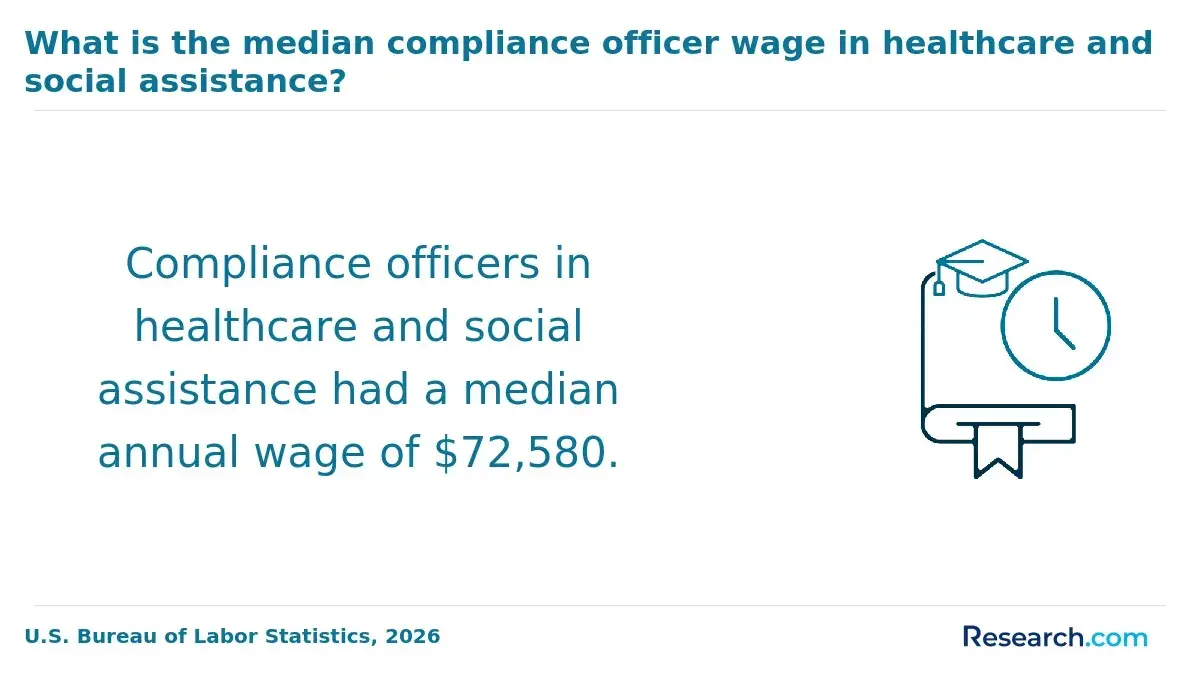
There is no single salary or growth rate for legal studies master's graduates: people enter different occupations, and employers weigh experience alongside education. For one relevant benchmark, BLS reports that compliance officers had median annual pay of $80,730 in May 2025, with 4% projected job growth from 2025-2035 and about 32,700 openings per year.
The figure covers compliance officers broadly; it does not measure outcomes for degree holders or mentoring participants.
Evaluate a program against the job you want. Compare postings for that role with the curriculum and ask the school for clearly defined outcomes, including which graduates are counted. Be cautious if a program uses occupation-wide wages to suggest that enrollment will produce a particular salary, promotion, or return on investment.
How can you choose a reputable legal studies master's program?
Shortlist programs that are institutionally accredited, teach the legal subjects relevant to your work, and fit your schedule and budget. Then test the mentoring claim. A useful written answer from the school should tell you what support you will receive, not merely that faculty are accessible.
Ask each shortlisted program the same questions so you can compare what is included before accepting an offer:
- Who can serve as my mentor, how are mentors assigned, and can I request someone with relevant professional experience?
- How often can we meet, what feedback will I receive on applied work, and what happens if a mentor becomes unavailable?
- Are meetings scheduled outside standard work hours, and are any visits or live sessions required?
- What is the full expected cost at my enrollment pace, and is mentoring included?
- Can you show how the required courses and project would help me pursue my specific role without implying that the degree provides a license?
Favor the program that can document substantive, accessible mentoring tied to your goal - not necessarily the one with the most prominent "mentor" language. Treat vague answers about access, unclear total costs, and promises of employment or attorney-level authority as reasons to pause. If the answers reveal that you only need one legal topic, consider a shorter credential or employer training instead.
Other Things You Should Know About Law & Paralegal
Do not assume they will. A law school decides whether it accepts prior coursework and how any accepted credit applies. Get a written answer from the JD program before enrolling in a master's for that purpose.
Not without appropriate permission. Ask the program about its project rules and your employer about confidentiality requirements. A fictionalized scenario may be safer if it meets the assignment's requirements.
Policies vary. Ask whether reassignment is possible, who approves it, and whether changing mentors would delay a required project.
No. An academic degree and professional certification are different credentials. Certification requirements depend on the organization or state system granting it; completing a master's does not automatically confer that status.
References
- Cost of Attendance (Budget) | 2025-2026 Federal Student Aid Handbook https://fsapartners.ed.gov/knowledge-center/fsa-handbook/2025-2026/vol3/ch2-cost-attendance-budget
- Types of Financial Aid: Grants, Work-Study, and Loans | studentaid.gov https://studentaid.gov/understand-aid/types
- Legal Careers You Can Pursue Without a Law Degree | DePaul University Online Master of Legal Studies https://onlinemls.depaul.edu/articles/legal-careers-you-can-pursue-without-a-law-degree/
- Can You Practice Law Without Passing the Bar? | J.D. Jobs https://www.collegesoflaw.edu/blog/2022/04/12/jobs-for-j-d-s-bar-exam-not-required/
- MSL vs. LLM vs. JD: Which Law Degree Is Best for Your Career Path? | USC Online https://online.usc.edu/news/msl-llm-jd-law-degree-best-career-path/
- Juris Master vs. Juris Doctor: Which Law Degree Fits You? | Tulane University https://online.law.tulane.edu/blog/juris-master-vs-juris-doctor
- Master of Laws (LL.M.) Program | Howard University School of Law https://law.howard.edu/admissions/master-laws-llm-program
- Juris Doctor (JD) vs Master of Legal Studies | Pepperdine Caruso School of Law https://law.pepperdine.edu/blog/posts/jd-vs-mls.htm
- Juris Master Degree Program (For Non-Lawyers) | Antonin Scalia Law School https://www.law.gmu.edu/admissions/jm/jm_program
- Online Master of Legal Studies | AU-LAW https://onlinelaw.wcl.american.edu/legal-studies/