2027 Privacy-Focused MLS Programs: Comparing Technical Prerequisites and Legal Coursework

Co-Founder and Chief Data Scientist
A privacy-focused Master of Legal Studies (MLS) can help professionals interpret rules governing personal data, but programs differ in how much technology they expect students to understand and how deeply they teach privacy law. That difference matters if you work in compliance, human resources, security, or legal operations - and do not intend to become an attorney. This guide shows you how to compare entry requirements, course content, format, cost, and career value so you can identify a program that fills your actual skill gaps.
Key Things You Should Know
- Most privacy-focused MLS programs are designed for nonlawyers; do not assume that a program requires coding or cybersecurity experience without checking its published admissions rules.
- Compare required privacy-law courses and applied assignments, not just a concentration label. A cybersecurity course does not necessarily teach students to interpret privacy obligations.
- An MLS does not qualify graduates to practice law. For context, the U.S. median pay for compliance officers was $80,730 in May 2025, with 4% projected job growth for 2025-2035; those figures describe an occupation, not MLS graduate outcomes.
What are privacy-focused MLS programs, and who should enroll?
A privacy-focused MLS is a graduate legal-knowledge degree for people who need to work with privacy requirements without becoming lawyers. Schools may call a similar credential a Master of Studies in Law (MSL) or Master of Jurisprudence. "Privacy-focused" might mean a formal concentration, a prescribed course sequence, an embedded certificate, or simply a choice of electives. Check what the transcript and diploma will actually show.
The degree may suit a compliance analyst interpreting data-handling requirements, a human resources professional responsible for employee information, or a security professional who needs to understand the legal consequences of technical decisions. It is less compelling if your immediate goal is to configure security systems, learn to code, or obtain a narrow workplace credential: technical training, employer-sponsored instruction, or a shorter certificate may address those goals with less time and expense.
An MLS is not a Juris Doctor (JD) and does not, by itself, qualify someone for a law license or independent legal practice. If your work centers on contracts and organizational regulation rather than privacy specifically, online business law master's programs with shorter timelines may be another route to compare - but inspect their privacy electives before treating them as substitutes.
What technical prerequisites do privacy-focused MLS programs require?
Do not confuse admission prerequisites with skills a course will teach. A program intended for nonlawyers may accept applicants from varied academic backgrounds, while an applied course may still expect comfort with spreadsheets, information systems, or data flows. Coding, networking, and cybersecurity experience should be treated as requirements only when the school explicitly says so.
The comparison below separates three common educational approaches. It helps identify whether you need technical preparation before enrolling or legal instruction after you enroll; individual programs can combine these approaches.
| Program emphasis | Technical knowledge to check | Instruction to look for |
| Privacy law and compliance | Ability to understand how an organization collects, shares, and retains information; coding may not be required | Legal analysis, regulatory interpretation, policies, and incident-response obligations |
| Applied privacy governance | Familiarity with data inventories, vendors, and organizational systems may help with assignments | Data mapping, privacy assessments, contract review, and cross-functional decision-making |
| Cybersecurity or technical privacy | Programming, systems, or security fundamentals may be required or strongly recommended | System design, security controls, and technical testing alongside any legal content |
For each shortlisted MLS, read both the admissions page and the descriptions of required courses. Ask whether students must use a particular platform, whether introductory technical material is provided, and whether applied work assumes prior experience. A course that mentions data mapping is not the same as one that requires students to complete a data-mapping exercise.
What legal courses do privacy-focused MLS programs typically include?
Relevant curricula may cover U.S. privacy law, information governance, cybersecurity law, consumer protection, workplace privacy, contracts, and regulatory compliance. The useful distinction is breadth versus depth: one survey course can introduce major issues, while a sequence of required courses can provide sustained practice interpreting rules and applying them to organizational decisions.
Compare the required syllabus - not just the elective catalog - for instruction on how privacy obligations apply to data collection, sharing, retention, vendor relationships, and breaches. Then look for assessments such as drafting a policy, analyzing a vendor agreement, or evaluating a proposed data use. These assignments can reveal more about practical preparation than a course title does.
Industry context matters. A professional handling employee data may benefit from workplace privacy and employment-law courses; human resources law as a legal studies concentration offers a useful curriculum comparison. Someone working with health information should instead check for coursework that directly addresses that setting. No single survey course covers every applicable federal and state rule in equal depth.
Are privacy-focused MLS programs available online and on campus?
Legal studies degrees may be offered online, on campus, or in hybrid formats, but delivery labels do not establish scheduling flexibility. An online course may require live meetings, timed exams, group projects, or an on-campus session. A campus program may offer evening classes that suit local working professionals better than a rigid online cohort.
Before applying, request the current course schedule and ask whether required privacy courses are available in your preferred format every term. Also confirm any residency, practicum, or capstone attendance rules. If speed is a priority, distinguish the program's advertised fastest completion path from the sequence realistically available to a part-time student; comparisons with online business law master's programs with shorter timelines are most useful when the required courses are offered on a schedule you can actually follow.
What are the admission requirements for a privacy-focused MLS program?
Graduate legal studies programs generally ask applicants to document prior undergraduate study, but each school sets its own degree, grade, application, and language-proficiency rules. Some may value professional experience or request a statement of purpose; neither a technical background nor legal work experience should be assumed to be universally required.
If you have taken prior graduate coursework, ask whether the MLS accepts transfer credit and, separately, whether that credit can replace a required privacy course. The receiving institution decides how previous credit applies. This differs from undergraduate planning, where comparing transfer opportunities in paralegal bachelor's programs may be more relevant to students who have not yet completed the bachelor's degree typically needed for graduate admission.
A useful application check is to send admissions staff your background and the specific course descriptions that concern you. Ask which qualifications are mandatory, which are recommended, and how students without technical experience prepare for the first required class.
How long do privacy-focused MLS programs take, and what do they cost?
Completion time depends on required credits, course availability, and whether you study full time or part time. An advertised accelerated timeline may require a heavier course load than a working professional can manage. Request a term-by-term plan for your intended enrollment pace, including when each required privacy course is offered.
For a comparable cost estimate, multiply each school's published tuition rate by its required credits, then add mandatory fees, books, technology costs, and any travel. Ask whether tuition differs by residency or delivery format and whether an employer will reimburse legal studies coursework. Federal aid eligibility depends on the institution, the specific program, and the student; do not assume that a separately advertised certificate qualifies for the same aid as a degree.
The central trade-off is whether graduate-level legal study adds enough value beyond targeted training. If your intended role is paralegal rather than organizational privacy compliance, compare the substantially different curriculum and credential of affordable ABA-approved paralegal programs online before committing to an MLS. The American Bar Association (ABA) approves qualifying paralegal education programs; that approval is not a designation for MLS degrees.
How can students verify MLS program accreditation and quality?
First, confirm that the university holds institutional accreditation from an accreditor recognized by the U.S. Department of Education. Check the institution's current accreditation disclosure and the accreditor's listing rather than relying solely on promotional language. Institutional accreditation does not establish that a privacy concentration has a separate professional endorsement.
Next, examine evidence specific to the MLS: the current catalog, required-course rotation, instructor qualifications, access to legal research resources, and examples of applied coursework. Ask whether the privacy concentration is guaranteed to remain available throughout your planned enrollment and what happens if an elective is canceled. Published career outcomes, when offered, should be checked for sample size and whether they describe MLS graduates specifically.
What careers can a privacy-focused MLS degree prepare graduates for?
Potential applications include privacy compliance, information governance, vendor-risk review, policy operations, and legal operations support. In those roles, a professional may translate legal requirements into internal procedures, coordinate with counsel and technical teams, or document how an organization handles personal information. Employers determine their own hiring requirements, and an MLS is not generally a legal prerequisite for these jobs.
Choose coursework around the work you want to perform. A security specialist may need stronger regulatory interpretation; a compliance professional may need more practice understanding data systems. Prior experience remains important because studying a rule is different from implementing a process across an organization.
Readers aiming to become paralegals should compare a different entry route, such as finding an online associate program in paralegal studies. Paralegal education emphasizes supporting lawyers' work; an MLS emphasizes graduate-level legal knowledge for nonlawyer professionals. Neither credential authorizes independent legal practice.
What salaries and job outlook can privacy law graduates expect?
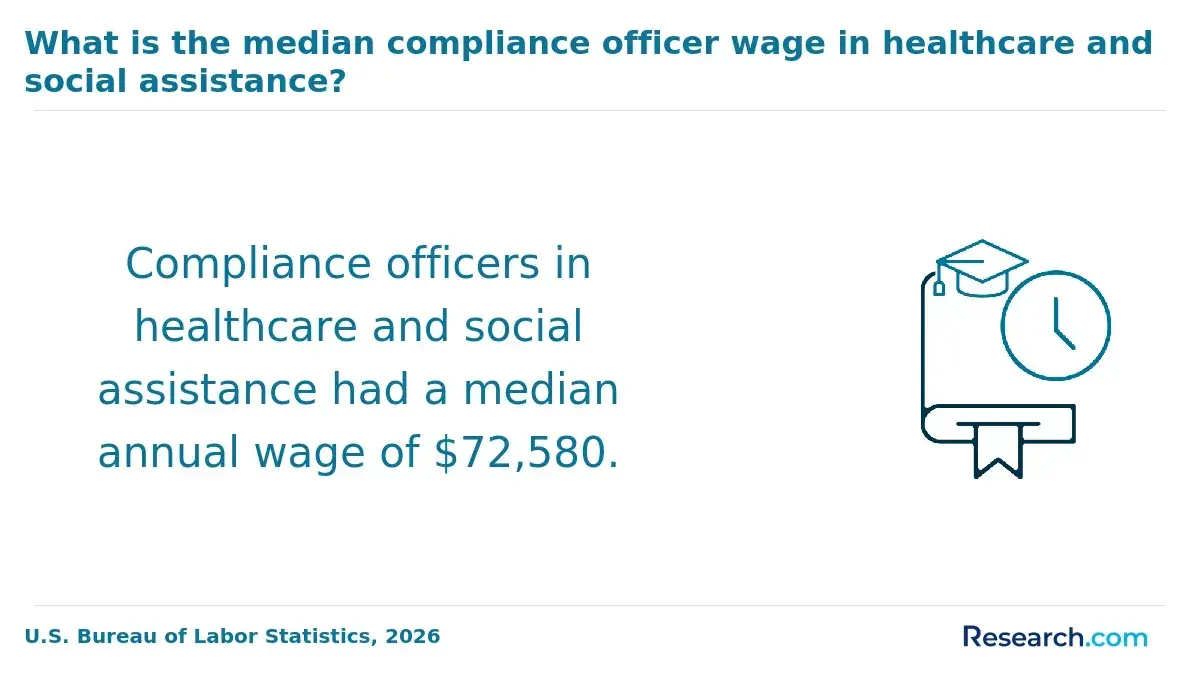
There is no single U.S. salary or job-growth figure for "privacy-focused MLS graduates." The Bureau of Labor Statistics reports a median annual wage of $80,730 in May 2025 for compliance officers and projects 4% growth for 2025-2035. Compliance officers work across many regulatory specialties, so those figures are context for one possible career path - not a prediction of pay or hiring prospects for privacy specialists or degree holders.
For an individual decision, compare local job postings with your current qualifications. Note whether employers ask for privacy experience, legal analysis, security skills, a professional certification, or a graduate degree. If experience is the consistent gap, an MLS alone may not resolve it; an internal project or an entry-level compliance role could be a more direct first step.
Do privacy-focused MLS graduates need licenses or professional certifications?
An MLS graduate does not need an attorney license to work in a nonlawyer privacy or compliance role, but the degree does not permit the graduate to practice law. Job duties and any applicable licensing rules depend on the role and state. Employers may also prefer particular professional credentials without those credentials being legal requirements.
A professional certification is awarded by a credentialing organization after its stated requirements are met; it is not the same as a university degree or a course-completion certificate. If job postings repeatedly name a privacy certification, review the issuing organization's current eligibility, exam, and renewal rules. Compare that focused option with an MLS based on the legal depth you need, your existing experience, and the time and tuition involved.
Other Things You Should Know About Law & Paralegal
Possibly. Ask the program whether it permits employer-based projects and what approvals or confidentiality safeguards it requires before using workplace information.
Usually not. An MLS centers on legal reasoning and organizational obligations; a cybersecurity degree may devote substantially more study to technical systems and controls. Compare required courses rather than degree titles.
A concentration can provide a defined sequence; electives may let you tailor study to an industry. Check which courses are actually offered and whether the concentration appears on your academic record.
They may perform compliance and operational work within their roles, but an MLS does not authorize independent legal advice or representation. Organizations should involve licensed counsel when legal advice is needed.
References
- Privacy Impact Assessments (PIA) | ed.gov http://www.ed.gov/about/ed-overview/required-notices/privacy-program/privacy-impact-assessments-pia
- Privacy Impact Assessments (PIAs) | hhs.gov https://www.hhs.gov/privacy/privacy-impact-assessments/index.html
- National Security & Cybersecurity Law | GW Law https://www.law.gwu.edu/national-security-cybersecurity-law
- Tech, Law & Security Program - Washington, DC | American University https://www.american.edu/wcl/impact/initiatives-programs/techlaw/curriculum.cfm
- MLS - Privacy Law and Cyber Security - Seton Hall Law School https://law.shu.edu/academics/mls-privacy-law-cyber-security-online.html
- Online Master of Legal Studies | AU-LAW https://onlinelaw.wcl.american.edu/legal-studies/
- Data Privacy, MS | Dakota State University https://dsu.edu/programs/MSDP/
- Specializations - Online & Hybrid MLS Career Tracks | UC Law San Francisco MLS https://mls.uclawsf.edu/curriculum/specializations/
- Course Offerings | Institute for Technology Law & Policy https://www.law.georgetown.edu/tech-institute/academics/course-offerings/
- Privacy Impact Assessments - Cybersecurity | Illinois https://www.cybersecurity.illinois.edu/privacy-impact-assessments/