2027 From Law Firm Receptionist to Paralegal: Choosing a First Academic Credential

Co-Founder and Chief Data Scientist
Working at a law firm gives you a head start: you may already understand client intake, deadlines, and how a practice operates. But receptionist experience alone may not show an employer that you can conduct legal research or prepare documents under attorney supervision.
This guide helps you decide whether an associate degree, paralegal certificate, or shorter first step fits your education and career goals. You'll also learn what to verify before paying for a program, including its admission rules, practical training, schedule, and full cost.
Key Things You Should Know
- If you do not already have a college degree, a paralegal associate degree is often the clearest first academic credential; if you have a bachelor's degree, compare post-baccalaureate certificates before starting another degree.
- A program certificate is not professional certification, and American Bar Association (ABA) program approval is not the same as institutional accreditation. Neither is universally required for paralegal employment.
- The U.S. Bureau of Labor Statistics reports $62,890 median annual pay for paralegals and legal assistants in May 2025, but that occupation-wide figure is not an expected starting salary for someone moving from reception.
What is the best first credential for becoming a paralegal?
Start with your existing education, not your job title. If you have a high school diploma but little college coursework, a paralegal associate degree usually offers the most complete first credential: general education alongside legal research, writing, procedure, and document preparation. If you already hold a bachelor's degree, a paralegal certificate designed for degree holders may teach the missing legal skills without repeating general education.
Your receptionist experience can strengthen either route. Familiarity with client communications, scheduling, and confidentiality is valuable, but it does not replace training in research, citation, legal documents, and the limits of a paralegal's role. If you are unsure whether you want paralegal work specifically, online study for a legal studies associate degree offers a broader option to compare. Check its curriculum carefully: a legal studies degree may not provide the same paralegal-focused practice courses.
Do paralegals need a degree, certificate, or professional certification?
There is no single nationwide degree requirement for paralegals. Employers set hiring preferences, while state rules may impose additional conditions on particular titles or work. A degree is an academic award; a program certificate documents completion of a defined course of study. Professional certification is a separate credential awarded by a certifying organization after its eligibility and assessment requirements are met.
For a receptionist seeking an internal move, the useful question is what your firm requires for its entry-level paralegal work. Ask the supervising attorney or hiring manager which tasks you would need to perform and what education they expect. You might be able to take on supervised legal-assistant duties while studying, but paralegals do not become attorneys through these credentials and cannot independently give legal advice or practice law.
How do you choose an accredited paralegal program?
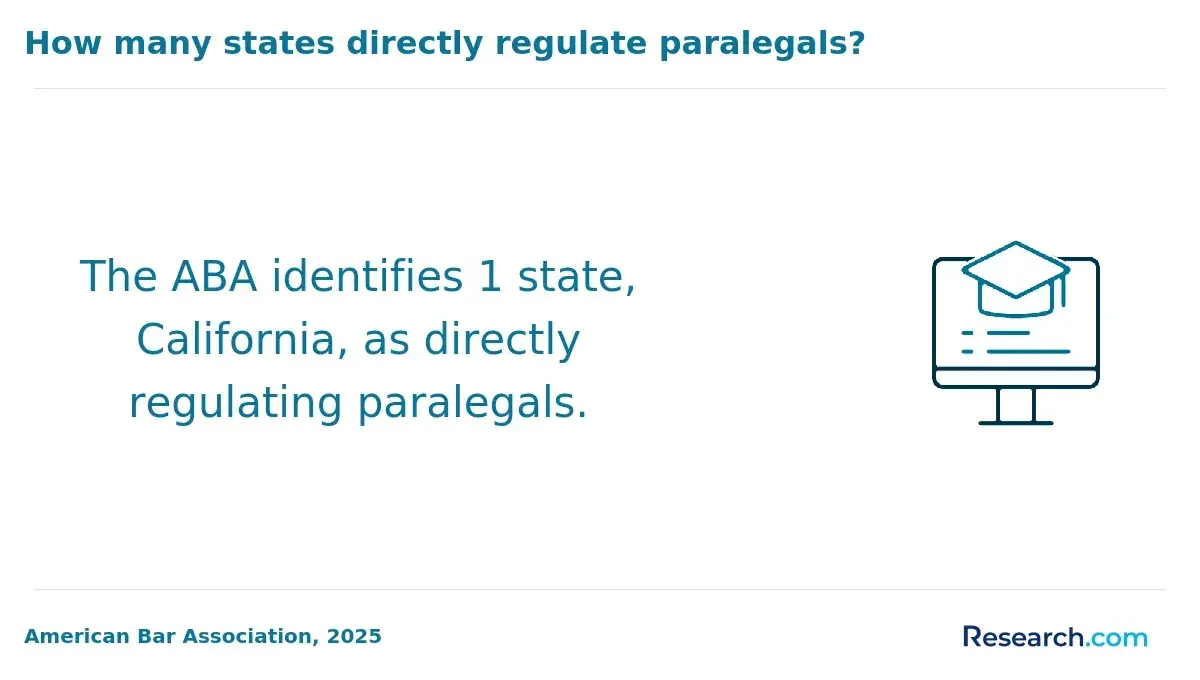
Check two statuses separately. Institutional accreditation concerns the college or school; confirm its current status through the institution and its recognized accreditor. The American Bar Association (ABA) approves qualifying paralegal education programs, not colleges as a whole. Check the ABA's current paralegal program directory if approval matters to you or a prospective employer. A program without ABA approval is not automatically unaccredited or unsuitable.
Then read the current catalog rather than relying on an advertisement. Look for substantial legal research and writing instruction, attorney-supervised work boundaries, usable legal technology training, and an internship or comparable practical assignment if you need experience beyond reception. Confirm the credential awarded, graduation requirements, and whether required courses run often enough for your schedule. Treat claims about placement or certification eligibility as questions to verify, not promised outcomes.
What is the difference between an associate degree and paralegal certificate?
Both can be first steps, but they serve different starting points. This comparison focuses on what you must bring to the program and what you receive in return; individual schools' rules can differ.
| Decision factor | Paralegal associate degree | Paralegal certificate |
| Typical starting point | Applicants entering college or seeking a first degree | Varies: some admit beginners; others require prior college credits or a bachelor's degree |
| Coursework | General education plus paralegal-specific courses | A more focused course sequence; prerequisites may add time |
| Time and cost trade-off | Usually more coursework, with degree credit that may support further study | May be shorter, but not necessarily cheaper once prerequisites and fees are included |
| Credential received | Academic degree | Academic or continuing-education certificate, depending on the program |
If you may later pursue a bachelor's degree, ask a prospective receiving college how the associate courses would apply; accreditation alone does not guarantee transfer. If your interests extend beyond paralegal work, transfer-friendly business law degree programs are another route to investigate. If you already have a bachelor's degree, compare the certificate's legal coursework and prerequisites before paying for a second undergraduate degree.
Should you study paralegal studies online or on campus?
Choose the format that lets you complete the required work, not merely attend lectures. Online does not necessarily mean self-paced: courses may have live meetings, fixed deadlines, scheduled exams, or in-person requirements. Campus study may make it easier to meet instructors and classmates, but travel can be a substantial burden for someone working firm hours.
Compare actual course schedules and ask whether an internship is required, who arranges it, and whether work at your current firm could qualify. Do not assume receptionist duties will satisfy a paralegal practicum. If an associate degree is your likely route, compare online study for a paralegal associate degree against local programs on scheduling, practical assignments, and total cost - not delivery format alone.
What courses do paralegal programs typically include?
Look first for legal research, legal writing, civil procedure, and instruction in preparing and organizing documents. Many programs also introduce contracts, legal ethics, litigation support, and practice areas such as family, real estate, or business law. An associate degree generally adds general education courses; certificate curricula vary more by admission level.
For your move from reception, examine how skills are taught. A course requiring you to research an issue, cite sources, and draft a supervised work product is more directly relevant than a course that only describes legal processes. Ask whether students practice with current research and case-management tools, rather than assuming a tool named on a course page comes with hands-on access.
What are the admission requirements for paralegal programs?
Associate programs commonly admit applicants with a high school diploma or equivalent, subject to the college's other admission and placement rules. Certificate requirements differ substantially: one may accept applicants without college experience, while another is intended only for students who already have a bachelor's degree. Prior law firm employment is useful context for an application, but it does not automatically waive academic prerequisites.
Before applying, read the current catalog entry for the specific credential. Confirm required prior coursework, whether classes carry college credit, any minimum grades, and the order in which courses must be taken. If you have earlier college credits, request an individual evaluation; the receiving school decides whether and how they apply.
How long do paralegal programs take and what do they cost?
An associate degree often takes about two academic years of full-time study; part-time attendance can extend that timeline. Certificate length depends on prerequisites, course sequencing, and how often classes are offered. Some online paralegal programs with faster completion pathways may reduce elapsed time, but an accelerated schedule can be difficult alongside full-time firm work.
There is no dependable single price for either route. Request a written estimate covering tuition, mandatory fees, books, technology or research-platform charges, prerequisite classes, and any travel or internship expense. Compare the amount you would actually pay and the credit you would receive. Ask the school's financial aid office whether the specific program qualifies for federal aid; institutional eligibility alone does not establish that every certificate is eligible. Also check whether your employer offers tuition assistance and what continued-employment conditions apply.
What jobs and salaries can paralegal credentials lead to?
A first credential may help you compete for paralegal or legal-assistant openings, particularly when paired with documented research, writing, and supervised casework. It may also support a gradual internal transition from reception. Hiring still depends on the employer, practice area, location, and your demonstrated skills; completion does not guarantee a promotion.
The Bureau of Labor Statistics reports median annual pay of $62,890 in May 2025 for the combined occupation of paralegals and legal assistants. It projects 0% growth for 2025-2035, alongside about 40,800 openings per year, largely because workers leave or change occupations. Those figures cover experienced workers as well as new entrants, so use local job postings and your firm's pay range - not the national median - to assess a first move.
After gaining experience, you might pursue more specialized legal-support work or consider adjacent roles. A graduate legal studies degree is not necessary for an initial paralegal transition and does not qualify someone to practice law. If a later compliance or business-facing role makes graduate study relevant, compare its opportunity cost with employer training and cost-conscious legal studies graduate programs.
What certification and licensing rules apply to paralegals?
Do not confuse a school-issued certificate with certification of an individual. Organizations such as the National Association of Legal Assistants and the National Federation of Paralegal Associations offer professional credentials with their own eligibility, examination, and maintenance rules. Completing a program does not automatically award either organization's credential. The ABA approves certain education programs; it does not certify individual paralegals.
Paralegal regulation and use of titles can also vary by state. Before choosing a program or advertising a credential, check the rules of the state where you intend to work and the current requirements of any certification body you hope to use. For a first academic decision, prioritize a program that prepares you for supervised work and meets your prospective employer's expectations; add optional professional certification when you know its requirements and value for your career path.
Other Things You Should Know About Law & Paralegal
Ask for a meeting about specific supervised tasks you could learn, the skills required to do them, and how the firm evaluates internal candidates. Seek agreement on what you can do while studying rather than assuming enrollment changes your responsibilities or title.
Not without appropriate authorization. Client information may be confidential or privileged. Use instructor-provided materials or obtain your firm's explicit guidance before using, adapting, or sharing anything from a matter - even if names are removed.
That depends on its tuition-assistance policy. Ask which programs and expenses qualify, whether approval is needed before enrollment, and whether you must repay assistance if you leave the firm.
Prioritize a strong foundation in research, writing, procedure, and ethics, then ask whether electives or supervised work can address your firm's specialty. A single practice-area course is helpful, but it is not a substitute for training on the firm's actual matters and procedures.
References
- Qualified Ed expenses | Internal Revenue Service https://www.irs.gov/credits-deductions/individuals/qualified-ed-expenses
- 04785 | nj.gov https://info.csc.nj.gov/Titlelist/JobSpec
- How to Become a Paralegal | American Public University (APU) https://www.apu.apus.edu/area-of-study/security-and-global-studies/resources/how-to-become-a-paralegal/
- Do You Need ABA Approval for a Paralegal Program? | Bryan University Online© https://bryanuniversity.edu/faq/aba-approval-accreditation-paralegal-programs/
- Paralegal Career Paths: What You Should Know | Rasmussen University https://www.rasmussen.edu/degrees/justice-studies/blog/paralegal-career-path/
- Becoming a Paralegal: What You Need to Know | B&SC https://www.bryantstratton.edu/blog/paralegal/becoming-a-paralegal-what-you-need-to-know/
- Law Office Technology Specialist | uark.edu https://training.uark.edu/portal/training
- Tuition & Fees | National University https://www.nu.edu/admissions/tuition/
- Paralegal Certificate vs. Degree: Which Is Right for You? | Online Paralegal Studies Certificate Program https://paralegalonline.bu.edu/articles/paralegal-certificate-vs-degree/
- Tuition & Fees - Pennsylvania Institute of Technology https://www.pit.edu/financial-aid/tuition-fees/