2027 Paralegal Certificate vs. Legal Technology Certificate: Foundations or Specialization?

Co-Founder and Chief Data Scientist
A paralegal certificate and a legal technology certificate can lead toward the same workplace, but they solve different training problems. If you are new to legal work, you may need a foundation in research, procedure, and professional ethics before specializing in software. If you already know those basics, focused technology training may be a better use of your time and tuition. This guide compares what each certificate teaches, where it may help you get hired, and what to verify before enrolling.
Key Things You Should Know
- Start with a paralegal certificate if you need broad legal-support training; choose legal technology training if you already have that foundation or are targeting a defined technology-heavy role.
- Neither certificate licenses you to practice law or guarantees a job. For context, the U.S. Bureau of Labor Statistics reports median pay of $62,890 in May 2025 for paralegals and legal assistants - not for certificate holders specifically.
- Compare the actual curriculum and total cost, not just the credential name: a legal technology certificate may teach practical workflows, while a paralegal program may include technology alongside legal research and procedure.
What is the difference between a paralegal certificate and a legal technology certificate?
A paralegal certificate is an educational award for completing a program centered on supervised legal-support work. A legal technology certificate is an educational award focused on tools or processes used to manage legal information and work. Neither label has a universal curriculum, so the course list matters more than the title.
This comparison shows the usual distinction. Individual programs can overlap substantially, particularly when a paralegal curriculum includes technology courses.
| Decision factor | Paralegal certificate | Legal technology certificate |
| Primary purpose | Build a broad foundation for legal-support tasks under attorney supervision | Develop skills for particular legal tools, data processes, or technology-enabled workflows |
| Typical emphasis | Legal research, writing, procedure, ethics, and documents | May emphasize e-discovery, document management, automation, or related systems |
| Best starting point | Often more useful to someone entering legal work | Often more useful to someone with legal, records, IT, or operations experience |
| Main limitation | May offer limited depth in a desired tool or workflow | May not teach the legal fundamentals expected for general paralegal work |
A certificate is also different from a degree or a professional certification, which is a credential awarded by a certifying organization after its own requirements are met. If you are considering graduate legal study instead, a guide to different legal studies master's pathways can help clarify that separate decision. Neither these certificates nor a non-JD legal studies degree qualifies someone to practice as an attorney.
Which certificate better prepares you for entry-level legal careers?
For a general entry-level legal assistant or paralegal search, the paralegal certificate is usually the stronger first credential. Its legal research, writing, procedure, and ethics coursework maps more directly to varied assignments in a law office. Employers set their own hiring criteria, however, and some prefer or require an associate or bachelor's degree in addition to relevant training.
A legal technology certificate can be the better first move when a posting calls for a specific workflow - such as organizing electronic documents - and you already bring legal-office, records-management, or technical experience. It is a riskier substitute for foundational training if you cannot yet explain how legal documents, deadlines, confidentiality, and attorney supervision shape the work.
If local postings consistently call for a bachelor's degree, compare the additional time and tuition before stacking certificates. This guide to weighing time and tuition for a paralegal bachelor's provides a way to examine that alternative; do not assume a certificate will later transfer into a degree.
What do paralegal and legal technology certificate programs teach?
Paralegal coursework commonly covers legal research, writing, civil litigation procedures, contracts, and professional responsibility. Assignments may involve locating authority, drafting documents for attorney review, organizing case materials, or tracking procedural steps. Programs vary in depth and may emphasize particular practice areas.
Legal technology coursework may cover electronically stored information, e-discovery workflows, document review, databases, case-management systems, spreadsheets, or document automation. Some programs teach how technology fits legal duties such as protecting confidential information; others focus narrowly on software tasks. A course that mentions a product is not the same as one that provides access and requires hands-on work. Likewise, completing a course does not establish proficiency or award an external vendor credential.
Ask for current syllabi and sample assignments. For technology programs in particular, find out which tools students actually use, whether access is included in tuition, and whether that access ends at graduation. If you need both foundations and specialization, a paralegal program with substantial technology assignments may be more efficient than paying for two overlapping certificates.
How do online and campus-based certificate programs compare?
Online delivery can remove a commute, but it does not necessarily mean self-paced study. A program may require live meetings, scheduled exams, group projects, or a fixed course sequence. Campus-based classes may offer easier access to in-person practice and local contacts, but travel and set meeting times can increase the commitment.
Judge flexibility by the actual schedule, not the delivery label. Before enrolling, confirm meeting times, time zones, campus visits, technology requirements, and whether required courses run often enough for your intended completion date. If a program includes an internship or practicum, ask who finds the placement and whether your current job, a remote placement, or evening hours can satisfy its rules. Those details can matter more to a working student than whether lectures are online.
What are the admission requirements for each certificate program?
There is no nationwide admissions rule for either certificate. A paralegal program may accept applicants with a high school diploma, require prior college coursework, or be designed specifically for people who already hold a bachelor's degree. Legal technology programs likewise range from open-enrollment training to college certificates with formal admissions requirements.
Check the published prerequisites for the specific certificate, including any required writing or computer skills, before comparing completion times. Also confirm whether it is a credit-bearing academic program or noncredit professional training. That distinction can affect how coursework is recorded and whether another school might consider it for credit; the receiving institution decides what, if anything, transfers.
If your search expands from certificates to degrees, admissions requirements can change substantially. A guide to legal studies admissions without a personal statement addresses one degree-application requirement, not an admissions waiver for these certificates.
How long do these certificate programs take and how much do they cost?
Duration depends on required courses, prerequisites, course availability, and whether you enroll full time or alongside work. A narrowly focused technology certificate may require less coursework than a broad paralegal certificate, but the names alone cannot establish which program is faster. Request a term-by-term completion plan rather than relying only on an advertised minimum.
No single price fairly represents either category. Compare the total amount you would pay to finish: tuition, mandatory fees, books, software or research access, equipment, and any travel or internship expenses. A lower-priced noncredit course may be worthwhile for a specific skill, while a credit-bearing program may offer more useful academic options. Neither outcome follows from price alone.
Do not assume federal student aid covers a certificate. Eligibility depends on the institution, the particular program, and applicable aid rules; ask the financial aid office to confirm your program's status and provide a written cost estimate. If ABA approval matters to your search, this guide to affordable ABA-approved paralegal programs can help frame a comparison, but verify each program's current approval, format, and charges before applying.
Do paralegal or legal technology certificates require accreditation or licensing?
Neither certificate is a general U.S. license to practice law. Paralegals work under attorney supervision and cannot independently provide legal advice or represent clients merely because they completed a program. State rules and employer expectations can differ, so check the requirements where you plan to work.
Three distinctions prevent costly misunderstandings. Institutional accreditation concerns the educational institution. The American Bar Association may approve a qualifying paralegal education program; that is not institutional accreditation, and not every legitimate paralegal program has ABA approval. Finally, professional certification is a separate credential awarded under a certifying organization's or state system's rules. Completing an ABA-approved program does not make someone an "ABA-certified paralegal," because the ABA does not certify individual paralegals.
For a legal technology certificate, determine exactly who awards it. A school-issued completion certificate is not automatically a software vendor's certification. Confirm any claimed ABA program approval through the ABA's current paralegal program directory and verify institutional accreditation separately through the institution and its recognized accreditor.
What jobs can you get with each type of certificate?
A paralegal certificate can support applications for paralegal, legal assistant, or legal-office roles, subject to each employer's education and experience requirements. The work may include research, document preparation, case organization, and deadline support under an attorney's supervision.
A legal technology certificate may be relevant to document-support, e-discovery support, legal operations, or litigation-support openings. These titles are not interchangeable: one employer may seek a technician who handles data and systems, while another expects a paralegal who also uses those systems. Read the tasks and minimum qualifications in local postings before paying for specialized training.
If your interest is in company policies or contracts rather than law-firm casework, explore the skills requested by business-facing roles before choosing either certificate. A guide to business law degrees for working adults describes a broader educational route, but a degree is not automatically necessary for every business or compliance position.
How do salaries and job outlook compare for these certificate holders?
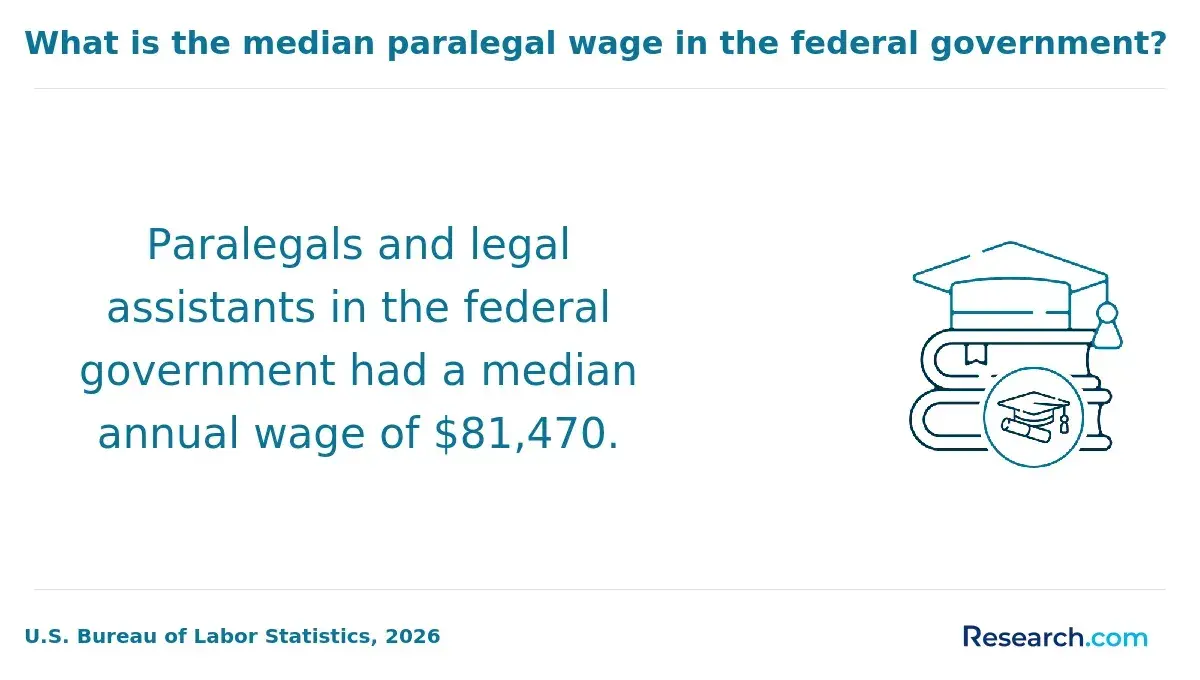
The Bureau of Labor Statistics reports $62,890 in median annual pay in May 2025 for paralegals and legal assistants. That is an occupation-wide figure, not an entry-level wage or an estimate of what graduates of either certificate earn. Pay varies with duties, experience, employer, and location.
BLS projects 0% employment growth for paralegals and legal assistants from 2025-2035, while projecting about 40,800 openings per year, largely from workers leaving occupations or the labor force. Little net growth therefore does not mean no hiring, but it does make relevant skills and local opportunities important to the decision.
There is no single comparable BLS wage or outlook category for "legal technology certificate holders." Technology-focused jobs span different occupations, so a salary claim for one narrow job title would not reliably describe everyone with this certificate. Compare local postings for the roles you want, and weigh the training cost against their actual requirements - not an advertised graduate salary.
How can you choose a reputable paralegal or legal technology certificate program?
Start with several current job postings you would realistically apply to. Then use the same checks for each shortlisted program so a compelling software list or a low advertised price does not obscure a missing requirement.
- Match coursework to the job: Compare required legal foundations or technology workflows with the postings, and request syllabi and examples of assessed work.
- Verify the credential: Check the institution's accreditation, any claimed ABA paralegal program approval, and whether an advertised external certification requires a separate exam.
- Test the schedule and cost: Get a written account of required courses, live sessions, placements, fees, software access, and the likely time to completion at your enrollment pace.
- Check the next step: Ask whether the school offers career support, whether coursework carries academic credit, and how a prospective receiving school would evaluate that credit.
Be cautious if a program suggests that its certificate permits independent legal practice, guarantees employment, or automatically qualifies you for financial aid or professional certification. For most newcomers seeking broad legal-support work, foundational paralegal study is the clearer starting point. For someone with legal basics and a specific technology-focused target, a well-matched specialization may offer better value.
Other Things You Should Know About Law & Paralegal
Yes, if you meet each program's admissions rules. Check for overlapping coursework first; a paralegal program with substantial technology training might make a second certificate unnecessary.
Possibly, but only if the school has a policy allowing it. Ask whether it awards credit for prior learning, grants course waivers, or requires every student to complete the same curriculum.
Some employers offer tuition assistance or professional-development funding. Ask whether your employer covers credit-bearing certificates, noncredit courses, software training, or only approved providers, and whether repayment conditions apply.
Ask your program whether you may share a research memo, document-organization exercise, or technology project created with fictional or otherwise authorized materials. Never put confidential client information in a job-search portfolio.
References
- Paralegal Certificate vs Certification | Let's clear up the confusion. https://paralegal.edu/blog/paralegal-certificate-vs-paralegal-certification-lets-clear-up-the-confusion/
- Paralegal Certification vs. Degree: What's the Difference? | Bryan University Online© https://bryanuniversity.edu/faq/the-difference-between-a-paralegal-certification-and-degree/
- How to Become a Paralegal | National University https://www.nu.edu/blog/how-to-become-a-paralegal/
- Legal Tech Career Development Information - LibGuides https://ncculaw.libguides.nccu.edu/c.php
- Paralegal Certificate - Emory Continuing Education https://ece.emory.edu/areas-of-study/paralegal/paralegal-certificate.php
- Paralegal vs. Legal Assistant: What's the Difference? | Online Paralegal Studies Certificate Program https://paralegalonline.bu.edu/articles/legal-assistant-vs-paralegal/
- Legal Studies vs Paralegal Studies: Career Path Comparison | American Military University https://www.amu.apus.edu/area-of-study/legal-studies/resources/legal-studies-vs-paralegal-studies-career-paths/
- Paralegal Studies Certificate Program | Long Island University https://liu.edu/brooklyn/academics/school-of-professional-and-continuing-studies/Paralegal-Studies-Certificate-Program
- Paralegal Studies Advanced Technical Certificate | Lone Star College https://www.lonestar.edu/programs-of-study/paralegal-certificate.htm
- Technology Skills for Law Students: Legal Practice Tech Tools | usc.edu https://lawlibguides.usc.edu/c.php