2027 Legal Studies Master's Programs for Regulatory Agency Staff

Co-Founder and Chief Data Scientist
Regulatory agency staff often work with statutes, rules, investigations, and enforcement decisions without serving as attorneys. A master's in legal studies can deepen that knowledge, but it may be more education than a particular role requires. This guide helps public-sector analysts, inspectors, investigators, and compliance staff compare degree types, identify useful coursework, assess cost and scheduling, and decide when a certificate, agency training, or experience is the better investment.
Key Things You Should Know
- Choose a non-JD legal studies master's for substantial work with rulemaking, administrative procedure, investigations, or enforcement - not because the degree is presumed necessary for agency employment.
- Verify institutional accreditation, agency-relevant courses, actual online meeting requirements, and total cost before applying; an MLS or MSL does not qualify graduates to practice law.
- The Bureau of Labor Statistics reports median pay of $80,730 in May 2025 for compliance officers and 4% projected growth, 2025-2035; those occupation-wide figures do not predict an individual agency employee's pay or promotion.
What Is a Master's in Legal Studies for Regulatory Agency Staff?
A Master of Legal Studies (MLS), Master of Studies in Law (MSL), or similarly named non-Juris Doctor degree teaches professionals to read legal authorities, understand legal processes, and apply that knowledge within their existing responsibilities. For agency staff, the most valuable applications may include interpreting regulations under counsel's guidance, documenting investigations, evaluating compliance submissions, and helping develop defensible procedures.
The degree is not an attorney-qualifying credential. Agency counsel, rather than nonlawyer staff, provide legal advice and representation within their authorized roles. Nor is an MLS the same as paralegal preparation: online certificate programs in paralegal studies generally target legal-support skills rather than graduate-level regulatory analysis. Completing a certificate also does not automatically confer professional certification.
The strongest reason to pursue the degree is a recurring need to connect legal doctrine with agency decisions. If a single rule set or workflow is the main gap, targeted agency training or a graduate certificate may solve it with less time and expense.
Which Master's Degrees Prepare Professionals for Regulatory Compliance Careers?
Degree titles vary, so compare the required curriculum rather than assuming every "compliance" or "legal studies" program covers administrative law. These routes emphasize different parts of regulatory work.
| Route | Most useful when your work centers on | Potential limitation |
| MLS, MSL, or Master of Jurisprudence | Statutory interpretation, administrative law, investigations, and legal risk | May offer limited training in budgeting or program management |
| Master of Public Administration or Public Policy | Agency operations, policy analysis, implementation, and leadership | May offer less sustained legal-methods coursework |
| Specialized compliance or risk master's | Controls, audits, and regulation in a defined industry | Specialization may be less transferable across agencies |
A formal regulatory concentration has defined requirements; a few relevant electives do not necessarily amount to one. Staff whose next role emphasizes administration may prefer an MPA, while staff regularly analyzing legal authority may gain more from an MLS. For applicants comparing business-law coursework or planning to use prior college credit, transfer-friendly business law degree programs provide another route to examine; the receiving school decides whether any credits apply.

What Accreditation Should Regulatory Professionals Look For in Legal Studies Programs?
Confirm that the university holds institutional accreditation from a U.S. Department of Education-recognized accreditor, and check that the specific master's degree is offered under that institution's current authorization. Institutional accreditation matters for educational oversight and can affect federal aid eligibility, but it does not establish that a curriculum fits your agency's work.
Do not confuse accreditation with American Bar Association (ABA) approval. The ABA approves qualifying paralegal education programs; that is separate from institutional accreditation and is not the credential to seek for an MLS. An MLS also should not be described as an ABA-approved route to becoming a lawyer. If an employer, promotion policy, or tuition-benefit program specifies an acceptable degree or institution, obtain that policy before enrolling.
How Do Online and Campus-Based Legal Studies Programs Compare?
Delivery format affects whether staff can attend classes during rulemaking deadlines, inspections, hearings, or travel. "Online" does not necessarily mean asynchronous or self-paced.
| Format | Possible advantage | Scheduling issue to verify |
| Online | Study without routine travel to campus | Live sessions, timed exams, residency visits, and time-zone expectations |
| Campus-based | Regular in-person discussion and access to local faculty events | Commute, fixed class times, and attendance rules |
| Hybrid | Mix of remote work and in-person contact | How often travel is mandatory, not merely available |
Ask for the current course rotation and a sample part-time schedule, not just an advertised completion time. If a program requires a practicum, confirm whether your current agency work can satisfy it, who approves the placement, and whether agency confidentiality rules restrict proposed projects.
What Courses Do Regulatory Compliance Master's Programs Include?
For U.S. regulatory staff, administrative law is often the pivotal subject: it connects agency authority, rulemaking, adjudication, and judicial review. Legal research and writing should teach students to locate controlling authorities and explain conclusions with appropriate limits, rather than merely summarize cases.
Other useful offerings depend on the job. Investigators may benefit from evidence, due process, and enforcement procedure; program analysts may prioritize statutory interpretation and policy implementation. Records and privacy work may call for courses addressing the Freedom of Information Act, the Privacy Act, and applicable data-governance rules. Procurement, employment, healthcare, environmental, or financial-regulation electives matter most when they match the agency's jurisdiction.
Look at assignments as well as course titles. A supervised exercise drafting a rulemaking analysis or reviewing a compliance finding may be more relevant than a broad survey with no applied work. Confirm that any advertised technology training includes hands-on assignments if practical proficiency is your goal.
What Are the Admission Requirements for a Master's in Legal Studies?
Non-JD legal studies master's programs generally admit applicants with a bachelor's degree rather than requiring a JD. Schools set their own rules for transcripts, minimum academic standing, recommendations, statements of purpose, professional experience, and English-language proficiency. A legal-studies or paralegal major is not necessarily required.
If you do not yet hold a bachelor's degree, online study for a legal studies associate degree can be an earlier educational step, but an associate degree alone does not replace a master's program's bachelor's prerequisite. Before applying, ask whether the school requires an entrance exam, accepts prior graduate credits, or allows a relevant graduate certificate to count toward the degree. Credit applies only if the receiving institution approves it.
How Long Do These Master's Programs Take and What Do They Cost?
Completion time depends on required credits, course sequencing, and whether you study full time or around agency duties. A part-time option may preserve work income but extend tuition payments and delay completion. Request a term-by-term plan based on the number of courses you can realistically take during your busiest work periods.
To compare costs, use each school's current published tuition and mandatory fees for your enrollment status. Add required books or research access, technology costs, and any travel for campus visits. Compare estimated total program cost, not one school's per-credit rate with another school's advertised total. Listings of online master's in legal studies tuition options can help start a shortlist, but confirm current charges directly with each school.
Ask your agency whether tuition assistance is available, what grades or service commitments it requires, and whether the degree aligns with an approved development plan. The school's financial aid office can confirm the program's federal aid eligibility and explain borrowing terms. A lower-cost certificate may be the sounder choice if it covers the skills needed for your next assignment.
What Careers Can You Pursue With a Regulatory Legal Studies Master's?
Possible paths include compliance officer, regulatory analyst, investigator, enforcement-support specialist, policy analyst, and program manager. Duties differ by agency: one analyst may review regulated entities' submissions, while another helps develop procedures or coordinates responses to findings. An MLS can strengthen legal analysis for these roles, but hiring and promotion depend on the position's qualifications, relevant experience, and applicable civil-service rules.
For advancement, compare the work in the target vacancy with your current skill gaps. If it calls chiefly for supervision, budgeting, or program evaluation, management experience or an MPA may have greater value. If the immediate barrier is a bachelor's credential rather than graduate-level legal knowledge, a guide to shorter online paralegal bachelor's degrees offers a different educational starting point; verify that any program's coursework suits the agency role you want.
What Salaries and Job Outlook Can Graduates Expect?
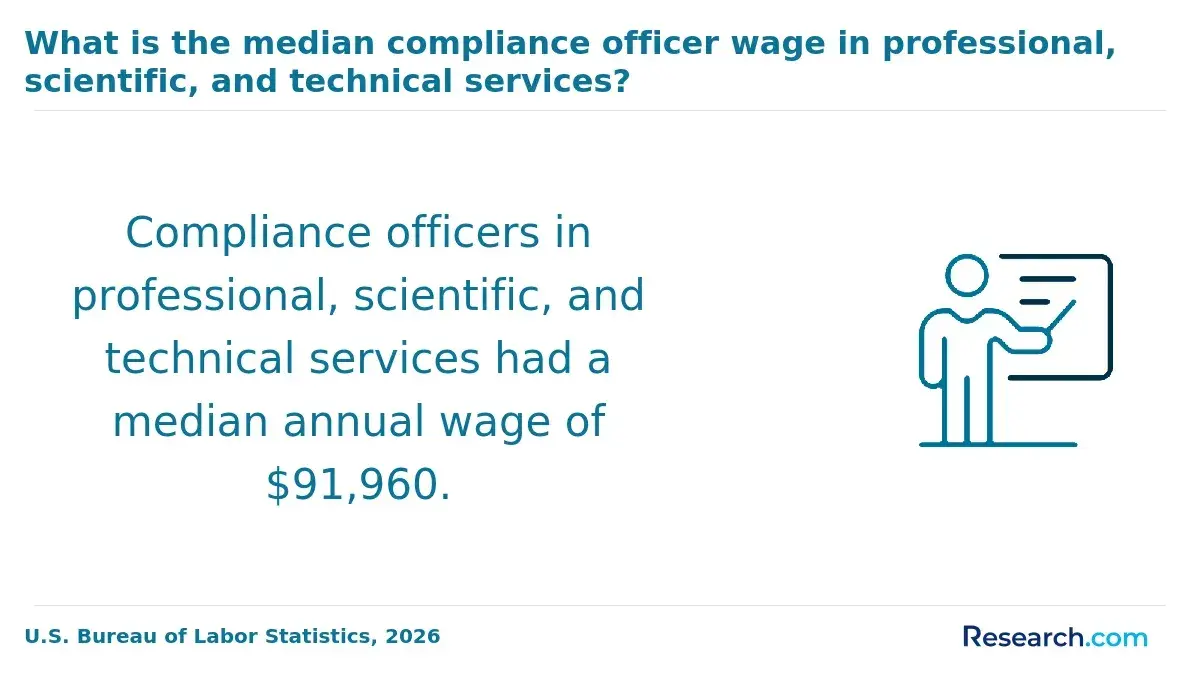
The Bureau of Labor Statistics reports median annual pay of $80,730 in May 2025 for compliance officers, with 4% projected growth, 2025-2035 and about 32,700 projected openings per year. This is a useful national benchmark for a broad occupation - not a salary estimate for MLS graduates, a particular agency, or a specific regulatory specialty.
Public-sector pay may instead be governed by an agency's grade, locality, bargaining agreement, or other classification system. Before paying for a degree to pursue a promotion, review actual vacancies and ask whether graduate coursework changes eligibility, hiring competitiveness, or the pay grade. Do not assume the credential alone will produce a raise.
Which Certifications and Professional Standards Support Regulatory Careers?
Optional professional credentials can demonstrate narrower expertise than a master's degree. For example, the Society of Corporate Compliance and Ethics offers the Certified Compliance & Ethics Professional credential; the American Bankers Association offers the Certified Regulatory Compliance Manager credential for banking compliance. The latter organization is not the American Bar Association. Eligibility, exams, experience requirements, and renewal rules belong to each credentialing body and can change.
Neither a certification nor an MLS replaces an agency's required training, delegated authority, or professional licensing. Before choosing between them, check target job postings and ask a supervisor which qualification addresses an identifiable work need. A credential may be efficient for an established specialty; a degree may make more sense when you need sustained legal study across multiple regulatory functions.
Other Things You Should Know About Law & Paralegal
Only with the approvals your agency requires. Ask the instructor whether a public, fictional, or properly authorized example can meet the assignment instead of sharing nonpublic records.
Enrollment alone does not necessarily create a conflict, but agency rules may address outside activities, gifts, use of government resources, or relationships with regulated entities. Check your agency's ethics guidance before accepting related projects or benefits.
Do not assume so. Continuing legal education rules are set by the relevant jurisdiction or licensing body, and a non-JD degree does not make a nonlawyer eligible to practice law.
Usually, that is an employer decision. Even closely related coursework may not replace required instruction on agency systems, procedures, safety, or delegated authority; confirm any substitution in writing.
References
- Program Integrity Questions and Answers - Credit Hour http://www.ed.gov/laws-and-policy/higher-education-laws-and-policy/program-integrity-information-questions-and-12
- Internships | hhs.gov https://www.hhs.gov/about/agencies/ogc/careers/internships/index.html
- Students & Recent Graduates | U.S. Office of Personnel Management https://www.opm.gov/policy-data-oversight/hiring-information/students-recent-graduates/
- Types of Financial Aid: Grants, Work-Study, and Loans | studentaid.gov https://studentaid.gov/understand-aid/types
- Learning from Regulatory Experience | Administrative Conference of the United States https://www.acus.gov/document/learning-regulatory-experience
- Distance Education Resources | Texas Higher Education Coordinating Board https://www.highered.texas.gov/new-program-development/distance-education-resources/
- Standards for Bachelor's and Master's Degree Programs | texas.gov https://reportcenter.highered.texas.gov/agency-publication/miscellaneous/standards-for-bachelors-and-masters-degree-programs/
- Rulemaking Training Classes | OAL https://oal.ca.gov/training/
- What Are the Requirements to Get Into Law School? | Purdue Global Law School https://www.purduegloballawschool.edu/blog/news/law-school-requirements
- Understanding Administrative Law | Pepperdine Caruso School of Law https://law.pepperdine.edu/blog/posts/understanding-administrative-law.htm