2027 ABA-Approved Paralegal Programs: Comparing the Number of Legal Specialty Credits

Co-Founder and Chief Data Scientist
Two ABA-approved paralegal programs can offer different amounts of legal coursework, even though both meet the approval standard. That difference matters if you are comparing a short certificate with a broader degree, changing careers, or paying for courses you may not need. This guide explains the legal specialty credit minimum, shows how to compare published curricula, and identifies the practical questions to ask before enrolling. The goal is to help you choose for relevant skills and value - not simply the largest credit total.
Key Things You Should Know
- ABA-approved paralegal programs must include at least 18 semester credits of legal specialty coursework or the equivalent; an individual program may require more.
- Compare legal specialty credits separately from total program credits. General education, electives, and transferred courses can make two programs' totals look similar while their legal coursework differs.
- A higher legal specialty credit count is useful only if the additional courses develop skills you need at a cost and schedule you can manage. Check required courses, delivery format, and internship obligations alongside the number.
What makes a paralegal program ABA-approved?
The American Bar Association (ABA) approves qualifying paralegal education programs under its program-approval standards. It reviews matters including curriculum, legal specialty instruction, faculty, resources, and administration. Approval belongs to the particular program, not automatically to every legal studies offering at the same college.
ABA program approval is different from institutional accreditation, which concerns the college or university. Neither status means that the ABA certifies graduates as individual paralegals. A school may offer a valuable paralegal program without ABA approval, but it should not describe that program as approved unless the specific offering appears in the ABA's current directory.
How many legal specialty credits do ABA-approved paralegal programs require?
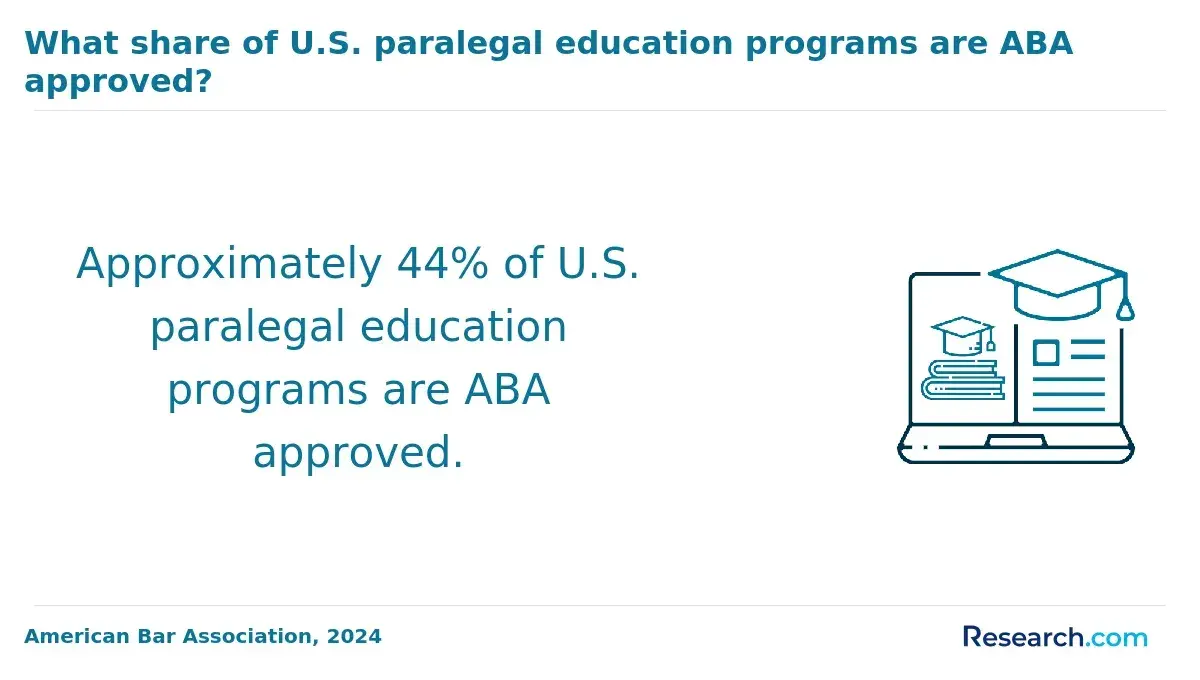
ABA-approved programs must provide at least 18 semester credits of legal specialty courses, or the equivalent. That is a floor, not a standard total for every approved program. A legal specialty course teaches substantive law, legal procedure, or practical skills directly related to paralegal work; the program's overall credit requirement can also include writing, communication, general education, and electives.
When comparing catalogs, use the same unit and the same definition. A quarter-credit total cannot be compared directly with a semester-credit total, and a college's overall degree credits are not its legal specialty credits. The table shows how to interpret the figures a school publishes without treating the largest total as an automatic advantage.
| Published figure | What it tells you | What it does not tell you |
| Total program credits | The coursework required for the credential | How much of that coursework is legal specialty instruction |
| Required legal specialty credits | The program's specified depth of paralegal-focused coursework | Whether the courses cover your preferred practice area or include hands-on work |
| Legal specialty electives | Potential room to explore practice areas | Whether a desired elective is offered regularly or fits your schedule |
A program exceeding the ABA minimum may suit someone seeking broader legal exposure. A program closer to the minimum may be sufficient for someone with an existing degree who needs targeted paralegal training. Ask for the current catalog's course-by-course designation if the specialty total is not explicit.
How do ABA-approved programs compare with non-ABA paralegal programs?
The clearest distinction is verifiable program approval: an ABA-approved program must meet the ABA's paralegal education standards, including the legal specialty credit floor. A non-ABA program might offer substantial legal coursework, but its curriculum must be assessed on its own published requirements rather than assumed to meet that standard. Non-ABA does not, by itself, mean low quality.
Compare both options on legal specialty credits, required research and writing, supervised practice, instructor qualifications, institutional accreditation, total cost, and local employer preferences. Some applicants are pursuing a different kind of legal knowledge altogether: a shorter pathway through a business law master's may serve a business professional, but it is not a substitute for paralegal-skills training.
Choose ABA approval as a priority if an employer you hope to join prefers it or if you value an independently reviewed paralegal curriculum. Consider a non-ABA option when its documented coursework, outcomes, schedule, and price better serve your goal. Confirm any particular employer or certification body's rules rather than assuming approval is universally required.
What courses count toward legal specialty credits in paralegal studies?
Legal specialty credits generally come from courses centered on law and paralegal practice, such as legal research and writing, civil litigation, contracts, real estate, family law, or legal ethics. Course titles alone are not decisive: the approved program identifies which courses satisfy its legal specialty requirement under ABA standards.
A litigation course may teach document preparation and case organization under attorney supervision, while legal research instruction may develop the ability to locate and assess authority. General composition, introductory computing, and broad business courses can strengthen those skills without necessarily counting as legal specialty coursework.
Look beyond the count to the required-versus-elective split. If the specialty that interests you is offered only as an occasional elective, its presence in the catalog does not ensure you can take it before graduation. Request a current course rotation and ask whether internships carry legal specialty credit or fulfill a separate requirement. Paralegals support legal work under appropriate supervision; coursework does not authorize independent legal practice.
Do online ABA-approved paralegal programs meet the same credit standards?
Yes. Online delivery does not remove the ABA-approved program's legal specialty credit requirement. It also does not mean every course is self-paced: programs may use live online instruction, scheduled discussions, proctored assessments, or in-person components to meet their instructional and practical requirements.
For a fair comparison, check whether the specific online pathway is part of the ABA-approved program, then review its published course schedule. Ask which legal specialty classes require live attendance, whether any campus visits are mandatory, and how an internship is arranged if one is required. A program can be online yet difficult to combine with a fixed work shift; delivery format and scheduling flexibility are separate questions.
What are the admission requirements for ABA-approved paralegal programs?
There is no single admission checklist for every ABA-approved program. Requirements depend on the institution and credential: an associate pathway may admit students starting college, while a post-baccalaureate certificate may require a completed bachelor's degree. Schools may also specify prior coursework, transcripts, placement requirements, or application materials.
Before applying, distinguish admission prerequisites from courses needed to graduate. A certificate advertised with a compact legal specialty curriculum may take longer if you must first complete writing or other required coursework. If you are also considering graduate-level legal study, online legal studies programs without an admissions essay illustrate how application requirements can differ across credentials; they do not establish the requirements for a paralegal program.
Ask admissions which prerequisites you already satisfy and obtain a written explanation of how any prior college credit would apply. The receiving institution decides whether transferred credit fulfills its program requirements.
How long do ABA-approved paralegal programs take and what do they cost?
Completion time depends on the credential, prerequisite coursework, course sequencing, enrollment pace, and any internship. A certificate designed for students who already hold a degree can have a different timeline from an associate degree that includes general education. The legal specialty credit count alone cannot predict either timeline or price.
Compare each school's current total cost for your intended enrollment period: tuition at your residency rate, mandatory fees, books, research-platform or technology charges, prerequisite courses, and travel or internship expenses. Published per-credit tuition is not a complete program price. Aid eligibility also depends on the institution, the specific program, and the student; do not assume that every certificate qualifies for federal aid.
If you are weighing paralegal training against graduate legal study, compare legal studies master's degree costs versus potential earnings separately. A master's degree can cost more time and money while preparing for a different purpose. Request each paralegal school's current program-specific cost estimate and a term-by-term completion plan before deciding whether extra specialty credits justify the expense.
Which degree and certificate pathways lead to paralegal careers?
Common routes include a paralegal associate degree, a bachelor's degree with a paralegal component, and a post-degree paralegal certificate. The right comparison is not degree versus certificate in isolation; it is how much legal specialty training you still need, which general education credits you already have, and what employers in your market request.
A paralegal certificate is an educational award, not professional certification. An organization or state system grants professional credentials under its own eligibility and examination rules. A non-JD legal studies master's serves a different goal: it develops legal knowledge for roles that may intersect with law but does not qualify its holder to practice as an attorney. For someone with a bachelor's degree considering that route, a full legal studies master's versus a graduate certificate is a separate decision from choosing a paralegal program.
Students beginning college may benefit from an associate pathway that combines general education and legal specialty work. Degree holders seeking a career change may prefer a focused certificate if its admissions rules and curriculum fit their background. Neither route guarantees a job; compare the courses and supervised experience with the positions you intend to seek.
What jobs, salaries, and outlook can paralegal graduates expect?
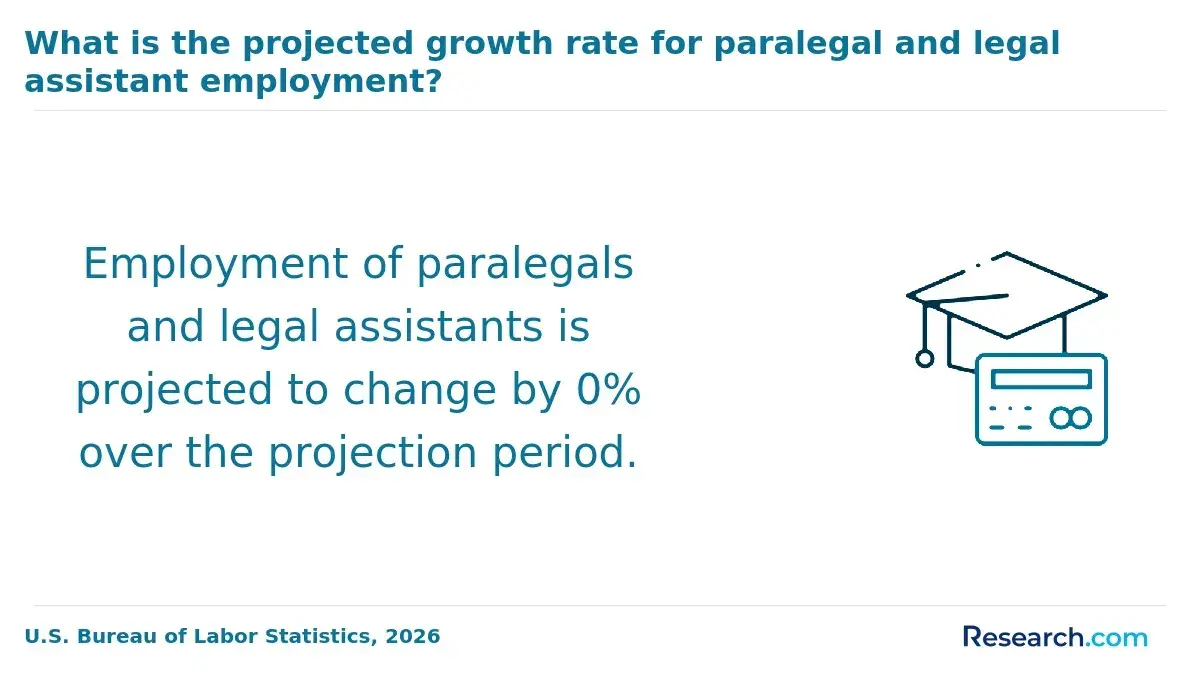
Paralegals and legal assistants help attorneys research law, organize files, draft documents, and prepare matters for proceedings or transactions. The Bureau of Labor Statistics reports $62,890 in median annual pay in May 2025 for this occupational group, with 0% projected growth, 2025-2035, and about 40,800 openings per year projected despite little or no net employment growth. This is a national benchmark for an occupational group, not an entry-level salary or a promised outcome for graduates.
For job selection, match specialty courses to actual duties in postings: litigation teams may value procedure and document work, while corporate legal teams may emphasize contracts and records. Some graduates also consider adjacent business or compliance work, but a paralegal curriculum should not be mistaken for preparation for every such role. Professionals interested primarily in workplace policy can compare legal studies degree options for studying human resources law with paralegal training before choosing a credential.
How can students verify an ABA-approved paralegal program?
Approval status and curriculum can change, so verify both before paying an enrollment deposit. A school's general statement that it offers "ABA-related" education is not the same as current approval of the specific program you plan to attend.
Use this sequence to check the claim and make the credit comparison meaningful:
- Find the institution and specific paralegal program in the ABA's current directory of approved paralegal education programs.
- Match the directory listing to the credential and campus or online pathway you intend to enter; ask the program directly about any ambiguity.
- Obtain the current catalog and identify the legal specialty courses required for your credential, distinguishing them from general education and optional electives.
- Confirm how prior credit, live attendance, internships, and course rotation affect your personal completion plan.
- Request current tuition and required-fee information, then compare the full cost of the coursework you would actually need.
If a school cannot show which courses make up its legal specialty requirement, pause the comparison until it can. The strongest choice is the program whose verified approval status, curriculum, schedule, and total cost support your intended work - not necessarily the one advertising the most credits.
Other Things You Should Know About Law & Paralegal
Do not assume they will. Law schools determine their own admission and credit policies, and paralegal coursework is not a substitute for a Juris Doctor (JD). Ask any prospective school for its written transfer policy.
Not automatically. Certifying organizations and state systems set their own education, experience, and examination requirements. Check the rules for the particular credential before enrolling.
It can affect some hiring decisions, but policies vary by employer, role, and jurisdiction. If this is a concern, ask prospective employers or relevant state authorities about applicable restrictions rather than relying on a school's general assurance.
Ask the program and the ABA how the change applies to your enrollment and expected completion date. Keep copies of the directory listing, catalog, and written guidance you receive; do not assume a status change has the same effect for every student.
References
- Educational Program Standards | North Carolina State Bar https://www.ncbar.gov/paralegal-certification/educational-program-standards/
- Implementation of updated clock-to-credit conversion regulations (EA ID: GENERAL-21-34) | Knowledge Center https://fsapartners.ed.gov/knowledge-center/library/electronic-announcements/2021-05-25/implementation-updated-clock-credit-conversion-regulations-ea-id-general-21-34
- Transfer credit policies - Office of Admissions https://admit.washington.edu/apply/transfer/policies/
- Credit Information and Continuing Education Units | ucr.edu https://extension.ucr.edu/helpcenterstudentresources/academicpoliciesandinfo/creditinformationandcontinuingeducationunits
- Paralegal Studies | Valencia College https://catalog.valenciacollege.edu/degrees/associateinscience/criminaljusticeparalegalstudies/paralegalstudies/
- Paralegal Studies Requirements | 2025-2026 Academic Catalog https://catalog.siu.edu/programs/parl/requirements.php
- Legal Studies, Advanced Legal Technology Specialization, BA | ncu.edu https://catalog.ncu.edu/preview_program.php
- Converting Credits - Tusculum University https://catalog.tusculum.edu/content.php
- Paralegal, AS - CT State Catalog https://catalog.ctstate.edu/programs/paralegal-as/
- Law & Paralegal Studies | ccp.edu https://www.ccp.edu/college-catalog/degree-programs/associate-applied-science-aas/law-paralegal-studies