2027 Paralegal Certificates for Journalism Graduates: Building Legal Research and Drafting Skills

Co-Founder and Chief Data Scientist
Journalism graduates already know how to investigate, verify facts, and write under deadline. Paralegal work uses those strengths but adds rules for researching law, drafting legal documents, and handling confidential information. A certificate may help bridge that gap, but it is not the only route into legal support work.
This guide explains what to look for in a program, when a certificate is worth the time and cost, and how to test your interest before enrolling.
Key Things You Should Know
- A journalism degree can support a paralegal career, but a useful certificate should add supervised legal research, citation, drafting, and professional-ethics practice - not repeat general writing instruction.
- A certificate is an educational credential, not professional certification; hiring expectations and state rules vary, so a certificate is not universally required.
- The median annual pay for paralegals and legal assistants was $62,890 in May 2025; the Bureau of Labor Statistics projects 0% growth for 2025-2035 but about 40,800 openings per year.
What Is a Paralegal Certificate for Journalism Graduates?
A paralegal certificate is a course of study in legal support work. It is not ordinarily a journalism-specific credential: a journalism graduate generally enters the same program as other applicants and brings different prior skills to the coursework. Programs may be designed for people who already hold a bachelor's degree or for applicants with less college education, so check the actual admission requirements before comparing them.
A paralegal works under attorney supervision on tasks such as researching legal authorities, organizing evidence, and preparing draft documents. A certificate does not authorize its holder to practice law or independently advise clients. It also differs from professional certification, which a certifying organization or applicable state system awards under its own requirements.
Why Should Journalism Graduates Earn a Paralegal Certificate?
The strongest reason is to learn the parts of legal work a reporting degree rarely teaches: finding controlling law, checking whether an authority remains valid, applying citation rules, and drafting for an attorney's review. Structured assignments and feedback can make that transition more credible to employers than a general claim of strong research skills.
The investment makes less sense if your goal is primarily to report on courts or understand contracts for your current job. Targeted legal-research training, employer training, or a course in media law may be sufficient. If your aim is broader business or regulatory work rather than a paralegal position, compare certificates with best business law degrees for working adults before committing to a legal-support curriculum.
What Skills Do Journalism Graduates Bring to Paralegal Careers?
Reporting experience can shorten the learning curve, but similar-looking tasks carry different obligations in a law office. This comparison shows where prior skills transfer and where formal legal training adds something distinct.
| Journalism experience | Paralegal application | Important difference |
| Finding and verifying sources | Locating statutes, cases, regulations, and records | Legal research requires attention to jurisdiction, authority, and whether a source remains good law. |
| Interviewing and note-taking | Preparing factual summaries and organizing witness information | Attorney supervision, confidentiality, and privilege can restrict how information is gathered and shared. |
| Clear, deadline-driven writing | Drafting correspondence, research memoranda, and document sections | Legal documents follow prescribed formats, citations, and review procedures. |
Editorial judgment also helps when sorting large records into a usable chronology. The adjustment is purpose: a reporter writes for an audience, while a paralegal prepares accurate work product for a legal team and follows the attorney's direction.
What Do Paralegal Certificate Programs Teach Journalism Graduates?
Look for a curriculum that moves from legal-system basics to assessed research and drafting. Relevant work may include reading cases and statutes, using legal citation, preparing research memoranda, handling civil-litigation documents, managing deadlines, and learning professional responsibility. Contract or regulatory coursework may matter more if you want in-house work than if you want a litigation role.
Course titles alone do not establish practical depth. Ask to see sample assignments or descriptions showing whether students research a legal issue, check the status of cited authorities, and revise a draft after feedback. If a school advertises Westlaw, Lexis, e-discovery, or AI tools, distinguish a classroom mention from student access and hands-on assessment. Legal AI output requires verification against authoritative sources; fluent text is not evidence that a citation or legal proposition is correct.
Do Journalism Graduates Need a Paralegal Certificate to Work?
No nationwide rule requires a paralegal certificate for every paralegal job. Employers set their own education and experience preferences, and state rules governing legal work can differ. A journalism graduate may qualify for some entry-level legal assistant or case-support roles through writing, records, and administrative experience, while other employers prefer formal paralegal education.
Search actual vacancies in your target market before enrolling. Compare their required qualifications with their preferred qualifications, then note which tasks you cannot yet demonstrate. If the gap is mainly legal research and drafting, a focused certificate may be more direct than a graduate degree. If your goal is policy or compliance rather than paralegal work, review legal studies master's affordability and career outcomes as a separate option; a non-JD legal studies degree does not qualify someone to practice law.
Are Online or Campus Paralegal Certificates Better for Journalism Graduates?
Neither format is automatically stronger. The useful comparison is whether its schedule, feedback, and practical work let you build evidence of legal skills. "Online" can still mean live classes, timed exams, or an in-person internship.
| Format | Potential advantage | Commitment to verify |
| Online | May allow study without relocating or commuting regularly | Live meeting times, campus visits, exam schedules, and placement rules |
| Campus | May offer face-to-face drafting feedback and local connections | Travel time, class frequency, and access to required courses |
If you are working in journalism, ask whether courses are asynchronous, whether required classes follow a fixed sequence, and who arranges any internship. Compare those answers across best online paralegal certificate programs rather than treating a remote label as proof of scheduling flexibility.
How Long Do Paralegal Certificate Programs Take and Cost?
There is no reliable single price or completion time for every certificate. Requirements vary by credit load, course sequence, term length, and whether enrollment is full-time or part-time. A short advertised timeline may depend on a particular start date or taking several courses at once.
Request a written breakdown of tuition, mandatory fees, books, research-platform charges, technology requirements, travel, and internship expenses. Confirm whether the program is credit-bearing or noncredit and whether that specific program qualifies for the financial aid you intend to use; institutional accreditation alone does not establish certificate aid eligibility. Also weigh time away from paid work against the benefit of supervised assignments. If you are considering graduate legal study instead, online legal studies master's timeline comparisons can help frame the larger time commitment, though those degrees serve different goals.
What Accreditation Should Journalism Graduates Look for in a Program?
Check two separate statuses. Institutional accreditation concerns the college or other educational institution. American Bar Association approval applies to qualifying paralegal education programs, not to the institution as a whole or to individual graduates. Not every worthwhile program has ABA approval, and an ABA-approved program does not make its graduates "ABA-certified paralegals."
Verify institutional accreditation through the school's identified accreditor and ABA approval, if claimed, through the ABA's current paralegal program directory. Then examine what matters for your goal: admission prerequisites, legal-writing assignments, attorney or practitioner feedback, internship arrangements, and local employer expectations. If you may later pursue a degree, ask the receiving institution how it would evaluate the certificate credits; transfer is its decision, not an automatic consequence of accreditation.
What Paralegal Jobs Can Journalism Graduates Pursue?
Entry-level possibilities include legal assistant, litigation support assistant, records or case-support specialist, and paralegal roles whose posted qualifications match your education and experience. Litigation work may use your ability to build timelines from documents; an in-house legal team may value concise summaries of contracts or regulatory developments. Job titles overlap, so compare duties rather than assuming every "assistant" or "specialist" posting describes the same work.
A practical first step is to save several local postings and identify their recurring research, drafting, software, and experience requirements. If many suitable openings ask for a degree rather than a standalone certificate, investigate associate-to-bachelor's pathways in legal studies only if they address a qualification you lack; journalism graduates who already hold a bachelor's degree may have no reason to pursue another one.
What Are Paralegal Salaries and Job Prospects for Journalism Graduates?
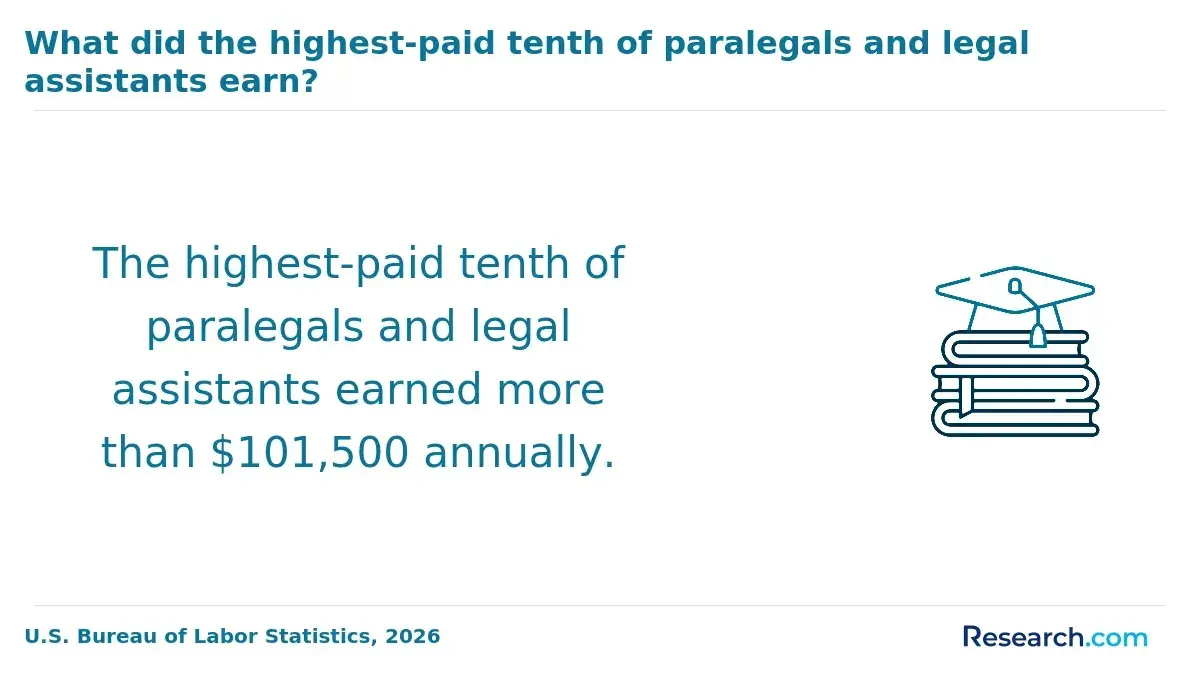
The Bureau of Labor Statistics reports median annual pay of $62,890 in May 2025 for the combined occupation of paralegals and legal assistants. That occupational median is not an entry-level offer or a journalism-graduate-specific salary. Location, employer, experience, and duties affect individual offers.
BLS projects 0% growth for 2025-2035, alongside about 40,800 openings per year, largely because workers leave the occupation or move to other roles. Openings therefore do not imply rapid expansion or guarantee that a certificate will secure a job. Compare local postings and likely starting pay with the program's full cost; a certificate is most defensible when it closes a skill gap employers actually name.
Other Things You Should Know About Law & Paralegal
Yes, if the employer accepts them, but choose clips that demonstrate accurate synthesis of complex records. Label them as journalism samples, not legal writing. A graded legal memo can better demonstrate the new skill once you have one you are permitted to share.
Possibly, but disclose outside work and follow the employer's conflict-of-interest and confidentiality policies. Reporting on a client, opposing party, or related dispute may create problems even if you do not intend to reveal confidential information.
Route questions requiring legal advice to the supervising attorney. Paralegals can convey attorney-approved information within their assigned role, but they should not independently advise a client on what the law requires or what action to take.
Not without permission and a confidentiality review. Use approved, de-identified work only when the supervising attorney permits it; otherwise, create a sample from a public case or a hypothetical assignment and clearly identify it as such.
References
- Law Student Internship and Externship Opportunities | dol.gov https://www.dol.gov/agencies/sol/careers/internships
- Program Eligibility, Written Arrangements, and Distance Education | 2024-2025 Federal Student Aid Handbook https://fsapartners.ed.gov/knowledge-center/fsa-handbook/2024-2025/vol2/ch2-program-eligibility-written-arrangements-and-distance-education
- Paralegal Studies - Academic Certificate | Midlands Technical College https://www.midlandstech.edu/programs-and-courses/education-and-public-service/paralegal-academic-certificate
- Legal Research & Writing | Online Paralegal Course | Washington Technical Institute https://www.washingtontech.edu/online-course/legal-research-writing/
- Paralegal Studies Certificate Program | FIU College of Law https://law.fiu.edu/programs/paralegal-studies/
- Legal Citations & Citing Legal Resources - Legal Research for UNT Students - Guides at University of North Texas https://guides.library.unt.edu/legal-research/legal-citations-and-citing-legal-resources
- Developing Essential Research Skills for Law Practice | tandfonline.com https://www.tandfonline.com/doi/full/10.1080/0270319X.2022.2089809
- What Does a Paralegal Do? | Purdue Global https://www.purdueglobal.edu/blog/legal-studies/what-does-paralegal-do/
- What Does a Paralegal Do? Key Roles & Responsibilities | American Public University https://www.apu.apus.edu/area-of-study/security-and-global-studies/resources/what-does-a-paralegal-do/
- Legal Analysis, Research & Writing Program | Washburn Law https://www.washburnlaw.edu/academics/legal-analysis-program.html