2027 Paralegal Certificate Prerequisite Courses: English Composition, Research, and Computer Skills

Co-Founder and Chief Data Scientist
A paralegal certificate may look like a direct route into legal work—until its application asks for college-level writing, research, or computer coursework you have not taken. Those requirements differ substantially by program, and a course with the right name may not satisfy a school's rules.
This guide helps prospective students distinguish admission prerequisites from classes taught inside the certificate, check whether previous coursework counts, and weigh the additional time and cost before enrolling.
Key Things You Should Know
- There is no universal prerequisite list: English composition, general research, and computer skills may be required before admission, assessed through placement, or taught within the certificate.
- Some certificates admit applicants with a high school diploma; post-baccalaureate certificates require a bachelor's degree. Check the specific credential before taking extra courses.
- For a career cost reality check, the Bureau of Labor Statistics reports $62,890 in median annual pay for paralegals and legal assistants in May 2025, with 0% projected job growth for 2025-2035; a certificate does not guarantee that pay or a job.
What prerequisite courses do paralegal certificate programs typically require?
No single set of courses applies to every U.S. paralegal certificate. Schools commonly look for college-level writing and basic computer competence, but some admit beginners and teach those skills as part of the program. Others require completed general education credits or a prior degree. "Legal research" is often a core certificate course rather than an admission prerequisite.
The distinction matters when comparing catalogs. This table shows how to interpret common course labels; it does not replace any school's published requirements:
| Skill or course | Possible admission rule | What to verify |
| English composition | A completed college writing course, a minimum grade, or writing placement | Accepted course level, grade, credit hours, and whether prior credit qualifies |
| Research | Sometimes general academic research preparation; often no separate prerequisite | Whether the school means library research, legal research, or a course taught after admission |
| Computer skills | Demonstrated proficiency or an introductory applications course | Whether proficiency testing is accepted and which applications or platforms are required |
Before registering for a prerequisite elsewhere, send the certificate program its course description and ask for written confirmation that the course will satisfy the requirement. The receiving institution decides whether prior credit applies; similar titles and institutional accreditation alone do not establish equivalency.
Do you need a degree to enroll in a paralegal certificate program?
Not always. Entry-level certificate programs may accept applicants with a high school diploma or equivalent, while others require prior college coursework, an associate degree, or a bachelor's degree. A post-baccalaureate certificate is specifically designed for people who already hold a bachelor's degree. Confirm which type a school offers before assuming a certificate is open to first-time college students.
If you already have a degree, a certificate focused on legal skills may avoid repeating broad general education courses. If you have little college credit, compare the certificate's prerequisite burden with an associate or bachelor's route: the extra courses could change the time and cost comparison. Readers considering the longer route can review online paralegal bachelor's completion times and costs, while confirming that any prior credits will actually transfer.
Why are English composition, legal research, and computer skills important?
Paralegals work with documents and information that attorneys and clients rely on. English composition supports clear summaries, correspondence, and careful editing. Legal research involves locating relevant law, checking whether authorities remain valid, and reporting findings accurately under attorney supervision. Computer skills support document formatting, spreadsheets, file organization, and secure handling of electronic information.
These subjects serve different purposes in admissions. A composition prerequisite can show that a student is ready for writing-intensive legal coursework; a computer requirement can prevent basic software instruction from consuming a skills-focused class. Legal research usually needs dedicated instruction because general web-search ability is not the same as finding and evaluating legal authority. If a program advertises legal databases or other technology, check whether students receive access and complete hands-on assignments, rather than assuming a tool's mention means practical proficiency.
What are the admission requirements for paralegal certificate programs?
Requirements vary by school and certificate level. An application may call for proof of a diploma or degree, transcripts, prerequisite grades, placement results, or evidence of English-language proficiency. Some schools also request an essay, résumé, or interview; none of these should be assumed to be universal. If application writing is a barrier, note that personal-statement-free legal studies application options concern other legal education routes and do not establish a particular paralegal certificate's rules.
Use the current catalog and admissions office to resolve requirements before paying an application fee. In particular, ask these questions in writing so you can compare programs on the same basis:
- Which requirements must be finished before applying, and which may be completed before the first certificate course?
- Will my existing composition, research, or computer coursework satisfy each requirement, including any minimum grade or recency rule?
- Can a placement assessment or documented experience replace a course, and is that an official policy or an individual exception?
- Are transcripts from every prior institution required, and when will I receive a decision on accepted credit?
A common costly mistake is taking a convenient outside course before the certificate program has evaluated it. Keep the written evaluation and check whether prerequisites also affect access to later courses.
What courses are included in a paralegal certificate curriculum?
Certificate coursework commonly includes legal research and writing, legal terminology, civil litigation or procedure, legal ethics, and instruction in areas such as contracts, real estate, or family law. Offerings differ: an internship, e-discovery course, or specialty elective may be required, optional, or unavailable. Read the required-course sequence rather than judging a program by its elective list.
For this decision, look closely at the transition from prerequisite to application. A strong match for someone who already writes well but lacks legal experience would teach how to research legal questions, organize findings, draft a supervised work product, and protect confidential information. Check actual assignments and any required software access. A paralegal certificate documents completion of an educational program; it does not itself grant professional certification or authority to practice law.
How long does it take to complete a paralegal certificate program?
Completion time depends on required credits, course sequencing, term schedules, and whether you study full-time or part-time. Prerequisites can extend the timeline if they must be completed before admission or are offered infrequently. A short advertised certificate duration may describe only the certificate courses, not the preparation an individual applicant needs.
Ask the school for a term-by-term plan based on your evaluated transcripts. Check whether legal research must precede advanced writing, whether required courses run every term, and whether an internship has scheduled hours or placement lead time. Compare the resulting calendar—not just the catalog's fastest possible completion time—with the work and family commitments you can sustain.
How much do paralegal certificate programs cost?
There is no reliable single price for all programs. The amount you would pay depends on whether the certificate is credit-bearing or noncredit, the school's tuition and fees, and how many prerequisites you still need. When comparing tuition for online paralegal degrees, keep degree and certificate prices separate: they may buy different amounts of transferable coursework.
Request an itemized estimate covering the certificate, prerequisite tuition, mandatory fees, books, technology, research-platform charges, and any travel or internship expenses. Ask which charges are included in an advertised price. Federal student aid is not automatic for a certificate, even at an accredited institution; confirm the specific program's eligibility with the school's financial aid office before relying on aid in your budget. A cheaper noncredit option may suit a skills goal, but it may be less useful if you need college credit later.
Are online paralegal certificate programs as reputable as campus programs?
Delivery format alone does not establish quality. Compare the school's institutional accreditation, the specific paralegal program's status if ABA approval matters to you, required coursework, instructor feedback, practical assignments, and graduate support. An online program can have live meetings, fixed deadlines, proctored exams, or an in-person internship; "online" does not necessarily mean self-paced.
Online access can reduce travel but does not remove technology or scheduling costs. If spreading payments would help, examine paralegal tuition installment options to compare without assuming that a degree program's payment terms also apply to a certificate. Ask an online certificate provider whether it supplies legal research access, how writing is assessed, and who arranges any required placement in your area.
How do accreditation and professional certification affect paralegal programs?
Institutional accreditation, ABA approval, and professional certification are separate things. Institutional accreditation concerns the school. The American Bar Association approves qualifying paralegal education programs; it does not accredit the institution through that approval and does not certify individual paralegals. Verify any claimed ABA approval in the ABA's current paralegal program directory, including the particular program you intend to attend.
Professional certification is an individual credential granted by a certifying organization or, where applicable, a state system under its own eligibility and examination rules. Completing a certificate does not automatically confer it. Certification is not a universal U.S. requirement for paralegal work, although employer preferences and state-specific rules can matter. If a credential is your goal, check its current eligibility rules against the certificate's coursework and your prior education before enrolling.
What careers, salaries, and job outlook can paralegal certificates lead to?
A certificate can help an applicant develop skills for paralegal or legal assistant roles, but hiring depends on the employer, experience, location, and quality of the applicant's work. Paralegals commonly research, organize documents, and help prepare materials under attorney supervision; they do not independently give legal advice or practice law.
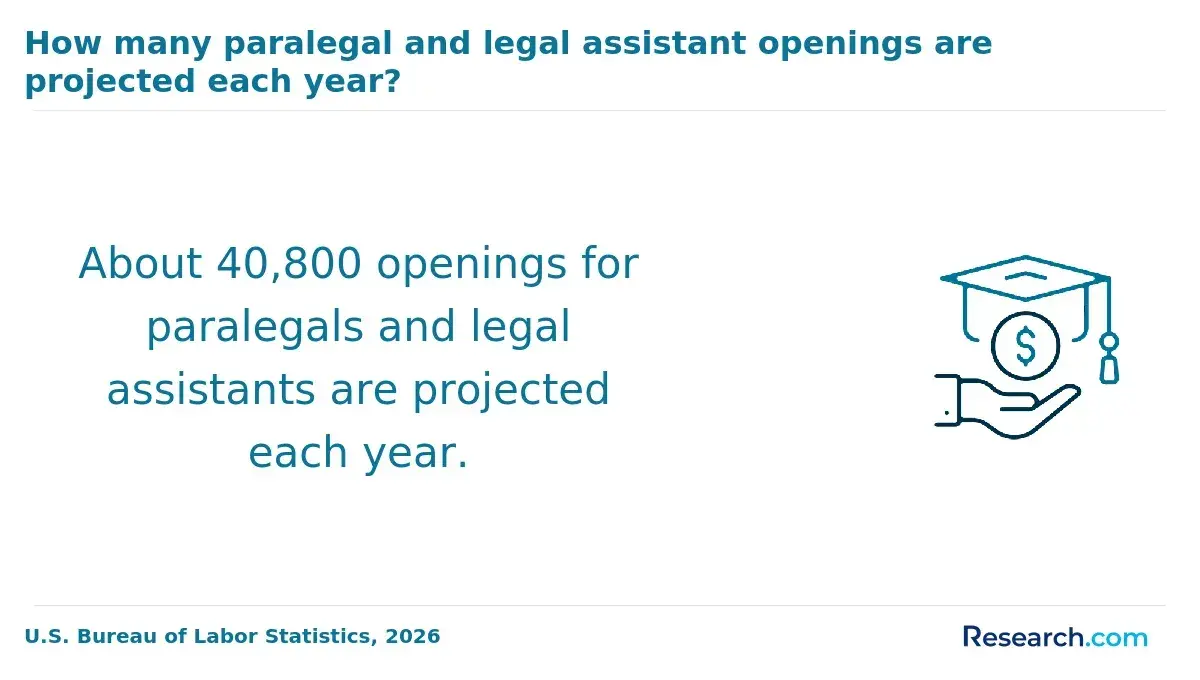
The Bureau of Labor Statistics reports median annual pay of $62,890 in May 2025 for the combined occupation of paralegals and legal assistants. It projects 0% growth for 2025-2035, alongside about 40,800 openings per year, largely reflecting the need to replace workers who leave the occupation. These are occupation-wide figures, not starting-pay or placement figures for certificate graduates.
If your goal is legal-support work, weigh the certificate's prerequisites against its practical training and your local job requirements. If your goal is broader regulatory or legal knowledge rather than paralegal work, legal studies master's specialization and career comparisons may clarify a different path. A non-JD legal studies degree does not qualify someone to practice law, and a more extensive credential is not automatically the better investment.
Other Things You Should Know About Law & Paralegal
Law schools set their own admission rules, and a paralegal certificate does not replace a required bachelor's degree. If you hope to use certificate credits toward a degree first, ask the degree-granting school how it would evaluate them.
Not automatically. A professional organization or state program determines which activities satisfy its continuing-education rules. Check approval and documentation requirements before enrolling for that purpose.
Generally, you can apply, but employers set hiring criteria and some states have distinct rules about paralegal titles or legal-services work. Check the rules in the state where you plan to work.
List it as in progress only if the application permits that status, and provide the expected completion term. Ask admissions whether a final transcript must arrive before admission, registration, or the first class.
References
- Strategy and Considerations - Getting Started With Legal Research - Guides at University of Michigan Law Library https://libguides.law.umich.edu/getting-started
- Placement Assessments for Course Prerequisites | wctc.edu https://www.wctc.edu/WCTC/Academics/Academic-Resources/Testing-Services/Placement-Assessments-for-Course-Prerequisites
- Online Post-Baccalaureate Certificate: Law&Paralegal Studies | UC News https://www.online.uc.edu/degrees-programs/certificates/graduate/post-baccalaureate-law-paralegal-studies.html
- Placement Testing for New Students | Wor-Wic Community College https://www.worwic.edu/services-support/testing-services/placement-testing-for-new-students/
- Paralegal Studies | Coastline College https://www.coastline.edu/programs/paralegal-studies.php
- Paralegal Studies Certificate Program | University of South Carolina https://sc.edu/about/offices_and_divisions/continuing_education/professional_education_and_certificate_programs/paralegal_studies/
- Placement Tests | mvc.edu https://www.mvc.edu/admissions-aid/assessment-orientation/placement-tests.php
- Paralegal Certification vs. Degree: What's the Difference? | Bryan University Online© https://bryanuniversity.edu/faq/the-difference-between-a-paralegal-certification-and-degree/
- Paralegal Studies Proficiency Certificate | ccp.edu https://www.ccp.edu/college-catalog/degree-programs/proficiency-certificate/paralegal-studies-proficiency-certificate