2027 Paralegal Programs With Westlaw or Lexis Training: Comparing Student Access and Practice Time

Co-Founder and Chief Data Scientist
A paralegal program may advertise Westlaw or Lexis training without giving students much time to use either platform. That difference matters when you are paying to develop research skills employers can use. This guide is for prospective paralegal students comparing certificates and degrees, whether online or on campus.
It explains what access can mean, how to assess actual practice, and which questions to ask before enrolling - so you can choose a program for its training rather than its software logos.
Key Things You Should Know
- A curriculum mention is not proof of a student account or hands-on assignments; request the current syllabus and written access terms.
- No universal number of Westlaw or Lexis practice hours defines a strong program. Compare required research tasks, feedback, and access outside scheduled classes.
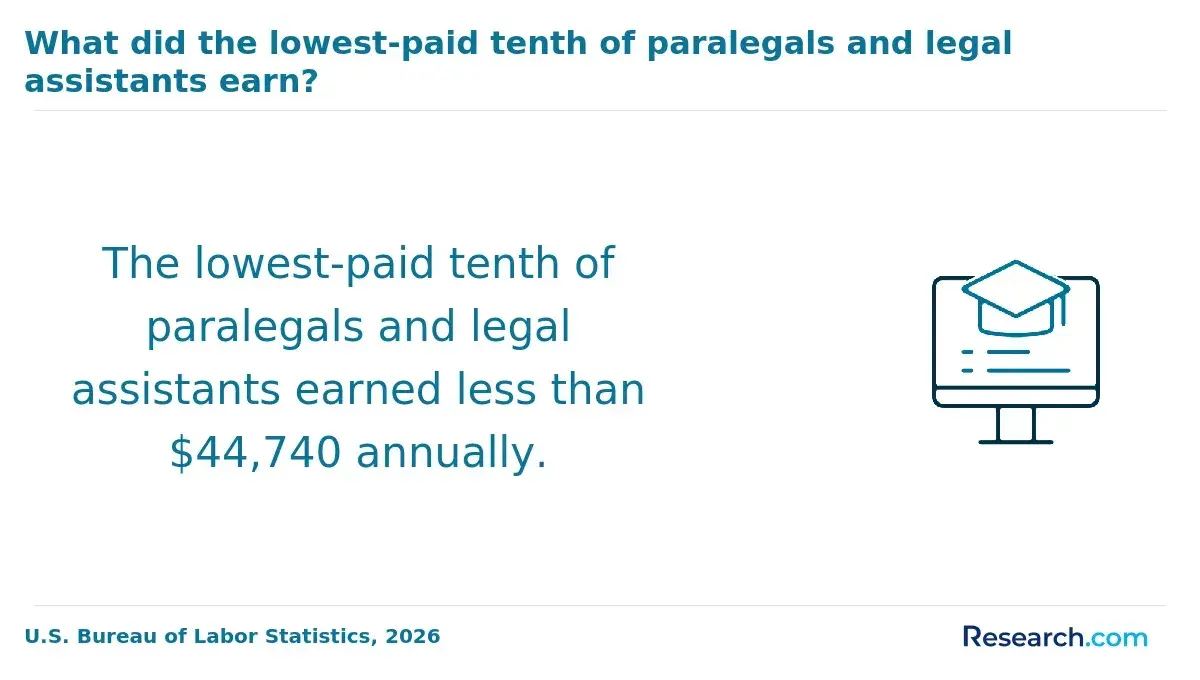
- The Bureau of Labor Statistics reports $62,890 median annual pay for paralegals and legal assistants in May 2025, but platform access alone does not predict an individual graduate's pay.
What Are Paralegal Programs With Westlaw or Lexis Training?
These are paralegal education programs that teach students to research law using Westlaw, Lexis, or both. The platforms provide searchable legal materials and research tools. A program might introduce one in a demonstration, give students individual accounts, or require repeated assignments using it. Those experiences are not equivalent.
Training can appear in a paralegal certificate, an associate degree, or a bachelor's program. A certificate is an educational award, not professional paralegal certification. If you are starting without college credit and want a broader credential, compare online pathways to an associate degree in paralegal studies - but confirm the research platform and assignments in each program's current materials.
Do Paralegal Programs Provide Student Access to Westlaw or Lexis?
Some programs provide individual academic accounts; others rely on a library subscription, classroom demonstration, or alternative research resources. Access can differ by course, campus, enrollment status, and vendor agreement. A school's statement that it "teaches Westlaw" does not establish which databases a student can search or whether off-campus login is available.
The distinctions below help you interpret a program's description before you compare its value.
| What the program provides | What a student can reasonably expect | Key limitation |
| Demonstration | Observation of an instructor's workflow | No assured individual practice |
| Library or lab access | Research when eligible resources are available | Remote access and hours may be restricted |
| Individual academic account | Direct use within the account's permitted scope | Databases, permitted uses, and expiration may be limited |
Ask whether access begins before the first research assignment, continues between terms, and ends at graduation. Academic access is subject to vendor and school terms; do not assume it permits research for an employer or client.
How Much Practice Time Do Paralegal Students Get With Legal Research Platforms?
There is no reliable program-wide hour count to assume. Scheduled instruction is only part of practice time: a student with an individual login and substantial homework may research more than a student who attends a longer course built around demonstrations. Schools may also count general legal research coursework without separating time spent on Westlaw or Lexis.
Look for required work that moves from finding a controlling statute or case to updating its status, comparing authorities, and producing a short research memo with citations. Multiple assignments with instructor feedback are stronger evidence of practice than one platform tutorial. Ask for a recent, identifying-information-free assignment description and grading rubric, along with the number of courses that require platform use. If the school cannot document assignments or explain access, treat any claimed practice hours cautiously.
How Do Online and Campus Paralegal Programs Compare for Legal Research Training?
Neither delivery format guarantees more platform practice. An online student with remote access and graded research tasks may get more hands-on time than a campus student limited to a lab; the reverse is also possible. "Online" does not necessarily mean asynchronous or self-paced.
This comparison isolates the format differences most likely to affect whether you can complete research assignments on your schedule.
| Training feature | Online program | Campus program |
| Platform access | Remote login may support practice outside class | Individual login or campus resources may be available |
| Instruction | May use recorded lessons, live meetings, or both | May offer live demonstrations and supervised lab sessions |
| Scheduling constraint | Live sessions and assignment deadlines may still apply | Travel and lab hours may limit practice time |
Check meeting times, proctored exams, campus visits, and any internship separately from the platform-access question. If you are comparing a broader legal studies curriculum with paralegal training, legal studies associate degree study options can provide context; do not assume those programs teach the same practical research tasks.
What Do Paralegal Programs Teach About Westlaw, Lexis, and Legal Research?
Useful training teaches a research process, not just a search box. Students should learn to identify the jurisdiction and legal issue, find primary authority such as statutes and cases, use secondary sources to build context, check whether an authority remains valid, and communicate findings accurately. Westlaw and Lexis have different interfaces and research features, but the underlying need to verify authority carries across platforms.
For paralegal work, a strong assignment also connects research to a supervised task: preparing a memo for an attorney, organizing authorities, or supporting document review. Ask whether instructors assess the reasoning and citations, not merely whether students completed a vendor tutorial. If a program introduces AI-assisted research, students still need to check cited authorities and comply with course, workplace, and confidentiality rules; an AI-generated answer is not verification.
Are Paralegal Programs With Westlaw or Lexis Training Accredited?
Software training says nothing by itself about a program's status. Institutional accreditation concerns the college or institution; American Bar Association (ABA) approval applies to qualifying paralegal education programs and is a separate designation. Not every reputable paralegal program has ABA approval, and an ABA-approved program does not make its graduates "ABA-certified paralegals."
Check the institution's current accreditation with its recognized accreditor and confirm any claimed ABA approval in the ABA's current paralegal program directory. Verify the exact program, not just the school name. These checks matter for evaluating the credential, but neither designation establishes how much Westlaw or Lexis practice students receive.
How Long and How Much Do Paralegal Programs With Legal Research Training Take?
Duration and price depend primarily on the credential, required courses, transfer credit, and schedule - not on whether the curriculum names a research platform. A certificate may have fewer requirements than a degree, while a student completing an associate or bachelor's program may need general education courses as well as paralegal coursework. Published tuition alone does not show total cost.
Compare the same cost categories at each school: tuition, mandatory fees, books, technology, any separately charged platform access, required campus travel, and internship expenses. Ask whether the specific program is credit-bearing and eligible for federal aid rather than assuming all certificates qualify.
The opportunity cost of extra terms also matters if a shorter credential would meet your hiring goal. Readers considering a different route can use weighing tuition against legal studies master's career potential to assess graduate study separately; a legal studies master's is not a prerequisite for paralegal work or a route to attorney licensure.
What Admission Requirements Apply to Paralegal Programs With Research Platform Training?
Admissions requirements follow the credential and institution, not the platform. A school may admit applicants to an entry-level associate program with a high school credential, while a particular certificate may require previous college coursework or a completed degree. Do not infer a certificate's prerequisites from its name; read its current admissions page and catalog.
If you already have credits, ask which courses satisfy admission requirements and which apply toward graduation. The receiving institution decides whether and how credits transfer. For students considering a guide to transferring into a paralegal bachelor's program, a written credit evaluation is more useful than a general promise that previous coursework will count. Also check whether the legal research course has prerequisites that delay your first platform assignment.
Do Westlaw or Lexis Skills Improve Paralegal Career Opportunities and Salaries?
Demonstrable research skills can help an applicant explain how they would support attorney-supervised work, especially when a job calls for finding and checking legal authority. A platform name on a résumé is less persuasive than a clear description of a graded memo or research project. Employers may use different platforms and may expect additional skills, such as writing, document organization, and careful handling of confidential information.
The Bureau of Labor Statistics reports median annual pay of $62,890 for paralegals and legal assistants in May 2025 and 0% projected job growth for 2025-2035, with about 40,800 openings per year projected despite little or no net growth. Those occupation-wide figures do not isolate the effect of Westlaw or Lexis training, and they are not a starting-salary estimate. If your goal is broader business-law knowledge rather than paralegal research work, a guide to faster online business law graduate study describes a different educational path; a non-JD legal studies degree does not qualify its holder to practice law.
How Can You Choose a Reputable Paralegal Program With Westlaw or Lexis Access?
Choose by evidence of usable access and assessed practice, then weigh that evidence against the credential's cost and schedule. A school that documents substantial work on one platform may be a better fit than one that advertises both without explaining what students actually do.
Before paying a deposit, use these checks to turn program descriptions into a comparable decision.
- Request the current catalog, legal research syllabi, and an example of a graded research assignment.
- Get written confirmation of which platform students use, whether accounts are individual, what resources they include, and when access begins and ends.
- Compare required platform assignments, instructor feedback, and off-campus practice access - not just scheduled course hours.
- Verify institutional accreditation and any claimed ABA program approval through the appropriate current listings.
- Compare total required costs, course sequencing, live meetings, and internship obligations before deciding whether the credential fits your schedule and goal.
A red flag is an unqualified promise of "certification" or job readiness based solely on software exposure. Completing a paralegal certificate does not automatically confer a professional certification; credential requirements depend on the certifying organization or applicable state system. Favor the program that can substantiate the skills you will practice and explain its limitations plainly.
Other Things You Should Know About Law & Paralegal
No. The Bluebook is a citation guide, not a requirement for opening either platform. Your program or employer may require a particular citation format, so follow its instructions.
Do not assume so. Check the applicable vendor license and school policy, and use the research access authorized by your employer for client work.
No. Platform training recognizes software learning; professional paralegal certification is a separate credential awarded under a certifying organization's or state system's rules.
Ask your instructor about school policies and remove any confidential or restricted material before using a project as a writing sample. Access to saved platform content may end when your student account expires.
References
- Summer Access to Databases | University of Miami https://library.law.miami.edu/research/databases/summer-access/
- Westlaw, Lexis, and Bloomberg Law access over the summer | uchicago.edu https://www.lib.uchicago.edu/about/news/westlaw-lexis-and-bloomberg-law-access-over-summer/
- Four-Step Legal Research Process: Step 4: Case Law | ttu.edu https://libguides.law.ttu.edu/c.php
- Summer and Post-Graduation Access to Lexis and Westlaw | Research Guides at University at Buffalo https://research.lib.buffalo.edu/summeraccess
- Paralegal Studies Certificate Program | ucdavis.edu https://cpe.ucdavis.edu/course/paralegal-studies-certificate-program
- LibGuides: Summer Intern & New Attorney Research Survival Guide: Lexis, Westlaw and Bloomberg Access | gmu.edu https://libguides.law.gmu.edu/summer-intern-new-attorney-research-survival-guide/summer-database-access
- Online Certified Paralegal (Voucher Included) | TCAT Knoxville https://tcatknoxville.edu/business-industry/online-certified-paralegal-voucher-included
- 9. Finding and Using Secondary Sources | Advanced Legal Research: Process and Practice https://opentext.uoregon.edu/legal/chapter/finding-and-using-secondary-sources/
- Legal Research Basics - Legal Research Tool Kit https://lawguides.suffolk.edu/research-toolkit
- Lexis and Westlaw Permissible Use Policy - About the Law Library - LibGuides at University of Akron https://libguides.uakron.edu/aboutthelibrary/LexisandWestlawPolicy