2027 Paralegal Certificates for Accountants Interested in Litigation and Financial Records

Co-Founder and Chief Data Scientist
Accountants who already know how to trace transactions may still need legal training to work effectively on litigation teams. A paralegal certificate can teach the procedures behind discovery, evidence management, and attorney-supervised case preparation - but programs differ in prerequisites, practical training, schedules, and cost. This guide is for accountants considering that transition or adding litigation skills to their current work. It explains what to look for, when a certificate is worth the commitment, and when a narrower course or on-the-job experience may be enough.
Key Things You Should Know
- Choose a certificate with litigation procedure, discovery, legal research, and document-management practice - not simply a course labeled "business law."
- A certificate documents education, not professional certification or permission to practice law; ABA program approval and institutional accreditation are separate checks.
- The Bureau of Labor Statistics reports median pay of $62,890 in May 2025 for paralegals and legal assistants, with 0% projected growth for 2025-2035. Accounting experience may help in financial-records work, but it does not guarantee a litigation position.
What Are Paralegal Certificates for Accountants Interested in Litigation and Financial Records?
A paralegal certificate is an educational award for completing a school's paralegal curriculum. For an accountant, its value lies in adding legal workflow to existing strengths in reconciliations, transaction analysis, and financial documentation. In litigation, that can mean helping an attorney organize records produced in discovery, compare financial exhibits, track document requests, and prepare materials for depositions or trial.
Programs are not all alike. Some are post-baccalaureate certificates designed for people who already have a degree; others accept students earlier in their education. A certificate is also different from professional certification, which a credentialing organization or state system may award after separate eligibility and assessment requirements. Neither makes its holder an attorney or permits independent legal advice.
If your goal is regulatory analysis rather than attorney-supervised case support, compare a paralegal certificate with legal studies master's and graduate certificate options. Those non-JD routes build legal knowledge but do not qualify graduates to practice law.
Why Should Accountants Earn a Paralegal Certificate for Litigation Work?
Accounting experience transfers most directly to cases involving damages, fraud allegations, business disputes, or voluminous financial records. The missing piece is usually not spreadsheet fluency; it is knowing how legal teams collect, review, describe, and use information under procedural deadlines and attorney direction.
A well-chosen certificate can help an accountant learn legal research, citation, pleadings, discovery requests, confidentiality, and evidence-handling conventions. It can also provide supervised assignments that demonstrate those skills to employers. The return is less clear if the accountant already works alongside litigation counsel and needs only targeted training in a particular workflow.
Before enrolling, compare the certificate with an employer-sponsored course, litigation-support training, or supervised experience in your current role. A certificate is more persuasive when local job postings request paralegal education and the program supplies work samples or a practicum; a short course may be more efficient when the aim is to improve one task rather than change roles.
What Paralegal Certificate Requirements Apply to Accountants?
There is no single nationwide educational requirement for becoming a paralegal. Employers set hiring preferences, programs set entry requirements, and some states impose additional rules on particular paralegal titles or activities. An accounting degree may satisfy a post-baccalaureate program's degree prerequisite, but it does not automatically waive legal coursework.
Completing a certificate does not automatically confer a professional credential. Organizations such as NALA and the National Federation of Paralegal Associations administer separate certification pathways with their own current eligibility rules. If an employer names a particular credential, check that organization's requirements rather than assuming any certificate will qualify you.
For accountants without a bachelor's degree, a certificate may still be available, depending on the school. If postings you want consistently prefer a degree, compare the certificate's credit value and transfer prospects with our guide to shorter paralegal bachelor's study routes. The receiving college, not the certificate provider, decides whether credits apply toward a later degree.
How Do ABA Approval and Institutional Accreditation Affect Program Quality?
The American Bar Association (ABA) approves qualifying paralegal education programs; it does not accredit an entire college through that process or certify individual graduates. Institutional accreditation is a separate review of the school. Neither status alone establishes that a curriculum emphasizes financial-records litigation.
ABA approval can be useful when an employer prefers it or when you want a program reviewed against the ABA's paralegal education standards. A program without ABA approval is not automatically unsuitable. Check its institutional accreditation, course assignments, instructor experience, and employer relevance. Verify a claimed approval in the ABA's current paralegal program directory, and confirm institutional status through the school's recognized accreditor or federal accreditation records.
Pay attention to the exact program and campus or delivery option under review. Do not assume that every certificate offered by an approved institution shares the same status. Also ask whether the program provides substantial legal research and writing practice: those skills matter to litigation work regardless of the label on the brochure.
Which Courses Prepare Accountants for Litigation and Financial Records?
Look beyond course titles to assignments. The strongest fit is a curriculum that makes students apply legal procedure to records, write for attorney review, and handle sensitive information responsibly. This table connects useful subjects to realistic attorney-supervised work.
| Course or skill area | Relevance to financial-records litigation |
| Civil litigation and procedure | Understanding pleadings, deadlines, discovery stages, and trial preparation. |
| Legal research and writing | Locating authority and preparing research summaries or draft materials for attorney review. |
| Discovery and e-discovery | Tracking requests, organizing productions, and identifying records for review under an attorney's direction. |
| Evidence and ethics | Recognizing preservation, confidentiality, privilege-review, and documentation issues that require escalation. |
| Business law or litigation electives | Providing context for contract disputes, entity records, and financial claims. |
A syllabus that merely mentions e-discovery software is not the same as hands-on access or assessed assignments. Ask what students actually do, which tools they can use, and whether they practice with realistic but appropriately anonymized records. Legal training complements accounting expertise; it does not replace an attorney's decisions about privilege, admissibility, or litigation strategy.
Can Accountants Complete Paralegal Certificates Online?
Yes, some paralegal certificates offer online coursework. "Online" does not necessarily mean asynchronous or self-paced: a program may require live classes, scheduled exams, campus visits, or a locally arranged internship. Those details can matter more than the delivery label to an accountant working through month-end close or tax season.
Before applying, obtain the current course schedule and internship policy. Confirm whether required litigation classes are offered when you need them, who finds a placement, whether your existing job can satisfy a practicum, and whether any in-person attendance is mandatory. If ABA approval matters to you, verify the status of the specific program rather than assuming that online delivery establishes or rules out approval.
Online study is a sound fit when the program provides feedback on research and drafting, realistic document exercises, and a schedule you can actually meet. It is a weaker fit if the advertised flexibility depends on securing an internship you cannot accommodate.
How Long Do Paralegal Certificate Programs Take and What Do They Cost?
Completion time depends on required courses, prerequisites, course sequencing, and whether you study full time. A post-baccalaureate curriculum may avoid general education requirements, while a broader certificate can take longer. Ask for a term-by-term plan based on your transcript and work schedule rather than relying on an advertised fastest-completion time.
There is no reliable single price for "a paralegal certificate." Compare each school's tuition and mandatory fees using the same unit - total program cost or required credits at the applicable per-credit rate. Include books, research-platform charges, technology, travel, and internship expenses where required. Noncredit courses and credit-bearing certificates may differ substantially in transfer value and aid eligibility.
Do not assume federal aid is available merely because the school participates in it; eligibility depends on the specific program and the student. Request the program's aid determination and a written cost estimate. If cash flow is the obstacle, compare any school-offered installment terms with paralegal degree tuition payment schedules, keeping in mind that a payment plan spreads charges rather than lowering them.
What Are the Admission Requirements for Paralegal Certificate Programs?
Requirements vary. A post-baccalaureate certificate ordinarily asks for a completed bachelor's degree; other certificates may accept applicants with an associate degree, prior college coursework, or a high school diploma. Schools may also request transcripts, an application statement, or evidence of English-language proficiency. Treat a published prerequisite as mandatory and a suggested accounting or business background as a preference.
Accountants should ask admissions staff whether their degree meets entry rules, whether any introductory legal course must come first, and whether prior coursework can reduce the required curriculum. Get transfer or waiver decisions in writing before budgeting for a shorter program. For readers considering a degree instead, business law degrees with credit transfer opportunities offer another route to investigate, but acceptance and application of credits remain the receiving school's decision.
Which Careers Can Accountants Pursue After Earning a Paralegal Certificate?
Potential roles include litigation paralegal, legal assistant on a commercial disputes team, litigation-support specialist, and financial-records coordinator in a law firm or corporate legal department. Actual duties and hiring criteria vary. An accountant might also remain in accounting or compliance while collaborating more effectively with counsel; a paralegal job is not the only useful outcome.
The strongest transition story pairs accounting work - such as tracing payments or explaining ledgers - with demonstrated legal research, discovery organization, and careful drafting. A certificate alone is unlikely to substitute for litigation experience in a senior specialist posting. Review local vacancies to see whether employers request paralegal education, specific software experience, or prior casework before choosing a program.
If your preferred work is interpreting rules for a business rather than managing an attorney's case materials, compare the certificate's time and cost with employer training and lower-cost options for a master's in legal studies. A non-JD legal studies degree may suit that goal, but it is neither required for all compliance roles nor a route to attorney licensure.
What Are Paralegal Salaries and Job Outlook for Litigation Specialists?
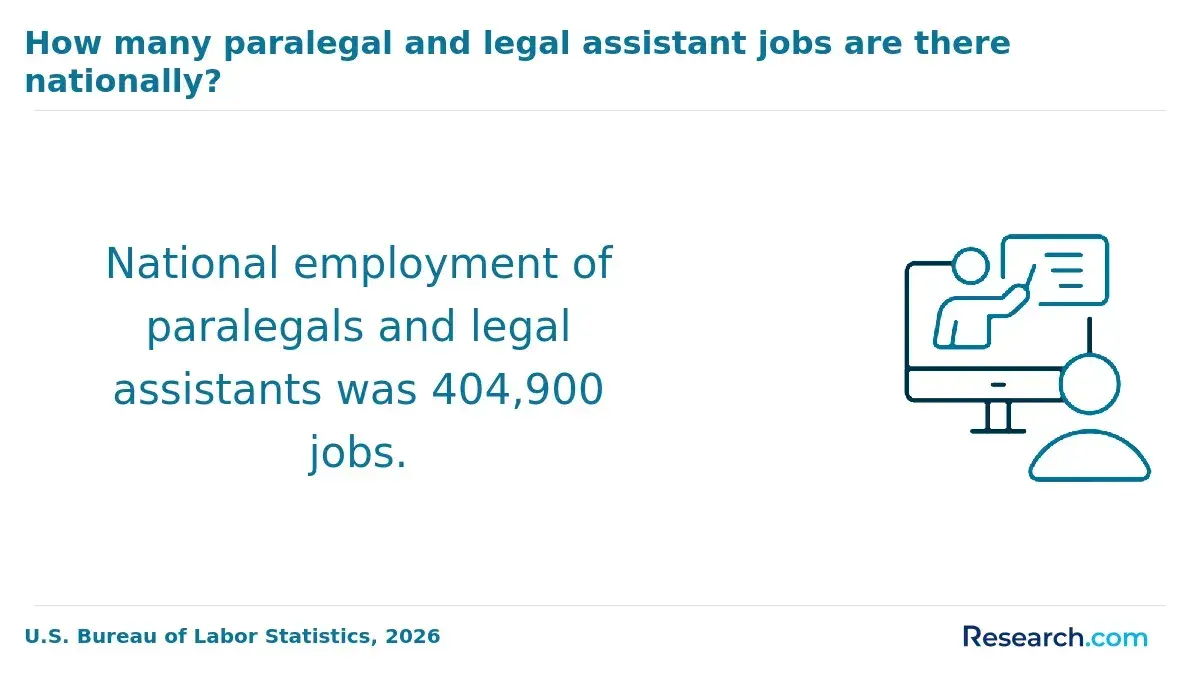
The Bureau of Labor Statistics reports median annual pay of $62,890 in May 2025 for paralegals and legal assistants. It projects 0% employment growth for that occupational group during 2025-2035, alongside about 40,800 openings per year, largely as workers leave or change occupations. These are national figures for a broad occupation, not a wage or hiring forecast specifically for accountants entering litigation support.
Pay for a particular opening depends on location, employer, experience, and responsibilities. A certificate may help demonstrate legal preparation, but it does not establish a salary premium. For a realistic decision, compare local litigation postings with your current compensation and account for tuition, study time, and any internship-related reduction in paid hours. If comparable openings consistently require experience you lack, seek supervised case exposure before committing to a more expensive credential.
Other Things You Should Know About Law & Paralegal
Not automatically. Your state accountancy board's rules and the course's subject matter and documentation determine whether it qualifies. Confirm eligibility before counting it toward a reporting requirement.
No. Expert-witness qualification depends on relevant knowledge, experience, and the applicable case and court rules. A certificate does not independently establish expertise or guarantee that testimony will be admitted.
Do not use confidential client or employer materials without proper authorization, even if you remove obvious names. Use coursework, simulated records, or materials your employer has expressly cleared for that purpose.
Potentially, yes. You must still meet your state board's renewal and professional obligations, and both roles may raise confidentiality or conflict questions. Check the applicable rules and your employer's policies before combining them.
References
- Qualified Paralegal Studies Programs | North Carolina State Bar https://www.ncbar.gov/paralegal-certification/how-to-get-certified/qualified-paralegal-studies-programs/
- Law Student Internship and Externship Opportunities | dol.gov https://www.dol.gov/agencies/sol/careers/internships
- Paralegal Studies Certificate | Community College of Baltimore County https://www.ccbcmd.edu/Programs-and-Courses-Finder/Program/paralegal-studies-certificate.html
- Certificate Program Costs | Elmhurst University https://www.elmhurst.edu/admission/financial-aid/tuition-fees/certificate-program-costs/
- Paralegal Studies Certificates - [email protected] https://gpem.luc.edu/portal/program
- Online Forensic Accounting and Fraud Examination Graduate Certificate | WVU Online https://online.wvu.edu/programs/graduate-certificates/forensic-accounting-and-fraud-examination-graduate-certificate/
- Paralegal/Legal Assistant Certificate | Prince George's Community College https://www.pgcc.edu/programs-courses/program-finder/paralegallegal-assistant-certificate/
- Online Certified Paralegal Training | Rutgers, The State University of New Jersey https://careertraining.rutgers.edu/training-programs/certified-paralegal/
- Do You Need ABA Approval for a Paralegal Program? | Bryan University Online© https://bryanuniversity.edu/faq/aba-approval-accreditation-paralegal-programs/
- Course Descriptions | ivytech.edu https://catalog.ivytech.edu/content.php