2027 Legal Studies Master's Programs for Internal Control and Assurance Teams

Co-Founder and Chief Data Scientist
Internal control and assurance teams must turn legal obligations into policies, tests, and evidence that an organization can defend. A legal studies master's degree may strengthen that work, but it may also be more education than a particular role requires. This guide is for auditors, compliance professionals, risk specialists, and managers weighing a non-lawyer graduate degree. It explains which courses and program features matter, how the degree compares with shorter credentials, and what to verify before committing time and tuition.
Key Things You Should Know
- Choose a legal studies master's program for its regulatory, governance, and applied coursework - not its title alone. An MLS or MSL does not qualify its holder to practice law.
- Compare the full cost and required schedule with a graduate certificate, professional certification, or employer training before enrolling.
- The U.S. Bureau of Labor Statistics reports $80,730 median annual pay for compliance officers in May 2025 and 4% projected growth for 2025-2035; those occupation-wide figures do not measure the payoff from a master's degree.
What are legal studies master's programs for internal control and assurance teams?
Internal controls are the policies and procedures an organization uses to manage risks, safeguard resources, and support reliable reporting. Assurance teams evaluate whether those controls are designed and operating as intended. For these teams, legal studies graduate education can help connect statutes, regulations, contracts, and enforcement expectations to everyday control decisions.
A Master of Legal Studies (MLS), Master of Studies in Law (MSL), Master of Jurisprudence, or similarly named degree is generally intended to teach legal knowledge to people who are not seeking to become attorneys. Program names and curricula vary. A relevant program might offer a formal compliance concentration, a set of useful electives, or only a few related courses; those are not equivalent commitments of study.
The degree is not normally a hiring requirement for internal control work and does not, by itself, qualify a graduate to practice law. Professionals who need a narrower introduction should compare legal studies graduate certificate versus full master's study before paying for a complete degree.
How do legal studies master's degrees prepare internal control professionals?
The strongest fit is a program that teaches students to identify an obligation, interpret its scope, translate it into a control, and document how that control is monitored. Legal research and writing can improve regulatory summaries and policy drafting. Courses on investigations or administrative enforcement can help professionals understand what evidence reviewers may expect.
Legal analysis is only part of the job. Assurance professionals also need to map processes, assess risk, select tests, evaluate exceptions, and communicate findings without overstating conclusions. A legal studies program that lacks applied work in those areas may complement an auditor's existing skills but will not replace audit training or supervised experience. Ask to see assignments - not just course descriptions - to determine whether students practice these tasks.

What careers can graduates pursue in compliance, risk, and internal assurance?
Potential paths include compliance officer, regulatory affairs specialist, internal auditor, controls analyst, risk manager, and governance or policy specialist. These roles overlap, but employers may weigh legal interpretation, accounting, data analysis, industry experience, and audit methods differently. A master's degree can add context to an established professional's experience; it is not a substitute for the technical requirements of a particular opening.
The table distinguishes common responsibilities so readers can judge where legal study would add value. Titles and qualifications vary by employer.
| Role | Typical focus | Where legal study helps |
| Compliance officer | Policies, monitoring, training, and regulatory issues | Interpreting obligations and documenting responses |
| Internal auditor or controls analyst | Testing processes and reporting control weaknesses | Connecting test criteria to legal and policy requirements |
| Risk or governance specialist | Assessing exposure and advising decision-makers | Explaining regulatory consequences and governance duties |
Someone aiming instead for legal-support work should compare the duties and educational expectations of that route. Affordable accredited online paralegal degrees address a different career path; a paralegal education program is not interchangeable with a graduate degree designed for organizational assurance.
Which courses cover internal controls, compliance, auditing, and risk management?
Start with the work you want to do, then inspect required courses and available electives. Relevant subjects include administrative law, business organizations, corporate governance, regulatory compliance, privacy, employment law, investigations, contracts, and legal research. Risk management, accounting controls, audit methods, and data analysis may sit outside a law-focused program, so their availability needs separate confirmation.
A useful curriculum lets students apply legal requirements to a process: identify the rule, assign a control owner, specify evidence, test performance, and explain how exceptions are escalated. Check whether a capstone permits an assurance-related project and whether desired electives are offered often enough to fit your graduation plan.
For teams handling workplace investigations or employment-policy controls, exploring HR law-focused legal studies degree pathways may help narrow the search. Verify whether "concentration" means a formally designated pathway rather than a handful of electives.
Are online legal studies master's programs suitable for assurance professionals?
Online study can suit professionals who need to keep working, particularly when assignments draw on policy analysis and documented workplace processes. But "online" does not mean asynchronous or self-paced. Live classes, group projects, fixed exam times, campus visits, and course sequencing can affect whether a program works around audit cycles or reporting deadlines.
Ask for a sample term schedule, the frequency of required live sessions, and any in-person or practicum obligations. If speed is important, compare accelerated graduate study options in business law, then check whether the compressed schedule leaves enough time for the compliance and assurance coursework you actually need. A faster degree is not necessarily the more practical one.
What accreditation should students look for in legal studies master's programs?
Confirm that the university holds institutional accreditation from an accreditor recognized by the U.S. Department of Education. Check the institution's current status rather than relying only on promotional language. Institutional accreditation matters for educational oversight and may affect eligibility for federal student aid, but it does not establish that a particular curriculum teaches internal controls well.
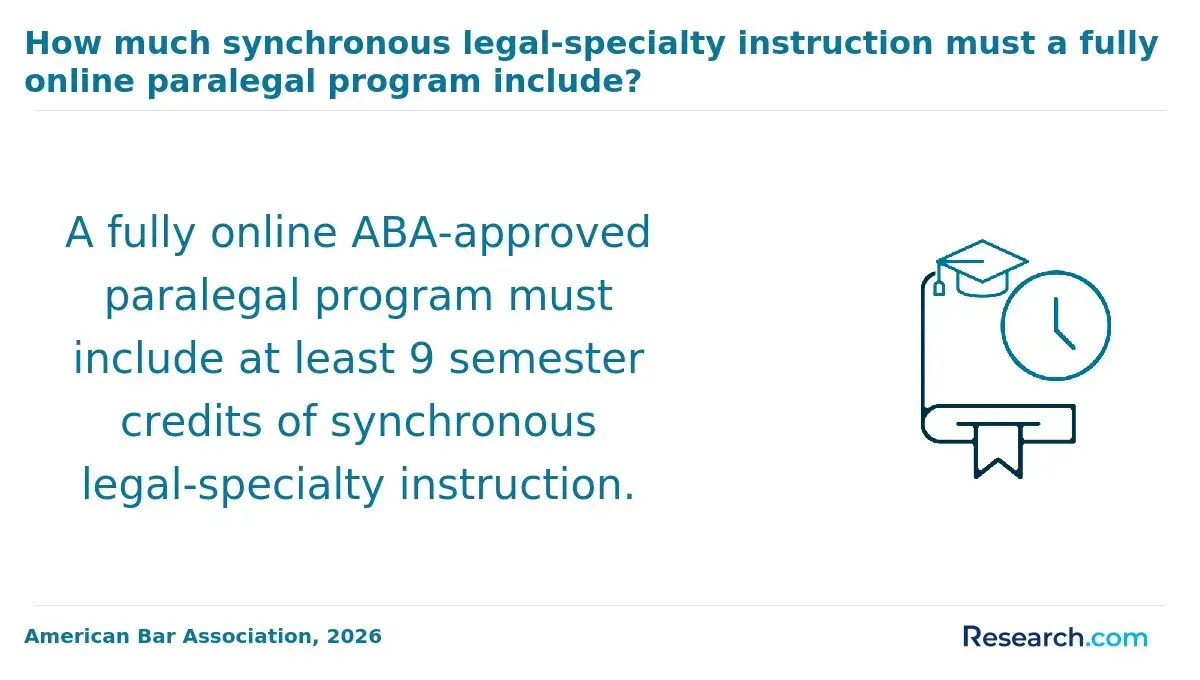
Do not confuse institutional accreditation with American Bar Association (ABA) approval. The ABA approves qualifying paralegal education programs; that approval is not the standard to apply to a non-JD legal studies master's degree. Neither status turns an MLS or MSL into a law license. For program quality, review faculty expertise, required courses, applied assignments, and the support available to working students.
What are the admission requirements for a legal studies master's program?
Requirements depend on the institution. Applicants generally need a bachelor's degree, while programs may also request transcripts, a résumé, a statement of purpose, recommendations, or evidence of relevant experience. A JD is not generally the intended prerequisite for non-JD legal studies programs. Confirm whether a program requires prior accounting, audit, or business coursework rather than assuming professional experience satisfies a prerequisite.
Applicants with previous graduate work should ask whether credit can apply to the degree and whether accepted credits replace required courses or only electives. The receiving university makes that decision under its own rules. Business law credit transfer considerations offer a starting point, but obtain a program-specific evaluation before planning a shortened path.
How long do these master's programs take, and what do they cost?
Completion time depends on required credits, course availability, enrollment pace, and whether a capstone has prerequisites. Compare a realistic schedule alongside advertised completion time: a working auditor may need a lighter load during busy periods, and an infrequently offered elective can delay graduation.
Published tuition is not the entire expense. Compare mandatory fees, books, technology and legal-research charges, any travel, and income affected by time away from work. Request each school's current tuition and fee schedule and an estimate based on the credits you would actually take; prices cannot be compared fairly when one figure is per credit and another represents a whole program.
Federal student aid depends on the institution, the student, and the specific program's eligibility. Employer tuition assistance may reduce out-of-pocket cost but can include grade, employment, or repayment conditions. Before borrowing, compare the degree's total cost with a targeted course, graduate certificate, or professional credential that could address the same skill gap.
What salaries and job outlook apply to compliance and internal audit careers?
The U.S. Bureau of Labor Statistics reports median annual pay of $80,730 for compliance officers in May 2025, with 4% projected employment growth for 2025-2035 and about 32,700 openings projected each year. This is an occupation-wide benchmark - not a starting salary, a measure of MLS graduates' earnings, or evidence that a degree causes a pay increase.
"Internal assurance" is broader than one occupational title, and an internal auditor's pay and prospects depend on the role's accounting, industry, location, and experience requirements. For a useful comparison, read postings for the jobs you want: note whether a legal studies master's is required, preferred, or unmentioned, and which audit or data skills appear repeatedly. That evidence is more relevant to your likely return than a broad salary figure alone.
Do graduates need licenses or certifications for internal control careers?
An MLS or MSL is an academic degree, not a professional license or certification. Internal control and compliance roles generally do not share a single nationwide licensing requirement, although particular regulated duties, employers, and states can impose their own rules. The degree does not authorize someone to give legal advice as an attorney.
Depending on the target role, an employer may value a credential such as the Institute of Internal Auditors' Certified Internal Auditor (CIA) or a compliance certification granted by a relevant professional body. Each certifying organization sets its own eligibility, examination, and continuing-education rules. Check those rules directly before assuming a master's degree satisfies them.
A sensible next step is to compare several target job descriptions, identify the missing skill they have in common, and price the shortest credible way to build it. Choose the master's when sustained legal and regulatory analysis is central to that goal; favor targeted training or certification when the gap is primarily audit technique or a credential employers specifically request.
Other Things You Should Know About Law & Paralegal
Only with appropriate employer permission and within the school's rules. Ask whether you can use public records, anonymized facts, or a fictional scenario instead.
Do not assume it will. A law school decides whether it accepts any prior coursework, and an MLS or MSL is not a substitute for a JD.
That depends on the university. Ask the registrar how the concentration is recorded on the transcript and diploma before relying on its name for a job application.
Possibly, if the program permits workplace-based projects and the employer agrees. Confirm who may supervise the work and how confidential information must be handled.
References
- Summary of the HIPAA Security Rule | hhs.gov https://www.hhs.gov/hipaa/for-professionals/security/laws-regulations/index.html
- Institutional Eligibility | 2025-2026 Federal Student Aid Handbook https://fsapartners.ed.gov/knowledge-center/fsa-handbook/2025-2026/vol2/ch1-institutional-eligibility
- Law Degrees for Non-Lawyers: When to Choose an M.L.S. | miami.edu https://news.miami.edu/law/stories/2024/03/law-degrees-for-non-lawyers-when-to-choose-an-mls.html
- Master of Legal Studies in Financial Compliance | Seattle U School of Law https://onlinelaw.seattleu.edu/financial-compliance/
- How to Stay Updated on Regulatory Changes | Northeastern University Graduate Programs https://graduate.northeastern.edu/knowledge-hub/how-to-stay-updated-regulatory-changes/
- Risk Management | tamu.edu https://info.law.tamu.edu/risk-management
- Online Master of Legal Studies (MLS) | William & Mary Law School https://online.law.wm.edu/master-of-legal-studies
- Why You Should Consider a Career in Internal Audit | St. John's University https://www.stjohns.edu/news-media/johnnies-blog/why-you-should-consider-career-internal-audit
- Legal Risk Management, Contracting, and Compliance | fsu.edu https://law.fsu.edu/academics/academic-programs/juris-master-online-program/legal-risk-management-contracting-and-compliance
- Master of Legal Studies vs Juris Doctor (JD) | Online Master of Legal Studies at Northeastern https://legalstudiesmastersonline.northeastern.edu/articles/what-is-the-difference-between-legal-studies-vs-law-degree/