
2027 Paralegal Certificates for Students Who Have an Associate Degree but No Bachelor's

Co-Founder and Chief Data Scientist
An associate degree can put paralegal training within reach, but not every certificate accepts applicants without a bachelor's degree. Programs also differ in credit value, hands-on training, scheduling, and cost.
If you want to enter legal support work without first completing a four-year degree, this guide will help you identify eligible programs, compare what they teach, and understand what a certificate can - and cannot - do for your career.
Key Things You Should Know
- Look for a paralegal certificate that explicitly accepts an associate degree or your completed college credits; some certificates require a bachelor's degree.
- Check institutional accreditation, any claimed ABA program approval, practical coursework, and the full cost before comparing programs by price or format.
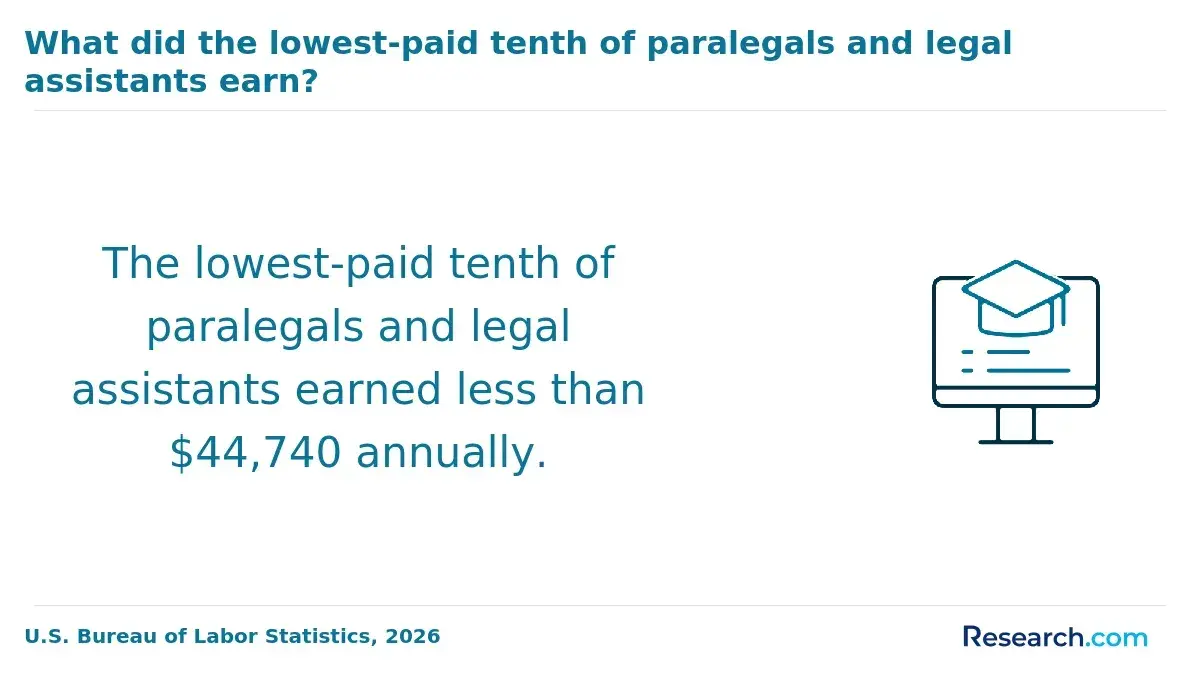
- The median annual pay for paralegals and legal assistants was $62,890 in May 2025; BLS projects 0% growth for 2025-2035, so a certificate alone is not a job guarantee.
What is a paralegal certificate for students with an associate degree?
A paralegal certificate is an educational award for completing a defined course of legal-support study. For someone who already has an associate degree, it may provide job-specific training without requiring another degree. Eligibility depends on the program: one school may accept any associate degree, another may require particular general education courses, and a third may admit only bachelor's degree holders.
Look closely at the credential's level. A post-associate certificate may build on previous college study, while a certificate that repeats much of an associate-level paralegal curriculum may offer less new learning. Credit-bearing coursework may also be more useful if you expect to pursue a bachelor's degree later, although the receiving college decides whether those credits transfer. Compare certificates with legal studies transfer pathways from associate to bachelor's if a four-year degree is already part of your plan.
A certificate is not the same as professional certification, a credential awarded by a certifying organization or state system after its requirements are met. Neither credential qualifies you to practice law as an attorney.
Can you become a paralegal without a bachelor's degree?
A bachelor's degree is not a universal prerequisite for paralegal work. Employers set their own hiring standards, however, and some prefer applicants with a bachelor's degree, relevant experience, or training from a particular type of program. State rules can also affect which education or experience qualifies someone to use a paralegal title or perform specific work.
An associate degree plus a substantive paralegal certificate can be a reasonable entry route when the certificate adds legal research, writing, procedure, and supervised practical work to your existing education. If your associate degree is already in paralegal studies, compare the certificate's courses with your transcript before paying for overlapping instruction. In either case, seek programs that help you produce work samples and apply for legal-support roles while studying.
Paralegals work under attorney supervision and cannot independently provide legal advice or represent clients where doing so would constitute unauthorized practice of law. Your state's rules and a prospective employer's job description matter more than a broad claim that a certificate "qualifies" graduates everywhere.
What are the best paralegal certificate programs for associate degree holders?
The best choice is an eligible, well-documented program that teaches skills you do not already have, fits your schedule, and costs an amount you can justify against your likely entry-level opportunities. A list of recognizable school names is less useful if some programs exclude applicants without a bachelor's degree or deliver the credential in a format you cannot attend.
These program types offer a starting point for comparison. Admissions, credit, approval, and practical-training requirements must still be confirmed for each specific certificate.
| Program type | Potential advantage | Important trade-off |
| Credit-bearing college certificate accepting associate degree holders | May combine legal-skills training with college credit | Credit transfer and financial aid are not automatic |
| ABA-approved paralegal program with an eligible certificate route | Program approval supplies an additional, specific quality check | Approval does not establish your admission eligibility or guarantee a convenient schedule |
| Noncredit continuing-education certificate | May offer a focused route for someone seeking job skills | May not provide transferable credit or qualify for federal student aid |
Start by ruling out bachelor's-required programs. Then compare the remaining choices using the same evidence: published admissions rules, required courses, opportunities to practice research and drafting, any internship obligation, total charges, and completion schedule. For one part of that search, see cost-conscious options for ABA-approved paralegal training; verify the current certificate route and its requirements directly before applying.
Do paralegal certificates require an accredited school or ABA approval?
Do not confuse two distinct checks. Institutional accreditation concerns the college or other educational institution. American Bar Association approval concerns a qualifying paralegal education program. ABA approval is not institutional accreditation, and a school's accreditation does not mean its paralegal certificate is ABA-approved.
ABA approval is not a universal legal requirement for becoming a paralegal. It may nevertheless matter to an employer, a student seeking a particular educational standard, or someone subject to state-specific rules. Confirm an approval claim against the ABA's current paralegal program directory and verify that it applies to the program and credential you intend to complete. For accreditation, check the institution and its recognized accreditor rather than relying on an unqualified "accredited" label.
A useful red flag is language promising that graduates become "ABA-certified paralegals." The ABA approves eligible education programs; it does not certify individual paralegals.
What do paralegal certificate programs teach?
A useful certificate should turn general college skills into legal-support skills. Core subjects commonly include legal research and writing, civil procedure, document preparation, ethics, and the boundaries of work performed under attorney supervision. Electives may address areas such as contracts, real estate, family law, or litigation.
Examine assignments, not just course titles. A research course is more valuable to a new applicant when it requires locating authority and writing a memorandum; a litigation course should explain how students practice organizing documents or preparing drafts. If a program advertises legal software or AI tools, ask whether students receive access and complete assessed work with them. A mention in a syllabus does not establish proficiency.
If your longer-term interest is employment policy or workplace investigations rather than conventional paralegal work, compare those goals with a guide to human resources law concentrations in legal studies. A concentration is a different educational route, not a substitute for checking the hands-on legal-support training in a certificate.
How long do paralegal certificate programs take, and how much do they cost?
Completion time varies with required coursework, course sequencing, and whether you attend full time or alongside a job. A short advertised timeline may assume that prerequisites are already complete and that required classes are available when you need them. Request a term-by-term plan based on your associate degree transcript before treating the advertised duration as your own.
Published tuition is only one part of the price. The following cost categories explain why two apparently similar certificates can require different budgets.
| Cost category | What to check |
| Tuition and mandatory fees | Credit-based charges, enrollment fees, and any required program charges |
| Learning materials and technology | Books, database access, software, and computer requirements |
| Attendance and practical work | Campus travel, scheduled visits, or expenses connected to an internship |
| Prerequisites | Additional courses required before admission or completion |
Ask for a written estimate covering your entire route, not only the first term. Federal aid depends on the institution, your eligibility, and the specific program's aid status; do not assume a certificate is aid-eligible, particularly if it is noncredit. If the combined cost of a certificate and later degree study is a concern, compare it with paralegal bachelor's degree duration and salary outlook before committing to either route.
What are the admission requirements for a paralegal certificate?
Requirements vary by school and by certificate. A program may require an associate degree, a specified amount of previous college coursework, particular writing or general education courses, or a bachelor's degree. Some certificates have broader entry requirements. Treat "college experience preferred" differently from a published admission requirement.
Before paying an application fee, send admissions staff your transcript and ask for a decision on eligibility in writing. Confirm whether your degree field matters, whether credits from your prior institution are accepted for prerequisites, and whether any course must be completed before you can start legal coursework. Admission to a certificate does not itself establish that its credits will apply to a future degree; only the receiving institution can decide that.
Are online paralegal certificates as valuable as campus programs?
Online delivery can be valuable when it provides rigorous assignments, useful instructor feedback, and a schedule you can actually meet. Campus delivery can be valuable when in-person classes, local contacts, or access to on-site resources suit you better. Neither format alone establishes educational quality or employer recognition.
Check what "online" means in practice. Classes may be asynchronous, require live meetings, follow a fixed cohort schedule, or include campus visits. If an internship is required, ask who secures the placement, whether your location is eligible, and whether current employment can satisfy the requirement. For students working full time, those conditions may matter more than the word "online" on a program page.
What jobs can you get with a paralegal certificate and associate degree?
Depending on employer requirements and your experience, relevant openings may include paralegal, legal assistant, litigation support assistant, or legal intake and document-support roles. A certificate can strengthen an application, but a job title does not guarantee that the employer accepts your particular combination of education and experience.
Paralegal and legal assistant positions commonly involve organizing case materials, researching facts or legal sources, preparing drafts, and tracking deadlines under attorney supervision. Administrative support positions may emphasize scheduling and records instead. Read postings closely: "entry level" can still carry software, writing, or prior office-experience expectations.
When applying, match your coursework and prior associate-degree experience to the work described. A polished research memorandum, carefully redacted writing sample, or documented internship task may demonstrate more than a certificate title alone. Protect confidential information in any sample you share.
What are paralegal salaries, certifications, and job outlooks without a bachelor's degree?
The Bureau of Labor Statistics reports $62,890 in median annual pay in May 2025 for the combined occupation of paralegals and legal assistants. That occupational median is not a starting salary or a figure specific to certificate holders without a bachelor's degree; location, employer, duties, and experience affect individual offers.
BLS projects 0% growth for 2025-2035 but about 40,800 openings per year, largely as workers leave the occupation or change jobs. For a new applicant, that makes relevant skills and a credible search strategy important even though openings are projected to continue.
Professional certification is a separate decision after - or sometimes alongside - education and experience. Organizations such as NALA and the National Federation of Paralegal Associations set requirements for their own credentials; check the current rules for a specific exam before assuming your certificate makes you eligible. Certification is not universally required, and the ABA does not certify individuals.
If you later complete a bachelor's degree and consider advanced legal education, weighing a graduate certificate against a legal studies master's may help with that later choice. Neither is necessary simply to begin applying for paralegal roles, and neither is a law degree that qualifies someone to practice as an attorney.
Other Things You Should Know About Law & Paralegal
It may. Some certificates accept associate degrees in any field; others specify coursework or prior study. Your degree subject may also affect how much new material the certificate adds.
Usually, if the work is yours and the school permits it. Follow the employer's instructions, label simulated assignments accurately, and never disclose confidential client information.
Yes, if you meet a posting's requirements. State the certificate's expected completion date accurately and highlight relevant coursework, office experience, and writing skills.
There is no universal transfer guarantee. Employers can assess your training differently, and state rules may vary. Check the destination state's requirements and compare local job postings before enrolling.
References
- Types of Financial Aid: Grants, Work-Study, and Loans | studentaid.gov https://studentaid.gov/understand-aid/types
- Cost of Attendance (Budget) | 2025-2026 Federal Student Aid Handbook https://fsapartners.ed.gov/knowledge-center/fsa-handbook/2025-2026/vol3/ch2-cost-attendance-budget
- Postsecondary/College Level Glossary | ed.gov https://nces.ed.gov/surveys/ctes/tables/glossary_college.asp
- Post-Secondary Employment Outcomes Tool Shows What You Might Earn Depending on the College You Attend | Census.gov https://www.census.gov/library/stories/2022/06/job-and-earnings-prospects-by-college-and-degree.html
- How To Get Certified | North Carolina State Bar https://www.ncbar.gov/paralegal-certification/how-to-get-certified/
- Paralegal - Career Bridge - Washington State Government https://careerbridge.wa.gov/learn/program/2029
- How Long Does It Take to Become a Paralegal? | Pepperdine Caruso School of Law https://law.pepperdine.edu/blog/posts/how-long-to-become-paralegal.htm
- Are There Advantages to an ABA-Approved Paralegal Program? | Campus https://campus.edu/blog/paralegal/american-bar-association-approval
- Associate of Applied Science in Paralegal Studies | BRCC https://mybrcc.edu/academics/business-and-law/aasparalegal.php
- Do You Need ABA Approval for a Paralegal Program? | Bryan University Online© https://bryanuniversity.edu/faq/aba-approval-accreditation-paralegal-programs/


