2027 Legal Studies Master's Programs for Construction Contract Managers

Co-Founder and Chief Data Scientist
Construction contract managers work where project delivery, commercial risk, and legal obligations meet. A legal studies master's degree may strengthen that work, but it can also demand time and money that a focused course or professional credential would not.
This guide is for construction professionals deciding whether graduate legal study is worth pursuing. It explains which programs and courses are relevant, how to evaluate online formats and total costs, and when another route may serve the same career goal.
Key Things You Should Know
- A non-JD legal studies master's can build contract and dispute-resolution knowledge, but it is not generally required for construction contract management and does not qualify graduates to practice law.
- Prioritize construction-specific coursework or a relevant capstone over a degree title alone; confirm that the courses you want are available in your study format.
- For context, the U.S. median pay for compliance officers was $80,730 in May 2025. That is a related occupation's benchmark, not a construction contract manager salary or a projected return on the degree.
What Is a Legal Studies Master's Degree for Construction Contract Managers?
A Master of Legal Studies (MLS), Master of Studies in Law (MSL), Master of Jurisprudence, or similarly named non-JD degree teaches legal concepts to people whose work involves law but who do not plan to become attorneys. For a construction contract manager, its value lies in understanding how contract terms affect bidding, change orders, payment, delays, claims, and dispute resolution.
The degree complements project and commercial experience; it does not replace either. A graduate may be better equipped to identify an issue, document it, and work with counsel, but the degree alone does not authorize independent legal practice. Whether someone may perform a particular legal task depends on applicable state rules and the nature of the work.
Do Construction Contract Managers Need a Master's Degree in Legal Studies?
Generally, no. Construction contract management is usually built on experience with projects, procurement, schedules, and contract administration, rather than a mandatory legal studies credential. A master's makes the strongest case when a manager regularly handles complex claims, negotiates substantial risk allocation, or works closely with legal and compliance teams.
Match the education to the gap in your current work. If you mainly need to interpret common clauses or improve change-order documentation, employer training or a focused course may cost less and take less time. If you want broader responsibility for contracting policy or disputes across an organization, graduate study may be more useful. Working professionals considering a wider commercial-law curriculum can also review business law education options for employed students.
Which Master's Programs Best Prepare Students for Construction Contract Management?
Start with the curriculum, not the credential's initials. A formal construction-law concentration is worth distinguishing from a general degree that permits relevant electives - and from a program that merely lists a construction topic in one course description.
The comparison below shows what each common program design can offer a contract manager and what needs checking before enrollment.
| Program design | Potential fit | Important limitation to check |
| Construction-law concentration within a non-JD master's | Work involving project contracts, claims, and construction-specific risk | Whether required courses and electives run often enough to finish on schedule |
| General MLS or MSL with contract and dispute-resolution electives | Managers who want legal breadth alongside project-related study | Whether construction content is substantial or only incidental |
| Business law or compliance-focused master's | Professionals moving toward enterprise procurement, governance, or regulatory work | Whether the curriculum addresses construction delivery and contract administration |
Ask for the current degree plan, course rotation, and capstone rules. Compare actual syllabi for construction contracts, public procurement, insurance, surety bonds, and dispute resolution; course titles alone can conceal different emphases. For a broader view of how concentrations align with roles, see career paths across legal studies master's specializations.
What Do Construction Contract Management Legal Studies Programs Teach?
The most useful curriculum connects legal rules to decisions made during a project. Contract law supplies the foundation, while construction-focused study may examine scope and change provisions, notice requirements, payment, delays, defects, indemnity, insurance, bonding, and methods for resolving disputes. Public-project work may also make procurement rules and government-contract requirements important.
Look for assignments that require students to analyze a clause, build a defensible record of events, or evaluate a claim - not just recall legal definitions. A manager should leave better able to recognize when an issue needs counsel, preserve relevant records, and explain the commercial consequences of available options. No course can substitute for legal advice on a live dispute.
Are Online Legal Studies Master's Programs Effective for Construction Professionals?
They can be, particularly when coursework uses contract analysis, writing, and realistic project scenarios. Effectiveness depends less on the word "online" than on access to appropriate courses, instructor feedback, and a schedule a working manager can sustain.
Online does not necessarily mean asynchronous or self-paced. Before applying, confirm whether classes have live meetings, fixed discussion deadlines, timed exams, a cohort sequence, campus visits, or a required capstone presentation. Also ask whether construction-related electives are offered online during the terms you expect to study. A flexible core is of limited value if the courses that motivated your application are unavailable remotely.
What Are the Admission Requirements for Legal Studies Master's Programs?
Applicants generally need a bachelor's degree, but each school sets its own standards for academic records, statements, references, and work experience. Construction experience may help explain an applicant's goals; it should not be assumed to replace a published degree prerequisite. Do not assume a non-JD program requires the LSAT or that admission follows the same process as admission to a JD program.
If you have not completed a bachelor's degree, resolve that prerequisite before comparing master's tuition. Previous college credit may shorten the undergraduate route, but the receiving institution decides which credits apply. One starting point for that comparison is continuing college study in an online paralegal bachelor's program; check whether its legal focus also supports your construction career goals.
How Long Do These Master's Programs Take and What Do They Cost?
Completion time depends on required credits, course rotation, and whether you enroll full time or part time. A published fastest-completion schedule may assume a workload that is unrealistic during active projects. Ask the school to map the courses you want onto the number of terms you can actually attend.
For a meaningful price comparison, request the current 2026-27 tuition and mandatory-fee schedule from each institution. Multiply the applicable per-credit tuition by the credits you would need, then add required fees and materials; ask separately about travel, campus visits, and any prerequisites. This produces a more useful estimate than comparing advertised per-credit rates alone. Employer tuition assistance can change your out-of-pocket cost, but eligibility and repayment conditions depend on your employer's policy.
Compare that estimate with the cost and time of a targeted course or certificate before borrowing for a full degree. If price is a primary constraint, you can compare affordable online legal studies master's degrees, then verify each school's current charges and construction-relevant courses directly.
What Careers Can Follow a Construction Law Legal Studies Master's?
Experienced graduates may seek broader responsibilities in construction contract administration, commercial management, procurement, claims coordination, risk management, or compliance. The degree is most persuasive alongside a record of managing contracts and projects; it does not by itself confer seniority or qualify someone to act as an attorney.
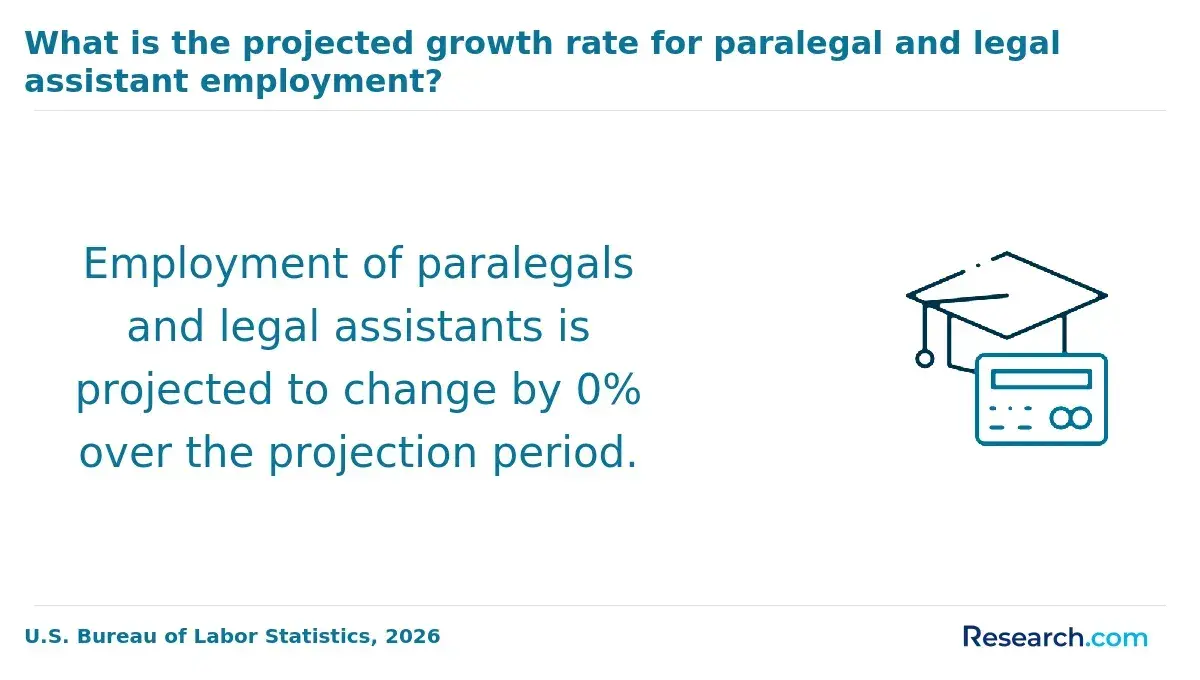
For perspective on one adjacent path, the Bureau of Labor Statistics projects 4% growth for compliance officers from 2025 to 2035. That projection covers compliance officers across industries, not construction contract managers specifically. If your goal is instead legal support work at a construction-focused law firm, compare the master's with role-specific paralegal education; our guide to shorter paralegal bachelor's study routes covers a different educational path. Paralegal education is not attorney education, and a paralegal certificate is not the same as professional certification.
How Much Do Construction Contract Managers Earn?
There is no single salary figure that accurately describes every construction contract manager: job titles, project responsibility, employer type, location, and experience vary. When reviewing pay data or job postings, distinguish a contract manager working for a builder from a construction manager overseeing broader project delivery. Those are not interchangeable benchmarks.
An adjacent U.S. benchmark is the Bureau of Labor Statistics median annual pay of $80,730 for compliance officers in May 2025. It does not measure construction contract manager pay. For a personal return-on-investment decision, compare current postings for your target role and region with your existing compensation, likely education costs, and whether your employer values the degree for advancement.
Which Certifications and Standards Benefit Construction Contract Managers?
Credentials can be a more focused alternative or a complement to graduate study. The Construction Management Association of America's Certified Construction Manager (CCM) credential addresses construction management practice; the National Contract Management Association's Certified Professional Contract Manager (CPCM) credential focuses on contract management. Their issuing organizations set eligibility and maintenance rules, so check the current requirements before treating either as a quick substitute for a degree.
Knowledge of the contract forms your employer actually uses can be just as important. Projects may use American Institute of Architects (AIA) or ConsensusDocs forms, while federal contracting can require familiarity with the Federal Acquisition Regulation (FAR). These are forms or rules, not personal certifications. Check your employer's project mix first: a credential or course aligned with the contracts on your desk is likely to be more immediately useful than one chosen for name recognition alone.
Other Things You Should Know About Law & Paralegal
Not necessarily. Some programs use a capstone, applied project, or additional coursework instead. Check the current degree requirements and whether you can use a construction-related topic.
Only if your employer permits it and the school's rules allow it. Project documents may contain confidential information; ask about using a public, simulated, or properly approved document instead.
Do not assume they will. A receiving law school determines whether any prior coursework applies to its JD requirements. Get its policy in writing before enrolling for that purpose.
No. The credential issuer decides which activities qualify and what documentation is required. Confirm approval with that organization before counting a course toward renewal.
References
- Frequently asked questions about educational assistance programs | Internal Revenue Service https://www.irs.gov/newsroom/frequently-asked-questions-about-educational-assistance-programs
- Types of Financial Aid: Grants, Work-Study, and Loans | studentaid.gov https://studentaid.gov/understand-aid/types
- Accreditation in the U.S. | ed.gov http://www.ed.gov/laws-and-policy/higher-education-laws-and-policy/college-accreditation/accreditation-in-the-us
- Cost of Attendance (Budget) | 2025-2026 Federal Student Aid Handbook https://fsapartners.ed.gov/knowledge-center/fsa-handbook/2025-2026/vol3/ch2-cost-attendance-budget
- Master of Legal Studies | Sturm College of Law https://law.du.edu/academics/graduate-degrees/masters-degrees/master-legal-studies
- Master of Legal Studies (MLS) vs. JD: What's the Difference? | SMU Online Master of Legal Studies https://onlinemasterlegalstudies.smu.edu/articles/mls-vs-jd/
- Master of Legal Studies & Graduate Certificates | Winston College of Law https://winston.utk.edu/admissions/degree-programs/master-of-legal-studies/
- Strengthening Contract Negotiation Skills in Construction and Development with an M.L.S. Degree | miami.edu https://news.miami.edu/law/stories/2024/12/stregthening-contract-negotiation-skills-with-an-mls-degree.html
- Master of Legal Studies vs Juris Doctor (JD) | Online Master of Legal Studies at Northeastern https://legalstudiesmastersonline.northeastern.edu/articles/what-is-the-difference-between-legal-studies-vs-law-degree/
- Class Formats | Ivy Tech Community College https://www.ivytech.edu/classes/class-formats/