2027 MLS Programs for Patient Privacy Officers: Comparing Health Law and Data Privacy Courses

Co-Founder and Chief Data Scientist
A patient privacy officer must turn health information rules into workable policies, training, investigations, and responses to patients. A Master of Legal Studies (MLS) can build that legal knowledge, but a program heavy on general data privacy may leave gaps in healthcare regulation—and a health law program may offer too little practical security training.
This guide compares the coursework, credentials, costs, and career implications so healthcare professionals and career changers can decide whether an MLS is worthwhile and which curriculum fits the work they want to do.
Key Things You Should Know
- For a provider or health plan privacy role, prioritize HIPAA, healthcare operations, breach response, and applicable state law; use broader data privacy courses to strengthen vendor, technology, and cross-industry skills.
- An MLS is not a legal requirement for patient privacy officers and does not qualify graduates to practice law. Compare it with experience, employer training, and targeted certification before enrolling.
- The Bureau of Labor Statistics reports $80,730 in May 2025 median pay for the broader compliance officer occupation, not specifically patient privacy officers; it projects 4% growth for that occupation in 2025-2035.
What Are MLS Programs for Patient Privacy Officers?
An MLS is a graduate-level legal-knowledge degree generally designed for people who do not intend to become attorneys. Schools may use other names, including Master of Science in Law (MSL) or Master of Jurisprudence. These degrees do not, by themselves, qualify graduates to practice law.
Patient privacy officers oversee how an organization handles protected health information. Their work can include interpreting privacy requirements with counsel, reviewing access and disclosure practices, managing complaints, coordinating breach investigations, training staff, and assessing vendors. An MLS can help with legal analysis and policy design, but employers also value healthcare operations experience and the ability to put rules into practice.
Look past a program's title. "Health law" might be a formal concentration with required courses, a set of electives, or simply one course within a general MLS. Ask for the current degree requirements and course rotation before treating any of those options as equivalent. For someone seeking an entry-level legal support role rather than responsibility for an organization's privacy program, a guide to online paralegal certificate programs describes a different, narrower educational route.
What Courses Should MLS Programs Cover In Health Law And Data Privacy?
The strongest curriculum for a patient privacy role combines healthcare-specific rules with operational privacy skills. This comparison shows where each course area adds value—and what a student may miss by choosing only one side.
| Course area | What to look for | Why it matters on the job |
| Health law and healthcare privacy | HIPAA Privacy Rule, patient access and disclosures, health plans and providers, applicable state privacy law, and substance use disorder records under 42 CFR Part 2 | Supports decisions about patient records and healthcare-specific obligations. |
| Data privacy and cybersecurity law | Data governance, vendor agreements, security obligations, incident response, and state privacy requirements | Helps officers work with IT, security, procurement, and outside service providers. |
| Practical compliance work | Policy drafting, risk assessments, investigations, training, and documented decision-making | Turns legal concepts into processes staff can follow and auditors can examine. |
For a hospital or health plan role, health law should be the foundation. A broader data privacy study is particularly valuable if the role spans digital health products, vendors, or multiple jurisdictions. The HIPAA Security and Breach Notification Rules also deserve explicit coverage: a course labeled "HIPAA" may focus mainly on the Privacy Rule. Check syllabi and assignments rather than relying on course titles alone.
What Education Do You Need To Become A Patient Privacy Officer?
There is no universal MLS requirement for patient privacy officers. Hiring requirements vary by employer and role. A candidate may enter through health information management, clinical administration, compliance, information security, or legal operations, then take on progressively more privacy responsibility. An MLS can be useful when the missing skill is interpreting law and translating it into policy; it is less likely to be the best first investment if the main gap is hands-on healthcare experience.
Are Online MLS Programs As Effective As Campus-Based Programs?
An online MLS can be effective for working privacy professionals if it provides substantive coursework, feedback on applied assignments, and access to instructors. Delivery format alone does not establish quality. Campus study may make in-person discussion and networking easier; online study can reduce travel but may still require live classes, group meetings, scheduled exams, or campus visits.
Compare the actual schedule and assessments, not just the "online" label. A working applicant should confirm whether health privacy courses are offered when needed, whether they involve realistic policy or incident exercises, and whether any residency or practicum is required. If speed is the main concern, choosing an accelerated online paralegal program is a separate decision: accelerated legal support training should not be mistaken for an accelerated MLS or equivalent preparation for privacy oversight.
What Are The Admission Requirements For An MLS Program?
MLS programs generally expect applicants to hold a bachelor's degree, but each school sets its own rules for academic records, recommendations, statements, work history, and any testing. A JD is not normally the intended prerequisite. Healthcare experience may strengthen an application, yet it should not be treated as mandatory unless the program says so.
Applicants with previous graduate or legal coursework should ask whether the MLS accepts transfer credit and whether accepted credits satisfy required health privacy courses or only electives. The receiving school makes that decision. Business law credit transfer considerations can help frame questions about prior coursework, but they do not establish an MLS program's policy. Request a written evaluation before counting on a shorter degree path.
How Long Do MLS Programs Take And What Do They Cost?
Completion time depends on required credits, full-time or part-time enrollment, course sequencing, and whether relevant electives run regularly. Ask each school for a term-by-term plan based on your intended course load; an advertised fastest completion time may not be realistic alongside full-time work.
Compare a written total-cost estimate, not tuition per credit alone. Include mandatory fees, books, technology, any campus travel, and the cost of extending enrollment if a needed course is unavailable. Ask the school's financial aid office whether your specific degree and enrollment pattern qualify for federal aid, and compare any borrowing with employer tuition assistance. Online paralegal study with monthly tuition payments illustrates a payment approach some students investigate, but availability for a paralegal program says nothing about an MLS school's payment or aid policies.
The opportunity cost matters as much as the bill. If a short course, supervised project, or certification preparation addresses the skills your target job requires, a full graduate degree may be more study than you need.
Which Certifications Complement An MLS In Health Privacy?
Professional certification is distinct from a university certificate or degree: a credentialing organization sets its eligibility and assessment rules. An MLS may help someone prepare, but graduation does not automatically confer a certification or guarantee exam eligibility.
The Compliance Certification Board's Certified in Healthcare Privacy Compliance (CHPC) is closely aligned with healthcare privacy compliance. The American Health Information Management Association's Certified in Healthcare Privacy and Security (CHPS) also connects privacy with health information security.
For broader privacy program work, the International Association of Privacy Professionals offers credentials including Certified Information Privacy Professional/United States (CIPP/US) and Certified Information Privacy Manager (CIPM). Check each organization's current eligibility, examination, fees, and renewal rules directly before paying for preparation.
Choose by job duties rather than collecting initials: healthcare compliance and records work favors a healthcare-focused credential; a role spanning products, vendors, and privacy governance may benefit from broader privacy study. Relevant experience remains important whichever route you take.
What Jobs Can You Get With An MLS In Health Law And Privacy?
Possible roles include privacy analyst, healthcare compliance specialist, health information privacy manager, vendor privacy specialist, and patient privacy officer. Titles are not standardized: one organization's officer may lead a program, while another's analyst may do substantial investigation and policy work. An MLS can support an application but does not guarantee a particular title or promotion.
A practical entry route is to build experience with access requests, disclosure reviews, incident documentation, training, or vendor assessments in an existing healthcare or compliance role. For a leadership vacancy, examine the posting for management experience and operational accountability as carefully as you examine its degree preference. Working with legal counsel does not authorize an MLS graduate to act as an attorney.
How Much Do Patient Privacy Officers Earn?
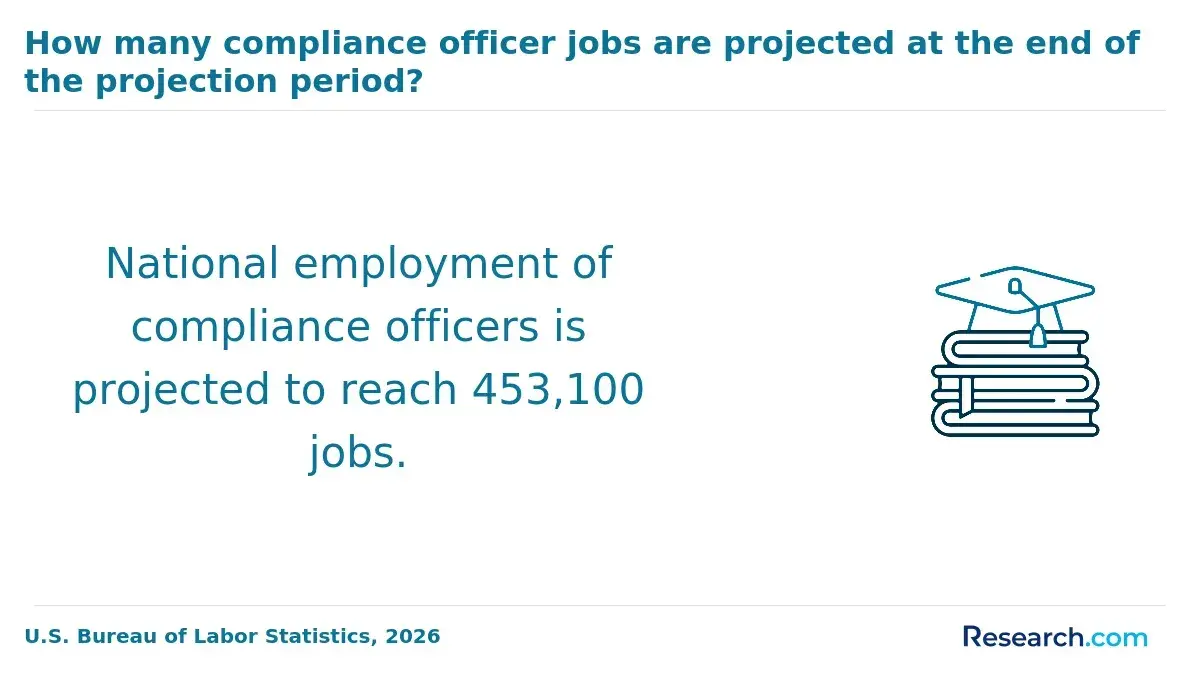
The Bureau of Labor Statistics does not publish a single median wage for the narrow title "patient privacy officer." Its broader compliance officer occupation had median annual pay of $80,730 in May 2025, with 4% projected growth in 2025-2035 and about 32,700 projected openings per year. Those figures provide labor-market context, not a pay prediction for a healthcare privacy officer or an MLS graduate.
Compensation for a particular opening can vary with management scope, healthcare experience, location, and whether the position includes security or enterprise-wide responsibilities. Compare actual job postings and their stated requirements before using a prospective salary to justify graduate tuition.
How Do You Choose An Accredited MLS Program For Health Privacy?
Start by confirming that the university has institutional accreditation recognized by the U.S. Department of Education. Then evaluate the MLS itself: institutional accreditation does not establish that its health privacy curriculum meets your career needs. ABA approval of paralegal education programs is a separate designation and is not the accreditation test for an MLS.
Use the same questions with each admissions office so differences in course content, scheduling, and cost are visible before you commit:
- Request the current degree plan and identify required healthcare privacy courses, relevant electives, and when each is offered.
- Ask for recent syllabi or assignment examples showing whether students draft policies, analyze incidents, and assess vendors rather than only read cases.
- Confirm live-session, campus, practicum, and course-sequencing requirements against your work schedule.
- Obtain a written estimate of tuition and required expenses, plus a determination of transfer credit and applicable financial aid.
- Compare those answers with the qualifications in jobs you would realistically seek next, including any experience requirements an MLS cannot replace.
A strong choice is the program that closes a specific skills gap at a defensible cost. Be cautious of vague concentration labels, unavailable electives, or claims that the degree alone leads to certification or an officer position.
Other Things You Should Know About Law & Paralegal
No. HIPAA generally applies to covered entities and their business associates, not every company handling health-related data. Other federal or state privacy and consumer-protection rules may still apply, depending on the app and how it uses data.
An organization may assign both functions to one qualified person, depending on its structure and applicable requirements. The important distinction is that privacy governance and information security involve overlapping but different responsibilities.
No. The method used, the remaining data, and the possibility of combining it with other information matter. Privacy teams should review the applicable de-identification standard and the proposed use rather than assume removing names is sufficient.
No. A suspected incident requires assessment; reporting duties depend on the facts and applicable law. The organization should follow its investigation and documentation procedures rather than assume every event triggers the same notice.
References
- Health Information Privacy Laws in the Digital Age - PMC - NIH https://pmc.ncbi.nlm.nih.gov/articles/PMC7883355/
- Incident Response Training | cisa.gov https://www.cisa.gov/resources-tools/programs/Incident-Response-Training
- Summary of the HIPAA Security Rule | hhs.gov https://www.hhs.gov/hipaa/for-professionals/security/laws-regulations/index.html
- ONC - Office of the National Coordinator for Health IT https://healthit.gov/
- Chapter 19.373 RCW | wa.gov https://app.leg.wa.gov/RCW/default.aspx
- hipaa privacy & intermediate security training (level 1) - NICCS https://niccs.cisa.gov/training/catalog/sgllc/hipaa-privacy-intermediate-security-training-level-1
- Online Master's in Health Care Compliance, MLS | ASU Online https://asuonline.asu.edu/online-degree-programs/graduate/masters-in-healthcare-compliance/
- Digital Diagnosis: Health Data Privacy in the U.S. | Stanford Law School https://law.stanford.edu/2025/02/26/digital-diagnosis-health-data-privacy-in-the-u-s/
- Health Information Privacy, Compliance, and Data Security (CERT) | University of Arizona Online https://online.arizona.edu/programs/graduate-certificate/online-graduate-certificate-health-information-privacy-compliance-and
- Online Master of Legal Studies | AU-LAW https://onlinelaw.wcl.american.edu/legal-studies/