
2027 MLS Programs for Court Administrators: Comparing Judicial Administration Coursework

Co-Founder and Chief Data Scientist
Court administrators oversee the people, processes, and systems that keep courts operating. If you are considering a Master of Legal Studies (MLS), the key decision is whether its coursework will help you manage those responsibilities better than a public administration degree, targeted training, or experience on the job.
This guide explains what to look for in judicial administration courses, how to compare online programs and costs, and when a non-JD legal degree is - or is not - a sensible investment.
Key Things You Should Know
- An MLS is not a standard requirement for court administrators. Prior court experience, supervisory ability, and the hiring court's requirements may matter more than the degree title.
- Prioritize courses in court operations, procedure, access to justice, records, technology, and public-sector management; a judicial-sounding concentration does not necessarily cover all of them.
- The Bureau of Labor Statistics reports $72,110 in May 2025 as the median pay for "legal support workers, all other," but that broad category is not a court-administrator salary estimate.
What Is an MLS Degree for Court Administrators?
An MLS is a graduate degree designed to build legal knowledge for people who do not intend to practice law. A school may instead use the name Master of Studies in Law (MSL) or Master of Jurisprudence. For a court administrator, useful study connects legal rules to operational decisions: how cases move through a court, how staff handle records, and how policies affect public access and fairness.
"Judicial administration" is not a uniform MLS credential. At one school it might be a formally designated concentration; at another, a group of electives or a topic covered within general legal studies courses. Check the current catalog for the credential awarded and the courses you can actually take, rather than relying on a program's description of possible career applications.
An MLS does not qualify its holder to practice law, serve as a judge, or provide legal advice. If your goal is narrower - such as learning legal research or court-related regulation without completing a master's - compare a legal studies graduate certificate versus full master's study before committing to the larger program.
What Education Does a Court Administrator Need?
There is no single nationwide degree requirement for court administrators. Qualifications depend on the court system, jurisdiction, and seniority of the position. Employers may seek a bachelor's degree and relevant administrative or court experience for some roles, while leadership positions may favor graduate study. A posted job's minimum qualifications - not an MLS advertisement - are the best starting point.
Many candidates enter through court clerk, case-management, records, budget, or supervisory work. Someone who already understands court operations may benefit more from management training than introductory legal courses; someone moving from another industry may need direct experience with court workflows before a graduate degree substantially improves their candidacy.
If you do not yet have a bachelor's degree, review associate-to-bachelor's pathways in law-related study before planning graduate enrollment. The receiving school decides whether prior credits transfer and how they apply. Professional development offered through courts or court-administration organizations can also be valuable, but its completion certificates are not the same as an academic degree or a universally required professional certification.
How Does Judicial Administration Coursework Prepare Court Administrators?
The strongest coursework helps a student connect law to decisions a court office makes every day. Studying procedure can clarify why filing deadlines and case routing matter; records and privacy coursework can inform access policies; and ethics instruction can help managers recognize conflicts, confidentiality concerns, and the boundary between administrative assistance and legal advice.
Legal knowledge alone is insufficient for a leadership role. Court administrators may also supervise staff, prepare budgets, implement technology, monitor performance, and coordinate with judges and other agencies. Compare an MLS with a Master of Public Administration or a management-focused program if those responsibilities dominate the jobs you want. For professionals whose work crosses courts and organizational regulation, business law degrees suited to adult learners offer another curriculum to examine, though business-law study is not a substitute for court-specific training.
A useful test is whether the program requires students to apply what they learn - for example, by analyzing a records policy or a caseflow problem. Reading about courts can build context; supervised projects and relevant work experience are more direct evidence of operational skill.
What Courses Are Included in an MLS Judicial Administration Program?
Course names and availability vary, so compare actual requirements and elective schedules rather than assuming every MLS offers a judicial administration track. The following subjects show what to look for and why each could matter in court work.
| Course subject | Connection to court administration |
| Courts and judicial process | Explains court structure, institutional roles, and how cases progress. |
| Civil or criminal procedure | Provides context for filings, deadlines, and case-management rules. |
| Administrative law and ethics | Builds understanding of public decision-making, accountability, and professional boundaries. |
| Privacy, records, or information governance | Supports decisions about access, confidentiality, and retention. |
| Public management or budgeting | Addresses staffing, resources, and service delivery where offered. |
| Technology or applied project work | Can provide practice evaluating workflows or policy changes, depending on the assignments. |
Look beyond a course title for its description, prerequisites, and assessment methods. A general legal research class may be useful, but it will not necessarily teach caseflow management. Conversely, a strong public-sector management elective may be more valuable for a supervisory position than another survey of substantive law. Confirm that the courses you value are offered regularly enough for you to complete them before graduation.
Are Online MLS Programs Effective for Court Administration Careers?
Online study can work well for an employed court professional when it allows immediate application of assignments to real operational problems. Its effectiveness depends less on the label "online" than on the courses, instructor feedback, opportunities for applied work, and whether the schedule is manageable alongside court hours.
Do not assume online means self-paced. Courses may have live meetings, fixed deadlines, group projects, proctored assessments, or occasional campus requirements. Ask whether a capstone or internship is required, who arranges any placement, and whether work at your current court can satisfy an applied requirement. Published rules - not a general promise of flexibility - should settle these questions.
If completion speed matters, use online business law master's timeline comparisons as a prompt to examine scheduling, not as evidence that a faster business-law program teaches court administration. Compare course sequencing and the number of terms you can realistically manage while employed.
How Do You Choose an Accredited MLS Program?
Start by confirming that the university holds recognized institutional accreditation. Then examine the current academic catalog to verify the degree name, graduation requirements, available courses, and any claimed concentration. Institutional accreditation speaks to the institution's status; it does not establish that an MLS has specialized court-administration approval or that its curriculum suits your target job.
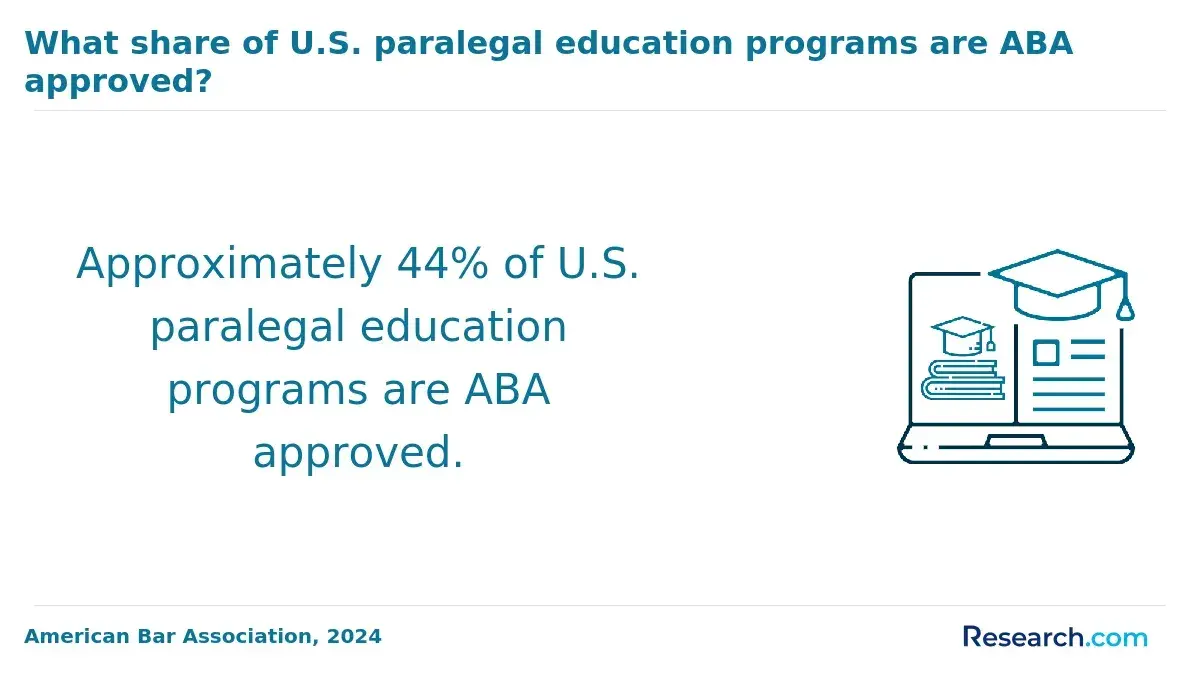
ABA approval is a separate designation for qualifying paralegal education programs, not a quality label to expect on an MLS. Do not reject an MLS because it lacks ABA paralegal-program approval - or treat institutional accreditation as proof of it.
Once status is clear, compare programs on the same decision points: required court-relevant courses, elective access, applied assignments, faculty experience, delivery requirements, total cost, and evidence that the schedule works for employed students. A red flag is a prominent judicial-administration claim that cannot be matched to current catalog requirements or reliably available courses.
What Are the Admission Requirements for MLS Programs?
MLS programs generally admit applicants who already hold a bachelor's degree, but each school sets its own rules. Check its current admissions page for accepted degree backgrounds, minimum academic standards, application materials, deadlines, and any English-language requirements that apply to you. Do not assume court employment is mandatory - or that experience can replace an explicitly required bachelor's degree.
Applicants with court experience can use a statement of purpose to identify a concrete operational problem they want to study, such as caseflow, records access, or staff policy. Career changers should explain their transferable management or compliance skills and how they plan to gain court-specific knowledge. Before paying an application fee, confirm that your preferred courses are open to MLS students and ask whether any prerequisite or enrollment restriction applies.
How Long Do MLS Programs Take and What Do They Cost?
Completion time depends on required credits, course sequencing, and whether you enroll full-time or part-time. A published accelerated timeline may assume a course load that is difficult to maintain while supervising court operations. Ask for a term-by-term plan showing when required courses run, particularly if a concentration or capstone has limited availability.
No single price accurately represents all MLS programs. To compare offers, use each school's current tuition rate and required credit total, then account for mandatory fees, books, technology, travel for any in-person component, and time away from work. Compare estimated total cost on the same basis - not one school's per-credit price against another school's advertised program total.
Ask the financial aid office what aid applies to the specific degree and your enrollment status; eligibility is not automatic. Employer tuition assistance may change the calculation, as may a less expensive graduate certificate or professional training. The opportunity cost matters most when a job posting emphasizes experience or management ability over graduate legal study.
What Careers Can You Pursue With an MLS in Judicial Administration?
An MLS may complement experience for court administrator, court operations manager, clerk's office supervisor, case-management manager, or court policy roles. The degree can also be relevant to some justice-system compliance and program-management positions. Titles and duties vary across jurisdictions, and an MLS alone does not qualify a new graduate for a senior court leadership job.
Match the education to the work you want. For a court operations role, prioritize experience with caseflow, personnel, budgets, and public service. For a legal-support role under attorney supervision, paralegal education may be a more direct route; readers considering that path can examine finding affordable online paralegal programs with ABA approval. ABA approval applies to the qualifying program, and completing one does not make a graduate an "ABA-certified paralegal."
Review several current postings from courts where you could realistically work. If they consistently request supervisory experience that you lack, seek responsibility on the job before assuming another degree will close that gap.
What Salary and Job Outlook Can Court Administrators Expect?
There is no single national Bureau of Labor Statistics salary-and-growth series that precisely describes every court administrator position. Pay can vary with the jurisdiction, court size, duties, and level of responsibility, so the salary range on a relevant court system's current postings is more useful for a personal decision than a loosely related national median.
For context only, the Bureau of Labor Statistics reports median pay of $72,110 in May 2025 and 0% projected growth, 2025-2035 for "legal support workers, all other." That broad occupational category is not a court-administrator forecast; it should not be used to predict an MLS graduate's pay or hiring prospects.
Before investing, compare the posted pay range for roles you could plausibly obtain now with ranges for roles requiring the experience and education you plan to gain. Consider whether the MLS addresses a stated hiring preference and whether the possible advancement justifies its cost and study time. Neither a degree nor an occupational median guarantees a promotion or salary increase.
Other Things You Should Know About Law & Paralegal
Use only information you are authorized to disclose. Court records may be sealed, confidential, or subject to workplace policies; ask your employer and instructor about using a hypothetical or appropriately de-identified example.
No. An MLS does not authorize legal practice. Court staff should follow their jurisdiction's rules and employer policies on providing procedural information without giving legal advice.
Possibly, but the MLS institution decides whether outside graduate credits are accepted and how they satisfy degree requirements. Obtain written approval before enrolling elsewhere for that purpose.
Yes, if you are employed by a court. Ask human resources about tuition assistance, eligibility conditions, approval deadlines, and any repayment obligation if you leave your position.
References
- A Three-Year Training Program Helps Courts Across Ohio | courtnewsohio.gov https://www.courtnewsohio.gov/happening/2024/CourtMgmtGrads_090924.asp
- III. Characteristics and Skills of an Effective Court Manager | ohio.gov https://www.supremecourt.ohio.gov/courts/services-to-courts/managing-courts-in-ohio-a-guide-for-court-managers/iii-characteristics-and-skills-of-an-effective-court-manager/
- Legal Careers | Honors Program & Summer Law Intern Program Application Tips and Checklist https://www.justice.gov/legal-careers/application-tips-and-checklist
- Cost of Attendance (Budget) | 2025-2026 Federal Student Aid Handbook https://fsapartners.ed.gov/knowledge-center/fsa-handbook/2025-2026/vol3/ch2-cost-attendance-budget
- Master of Legal Studies & Graduate Certificates | Winston College of Law https://winston.utk.edu/admissions/degree-programs/master-of-legal-studies/
- Judicial Administration Certificate | Sac State | Sacramento State College of Continuing Education https://cce.csus.edu/programs/judicial-administration-certificate
- Online Master of Legal Studies | AU-LAW https://onlinelaw.wcl.american.edu/legal-studies/
- Key Skills You'll Gain in a Master of Public Administration Program | UIC Online MPA https://onlinempa.uic.edu/news-stories/key-skills-master-public-administration/
- What is a Master of Studies in Law (MSL)? | George Washington University School of Law https://msl-law.gwu.edu/articles/what-is-a-master-of-studies-in-law/
- Public Administration Courses | University at Albany https://www.albany.edu/graduate-bulletin/public-administration-courses.php


