2027 Legal Studies Master's Programs for Regulatory Change Management Professionals

Co-Founder and Chief Data Scientist
Regulatory change management turns new legal requirements into updated policies, controls, training, and evidence that an organization can follow. If you already work in compliance, risk, operations, or legal support, a legal studies master's degree may strengthen that work - but it may be more education than you need. This guide explains what these programs teach, how they compare with shorter options, and which costs and career limits to check before applying. You'll leave with a practical way to decide whether a non-JD legal degree fits your role and goals.
Key Things You Should Know
- A Master of Legal Studies (MLS) or similar non-JD degree can build regulatory analysis skills, but it is not required for most change-management roles and does not qualify you to practice law.
- Prioritize courses that connect legal research and administrative law to implementation, documentation, and your industry's regulations; a concentration is more specific than a few relevant electives.
- Compliance officers earned a median $80,730 in May 2025, with 4% projected job growth for 2025-2035. Those broad occupation figures do not predict pay or demand for a regulatory change manager or an MLS graduate.
What are legal studies master's programs for regulatory change management professionals?
A regulatory change management professional tracks proposed and final rules, determines which parts of an organization are affected, coordinates implementation, and documents what changed. The work often crosses legal, compliance, technology, operations, and audit teams. Lawyers may advise on legal interpretation; a nonlawyer change manager helps turn that advice and applicable requirements into working processes.
An MLS, Master of Studies in Law (MSL), Master of Jurisprudence, or similarly named degree is graduate legal education generally designed for people who do not plan to become attorneys. There is no single standardized "regulatory change management" curriculum: one school may offer a formal compliance concentration, while another offers only related electives. Neither route is a Juris Doctor (JD), and completing it alone does not authorize legal practice.
If your immediate goal is legal-support work rather than organization-wide regulatory oversight, paralegal certificate programs to compare represent a different, typically narrower educational route. A school-issued certificate is not the same as professional certification, and paralegal training does not authorize independent legal practice.
What education and skills do regulatory change management professionals need?
There is no universal degree or license for this job title. Employers may seek a bachelor's degree and experience in compliance, risk, auditing, legal operations, or a regulated industry; expectations differ by role and employer. An MLS can be useful when the missing skill is interpreting legal sources and communicating their operational consequences. It is less likely to replace industry experience or familiarity with an employer's systems.
The core skills are legal and regulatory research, careful reading of effective dates and exceptions, impact assessment, project coordination, clear writing, and maintaining an audit trail. A professional moving from operations may already know how to implement changes but need legal-research training. Someone from legal support may need more experience with controls, testing, and cross-functional projects.
If you do not yet hold a bachelor's degree, graduate admission is not the next step. A guide to shorter online paralegal bachelor's degrees can help you examine an undergraduate route, though a paralegal-focused curriculum is not interchangeable with industry-specific compliance training.

How can a legal studies master's degree prepare you for regulatory change management?
The degree's strongest potential contribution is a method for finding authoritative law, separating a binding requirement from guidance, and explaining what a change means to nonlawyers. Applied assignments can help you practice writing an impact assessment or implementation memo. A program focused mainly on legal theory may be less useful if your goal is to manage controls and deadlines.
These routes differ in scope and opportunity cost. The comparison can help you decide whether a full graduate degree addresses a gap that a shorter option would not.
| Route | Likely strength | Principal limitation |
| Legal studies master's | Broad legal framework and sustained graduate-level study | Greater tuition and time commitment; no attorney qualification |
| Graduate certificate or targeted courses | Focused study in a specific regulatory area | Less breadth; credit toward a later degree is not guaranteed |
| Employer training and supervised projects | Direct practice with the organization's rules and processes | May provide less transferable legal-research instruction |
| Industry credential | Recognition tied to a particular professional body or field | Eligibility and value vary; it may not teach broad legal analysis |
If you already handle regulatory updates successfully, ask what new responsibilities the degree would make you better prepared to perform. That answer is a more reliable basis for the investment than the credential's name.
What do legal studies master's programs teach about regulatory compliance?
Relevant courses may cover legal research, administrative law, statutory interpretation, corporate compliance, privacy, employment law, healthcare, or financial regulation. The useful combination depends on your industry. For change-management work, look beyond course titles for assignments involving proposed rules, applicability decisions, implementation timelines, policy revisions, and defensible records of those decisions.
Administrative law can explain how agencies make rules and how to distinguish a proposal from a final requirement. Legal research can help you locate current text and check whether a rule applies. Compliance courses may connect those findings to controls, reporting, investigations, and escalation. These are complementary skills: understanding a rule is not the same as getting an organization ready to follow it.
Check how the school describes any specialization. A formal concentration has published requirements; electives offer flexibility but may not produce a concentration on your transcript. An embedded certificate has its own completion rules. Also ask whether courses provide hands-on work with regulatory research or tracking tools rather than merely mentioning them. AI-assisted summaries can save reading time, but assignments should still require students to verify authoritative text, dates, and exceptions.
Are online or campus-based legal studies programs better for working professionals?
Neither format is inherently better. Online delivery may reduce travel, but it does not necessarily mean asynchronous classes or flexible deadlines. Campus study may offer easier in-person collaboration, yet commuting and fixed meeting times can make it harder to keep a full-time job.
The practical differences matter most when a regulatory deadline collides with coursework. Compare the schedule you would actually follow, not just the format advertised.
| Format | Potential advantage | Commitment to verify |
| Online | Study without routine campus travel | Live sessions, exam windows, group work, and any required visits |
| Campus-based | Regular in-person discussion and access to campus activities | Commute, class times, and course availability |
| Hybrid | Combination of remote and in-person study | Frequency and location of required attendance |
Request a sample course sequence and confirm whether part-time students can take required courses when needed. If an online program's schedule works but its bill does not, compare tuition payment plans for online paralegal programs only as an example of a different educational market; ask the MLS school directly about its own payment terms. A payment plan changes when tuition is due, not its total cost.
What are the admission requirements for a legal studies master's program?
Programs generally expect a completed bachelor's degree, but GPA thresholds, professional-experience expectations, recommendations, essays, and test policies vary. A prior law degree is generally not the point of a non-JD program. Check the current admissions page for each school rather than assuming that requirements for its JD or another graduate program apply to the MLS.
If an essay is an obstacle, review personal-statement-free legal studies application options and then confirm the requirements for the specific degree and entry term. A simplified application does not establish that admission is automatic or that the curriculum fits regulatory work.
Before applying, ask whether relevant professional experience can support your application, whether prerequisite coursework is required, and whether prior graduate credit can count. The receiving school decides whether transferred credit applies to its degree; accreditation alone does not guarantee acceptance.
How long do legal studies master's programs take and what do they cost?
Completion time depends on required credits, course sequencing, and whether you study full time or part time. Ask for a term-by-term path at the pace you can sustain while working. A program that advertises a fast completion option may still require classes or a capstone at times that do not fit your schedule.
Compare total educational cost, not just advertised tuition. Request a written estimate covering mandatory fees, books, technology, travel for required visits, and any charges tied to a capstone or additional terms. Check whether tuition changes with enrollment status and whether employer reimbursement has grade or service conditions.
For a lower-cost legal-support alternative, a guide to low-cost accredited paralegal degrees can provide a separate comparison. Those degrees serve a different goal; a lower price alone does not make one a substitute for graduate compliance study. Federal graduate aid may be available to eligible students at eligible institutions and programs, but loan eligibility is not a reason to borrow without comparing the likely benefit with the full cost.
What careers can you pursue in regulatory change management after graduation?
Relevant job titles include regulatory change analyst, compliance analyst or officer, regulatory affairs specialist, compliance program manager, and risk or policy manager. Titles overlap: one employer may place rule tracking in legal operations, while another assigns it to compliance or a business unit. Read job descriptions for ownership of impact assessments, implementation plans, controls, and reporting rather than relying on titles.
An MLS may help an experienced analyst seek work involving more complex interpretation or cross-functional coordination. It does not, by itself, make someone a lawyer, qualify them to give independent legal advice, or guarantee a management role. If you are changing industries, you may need to learn its regulators, products, and reporting obligations alongside the legal framework.
How much do regulatory change management professionals earn?
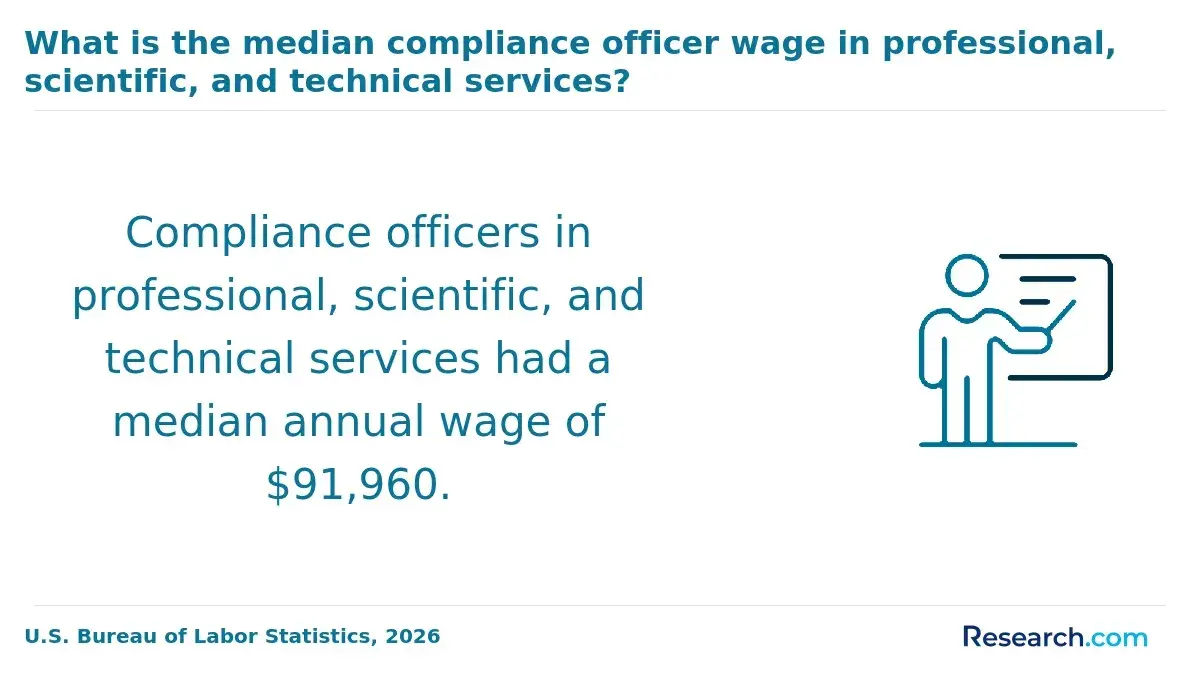
The Bureau of Labor Statistics does not publish a single wage figure specifically for "regulatory change managers." Its broader compliance officers occupation is a useful but imperfect benchmark: median annual pay was $80,730 in May 2025, with 4% projected growth for 2025-2035 and about 32,700 projected openings per year. Those figures include roles beyond regulatory change management and do not measure the payoff from an MLS.
Pay for a particular opening depends on industry, location, responsibilities, and experience. Compare local postings with your current compensation and the program's full cost. A degree is a stronger financial proposition when it fills a documented requirement or skill gap for roles you could realistically pursue, not when the case rests on an occupational median alone.
How do you choose an accredited legal studies master's program?
Start by verifying that the institution holds recognized institutional accreditation and that the current catalog lists the exact degree, delivery format, and requirements you intend to complete. Institutional accreditation is separate from curriculum quality or employer recognition. American Bar Association approval of qualifying paralegal education programs is a different designation; it is not accreditation of an MLS program and should not be treated as a requirement for one.
Use the following checks to narrow your shortlist before paying an application fee. Each one tests whether the program fits regulatory change work rather than merely offering a law-related title.
- Match required courses and available electives to the rules, research tasks, and implementation work in your target industry.
- Confirm whether a compliance specialization is a formal concentration, an embedded certificate, or simply a choice of electives.
- Request the part-time course sequence and verify live classes, campus visits, capstone expectations, and graduation requirements.
- Compare written estimates of total cost and ask whether employer support or eligible financial aid applies to this specific program.
- Ask for examples of applied assignments and speak with admissions staff about how the program supports nonlawyer compliance work.
A warning sign is a promise that the degree alone will deliver a particular job, salary, certification, or authority to practice law. Choose the program only after its documented curriculum and schedule justify the time and expense relative to targeted coursework, supervised experience, or an industry credential.
Other Things You Should Know About Law & Paralegal
Possibly. Ask the program whether it permits employer-based projects and whether your employer allows its documents or data to be used. Confidentiality restrictions may require an anonymized or hypothetical project.
Do not assume so. JD transfer and advanced-standing rules are set by the receiving law school. Get its policy in writing before taking MLS courses with that goal.
Not automatically. Each certifying organization sets its own education, experience, examination, and continuing-education rules. Check the requirements for the specific credential you want.
Rules vary by jurisdiction and professional body. An MLS is not attorney licensure, and enrollment does not automatically earn continuing legal education credit. Confirm eligibility with the body that administers your requirement.
References
- Cost of Attendance (Budget) | 2025-2026 Federal Student Aid Handbook https://fsapartners.ed.gov/knowledge-center/fsa-handbook/2025-2026/vol3/ch2-cost-attendance-budget
- Cost of Attendance | HESC - NY.gov https://hesc.ny.gov/dictionary/tap-coach/term/cost-attendance
- General Schedule Qualification Standards | U.S. Office of Personnel Management https://www.opm.gov/policy-data-oversight/classification-qualifications/general-schedule-qualification-standards/
- Is a Master of Legal Studies Worth the Investment? | emory.edu https://law.emory.edu/admission/online-master-legal-studies-mls/articles/is-master-of-legal-studies-worth-the-investment.html
- Online Master of Legal Studies (MLS) | William & Mary Law School https://online.law.wm.edu/master-of-legal-studies
- Regulatory Affairs - CPS (RGA) | Northeastern University Academic Catalog https://catalog.northeastern.edu/course-descriptions/rga/
- Can You Practice Law Without Passing the Bar? | J.D. Jobs https://www.collegesoflaw.edu/blog/2022/04/12/jobs-for-j-d-s-bar-exam-not-required/
- Cost of attendance | Twin Cities One Stop Student Services https://onestop.umn.edu/finances/costs/cost-attendance
- Admission Requirements https://graduate.appstate.edu/graduate-admissions/apply-graduate-school/application-requirements
- Compliance Law - SMU Online Master of Legal Studies https://onlinemasterlegalstudies.smu.edu/curriculum/compliance-law/