2027 Graduate Public Health Preparation for Applied Epidemiologist Roles

Co-Founder and Chief Data Scientist
Applied epidemiologists turn population-health data into decisions about surveillance, prevention, and response. For a prospective graduate student, the challenge is choosing preparation that proves those abilities - not simply earning a degree with "epidemiology" on the transcript. This guide is for early-career practitioners and applicants entering public health from another field. It explains which degree routes fit applied work, what technical and field experience to seek, and how to assess cost, accreditation, and job requirements before enrolling.
Key Things You Should Know
- A master's degree is the typical entry-level education for the epidemiologist occupation, according to the U.S. Bureau of Labor Statistics; individual employers may also require relevant experience.
- For applied roles, prioritize surveillance, study design, data analysis, clear reporting, and a supervised project with a usable public health deliverable - not the concentration name alone.
- Compare the exact degree's accreditation coverage, fieldwork access, total cost, and recent epidemiologist postings before committing; an online format or credential does not establish job readiness.
What degree prepares you for applied epidemiologist roles?
An applied epidemiologist studies patterns of disease, injury, or other health outcomes to inform decisions in settings such as health departments, health systems, and public health organizations. The strongest graduate route depends on the work you want to do: routine surveillance and response, more specialized analysis, or research that develops new methods.
The comparison below focuses on preparation for those tasks, rather than treating degree titles as interchangeable.
| Pathway | Best fit for applied epidemiology | Limitation to check |
| MPH with epidemiology coursework or a formal concentration | Combines population-health practice, methods, communication, and potentially a supervised applied experience. | Quantitative depth and access to epidemiology-focused placements vary. |
| MS in epidemiology or a related quantitative field | May offer deeper study design, statistical analysis, and research training. | A thesis or research internship may not provide experience with public health agency workflows. |
| Targeted courses plus relevant work experience | Can fill a specific methods gap for someone already doing surveillance or analysis. | May not meet postings that explicitly require a master's degree. |
| DrPH or PhD | Can support later practice leadership or research-intensive work. | Usually an inefficient first step solely to qualify for an initial applied epidemiologist position. |
A clinically trained applicant may already understand case definitions and care systems but need population-level study design and statistical practice. An applicant from computing may bring programming skills but need epidemiology, health equity, and public health reporting. Compare those gaps with course descriptions and placement opportunities; an online public health master's value guide can help frame the broader education-cost decision, but the decisive test here is evidence of epidemiology work.
What education requirements do epidemiologists need?
The U.S. Bureau of Labor Statistics identifies a master's degree as the typical entry-level education for the epidemiologist occupation. That occupational description is not a universal hiring rule: agencies, health systems, and research employers define their own degree, methods, and experience requirements. Read the qualifications and duties in postings for the specific jurisdiction and specialty you want.
Some bachelor's graduates can enter adjacent positions - such as surveillance support, data coordination, or program assistance - and build experience before applying for epidemiologist jobs. Conversely, a master's graduate without hands-on data work may be less competitive than the degree title suggests. Doctoral study is more relevant when the target position calls for independent research or substantial practice leadership; applicants considering it should compare the actual program requirements rather than assume an MPH is always required. A guide to comparing public health doctorate entry requirements addresses that separate decision.
For a practical benchmark, save several recent postings and mark which requirements are mandatory, preferred, or tied to a particular software system or data source. Use that pattern - not one unusually demanding advertisement - to plan your preparation.
How does CEPH accreditation affect public health degree programs?
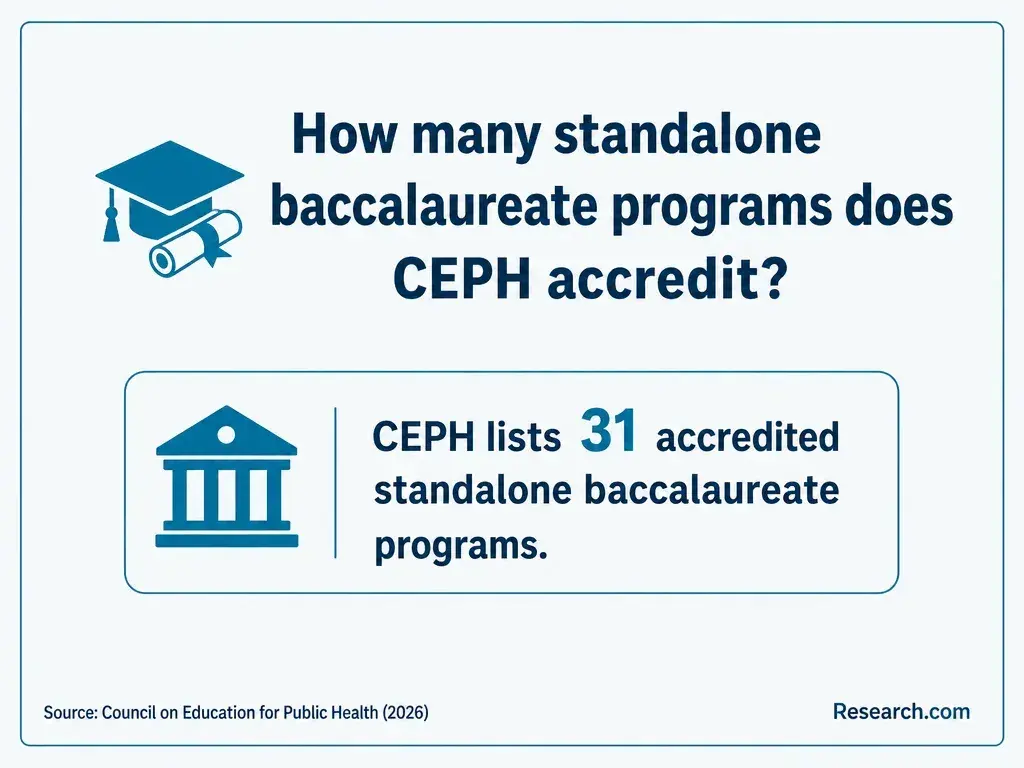
The Council on Education for Public Health (CEPH) accredits eligible public health schools and programs. It is distinct from an institution's broader accreditation. Before applying, check the CEPH directory and the institution's published information to determine which school, unit, or program is accredited and whether your intended degree is covered. Do not assume that every degree at a university shares the same status.
CEPH accreditation provides a public health-specific quality review, but it does not certify an individual graduate's epidemiology skills or promise a placement. An MS outside CEPH's accredited scope may still offer strong methods training; evaluate it against employer requirements and its actual curriculum. Accreditation is a useful first screen before comparing schedules and cost through public health degree affordability and completion planning. Confirm status for the degree and entry term you are considering.
For applied epidemiology, coursework should move from describing a population-health problem to analyzing evidence and communicating a defensible recommendation. Relevant subjects include disease surveillance, measures of occurrence and association, study design, biostatistics, data management, and interpretation of bias and uncertainty. Population health, community context, and ethical communication matter because a technically correct analysis can still mislead decision-makers if its data or limitations are poorly explained.
Depth matters more than a course title. Look for assignments that require cleaning data, documenting code or analytical decisions, choosing an appropriate comparison, and presenting findings to a nontechnical audience. A supervised project might produce a surveillance brief or evaluation plan, subject to site approval and data-access rules; a classroom exercise alone does not prove experience with confidential agency data.
If the target postings emphasize regression, reproducible programming, or complex data structures beyond an MPH's offerings, compare advanced electives with biostatistics graduate programs for busy professionals. More statistical training is useful when it serves the intended work, not merely because it sounds more rigorous.
Yes, an online degree can support epidemiology preparation if its methods instruction, feedback, and supervised experience are strong. Delivery format does not by itself show whether students can practice analysis or secure an appropriate field placement. Ask how students obtain approved sites, what supervision is required, whether data-intensive courses include live collaboration, and whether any campus visits are mandatory.
For an early-career applicant, local access to a health department, research team, or health system may matter as much as the online classroom. Working applicants should also check fixed meeting times, group-project demands, and whether a current job can serve as a placement; employer permission and university approval are separate decisions. Someone still completing undergraduate preparation may consider accelerated courses in public health bachelor's study, but faster courses should not displace foundational statistics or relevant experience.
Requirements differ by school and degree. Applicants generally need to document prior higher education and follow the program's instructions for transcripts, statements, references, deadlines, and any required tests. An undergraduate major outside public health does not automatically bar entry. Quantitatively intensive programs may expect stronger preparation in statistics, mathematics, programming, or research methods than a generalist MPH.
Separate three questions when reviewing a program: What must be completed before applying? What can be completed before enrollment or through a bridging course? What would make an eligible applicant competitive? Admissions staff - not a general program description - should confirm whether your specific coursework or experience satisfies a prerequisite.
If a transcript gap is your main concern, less selective online MPH programs may be worth investigating. Selectivity alone is a poor proxy for epidemiology fit: examine the methods sequence and applied opportunities before choosing a program for its admissions flexibility.
Completion time depends on the required credits, course sequence, enrollment pace, and the timing of fieldwork or a thesis. Published "time to finish" estimates may assume continuous full-time study. Ask for a term-by-term plan that reflects your actual availability, including when advanced methods courses are offered.
Compare total expected expense, not advertised tuition alone. Include mandatory fees, software or computing needs, travel or campus visits, and any income you would give up for an unpaid placement. Request a written estimate from each school using the same enrollment assumptions, then ask which aid is available, renewable, or conditional. A resource on public health master's tuition after university aid can help you organize that comparison; awards should never be assumed before eligibility and terms are confirmed.
Degree holders may pursue epidemiologist positions in governmental public health, health systems, or research organizations, but their first job depends on experience as well as education. Early-career alternatives include surveillance support, public health data analysis, research coordination, and program evaluation. These roles can build the data-handling, documentation, stakeholder communication, and supervised judgment that epidemiologist postings seek; they are not identical jobs with interchangeable qualifications.
An applied epidemiologist might monitor trends, investigate an unexpected pattern, assess data quality, or explain findings to a response team. A research-oriented role may instead emphasize study protocols, manuscripts, and advanced modeling. If your goal eventually shifts toward independent epidemiology research, examine supervision and funding before pursuing a doctorate; an epidemiology doctoral education funding guide belongs to that later decision, not the initial job search.
There is no single reliable salary for "applied epidemiologist" across U.S. employers. The Bureau of Labor Statistics publishes a national median wage and employment projections for the broader epidemiologist occupation, not a starting salary for MPH graduates or a wage specific to applied practice. Consult its latest Occupational Outlook Handbook entry for the reference year and projection period, then compare current postings in your target location, employer type, and experience band. Government pay grades can make those comparisons more concrete.
Do not justify a more expensive degree by applying an occupation-wide median to your expected first job. The relevant financial question is whether the program offers skills and access to experience that your target postings reward, at a cost you can manage. Even when considering affordable public health doctorates and earning potential, doctoral study should be tied to a role that actually calls for it rather than an assumed salary increase.
What certifications and professional standards support epidemiology careers?
Applied epidemiology generally relies on demonstrated methods and practice experience rather than one universal professional license. The Certified in Public Health (CPH) credential can signal broad public health knowledge for applicants who meet its certifying body's current eligibility rules. Health education credentials such as CHES or MCHES address a different professional focus and should not be treated as substitutes for epidemiology training. Check each employer's posting before paying for an exam.
Professional standards are also visible in the work itself: transparent methods, reproducible analysis, careful treatment of missing or biased data, protection of confidential information, and clear communication of uncertainty. If you lack those foundations, a certificate alone is unlikely to close the gap. Compare targeted training with the full cost and curriculum of choosing a budget-friendly online MPH, then select the smallest pathway that meets the qualifications and skills you actually need.
Other Things You Should Know About Public Health
Only with the necessary employer and program approvals. Confirm data-use, privacy, and any research-review requirements before accessing, analyzing, or sharing records; employment does not automatically grant permission for coursework.
Ask the data owner what may be shared. You may be able to present an approved, redacted methods summary or a separate demonstration using public or synthetic data, without disclosing restricted results.
No. Some work on infectious disease response, while others monitor chronic conditions, injuries, environmental exposures, or health-service patterns. Look at a posting's routine duties, not just its title.
Speak with practitioners and seek an appropriately supervised opportunity to clean, interpret, or communicate population-health data. The experience can reveal whether you prefer analytical work, community-facing practice, or another public health function.
- Applied Epidemiology Training Needs for the Modern Epidemiologist | cdc.gov https://stacks.cdc.gov/view/cdc/79695
- Applied Epidemiology and Public Health: Are We Training the Future Generations Appropriately? - PMC https://pmc.ncbi.nlm.nih.gov/articles/PMC5578705/
- Stages of an outbreak investigation | who.int https://www.who.int/emergencies/outbreak-toolkit/standardized-data-collection-tools/investigating-outbreak-of-unknown-disease
- Conducting the Investigation | Missouri Department of Health and Senior Services https://health.mo.gov/providers/manuals/outbreak-investigation/conducting-investigation
- Conducting a Field Investigation | Field Epi Manual https://www.cdc.gov/field-epi-manual/php/chapters/field-investigation.html
- Conducting an Epidemiologic Investigation | iowa.gov https://hhs.iowa.gov/epi-manual-guide-surveillance-investigation-and-reporting/foodborne-outbreak-investigation/conducting-epidemiologic-investigation
- CDC/CSTE Applied Epidemiology Fellowship Program | duke.edu https://researchfunding.duke.edu/cdccste-applied-epidemiology-fellowship-program
- Outbreak Investigation Steps: A Guide for Epidemiologists | tamu.edu https://public-health.tamu.edu/degrees/mph/blog/outbreak-investigation-101.html
- 10. Field epidemiology and outbreak investigation | Infectious Disease Emergencies https://emergencies.pubpub.org/pub/field-epidemiology