2027 Evaluating an MPH Practicum in A County Disease Surveillance Unit

Co-Founder and Chief Data Scientist
A county disease surveillance unit can offer an MPH student unusually direct experience with the data and decisions behind local public health action. But a placement is valuable only if the county can provide meaningful work, appropriate supervision, and an approved project the student can complete without compromising confidential information.
This guide is for students weighing a county placement, including online learners and those entering epidemiology from another field. It explains how to assess the work, meet academic requirements, and decide whether the experience advances a realistic career goal.
Key Things You Should Know
- Choose a county placement for its approved project, qualified supervision, usable data access, and feasible schedule, not its surveillance-unit name alone.
- CEPH's MPH applied practice criteria call for at least two products demonstrating at least five competencies, including at least three foundational competencies. The school determines how its placement meets those criteria.
- Confirm site approval, confidentiality rules, deliverables, hours, and any unpaid time or travel costs before accepting an offer.
What Is an MPH Practicum in a County Disease Surveillance Unit?
An MPH practicum, often called an applied practice experience, is supervised work that connects public health coursework to a practice setting.
In a county disease surveillance unit, that setting may involve receiving reports of notifiable conditions, checking data quality, describing patterns, and helping staff communicate information for prevention or response. The county's legal authority and the student's permitted duties depend on the jurisdiction and host agency.
The strongest placement has a defined question the unit wants answered and an output staff can use, such as a data-quality protocol or an internal surveillance summary. Shadowing investigations can provide context, but observation alone is a weak substitute for assessed student work.
Students still completing online public health bachelor's degrees and programs should distinguish undergraduate internships from an MPH program's graduate-level applied practice requirements.
What Skills Can Students Gain From County Disease Surveillance Work?
Surveillance work can develop practical epidemiology skills: defining a case consistently, identifying duplicate or incomplete records, selecting an appropriate denominator, interpreting changes in reported counts, and explaining uncertainty to staff who must act. Students may also learn how laboratories, clinicians, county staff, and state health departments exchange information.
The learning depends on the task. Updating a chart does not, by itself, establish that a student can design an analysis or lead an investigation. A useful learning plan pairs a technical contribution with interpretation and communication—for example, documenting missing fields, explaining how they limit a trend report, and proposing a feasible correction.
Students coming from another discipline can build introductory data skills through prior coursework, including public health undergraduate study with intensive terms, but should not mistake a short course for permission to handle restricted county data independently.
What Are the CEPH Requirements for an MPH Practicum?
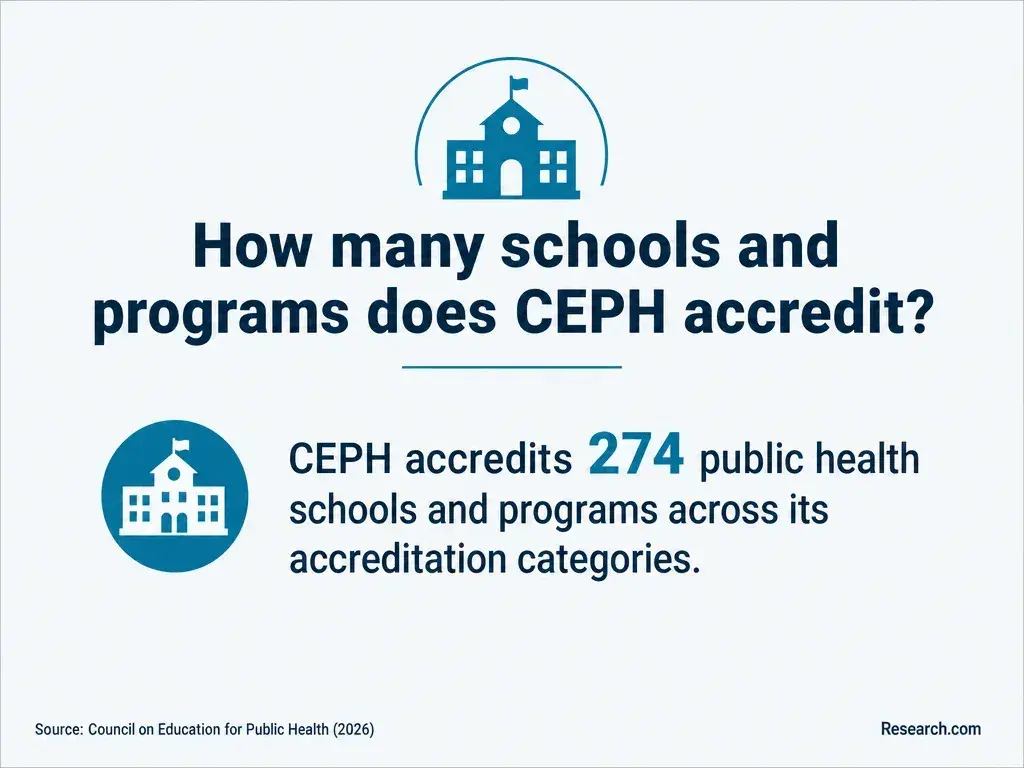
The Council on Education for Public Health (CEPH) requires accredited MPH programs to provide an applied practice experience in which students demonstrate competency attainment through at least two products. The experience must address at least five competencies, including at least three foundational competencies.
CEPH sets accreditation criteria; the student's school decides how to approve sites, document supervision, assess products, and apply any additional hours or course requirements. Students should confirm that CEPH accreditation covers their particular MPH program, not merely their university.
Ask the academic coordinator to approve a proposed competency map before fieldwork starts. It should connect each competency to a task, a reviewable product, and the person who will provide feedback.
A county's willingness to host a student is not school approval, and school approval does not grant access to county records. These MPH practice criteria should not be assumed to describe the research or applied-project requirements of public health doctoral education options online.
Appropriate tasks depend on the unit's needs, the student's preparation, and what information the county permits them to see.
A student might help document a reporting workflow, check a permitted dataset for missing fields, develop a draft internal summary, or evaluate whether a surveillance indicator is consistently defined. Staff retain responsibility for official interpretations, investigations, and public communications.
The following questions help determine whether a proposed assignment is both useful to the county and achievable within a term:
- What decision will the project support, and which two products can the student submit for academic assessment?
- Who will supervise the work, provide feedback, and cover absences or urgent response duties?
- What data may the student access, where may work be done, and who approves any extract, presentation, or publication?
- Can a smaller, non-identifiable product be completed if data access or case volume changes?
Routine surveillance practice is not automatically a research project. If a student wants to test a research question or publish findings, the school and county must determine the applicable review and permissions first.
A research-focused path, such as those discussed in guides to affordable online public health PhD programs, serves a different purpose than completing an MPH practice deliverable.
An online MPH may let a student complete coursework while pursuing a placement near home. It does not make county surveillance work automatically remote or asynchronous: secure systems, supervisor availability, meetings, and training may require scheduled or on-site attendance. Before enrolling, ask whether the program helps identify county sites, accepts a student-proposed site, and has arrangements for supervision and assessment across locations.
Compare the full degree expense alongside placement feasibility. Master of Public Health affordability comparisons can help identify programs to investigate, but a lower advertised tuition will not offset a placement that requires unaffordable travel or time away from paid work. Students with caregiving or employment obligations should get the county's expected weekly schedule in writing rather than relying on the flexibility of online classes.
Introductory epidemiology and biostatistics provide the basis for describing disease patterns without treating every change in reported cases as a change in underlying risk.
Coursework in infectious disease epidemiology, surveillance systems, data management, public health law, and risk communication can be especially useful when available. Students should be able to explain how reporting practices, delayed records, and missing data affect an apparent trend before drawing conclusions from it.
Preparation should follow the proposed assignment. A workflow-improvement project may demand careful documentation and stakeholder communication more than advanced modeling; an analytic assignment may require stronger statistical and coding skills.
Programs described as having MPH programs with broader admissions criteria can still expect students to acquire substantial quantitative skills before a surveillance placement. Ask the course instructor and county supervisor which skills must be in place on day one.
MPH epidemiology programs commonly ask for a recognized bachelor's degree and evidence that an applicant can succeed in graduate study.
Specific GPA thresholds, statistics prerequisites, tests, references, and application systems vary by school; a non-public-health major does not automatically rule out admission. For a prospective county practicum, quantitative preparation and an interest in local public health practice are more informative than the undergraduate major alone.
Check a program's current admissions page for formal requirements, then separately assess readiness for its epidemiology coursework. Applicants seeking online MPH study without reference letters should verify that policy for the exact program and entry term. An admissions exception does not waive the competencies or approvals required later for fieldwork.
There is no single practicum duration or price across MPH programs. The school may specify hours, credits, registration periods, and deadlines, while the county may set onboarding dates, training requirements, and minimum weekly availability. Data-access approval can take time even after a site accepts a student, so confirm the schedule before assuming the project will fit one term.
Build a budget for any practicum-course tuition and fees, commuting, required equipment, and earnings lost to unpaid hours. Ask whether the placement is paid, whether existing employment can qualify with a distinct approved project, and whether a delayed finish triggers another registration charge.
Institutional scholarships for public health graduate students are worth checking, but eligibility and the amount available must be confirmed with the school; funding should not be assumed to cover fieldwork expenses.
A well-documented placement can support applications for local or state health department epidemiology, surveillance, data-quality, and program-analysis roles. The strongest evidence is specific: a supervisor-verified description of the student's responsibilities and a shareable, approved work sample that demonstrates sound interpretation.
Job titles and minimum qualifications vary by employer; completing an MPH and a practicum does not confer authority to lead investigations or guarantee an epidemiologist position.
Someone who enjoys improving reporting operations may also consider surveillance coordination or public health informatics roles. Someone seeking independent research leadership may eventually need deeper methods training and experience.
Evaluate that goal before taking on the additional time and expense described in guides to doctoral public health study costs and career directions; a doctorate is not the default next step after county fieldwork.
What Are Epidemiology Salaries and Job Outlook After an MPH?
The US Bureau of Labor Statistics Occupational Outlook Handbook is the appropriate starting point for epidemiologist pay, projected employment, and typical entry education. Its figures describe an occupation across employers and experience levels, not the starting salary or hiring prospects of students who complete a county practicum. County pay can also depend on a government salary schedule, job classification, location, and prior experience.
Use the latest BLS epidemiologist profile to compare the occupation with your target role, then inspect actual county or state postings for pay ranges and required skills. A public health master's graduate pay guide may offer broader context, but MPH-wide earnings should not be substituted for epidemiologist data or a specific employer's offer. The practicum's financial value is strongest when it provides evidence for jobs you can realistically pursue.
Other Things You Should Know About Public Health Programs
Only with county and school permission. A public portfolio may need an approved summary or recreated example rather than records, small-cell counts, internal documents, or identifiable details.
Do not assume so. Reporting authority and procedures depend on state law, county policy, and the student's assigned role. Follow the supervisor's instructions and escalation process.
Tell the county supervisor and academic coordinator promptly. They can assess whether revised tasks still produce the required competencies and products, or whether the scope or timeline must change.
Not unless the site or your school requires one. For most students, relevant coursework, basic data skills, and readiness to follow confidentiality procedures are more immediate priorities.
- Chapter 19: Enhancing Surveillance | cdc.gov https://www.cdc.gov/surv-manual/php/table-of-contents/chapter-19-enhancing-surveillance.html
- Surveillance of Disease: Overview - PMC https://pmc.ncbi.nlm.nih.gov/articles/PMC7149774/
- Updated Guidelines for Evaluating Public Health Surveillance Systems: Recommendations from the Guidelines Working Group https://stacks.cdc.gov/view/cdc/248461
- BSPH Epidemiology - Internship https://internships.publichealth.indiana.edu/internship_area/bsph-epidemiology/
- Program: Public Health (MPH) - University of Southern California https://catalogue.usc.edu/preview_program.php
- Public Health Practicum | UCLA Fielding School of Public Health https://www.mphhp.ph.ucla.edu/public-health-practicum
- Which Aspects of a Surveillance System Can Be Assessed? | INSIGHT Surveillance Toolkit https://sites.uw.edu/surveillancetoolkit/surveillance-overview/which-aspects-of-a-surveillance-system-can-be-assessed/
- Practicum Examples | UW School of Public Health https://sph.washington.edu/mph-practicum/examples