2027 From Childcare Center Administrator to Public Health: Planning a Bachelor's Pathway

Co-Founder and Chief Data Scientist
Running a childcare center builds experience in family communication, staff supervision, safety procedures, and community partnerships. Moving into public health means applying those strengths beyond one center - and gaining skills in population health, data, and program evaluation. This guide is for childcare administrators considering a bachelor's degree, especially those returning to college while working. It explains which credits and experiences may help, what a feasible program looks like, and when a degree is worth pursuing instead of a shorter route to your target job.
Key Things You Should Know
- Childcare administration can support a move into family-health outreach or program coordination, but a public health bachelor's degree alone does not qualify you for every specialist or management role.
- Bachelor's degrees are commonly structured around 120 semester credits; an official degree audit - not the number of credits accepted - shows what remains for graduation.
- Compare programs on credits that satisfy requirements, fieldwork scheduling, total remaining cost, and evidence of preparation for the jobs you want.
What Is a Public Health Bachelor's Degree for Childcare Administrators?
A public health bachelor's degree studies how communities prevent health problems and improve conditions that affect groups of people. For a childcare administrator, the connection might be family access to preventive services, infection-prevention communication, food security, or the evaluation of an early-childhood outreach program. It is not a childcare director credential or a clinical qualification.
Programs may award a BA, BS, or another undergraduate degree, with different science, statistics, and general-education requirements. Compare the actual curriculum and transfer policies rather than assuming similarly named degrees are interchangeable. A starting point for comparing public health undergraduate study options is useful, but request a school-specific degree audit before choosing.
How Can Childcare Administrators Transition Into Public Health Careers?
Start with a job function, not a degree title. Your experience coordinating staff, explaining policies to families, maintaining records, and working with local agencies may translate well to community outreach or program operations. The gaps are likely to be population-level planning, interpretation of health data, and evidence that you can evaluate a program - not simply run its daily activities.
A practical transition is to identify local job postings, note their required skills, then seek supervised work or a class project that demonstrates one missing skill. For example, a permitted, deidentified review of participation in a family-resource referral process could demonstrate evaluation skills; access to family records would require employer permission and appropriate privacy safeguards. If you already hold a bachelor's degree, a second bachelor's may be unnecessary. Compare targeted coursework, experience, and public health graduate degrees and salary pathways against the requirements of your intended role.
What Public Health Bachelor's Degree Requirements Should You Expect?
Expect general education, public health major courses, and possibly prerequisites in statistics or biology, plus an internship or capstone if the program requires one. Admission to the college, admission to the major, acceptance of prior credits, and satisfaction of graduation requirements are separate decisions.
This distinction matters if you have an associate degree, an applied degree, or scattered credits earned while building your childcare career. A school may accept a course as an elective without allowing it to replace a required statistics or public health course. Ask the registrar or transfer-credit office for a course-by-course evaluation and the department for an approved degree audit. Provide transcripts, syllabi for disputed courses, and documentation of relevant prior learning; ask about credit recency, substitutions, residency credits, and when required courses are offered.
If an MPH is a later goal, check its requirements separately from the bachelor's plan. Guidance on addressing prerequisite gaps before MPH enrollment can help frame questions, but no undergraduate course automatically satisfies every graduate program's rules.
Neither format is automatically better. Online study may remove a commute but still require live meetings, group work, proctored exams, or daytime fieldwork. Campus classes may offer easier access to faculty and local partners but conflict with center operating hours. The workable choice depends on your staffing coverage, caregiving commitments, and ability to complete applied work - not just where lectures appear.
Before enrolling, request a sample course schedule and ask whether classes are asynchronous, whether required visits occur, who arranges field placements, and whether you can slow your pace without losing course access. Intensive online public health bachelor's classes may shorten a calendar term while increasing weekly workload; that trade-off deserves particular scrutiny during a center's busiest periods.
Common subjects include epidemiology, introductory biostatistics, environmental health, health policy, health communication, and program planning or evaluation. Course names and depth vary. For a childcare administrator, the most useful combination is often statistics and evaluation alongside family or community health: it helps you move from describing a need to assessing whether an outreach effort reaches its intended population.
Look for assignments that produce usable evidence, such as a clearly defined needs assessment or an evaluation plan, and check whether a field experience can take place in an approved early-childhood or family-serving setting. Your existing job does not automatically qualify as a placement. If past grades make you concerned about later graduate study, strong work in methods courses may demonstrate preparation, but it does not erase an MPH program's admissions criteria. Advice on applying to an MPH with a lower GPA addresses that separate, future decision.
A bachelor's is commonly organized around 120 semester credits, but that figure is not a promise about credits remaining. Completion time depends on which prior courses fulfill requirements, how many classes you can take while working, prerequisite order, and internship availability. Ask each school for a term-by-term plan based on its official evaluation, including a plan for any course offered infrequently.
For cost, compare the price of remaining required credits, not advertised tuition alone. Include mandatory fees, books, travel or placement expenses, and any reduction in work hours. Confirm the charges and aid eligibility for your intended enrollment pace, and ask your employer about education assistance without assuming it is available. An advanced degree is not automatically a better financial investment; a public health doctorate career value guide is relevant only if a much later leadership goal actually calls for doctoral training.
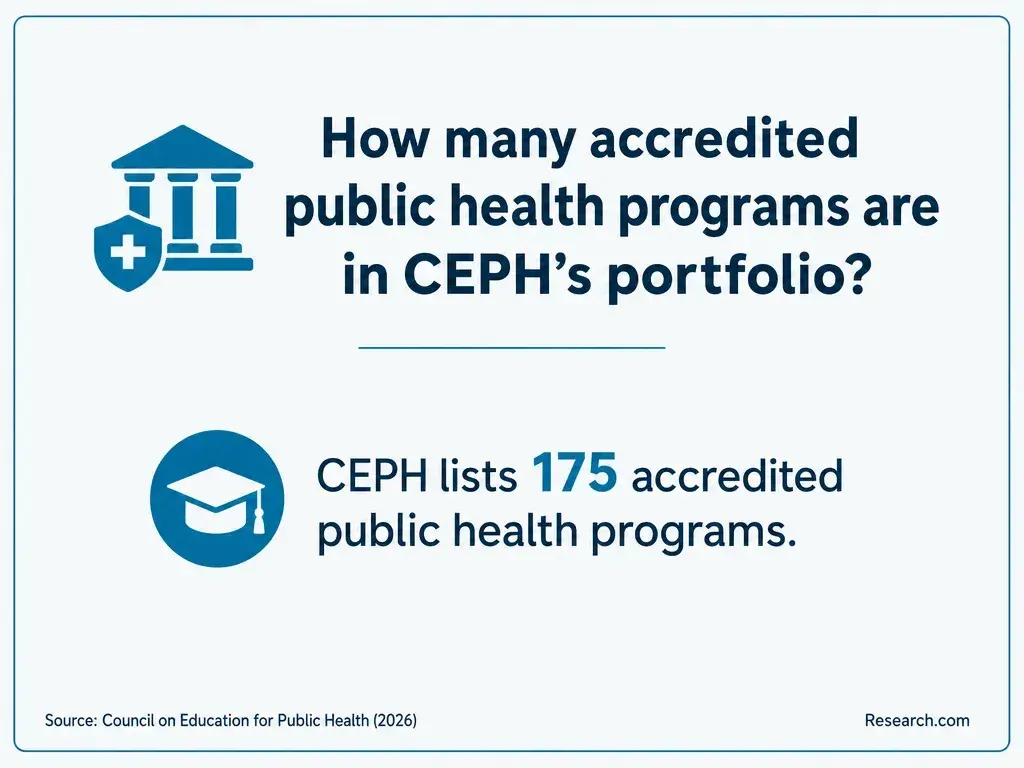
First, confirm that the institution holds recognized institutional accreditation; this affects matters such as credit acceptance and access to federal student aid. Then check whether the Council on Education for Public Health (CEPH) accredits the relevant school, unit, or standalone program and whether your specific degree is within that scope. Institutional accreditation and CEPH accreditation answer different questions, and neither replaces a review of curriculum, scheduling, and outcomes.
Ask the program to identify the accrediting body, covered degree, and current status in writing. If you expect to pursue graduate study, reassess accreditation at that stage rather than assuming an undergraduate choice determines every later option. The same scope-checking principle applies when choosing an online public health doctorate, although doctoral study is not needed for the bachelor's-entry roles discussed here.
Depending on the employer and your experience, plausible targets include community health worker, outreach coordinator, health education program assistant, family-services program coordinator, or public health program assistant. Duties may involve connecting families with services, preparing accessible information, tracking participation, or supporting a supervised evaluation. Some positions favor your childcare leadership experience; others require direct public health experience or a particular credential.
Do not treat "coordinator" and "manager" as interchangeable titles. Check whether a posting expects budget authority, independent analysis, clinical practice, or advanced research before counting it as a bachelor's-level opportunity. Epidemiologist and senior public health leadership positions generally call for additional preparation or substantial experience. Public health doctoral admissions requirements concern a far later pathway, not a requirement for entering community-facing work.
There is no reliable single salary for people with a public health bachelor's degree: pay follows the occupation, location, employer, responsibilities, and experience. A former childcare administrator entering outreach may also be changing pay structures, so compare actual local postings with your current compensation and benefits rather than assuming a degree brings a raise.
For a defensible benchmark, use the latest US Bureau of Labor Statistics Occupational Outlook Handbook figures for the specific occupation you are considering, such as community health worker or health education specialist, and check its published wage year and projected employment period. Those occupation-wide figures are not starting salaries or degree-specific outcomes. An MPH salary and career earnings outlook describes a different educational comparison and should not be used to forecast returns on a bachelor's degree.
Do Public Health Careers Require Licensure or Certification?
A public health bachelor's degree does not itself grant clinical licensure or a professional certification. Requirements depend on the job and state. A community health worker position may have state-specific training or certification rules; a health education position may prefer a credential such as CHES, whose eligibility must be checked with its certifying organization. Clinical jobs require their own professional education and licensing pathways.
Read target job postings for required versus preferred credentials, then confirm any state rule with the responsible authority before choosing coursework. Graduate admission is another distinct gate: comparing selectivity across online MPH options can inform a later education decision, but entry to an MPH neither substitutes for a job credential nor confers a license.
Other Things You Should Know About Public Health
Possibly. Obtain your employer's permission and the school's approval of the project and any site requirements before starting. Employment at the center alone is not approval to use its data or families' information.
Do not include identifiable child, family, or staff records. Ask what your employer permits, and use a redacted work sample or a clearly labeled hypothetical example when appropriate.
Licensing compliance focuses on meeting rules for a facility. Public health work may examine patterns and barriers across a population, design a response with community partners, and evaluate its reach.
Yes. Publicly available, appropriately aggregated information can help frame a question or plan a project. Check its source and limitations, and do not claim it measures outcomes for your center's families.
- Competencies for Public Health Professionals | cdc.gov https://www.cdc.gov/infrastructure/training-professional-development/competencies-for-public-health-professionals.html
- Types of Financial Aid: Grants, Work-Study, and Loans | studentaid.gov https://studentaid.gov/understand-aid/types
- Employer-offered educational assistance programs can help pay for college | Internal Revenue Service https://www.irs.gov/newsroom/employer-offered-educational-assistance-programs-can-help-pay-for-college
- Early Childhood Education | Oakland County, MI https://www.oaklandcc.edu/programs/early-childhood-education/
- What Can You Do With a Public Health Degree? | University of North Dakota https://und.edu/blog/what-can-you-do-with-a-public-health-degree.html
- How Do Transfer Credits Work When You Go Back to School? | Whitworth Online https://online.whitworth.edu/news-articles/how-do-transfer-credits-work-when-you-go-back-to-school/
- Bachelor of Science in Child Development and Services | Western Michigan University https://wmich.edu/familyconsumer/child-development
- What Can You Do With an MPH? Careers & Salaries Explained | Marshall University https://www.marshall.edu/blog/mph-career-guide/
- College Credit for Your Work and Life Experience | University of Phoenix https://www.phoenix.edu/tuition-financial-aid/prior-learning-assessment.html
- What Can You Do With a Public Health Degree? | snhu.edu https://www.snhu.edu/about-us/newsroom/health/what-can-you-do-with-a-public-health-degree