2027 From Public Benefits Eligibility Worker to Public Health: Planning a Bachelor's Pathway

Co-Founder and Chief Data Scientist
Public benefits eligibility work puts you close to the policies and barriers that shape health, but moving into public health may require skills your current job does not formally teach. This guide is for eligibility workers considering a bachelor's degree while employed. It shows how to connect your experience to realistic roles, identify coursework and fieldwork gaps, compare programs without losing useful credits, and judge whether the time and cost support your career goal.
Key Things You Should Know
- Eligibility work can support a move into outreach, program support, or health education, but a bachelor's degree alone does not qualify you for every public health role.
- A full-time bachelor's pathway commonly takes about four years; prior college credit may shorten it only if the receiving school applies those credits to graduation requirements.
- Before enrolling, compare a written degree audit, the total cost to finish, required fieldwork, and actual course schedules - not the advertised program length alone.
What can a public health bachelor's degree lead to after public benefits work?
An eligibility worker already interprets policy, documents decisions, explains complex rules, and helps people navigate services. Those strengths transfer particularly well to public health programs concerned with access to care, prevention, and the social conditions that affect health. The transition is most direct when the new job also involves client communication, referrals, or program operations.
A public health bachelor's degree adds a population-level perspective: instead of determining one household's eligibility, you may help assess barriers across a community or support a program designed to reduce them. It does not, by itself, prepare you to practice clinical care, lead a research team, or become an epidemiologist. If your long-term goal is specialized or senior work, use comparing public health master's career directions to distinguish that later decision from the immediate bachelor's pathway.
Start by selecting a target function, such as outreach, health education, or program coordination. A specific target makes it easier to choose courses and seek relevant supervised experience.
What education requirements are needed to transition into public health?
There is no single education requirement for "public health." Some community-facing jobs accept relevant experience or a high school credential; many program and health education positions prefer or require a bachelor's degree. More technical research and epidemiology roles commonly require graduate preparation. Read the qualifications for the jobs you actually want before deciding that another degree is necessary.
For an eligibility worker without a bachelor's degree, a public health BA or BS can provide broad preparation in population health, data interpretation, policy, and program work. A related major - such as health education, social work, or public administration - may fit better if its coursework matches the target job more closely. If you already hold a bachelor's degree, an internship, employer-supported training, or targeted coursework may offer a more direct route than earning a second one.
A future MPH is a separate decision, not an automatic next step. Graduate prerequisites vary by school; addressing prerequisite gaps before MPH enrollment is relevant if you later identify a program that requires preparation your bachelor's coursework did not provide.
How do you choose an accredited bachelor's program in public health?
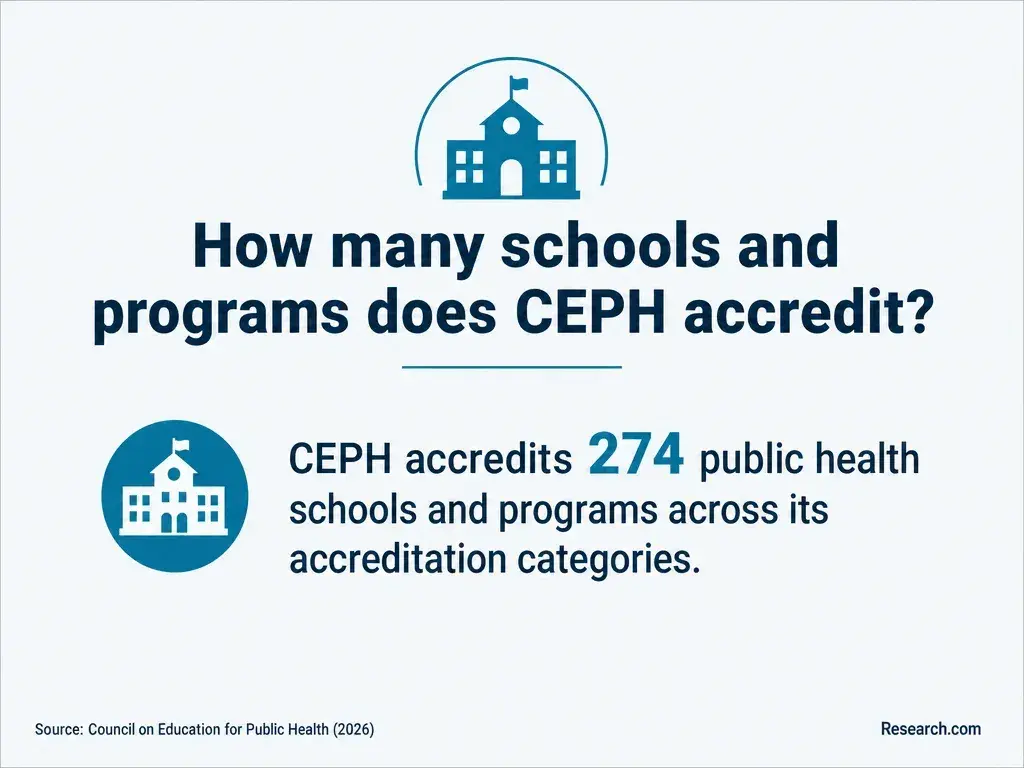
First, verify the institution's accreditation through the accreditor and the U.S. Department of Education's recognition information. Then check whether the exact public health degree is covered by Council on Education for Public Health (CEPH) accreditation. Institutional accreditation and CEPH accreditation answer different questions; do not assume that a university's public health branding establishes the scope of its CEPH recognition.
For a returning student, the more consequential comparison may be the written degree audit. A school can accept a previous course as elective credit without using it to satisfy statistics, general education, or a major requirement. Ask the registrar or transfer-credit office for the official evaluation and the academic department for decisions on major equivalencies or substitutions.
Compare the remaining required courses, when they are offered, fieldwork approval rules, career support, and the estimated cost to graduate. A useful starting point for finding candidates is cost-conscious online public health undergraduate study, but confirm each school's current charges, accreditation scope, and degree requirements directly.
Online study can eliminate a commute, but it does not necessarily let you study whenever you want. Some courses have live meetings, group assignments, scheduled exams, or community fieldwork during business hours. Campus programs may offer easier access to faculty, local partners, and student support, but required travel and fixed class times can conflict with an eligibility worker's schedule.
Ask each program for a sample term schedule and its fieldwork policy. Check whether required classes are offered every term, whether part-time enrollment changes course sequencing, and whether you can arrange an approved project near your workplace or home. If you are considering shorter terms, planning an accelerated public health bachelor's workload matters more than the word "accelerated" in an advertisement: compressed courses can increase weekly demands even when the calendar is shorter.
Choose the format you can sustain through statistics, group work, and fieldwork - not merely the one that seems easiest to start.
Most public health bachelor's curricula introduce epidemiology, biostatistics or statistics, social and behavioral influences on health, health policy, environmental health, and program planning. A BA and a BS may differ in science and quantitative requirements, but the label alone does not establish which is more rigorous. Compare actual course descriptions and prerequisites.
For someone leaving eligibility work, the most valuable additions may be learning to interpret population data, assess evidence, plan an outreach activity, and evaluate whether a program reached its intended population. Coursework on health systems and policy can connect your knowledge of benefit rules to broader questions of access. Seek an applied course or supervised project where you can demonstrate those skills without using identifiable client records unless the employer and school have explicitly authorized access and use.
You do not need doctoral-level training for these entry-level tasks. A public health doctoral degree comparison guide becomes relevant only if later career goals call for advanced practice leadership or research; it should not drive your undergraduate course choice now.
Requirements depend on whether you apply as a first-year student, transfer student, or degree-completion applicant. Schools may request prior transcripts and may set separate conditions for entry to the university and entry to the public health major. Some majors require introductory courses or a minimum GPA before declaration; verify the rules for your intended entry term.
If you have attended college, gather transcripts and course descriptions before applying. Ask which credits will be accepted, which will satisfy general education or major requirements, whether older science or statistics work remains usable, and how many credits must be completed at the new institution. The school receiving your application has final authority over its credit evaluation.
A previous GPA concern should be assessed against undergraduate transfer policy, not graduate admissions advice. If an MPH becomes a later goal, low-GPA eligibility for public health graduate programs addresses a different application stage. For now, ask the bachelor's program about its current admission thresholds and any academic-renewal or appeal process it actually offers.
A full-time bachelor's degree commonly spans about four years, but your remaining time depends on applicable transfer credit, course sequencing, enrollment pace, and fieldwork availability. Part-time study may fit employment better while extending the period over which you pay fees and balance school with work. Do not rely on an estimate based only on the number of credits a university accepts; request a degree audit showing what remains.
For a useful cost comparison, ask each school for tuition and mandatory fees at your planned course load, then add books, technology, travel, and any fieldwork-related expenses. Consider whether changing work hours would reduce earnings. Ask your employer whether education assistance is available and what service or grade conditions apply; do not count reimbursement until you have confirmed eligibility.
Comparisons of online public health cost-duration tradeoffs can help you build a shortlist. Your decision, however, should rest on the cost and time remaining for you after an official credit evaluation, not a published shortest-case timeline.
The closest next jobs often build on your existing service-navigation and policy experience. The table distinguishes plausible roles from positions that usually require a larger change in technical preparation or responsibility; individual employers set their own qualifications.
| Role to investigate | Connection to eligibility work | Additional evidence to build |
| Community health worker or outreach specialist | Explaining services, making referrals, and communicating with community members | Community engagement, outreach experience, and any state- or employer-required training |
| Public health program assistant or coordinator | Applying policy, tracking cases or activities, and coordinating services | Project documentation, basic reporting, and program evaluation skills |
| Health education specialist | Translating complex information into useful guidance | Health education coursework, audience-focused materials, and the qualifications in specific postings |
| Research or data assistant | Accurate records and careful handling of sensitive information | Statistics, data-quality practices, and supervised analytic work |
A strong application should describe the public health relevance of your work without claiming duties you have not performed. For example, distinguish helping an individual navigate benefits from evaluating whether a program improves access across a population. Epidemiologist, research-lead, and senior management positions are not typical first jobs conferred by a bachelor's degree alone.
If you eventually consider a doctorate for advanced leadership, accessible online public health doctoral pathways concerns a much later educational choice - not a requirement for these bachelor's-level opportunities.
Which public health certifications and licenses do graduates need?
A public health bachelor's degree does not itself grant a clinical license or a professional certification. Many program-support jobs have no universal public health license, while specific employers or states may require training or certification for particular community health worker roles. Check the exact posting and state rules rather than assuming a credential is required everywhere.
For health education positions, the Certified Health Education Specialist (CHES) credential may be relevant, but eligibility is determined by its certifying organization and qualifying coursework - not simply by having a public health degree. Certified in Public Health (CPH) has its own eligibility routes and examination requirements. Confirm current rules with the respective certifying body before choosing courses or paying an exam fee.
A master's degree is not a substitute for a required license or certification. Likewise, the potential value of an online public health master's value guide matters only if a future target role calls for graduate-level preparation; it does not change the credential rules for a bachelor's-level job.
Other Things You Should Know About Public Health
Do not use identifiable case information without your agency's permission and the school's required approvals. A fictional scenario or properly authorized, deidentified material is generally safer; confirm the rules before sharing either.
Not necessarily. Civil-service classification, retirement-system, and transfer rules vary by employer and jurisdiction. Ask human resources how a proposed move would affect pay, leave, pension credit, and probation.
Request informational interviews with public health staff and compare several local postings. Ask what they do each week, which skills new hires struggle with, and whether your current experience would meet the entry requirements.
That depends on your workplace and goals. If you want tuition assistance, a schedule adjustment, or an internal move, first review the relevant policies so you can make a specific request without assuming approval.
- Programmatic Accrediting Agencies | ed.gov http://www.ed.gov/laws-and-policy/higher-education-laws-and-policy/college-accreditation/programmatic-accrediting-agencies
- Competencies for Public Health Professionals | cdc.gov https://www.cdc.gov/infrastructure/training-professional-development/competencies-for-public-health-professionals.html
- What Can You Do With a Public Health Degree? | Goodwin College of Professional Studies https://drexel.edu/dornsife/students/career-services/what-can-you-do-with-a-public-health-degree/
- Practice Experience (MPH/DrPH) | Rutgers School of Public Health https://sph.rutgers.edu/academics/practice-experience-mphdrph
- Public Health Accreditation and Competencies | Arcadia University https://www.arcadia.edu/majors-and-programs/public-health-mph/accreditation-competencies/
- Bachelor's Degree Completion Programs | Cal State LA https://www.calstatela.edu/dtla/bachelor%E2%80%99s-degree-completion-programs
- How to Get College Credit for Work Experience | post.edu https://post.edu/blog/pla-101-can-a-prior-learning-assessment-get-me-college-credit-for-work-experience/
- What Can You Do With a Public Health Degree? | University of North Dakota https://und.edu/blog/what-can-you-do-with-a-public-health-degree.html
- How to Become a Public Health Professional | West Coast University https://westcoastuniversity.edu/about/career-guides/how-to-become-a-public-health-professional