2027 MPH Admissions With a Three-Year International Bachelor's Degree

Co-Founder and Chief Data Scientist
A three-year bachelor's degree may qualify you for a U.S. Master of Public Health (MPH), but there is no admissions rule shared by every program. The decisive issue is whether a particular university recognizes your credential as sufficient preparation for graduate study. For international applicants, that decision can affect where to apply, which evaluation to order, and whether additional study is necessary.
This guide explains how to get a program-specific answer before spending money on applications or assuming that a fourth undergraduate year is required.
Key Things You Should Know
- A three-year international bachelor's degree can qualify for an MPH when the university accepts that specific credential as equivalent to its graduate-entry requirement; the degree's length alone does not settle eligibility.
- Ask each program which credential evaluator and report type it accepts and whether the admissions office—not just the evaluator—will approve your degree.
- CEPH-accredited MPH degrees generally require at least 42 semester credits, so compare the full cost and time to completion only after confirming that you can enter the program.
Can you earn an MPH with a three-year international bachelor's degree?
Yes, it is possible to earn a U.S. MPH with a three-year international bachelor's degree. Some universities recognize certain three-year credentials as comparable to a U.S. bachelor's degree; others require a different qualification or additional university-level study. The decision can depend on the awarding institution, country, degree structure, accreditation or recognition in the home country, and the graduate school's policy.
Eligibility is not the same as competitiveness. A school may accept your degree as a valid entry credential yet still evaluate your grades, preparation, experience, statement, and references against other applicants. Conversely, a strong application cannot override a firm graduate-school rule that your credential does not meet its degree requirement.
Do not enroll in another bachelor's program solely because your degree took three years. First obtain written decisions from prospective MPH programs. If additional undergraduate study is genuinely required, compare the exact missing qualification with options such as comparing accelerated public health undergraduate schedules; a faster schedule is useful only if the MPH admissions office confirms it would resolve your eligibility problem.
What international credential evaluation does MPH admission require?
An international credential evaluation translates academic records into a format a U.S. institution can assess. Depending on the school, the required report may assess overall degree equivalency, individual courses and grades, or both. An evaluator's finding is evidence for admissions; it does not compel a university to admit you or accept the degree.
Before ordering a report, send admissions staff your awarding institution, country, exact degree title, normal program length, graduation status, and transcript. Ask whether the MPH uses a centralized application service, which evaluators it accepts, whether it requires a course-by-course report, and where official records and translations must be sent. Application-service instructions and the university's graduate-school rules must both be satisfied.
Allow time for records to arrive from the awarding institution. If the evaluation concludes that your degree is not equivalent, request the school's policy on appeals, additional qualifying study, or admission after another recognized credential. A separate public health BS program selection guide can help you assess an undergraduate route, but do not assume that earning a U.S. public health major is the only remedy.
Which U.S. MPH programs accept three-year bachelor's degrees?
There is no reliable blanket list of U.S. MPH programs that accept every three-year bachelor's degree. A published statement accepting "international degrees" may not answer whether the school accepts your degree. Policies can also differ between an MPH program and the university's graduate admissions office.
Build a shortlist by checking each school's international graduate-entry policy, then request an individual assessment. The most useful written reply answers: "Does my named degree from my named institution meet the academic-degree requirement for this MPH entry term, subject to official evaluation?" Ask whether the answer applies to the specific campus or online MPH you intend to enter. Treat a reply of "you may apply" as permission to submit an application, not necessarily confirmation of degree equivalency.
If a school declines your credential, compare the additional study it actually requires rather than assuming you must start over. Affordable public health BS study options may be worth investigating when a recognized bachelor's degree is necessary, but obtain written confirmation that the proposed qualification would meet the MPH's graduate-entry rule before enrolling.
No, a public health bachelor's degree is not a universal MPH prerequisite. Applicants may bring preparation in medicine, nursing, social sciences, mathematics, environmental science, business, humanities, and other fields. Programs may nevertheless specify prerequisites or recommend statistics, quantitative reasoning, biology, or relevant experience, particularly for methods-intensive concentrations.
Separate the required before admission from the recommended for success. If you want epidemiology or biostatistics, ask whether your transcript demonstrates the expected mathematics and statistics preparation. If your goal is community program work, documented partnership, communication, or evaluation experience may strengthen your application even without a public health major. A missing skill may be addressed through an approved course rather than another entire degree.
An MPH is generally practice-oriented; a research-intensive MS may be a better fit for some technical goals. Use MPH and related public health graduate pathways to compare those purposes, while checking the actual prerequisites of every program on your shortlist.
International applicants may be asked to demonstrate English proficiency through an accepted test such as TOEFL, IELTS, or another exam specified by the university. There is no single MPH-wide test, minimum score, or waiver policy. A school may waive testing based on prior instruction in English, citizenship or residence criteria, or another documented condition—but applicants should not assume that an English-medium degree automatically qualifies.
Check the policy for your entry term before booking a test. Confirm accepted test versions, minimum overall and section scores, score-validity periods, official score-delivery instructions, and whether both the graduate school and MPH program impose requirements. If you need to retest, factor the deadline and expense into your shortlist rather than choosing a school solely because its tuition looks attractive. A comparison of budget-friendly Master of Public Health programs is useful only after filtering for degree and language eligibility.
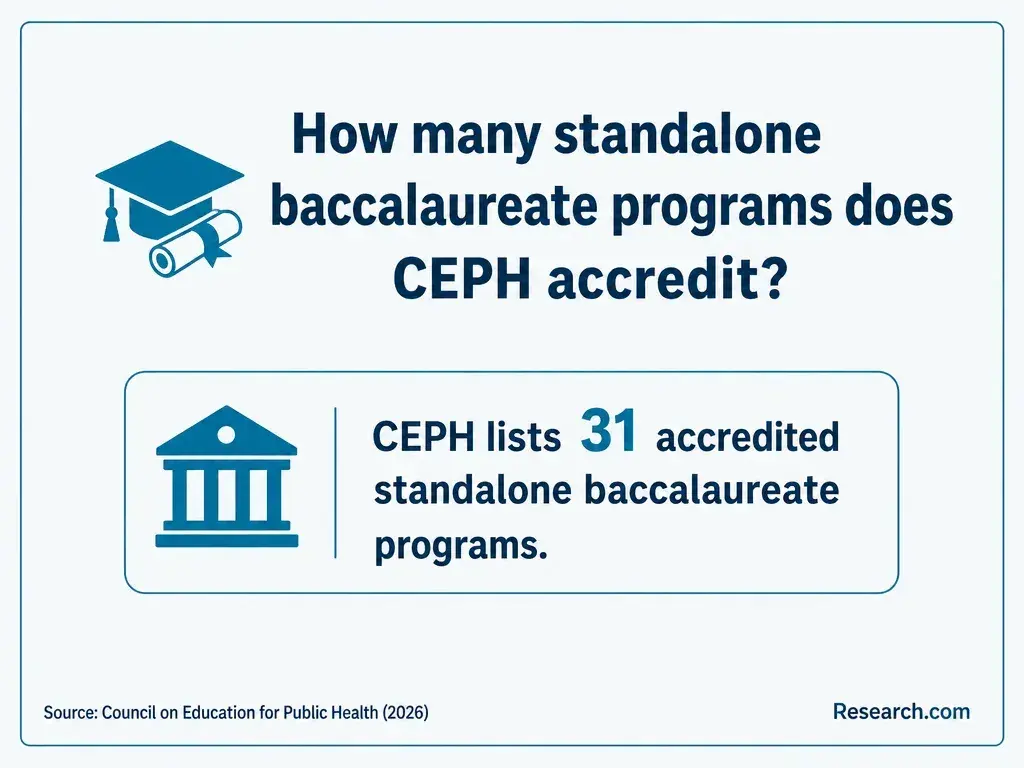
Check two different forms of recognition. First, verify the university's institutional accreditation with its recognized accreditor. Second, use the Council on Education for Public Health (CEPH) directory to establish whether the relevant school, public health unit, or standalone MPH program is accredited and whether your intended degree falls within that scope. Institutional accreditation alone does not establish CEPH accreditation for an MPH.
Accreditation is a starting point, not a complete quality assessment. Ask for the current curriculum, applied practice requirements, placement support, course availability, faculty expertise, and any reported outcomes with clear cohort definitions. For online study from abroad, confirm whether enrollment is permitted from your location, whether live meetings fit your time zone, and where you may complete required fieldwork. A resource for comparing accreditation across online MPH programs can help form a shortlist; confirm each program's present status and degree coverage directly with CEPH.
An MPH usually combines population-health foundations with applied work. Expect study of epidemiology, biostatistics, health systems and policy, environmental health, social and behavioral factors, and ethical community engagement. CEPH-accredited MPH degrees generally require at least 42 semester credits and include applied and integrative learning requirements; the school determines how these appear in its curriculum.
Concentrations may include epidemiology, biostatistics, health policy, community health, or environmental health, but names and depth vary. A concentration is not the same as a separate degree, and taking one data course does not establish advanced analyst competence. Compare required methods courses, electives, supervised projects, and the possibility of completing applied work where you live. Applicants seeking deeper quantitative training can also examine working-professional pathways into biostatistics study rather than assuming every MPH concentration provides the same technical depth.
Completion time depends on credit requirements, full-time or part-time enrollment, course sequencing, and fieldwork arrangements. Compare programs using a term-by-term plan, not just an advertised "time to degree." For an international online student, a required live session, campus visit, or locally approved practice site may determine whether the schedule is feasible.
Request an itemized estimate showing tuition, mandatory fees, any international-student charges, health coverage where applicable, travel, materials, and potential fieldwork expenses. Ask whether the quoted tuition covers the entire degree or only one term or credit. Scholarships and assistantships may have separate citizenship, location, or enrollment conditions; do not include unconfirmed awards in your budget.
If the MPH is intended as a step toward doctoral research, consider the cost of the entire pathway before borrowing. Comparing epidemiology doctoral tuition support can help with longer-term financial planning, but doctoral funding should not be assumed to offset MPH costs.
An MPH can support work in health departments, nonprofits, research organizations, health systems, and other population-health settings. The realistic entry point depends on your previous experience and demonstrated skills: a new graduate might assist with program implementation or data collection, while an epidemiology role may require stronger method preparation and relevant experience.
For salary context, the U.S. Bureau of Labor Statistics reports an occupation-wide median annual wage of $83,980 for epidemiologists in May 2024. That figure is not the expected pay for a new MPH graduate: it spans workers with different degrees, experience levels, employers, and locations. Compare postings for the specific role and U.S. location you want, alongside career salary ranges for MPH degree holders.
If your goal is U.S. employment, also verify visa and work-authorization rules independently. Admission to an MPH—including an online MPH—does not itself grant permission to enter or work in the United States.
Do MPH graduates need licenses or professional certifications?
Most MPH roles do not have a single profession-wide license. Particular jobs may require a license already tied to another profession, such as nursing, or an employer-preferred certification. An MPH does not grant clinical licensure or automatically award credentials such as Certified in Public Health (CPH) or Certified Health Education Specialist (CHES); check the issuing organization's current eligibility and examination rules.
Match credentials to the work you intend to do. A certification may document a defined competency, while a license authorizes regulated practice; neither is interchangeable with graduate education. Likewise, an MPH certification decision is separate from whether you later need a practice-focused DrPH or research-focused PhD. If that later step matters to your career plan, compare the actual requirements of online public health doctoral programs rather than treating a professional certificate as a substitute.
Other Things You Should Know About Public Health
Some schools review applicants who are finishing a degree, but they may require proof of conferral before enrollment. Ask which provisional records they accept and when final documents are due.
Follow the application service's and university's instructions. When a transcript is not in English, schools commonly require both the original-language record and an approved translation; a translation does not replace an official academic record.
Possibly, if those programs accept the same evaluator and report type. Check delivery and application-service rules before ordering extra reports.
Recognition depends on your country's employers, education authorities, and any regulated profession involved. Check those rules before enrolling, particularly if you expect the degree to qualify you for a specific position.
- Credential Evaluations - Terra Dotta https://terradotta.wisc.edu/
- International Credential Evaluation Requirements | Information Technology Services https://graduate.louisville.edu/admission/international/evaluation/requirements
- Required Academic Credentials from Non-U.S. Institutions | umich.edu https://rackham.umich.edu/admissions/applying/required-credentials-from-non-us-institutions/
- MPH Application Requirements - Program in Public Health https://publichealth.stonybrookmedicine.edu/mph/admissions/MPH
- Choosing the right online MPH for your career | Brown University https://masters.brown.edu/news/2026-09-08/how-choose-online-mph-your-career-goals
- Admission Requirements | The Graduate School https://grad.uconn.edu/admissions/requirements/
- FAQs | USC Online Master of Public Health https://keck.online.usc.edu/mph/faqs/
- International Transcript Evaluation - Pitt Admissions https://admissions.pitt.edu/international/international-transcript-evaluation/
- Foreign Degree Evaluation Process | LACC https://www.lacc.edu/academics/noncredit-dept/foreign-degree-evaluation-process
- The New Three-Year Bachelor's Degree in the U.S.: Part 3 | aacrao.org https://www.aacrao.org/news/the-new-three-year-bachelor-s-degree-in-the-u-s-part-3/