2027 MPH Programs: Preparing an Alternative Capstone Data Source

Co-Founder and Chief Data Scientist
A promising MPH capstone can stall when interviews, surveys, or partner records are unavailable before the deadline. An alternative data source may keep the project feasible, but convenient data are useful only if they answer the right question and can be used responsibly. This guide is for MPH students planning an applied analysis or research brief. It explains which existing sources fit common public health questions, how to check quality and permissions, and what to confirm with an advisor before committing to a project.
Key Things You Should Know
- Choose the research question and intended decision-maker first; then verify that a dataset contains the right population, measures, geography, and time period.
- Public access does not establish data quality or settle every ethics question. Check documentation, missingness, disclosure restrictions, and your program's review requirements.
- An alternative source can support a strong MPH capstone when the analysis, limitations, and usable deliverable demonstrate the competencies your program assesses.
What Is an Alternative Data Source for an MPH Capstone?
An alternative data source is information the student did not collect specifically for the capstone. It might be a public survey, a published surveillance table, an existing program dataset, or documents supplied by a community partner. "Alternative" describes the project plan, not a lesser standard of evidence: the source still has to fit the question and the program's capstone rules.
Start by identifying the deliverable. A county health department might need a descriptive brief to prioritize outreach; a nonprofit might need a dashboard specification rather than another survey.
An MPH capstone generally needs a defined public health purpose and an integrative product, not simply a dataset and a statistical test. Students comparing degree levels should not assume a capstone is required everywhere; comparing public health undergraduate study options addresses a different set of program requirements.
How Do MPH Capstone Projects Use Secondary and Publicly Available Data?
Secondary analysis uses data collected for another purpose. Publicly available data can be downloaded or viewed without individual authorization, although use terms may still apply. The categories overlap, but they are not identical: a partner's existing, restricted records are secondary data without being public.
A manageable capstone might describe changes in a published indicator, compare appropriately defined populations, or assess whether existing measures can monitor a program goal. The methods must match the source.
A cross-sectional survey may support an estimate of prevalence or an association, but it usually cannot show that a local intervention caused a change. Likewise, an aggregate county rate cannot establish what happened to particular residents.
If the question requires developing new methods or a sustained original research program, it may exceed an MPH capstone's scope. A public health doctoral degree comparison guide can help distinguish that longer-term research goal from the applied deliverable needed now.
What Data Sources Can MPH Students Use Instead of Primary Data Collection?
The best substitute depends on the decision the capstone must inform. These source types differ in access, analytical flexibility, and the permissions a student should confirm.
- Public-use microdata: Deidentified respondent-level survey files permit analyses defined by available variables, subject to sampling and disclosure rules.
- Published aggregate indicators: Agency tables and dashboards are useful for descriptive comparisons but may not permit new subgroup analyses.
- Partner-held administrative or program data: Service counts and monitoring records can address an operational question if the partner authorizes access and the measures are sufficiently consistent.
- Documents and existing qualitative materials: Public plans, policies, meeting records, or previously collected interviews may support a structured analysis when use rights and context are clear.
- Literature-derived evidence: Published studies can underpin a focused evidence brief or evaluation plan when the program accepts that deliverable in place of original data analysis.
Do not make restricted access the project's critical dependency until an agreement and timeline are confirmed. If obtaining specialized epidemiologic data is central to a longer research ambition, assess that path separately, including the funding questions covered in epidemiology doctorate scholarships and grants.
Evaluate fitness for purpose, not just whether a file comes from a recognizable agency. A credible national survey can still be a poor source for a neighborhood-level question. Before proposing an analysis, record the following checks in a short source memo.
- Define who or what the data represent, how observations were selected, and whether the sample supports the intended geography or subgroup.
- Check how each key measure was collected, coded, and changed over time; do not treat differently defined indicators as a single trend.
- Inspect missing values, suppressed cells, small sample warnings, and any weighting or complex-survey instructions.
- Confirm the release period, revision history, source documentation, permitted uses, and whether the data will remain accessible through the capstone.
- Write down the strongest conclusion the source can support - and the causal, geographic, or population claims it cannot.
A useful fallback is a simpler descriptive question using well-documented data, rather than an elaborate model built on unsuitable measures. Additional doctoral study is not a remedy for a mismatched dataset; if further training is genuinely the goal, weigh its time and cost separately using an online public health PhD tuition guide.
The following US sources illustrate how dataset choice follows the unit of analysis. Their suitability depends on the current release, available variables, documentation, and your approved question - not the source name alone.
| Source | Potential capstone use | Important boundary |
| CDC Behavioral Risk Factor Surveillance System (BRFSS) | Adult health behaviors and self-reported conditions in covered jurisdictions | Survey methods and weighting matter; small local-area claims may not be supported. |
| CDC National Health and Nutrition Examination Survey (NHANES) | Questions combining interviews, examinations, and laboratory measures | Public files do not support every geography or subgroup; use the specified survey design. |
| CDC WONDER public tables | Descriptive analyses of available vital-statistics or other published indicators | Suppression, definitions, and rate denominators constrain comparisons. |
| US Census Bureau American Community Survey (ACS) | Community demographic and socioeconomic context | ACS estimates are not individual health outcomes; account for margins of error. |
| County Health Rankings & Roadmaps | Initial comparison of county-level health indicators | Indicators come from different underlying sources and periods; verify each one. |
A source can also be suitable without yielding an individual-level analysis. For example, an ACS-based context brief paired with a clearly labeled health indicator may help a partner decide where to investigate further.
Do not combine tables merely because they share a county name: check years, boundaries, definitions, and denominators first. A capstone need not expand into a doctorate; comparing public health doctorate tuition and length is relevant only if the student's objective has changed to sustained doctoral work.
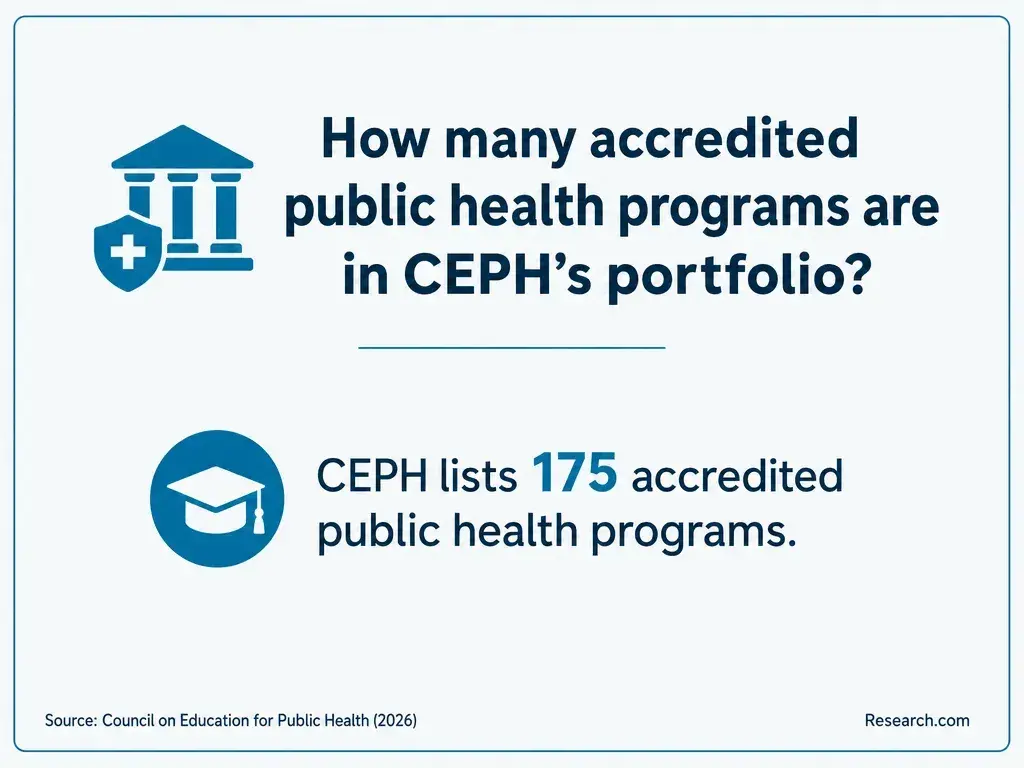
CEPH-accredited MPH education includes foundational competencies and an integrative learning experience in which students synthesize competencies in a high-quality written product. CEPH does not prescribe one universal capstone dataset or require every student to collect primary data. The school identifies the competencies and assessment expectations applicable to its degree and project.
Map the proposed work to your program's rubric before requesting data. A well-scoped secondary-data brief might demonstrate evidence appraisal, selection and interpretation of quantitative methods, attention to population needs, and communication to a public health audience.
It will not demonstrate a competency simply because that competency is named in the proposal; the deliverable must show the work. Ask the capstone coordinator whether a data-only analysis meets the integrative requirement and whether an applied practice experience is assessed separately.
Prospective students can use an online public health master's accreditation guide as a starting point, then confirm the exact degree's accreditation scope and current integrative-learning rules with the program.
Work backward from the intended decision, rather than forward from an interesting download. This sequence turns a broad interest into a question that can survive real data constraints.
- Name the audience and decision: for example, whether a community organization should investigate a possible service gap.
- Specify the population, location, outcome or indicator, comparison, and time period the decision requires.
- Check candidate sources for those exact fields, an appropriate unit of analysis, usable denominators, and enough observations for the proposed comparison.
- Choose the least complex defensible analysis, identify an alternative source or narrower question, and get advisor and partner approval before substantial work begins.
For example, if a student wants to assess neighborhood access to a service but only county-level indicators are available, the honest options are to seek an authorized local source or reframe the deliverable as county-level context.
A county average is not a neighborhood estimate. Prospective MPH students still assessing their preparation can consider public health master's provisional admission pathways, but admission flexibility does not replace the methods preparation needed for a sound capstone.
"Existing" and "deidentified" do not mean "free to use for any purpose." Public files, restricted research files, identifiable partner records, and protected health information carry different access and security obligations. Small cells, precise locations, and linked files can also increase reidentification risk even when names are absent.
Before receiving partner data, ask who owns them, which uses and outputs are authorized, where files may be stored, who may access them, when they must be deleted, and whether the partner must review results before release.
Follow the institution's process for determining whether the activity is human-subjects research and needs institutional review board review; do not make that determination solely from the fact that the data were collected earlier. HIPAA may apply to covered entities and their arrangements, but it is not a blanket rule for every public dataset.
Permissions belong to the project, not to an admissions application. For students still entering the field, public health graduate applications without references addresses a separate hurdle; neither an offer of admission nor a willing partner grants data-use approval.
Online delivery can make meetings and analysis possible from a distance, but it does not guarantee a flexible capstone schedule. Useful support includes a faculty advisor with relevant methods expertise, access to required software or secure computing, library help with source documentation, timely feedback on drafts, and a clear route for ethics and partner approvals.
Ask when proposals must be approved, how often advising meetings occur, whether sessions are live, and what happens if access to a dataset falls through. Students balancing work or caregiving should also check group-work obligations and the time between proposal, analysis, partner review, and final submission. An asynchronous course does not make a partner's approval process asynchronous.
Students comparing online education schedules across levels may also encounter public health bachelor's accelerated study schedules; those course lengths do not predict the advising or approval timeline for an MPH capstone.
How Should Students Present Findings From an Alternative Capstone Data Source?
Present the work for its intended decision-maker, then make the analysis inspectable. A concise brief or report should state the decision, question, source and release, population, measures, exclusions, analytical approach, findings, limitations, and recommended next step. Figures need clear labels, units, time periods, and denominators; estimates should not be described as effects unless the design supports that interpretation.
Keep a data dictionary, source citations, documented transformations, and code or calculation notes so an advisor can reproduce the work where permitted. Separate observed findings from recommendations. If a partner needs an outreach decision, explain what the data suggest investigating next rather than claiming that an untested intervention will work.
For a portfolio, use only material approved for sharing. Remove restricted records, small-cell disclosures, confidential partner details, and identifying metadata; where necessary, show a blank template or a clearly labeled demonstration instead of the real output.
Students using a project to demonstrate academic readiness may find low-GPA public health graduate application strategies helpful, but should never imply that a proposed or redacted artifact is a completed, partner-approved evaluation.
Before submission, have the advisor check competency alignment and the partner check any authorized, partner-facing deliverable. Revise claims that outrun the data, and retain a shareable version only if the applicable permissions allow it.
Other Things You Should Know About Public Health
Tell your advisor promptly. Use the backup source or narrower question identified in your proposal, and obtain approval for any material change before redoing the analysis.
Not necessarily. The required software depends on the dataset, analysis, and program. Ask whether the school provides licenses, secure access, or support for an approved free alternative before purchasing anything.
Possibly, if the work and publication plans justify authorship under the applicable guidelines. Discuss contributions, review rights, and permissions early; supplying data alone does not automatically settle authorship.
Share code when your program and data-use terms permit it, after checking for embedded credentials, confidential paths, and sensitive outputs. If public release is prohibited, submit reproducible documentation through an approved institutional channel.
- HIPAA Privacy Rule | cdc.gov https://www.cdc.gov/nhsn/hipaa/index.html
- Secondary Research - OHSRP https://irbo.nih.gov/irb-review/secondary-research/
- MPH Capstone experiences: promising practices and lessons learned | nih.gov https://pmc.ncbi.nlm.nih.gov/articles/PMC10213715/
- Summary of the HIPAA Security Rule | hhs.gov https://www.hhs.gov/hipaa/for-professionals/security/laws-regulations/index.html
- Types of IRB Review | Thomas Edison State University https://www.tesu.edu/about/leadership-departments/institutional-review-board/types-of-irb-review.php
- Finding Data: Evaluating Datasets and Data Sources | umaryland.edu https://guides.hshsl.umaryland.edu/finding-data/data-quality
- Data Use Agreements (DUAs) | Division of Research | Brown University https://division-research.brown.edu/research-cycle/conduct-research/research-data-management/data-use-agreements-duas
- Study Design - MSU CSTAT https://cstat.msu.edu/resources/beginners-guide/study-design
- Thesis or Capstone: HSPop MPH | Health Systems and Population Health https://hspop.uw.edu/hspopmph/program-experience/thesis-capstone/
- Determining if IRB Review is Needed | fiu.edu https://research.fiu.edu/irb/determine-irb-review/