2027 Geoscientist Careers: Skills, Education, Salary & Job Outlook

Co-Founder and Chief Data Scientist
Choosing a geoscientist career means deciding whether you want work that combines field investigation, data analysis, environmental problem-solving, and technical reporting. It can be a strong fit if you are interested in Earth systems, natural resources, climate and environmental risk, infrastructure safety, or subsurface exploration.
The path usually requires a science-heavy education, practical field experience, and, for some roles, professional licensure. That can make the career feel demanding at the start. The upside is that geoscientists can qualify for stable, skilled roles across consulting, government, energy, environmental services, engineering, and research. This guide explains what geoscientists do, the skills and credentials employers value, salary and job outlook data, work settings, advancement options, and related careers to compare before committing to this path.
Key Things You Should Know About Geoscientist Careers
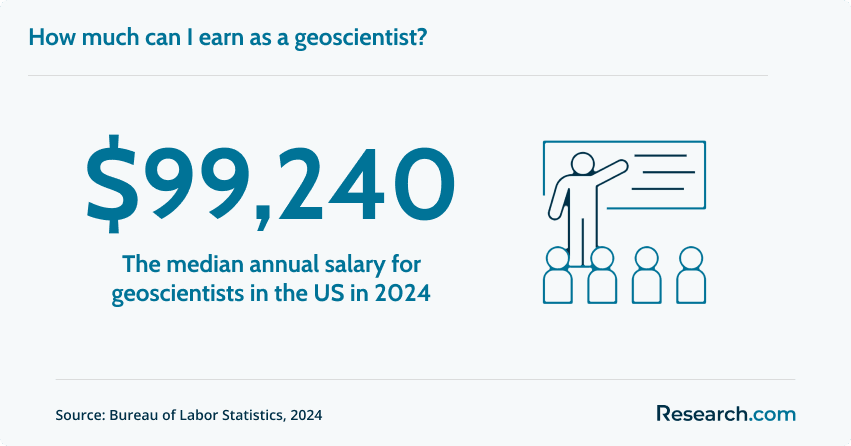
- The typical earning potential for geoscientists in the United States is a median annual wage of $99,240 as of May 2024.
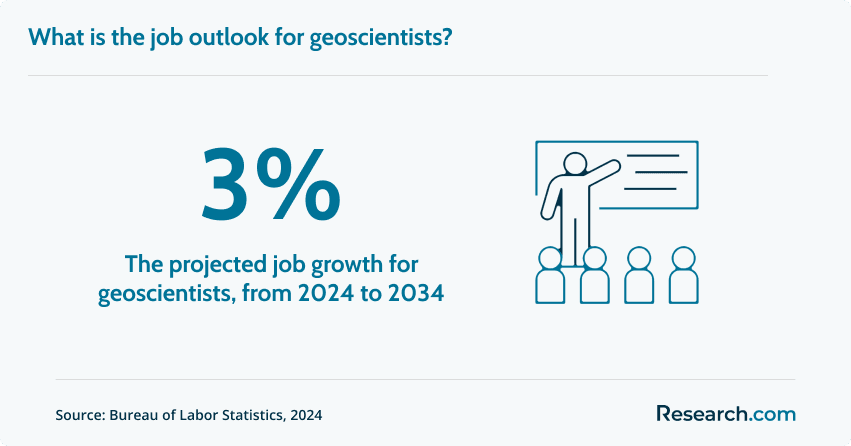
- This field is stable and growing, with employment projected to increase by 3% from 2024 to 2034, matching the average growth rate for all occupations.
- A bachelor's degree in geoscience or a related field is generally required to start, with many roles preferring a master's degree and most geoscientists needing a state-issued license.
- Key skills for success include strong analytical abilities, close attention to detail, critical thinking, effective communication, problem-solving, and proficiency in fieldwork.
- Career advancement often moves from entry-level roles to project lead or senior geoscientist positions, with opportunities to progress into management, specialized consulting, or research by gaining advanced degrees and professional licensure.
What do geoscientists do?
Geoscientists study the physical structure, composition, history, and processes of the Earth. Their work helps organizations understand what lies below the surface, how land and water systems behave, and what risks or resources may exist in a specific location.
In practical terms, geoscientists collect and interpret data about rocks, soil, groundwater, minerals, fossil fuels, earthquakes, volcanoes, contamination, erosion, and other Earth-related conditions. Their findings can influence construction plans, environmental cleanup, water management, energy exploration, land-use decisions, and public safety planning.
A day in the life of geoscientists
A geoscientist’s day can vary widely by employer and project. One week may involve field sampling, mapping, and site inspections. Another may focus on lab analysis, GIS mapping, 3D modeling, technical writing, or meetings with engineers, environmental scientists, regulators, and clients.
The job is not only about collecting scientific evidence. Geoscientists must turn complex findings into recommendations that decision-makers can use. A strong report may help determine whether a site is safe for development, where groundwater contamination may be moving, or whether a resource project is technically and environmentally feasible.
What are the key responsibilities of geoscientists?
Geoscientists are responsible for gathering reliable Earth science data, interpreting it accurately, and communicating what it means for a project or policy decision. The exact duties depend on the role, but most positions combine fieldwork, analysis, documentation, and collaboration.
- Plan and conduct field studies, including site visits, surveys, sample collection, and geologic mapping.
- Analyze rock, soil, sediment, and water samples using laboratory and field methods.
- Use GIS, aerial imagery, remote sensing data, and modeling tools to create maps, cross sections, and subsurface interpretations.
- Evaluate geological hazards, environmental conditions, groundwater behavior, or resource potential.
- Prepare technical reports, presentations, maps, and recommendations for clients, agencies, or internal teams.
- Coordinate with engineers, environmental professionals, drilling crews, construction teams, regulators, and community stakeholders.
- Supervise junior staff, field crews, or laboratory workflows as experience grows.
- Support environmental compliance, site remediation, resource management, hazard mitigation, or infrastructure planning projects.
The most challenging vs. the most rewarding tasks
The most challenging part of the job is often fieldwork. Geoscientists may work in remote areas, rough terrain, extreme weather, industrial sites, or locations with safety hazards. Data collection must still be precise, because poor field notes or sampling errors can weaken an entire project.
The most rewarding part is seeing scientific work affect real decisions. A geoscientist may help protect groundwater, reduce construction risk, support responsible resource use, or identify hazards before they threaten communities. Students who want a shorter entry point into a technical field may also compare introductory options such as a 6-month online certification program that pays well, although most professional geoscientist roles require more extensive college-level science training.
What are the key skills for geoscientists?
Geoscientists need more than a strong background in geology. Employers look for professionals who can collect defensible data, use technical tools, interpret uncertainty, and explain findings to people who may not have a science background.
Core technical skills
- Geology and Earth systems knowledge: Understanding minerals, rocks, stratigraphy, tectonics, geomorphology, hydrology, and Earth processes.
- Field data collection: Measuring, sampling, mapping, logging, and documenting site conditions accurately.
- GIS and spatial analysis: Using Geographic Information Systems to map field observations, environmental data, resource zones, and geologic features.
- Geological modeling: Building cross sections, 3D models, simulations, or conceptual site models to interpret subsurface conditions.
- Laboratory analysis: Applying techniques such as X-ray methods, microscopy, and geochemical testing to study material properties.
- Data analysis: Managing datasets, checking quality, recognizing patterns, and drawing conclusions from incomplete or uncertain information.
Key soft skills
- Analytical thinking: Interpreting evidence carefully and avoiding conclusions the data does not support.
- Attention to detail: Maintaining accurate field notes, sample labels, measurements, maps, and reports.
- Communication: Writing clear technical reports and explaining findings to clients, regulators, managers, or the public.
- Collaboration: Working productively with engineers, environmental scientists, drillers, laboratory staff, project managers, and community representatives.
- Judgment under uncertainty: Making practical recommendations when subsurface conditions are complex and data is limited.
The one overlooked skill that separates the good from the great
One of the most underrated skills is stakeholder engagement. Strong geoscientists do not work in isolation; they learn how to listen to engineers, environmental specialists, landowners, regulators, business leaders, and community members. That collaboration can prevent misunderstandings, reduce project delays, and improve the quality of recommendations.
For example, a geoscientist working on a resource exploration project may need to integrate geological evidence with environmental concerns, engineering limits, permitting requirements, and local community priorities. The best professionals can explain trade-offs without overselling certainty.
Technical depth matters, especially in high-paying sectors such as oil and gas extraction, but long-term career growth often depends on communication and cross-disciplinary problem-solving. Students comparing academic paths can also review easy majors, while keeping in mind that geoscience itself is typically science-intensive and requires strong quantitative preparation.
Geoscientist Careers: A Step-by-Step Guide to Getting Started
Starting a geoscience career is easier to plan when you separate the path into education, experience, credentials, and specialization. The sequence below reflects the usual progression from student to working professional.
- Build a science foundation: Complete coursework in geology, chemistry, physics, mathematics, biology, environmental science, computer science, and data analysis. Prioritize programs with field methods, lab work, and GIS training.
- Choose a relevant degree path: Most aspiring geoscientists pursue geoscience, geology, environmental science, or a closely related major with substantial geology coursework.
- Gain field and laboratory experience: Look for field camps, internships, undergraduate research, mapping projects, environmental consulting placements, government internships, or work with faculty research groups.
- Build technical evidence of your skills: Create a portfolio of maps, field reports, GIS projects, modeling work, lab analyses, or research posters where appropriate. Employers value proof that you can work with real data.
- Consider licensure or early credentials: Some states and roles require or prefer credentials such as the Geologist-in-Training (GIT) Certificate and, later, the Professional Geologist (PG) License.
- Apply for entry-level roles strategically: Search for titles such as staff geologist, entry-level geoscientist, environmental geologist, field geologist, GIS technician, hydrogeology assistant, or geotechnical field professional.
- Specialize over time: As you gain experience, move toward areas such as environmental geology, hydrogeology, geophysics, petroleum and energy geoscience, GIS, natural hazards, or marine geology.
The strongest candidates combine academic preparation with practical field judgment. A transcript alone is rarely enough; employers want to see that you can collect data safely, document it properly, analyze it with the right tools, and explain what it means.
What education, training, or certifications are required?
Most professional geoscientist roles require at least a bachelor's degree. Common majors include Bachelor of Science in geoscience, geology, or environmental science. Degrees in physics, chemistry, biology, mathematics, engineering, or computer science may also be acceptable when they include substantial geology coursework.
Course selection matters. Students should look for programs that include mineralogy, petrology, sedimentology, stratigraphy, structural geology, geophysics, hydrogeology, geochemistry, field methods, GIS, statistics, and technical writing. Employers often place high value on field experience because geoscientists must make accurate observations outside controlled classroom settings.
Important credentials include the Professional Geologist (PG) License, issued by the National Association of State Boards of Geology (ASBOG), and the Geologist-in-Training (GIT) Certificate, which is commonly used as an early-career credential. Licensure requirements vary by state, so students should check the rules in the state where they plan to work.
Training often includes mandatory summer field camps lasting 4-6 weeks, with a focus on geologic mapping, measurement, field notes, and field interpretation. Internships with private industry, government agencies, environmental consulting firms, energy companies, or academic research groups can also make a major difference in employability. There are no formal residency or supervised-hour requirements initially, but hands-on field and lab work during education is critical to career readiness.
Are advanced degrees or niche certifications worth the investment?
A Master of Science or Ph.D. in geoscience or a related field can be valuable for specialized technical roles, research positions, university teaching, and leadership tracks. Graduate study can also help candidates move into areas such as hydrogeology, geophysics, geochemistry, petroleum geology, environmental remediation, or natural hazards research.
However, graduate school is not automatically required for every geoscientist job. Many entry-level roles are accessible with a bachelor's degree, especially when the candidate has strong field experience, GIS skills, internships, and good references. The return on investment is strongest when the advanced degree is tied to a clear career goal.
Before committing to a long degree path, compare program outcomes, field opportunities, faculty expertise, licensure alignment, and total cost. Students still building toward a bachelor's degree may also review stepping-stone options such as the quickest associates degree programs, while confirming that credits will transfer into a geoscience-related bachelor's program if that is the goal.
What is the earning potential for geoscientists?
Geoscientists can earn strong salaries, but pay varies significantly by industry, location, education, specialization, and experience. According to the latest U.S. Bureau of Labor Statistics data for May 2024, the median annual wage for geoscientists is $99,240.
The geoscientist salary range 2025 spans from about $56,180 for workers near the lower end of the field to $172,490 for those in the top 10% of earners. This range is wide because geoscientist jobs are not concentrated in one type of employer. A field geologist at an environmental consulting firm, a hydrogeologist working on water resources, a government scientist, and an experienced geoscientist in oil and gas extraction may have very different pay levels.
Several factors can raise earning potential over time. Advanced technical skills, licensure, project management experience, specialized software expertise, graduate education, and work in higher-paying industries can all improve compensation. Geoscientists in oil and gas extraction or in resource-rich states such as Texas or California often earn more than peers in some government or academic roles.
When evaluating salary, look beyond the headline number. Field travel, overtime expectations, benefits, job stability, relocation requirements, and industry cycles can affect the real value of a position. A higher-paying role may also come with more travel, longer field assignments, or greater exposure to commodity market changes.
What is the job outlook for geoscientists?
The job outlook for geoscientists is stable but not uniform across all industries. The field shows a growth rate of 5% through 2032 and 3% from 2024 to 2034, which is about as fast as the average for all occupations.
The key factors shaping the future outlook
Demand for geoscientists is shaped by several forces. Environmental regulation, groundwater protection, infrastructure development, climate-related risk, natural hazard planning, and resource management can create steady need for Earth science expertise. At the same time, employment tied to energy and mineral exploration can rise or fall with commodity prices and investment cycles.
Retirement of baby-boomer geologists is another important factor because it can create openings even when overall job growth is moderate. Employers may especially need candidates who can combine classic field geology with GIS, modeling, data analysis, remote sensing, and clear technical writing.
Students preparing for this market should choose programs carefully. Look for field training, lab access, career services, internship connections, and coursework that matches the sector you want to enter. If flexibility is important, a list of best universities online can help you compare options, but make sure any program you choose includes the field and lab preparation needed for geoscience work.
What is the typical work environment for geoscientists?
Geoscientists usually split their work between offices, laboratories, and field sites. Office work may include data interpretation, GIS mapping, modeling, report writing, meetings, permitting support, and client communication. Laboratory work may involve sample preparation, testing, microscopy, or geochemical analysis. Fieldwork may involve mapping, drilling oversight, sampling, monitoring wells, geophysical surveys, or site inspections.
Common industries include architectural, engineering, and related services (25%), management, scientific, and technical consulting services (23%), and oil and gas extraction (12%). These settings can differ sharply. Consulting roles may involve multiple client sites and deadlines. Government roles may focus on regulation, public lands, water, hazards, or research. Energy roles may involve exploration, production support, or resource evaluation.
The typical work schedule is around 40 hours per week, but field assignments can require longer days, early starts, travel, and occasional weekend work. Some analysis, reporting, and meetings can be done remotely, but fully remote work is limited because many geoscience roles depend on site-specific field observations and sample collection.
Before choosing this career, consider your comfort with travel, outdoor work, safety protocols, variable weather, and project-based schedules. The work can be highly rewarding, but it is not always a desk-only science career.
What are the pros and cons of geoscientist careers?
Geoscience can be a meaningful and intellectually engaging career, but it also comes with practical trade-offs. The best fit is usually someone who enjoys science, problem-solving, outdoor work, data interpretation, and technical communication.
Pros
- Meaningful impact: Geoscientists help address environmental protection, groundwater safety, resource management, construction risk, and natural hazards.
- Varied work: The career can include fieldwork, lab analysis, mapping, modeling, consulting, research, and public-facing communication.
- Strong technical identity: Professionals build specialized expertise that can transfer across environmental, engineering, energy, government, and research settings.
- Problem-solving depth: The work requires interpreting incomplete evidence and connecting observations across time, space, and physical systems.
- Advancement potential: Experienced geoscientists can move into senior technical, project management, regulatory, research, or leadership roles.
Cons
- Field demands: Travel, difficult terrain, remote sites, weather exposure, and physical tasks can be part of the job.
- Variable schedules: Field campaigns, drilling schedules, emergency response, or client deadlines may require longer or irregular hours.
- Industry sensitivity: Some roles, especially in extraction-related sectors, can be affected by commodity prices and investment cycles.
- Licensure complexity: Requirements vary by state and role, so career planning may involve exams, experience documentation, and continuing education.
- High responsibility: Mistakes in data collection or interpretation can affect safety, environmental decisions, budgets, and public trust.
Students considering online study should verify accreditation, transferability, field requirements, and whether the program supports the licensing or employment path they want. A review of what online schools are nationally accredited can be a useful starting point, but program fit for geoscience matters just as much as institutional status.
What are the opportunities for advancement for geoscientists?
Geoscientists can advance by becoming stronger technical experts, managing larger projects, earning licensure, completing graduate study, or specializing in a high-demand area. Career growth is often tied to both scientific judgment and the ability to lead teams, manage budgets, communicate risk, and advise decision-makers.
Common advancement path
- Entry-level geoscientist or Geologist-in-Training: Supports fieldwork, sampling, mapping, data entry, lab coordination, and report preparation.
- Project geologist or mid-level geoscientist: Takes on more independent analysis, client communication, field planning, and technical writing.
- Senior geoscientist: Leads investigations, reviews technical work, mentors junior staff, and makes higher-level recommendations.
- Principal geoscientist or technical specialist: Provides expert review, handles complex projects, supports litigation or regulatory matters, and guides organizational standards.
- Geoscience manager or director: Oversees teams, budgets, strategy, business development, compliance, and long-term planning.
Specialization opportunities
- Environmental geology: Site assessment, contamination studies, remediation, permitting, and sustainability-related work.
- Hydrogeology and water resource management: Groundwater flow, aquifer protection, water quality, well monitoring, and water supply planning.
- Petroleum & energy geoscience: Exploration, reservoir characterization, subsurface interpretation, and energy resource development.
- Geoinformatics / GIS: Spatial analysis, remote sensing, digital mapping, modeling, and data-driven geoscience applications.
- Marine geology and oceanography: Sedimentology, coastal processes, seabed mapping, and ocean floor research.
- Volcanology and seismology: Earthquake and volcano research, monitoring, hazard assessment, and risk communication.
Strong advancement candidates usually combine technical credibility with leadership habits: documenting work carefully, explaining uncertainty, managing field risk, mentoring staff, and making recommendations that are scientifically sound and practical.
What other careers should you consider?
If you are interested in geoscience but not sure the geoscientist path is the best match, compare nearby careers that use similar scientific and analytical skills. The right alternative may depend on whether you prefer fieldwork, lab work, engineering problems, water systems, environmental policy, or data-heavy modeling.
- Geophysicist: Uses physics, mathematics, and instruments to study Earth’s structure and subsurface properties. This path is often more quantitative and may appeal to students who like modeling and signal interpretation.
- Hydrogeologist: Focuses on groundwater movement, water quality, aquifers, wells, and contamination. This is a strong option for those interested in water resources and environmental protection.
- Environmental scientist: Studies pollution, ecosystems, environmental impacts, and sustainability solutions. This path may involve broader regulatory and ecological work than traditional geology roles.
- Engineering geologist: Evaluates ground conditions for construction, slope stability, tunnels, dams, roads, and hazard mitigation. It is a good fit for students who want to connect geology with infrastructure safety.
- Geochemist: Studies the chemical composition and reactions of Earth materials. This role is often more lab- and data-focused and may connect to environmental, resource, or research applications.
When comparing options, ask what type of work you want most: outdoor site work, laboratory analysis, environmental problem-solving, engineering support, resource exploration, public-sector science, or advanced research. That preference should guide your choice of major, internships, electives, and graduate training.
Here's What Professionals Say About Their Geoscientist Careers
- Joe: "Fieldwork is demanding, but there is nothing quite like standing face-to-face with the Earth’s raw formations. I remember hiking for hours to reach a remote outcrop and realizing that one rock layer could reveal part of the planet’s history. The more I study Earth systems, the more I understand how much they can teach us about the past and the risks ahead. It is humbling to know that my work supports environmental understanding and protection in practical ways."
- Jackson: "Early in my career, I made a measurement error during a structural survey that could have affected the quality of the project data. Being corrected by a senior geologist was difficult, but it taught me how much precision matters in the field. That experience later shaped how I mentor younger geologists. I want them to build good habits early, ask questions, and understand that careful methods are the foundation of trustworthy science."
- Elena: "Working as an industry geologist has pushed me to turn theory into practical recommendations every day, whether I am analyzing core samples or advising on resource management. I have worked across multiple subfields, which has made me more adaptable and opened the door to varied projects. The most satisfying part is translating complex geological evidence into decisions that people can actually use."
Key Findings
- Geoscientists study Earth materials, structures, processes, resources, and hazards to support decisions in environmental, engineering, energy, government, and research settings.
- Most roles require at least a bachelor’s degree in geoscience, geology, environmental science, or a closely related field with substantial geology coursework.
- Field experience is essential. Summer field camps lasting 4-6 weeks, internships, mapping projects, lab work, and GIS experience can strengthen job readiness.
- Important credentials may include the Geologist-in-Training (GIT) Certificate and the Professional Geologist (PG) License, depending on state rules and job requirements.
- The median annual wage for geoscientists is $99,240, based on U.S. Bureau of Labor Statistics data for May 2024.
- The geoscientist salary range 2025 spans from about $56,180 to $172,490, with earnings affected by industry, location, experience, licensure, and specialization.
- The job outlook shows growth of 5% through 2032 and 3% from 2024 to 2034, which is about as fast as the average for all occupations.
- This career is best suited for people who are comfortable combining fieldwork, technical analysis, scientific uncertainty, teamwork, and clear communication.
Other Things You Should Know About Geoscientist Careers
In 2027, AI and automation are enhancing geoscientist careers through improved data analysis and prediction models. These technologies allow geoscientists to efficiently interpret complex datasets, increasing accuracy in projects related to natural resource management and environmental assessments.
Employers expect geoscientists to use GIS, remote sensing, and data analysis software such as ArcGIS, QGIS, MATLAB, Python, and Petrel. Many entry-level roles also require spreadsheet modeling and basic database skills, because modern field and lab data are processed digitally.
In 2027, the demand for geoscientists is anticipated to grow due to a surge in the need for energy resources and environmental management solutions. This growth is fueled by increased exploration and sustainable resource management efforts. Opportunities are expected to rise in both public and private sectors.
References
- AGI Press Release - Geoscience Employment - American Institute of Professional Geologists https://aipg.org/news/696255/AGI-Press-Release---Geoscience-Employment.htm
- Main navigation https://careersportal.ie/careers/detail.php
- Becoming a Geologist: Job Description & Salary Info https://learningpath.org/articles/Becoming_a_Geologist_Job_Description_Salary_Info.html
- Geologist https://www.princetonreview.com/careers/72/geologist
- Geoscience Careers https://education.americangeosciences.org/resources/geoscience-careers/
- Salary Information https://www.geolsoc.org.uk/Geology-Career-Pathways/Careers/Salary-Information.html
- What Does a Geoscientist Do? - Unity Environmental University https://unity.edu/careers/geoscientist/
- Profiling the geoscience community: exploring patterns of science communication and public engagement https://jcom.sissa.it/article/pubid/JCOM_2404_2025_A04/
- 6 Geoscientist Job Description Templates and Examples | Himalayas https://himalayas.app/job-descriptions/geoscientist
- Geoscientists : Occupational Outlook Handbook: : U.S. Bureau of Labor Statistics https://www.bls.gov/ooh/life-physical-and-social-science/geoscientists.htm