
2027 What Does a Public Health Data Analyst Do: Responsibilities, Requirements, and Salary

Co-Founder and Chief Data Scientist
Public health data analysts sit at the intersection of healthcare, statistics, policy, and technology. If you want a data career where the work can influence vaccination campaigns, disease surveillance, health funding, emergency response, and access to care, this role is worth serious consideration.
The career is especially relevant now because health organizations are collecting more information than ever—from electronic health records and insurance claims to community surveys and disease dashboards. The challenge is not simply having data; it is knowing which data is reliable, what it means, and how to turn it into decisions that improve population health. In the US, one related role, data scientist, is projected to grow by 34% through 2034, much faster than the average for all occupations.
This guide explains what public health data analysts do, what data and tools they use, how they influence programs and policy, what education and experience employers look for, where they work, how much they can earn, and how to decide whether this career fits your strengths and goals.
Key Things You Should Know About What a Public Health Data Analyst Does
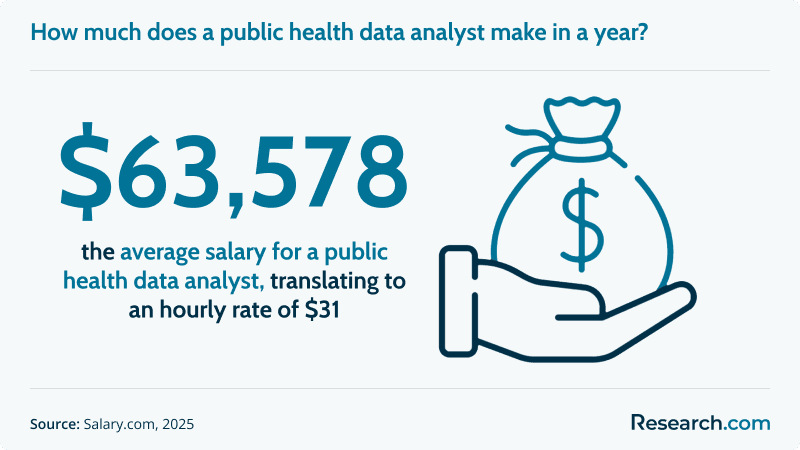
- The average salary for a public health data analyst in the U.S. is around $63,578 per year.
- The core of the job is collecting, cleaning, and analyzing health data to help leaders make better public health decisions.
- To succeed in this role, you’ll need key technical skills in SQL, a programming language like R or Python, and a data visualization tool like Tableau.
- While many work for the government, the private sector is the largest employer, accounting for nearly half of all jobs in the field.
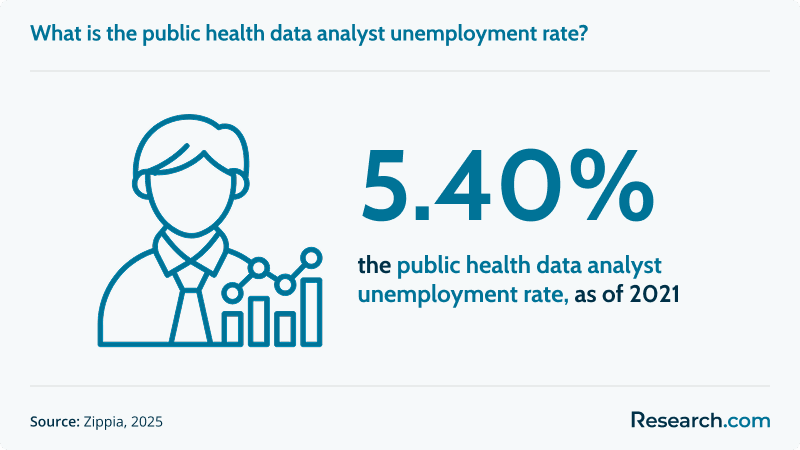
- The career offers good stability, with a relatively low unemployment rate of 5.4% according to the most recent data.
What are the primary day-to-day responsibilities of a public health data analyst?
A public health data analyst turns health information into evidence that organizations can use. The work is usually cyclical: gather data, check its quality, analyze it, interpret the results, and communicate what should happen next. The role is technical, but its purpose is practical—helping leaders understand health risks, program performance, and community needs.
Some analysts also build knowledge in adjacent areas such as privacy, security, and cloud systems. For example, professionals interested in protecting sensitive health information may explore accelerated CCSP online training as part of a broader data security skill set.
Common day-to-day responsibilities include:
- Collecting and acquiring data. Analysts identify useful data sources such as hospital records, public health registries, disease surveillance systems, insurance claims, laboratory reports, and community surveys.
- Cleaning and preparing datasets. Health data is rarely ready for analysis when it arrives. Analysts remove duplicates, correct coding problems, standardize formats, handle missing values, and document how the dataset was prepared.
- Analyzing trends and relationships. They use statistical methods to examine patterns such as disease incidence, vaccination rates, hospitalization trends, risk factors, and differences across populations.
- Building models and reports. Depending on the job, analysts may create dashboards, forecast service demand, evaluate intervention results, or develop models that help identify high-risk groups.
- Interpreting findings in context. Numbers alone are not enough. Analysts connect results to public health concepts, program goals, population characteristics, and possible limitations in the data.
- Communicating recommendations. They translate technical findings into clear reports, presentations, maps, charts, and dashboards for health officials, clinicians, nonprofit leaders, researchers, and policymakers.
What makes the role different from general data analysis?
The difference is context. A general data analyst may focus on revenue, operations, marketing, or user behavior. A public health data analyst works with questions that affect communities: Which groups are underserved? Is an intervention reducing hospital visits? Where is an outbreak spreading? Are health disparities widening or narrowing?
That context raises the stakes. Good public health analysis must be accurate, ethical, explainable, and useful to people who may not have a technical background.
What kinds of health data do public health data analysts work with?
Public health data analysts work with many types of structured and unstructured information. Some datasets describe individuals, while others describe neighborhoods, facilities, programs, or entire populations. The analyst’s job is to understand what each dataset can and cannot answer.
Common data sources include:
- Electronic Health Records (EHR). Hospital and clinic records may include diagnoses, procedures, medications, lab results, visit history, and patient demographics.
- Disease surveillance data. Agencies such as the CDC collect and report data used to monitor outbreaks, track infectious diseases, and identify emerging risks.
- Community health surveys. Survey data can capture behaviors, access barriers, chronic disease indicators, self-reported health, and social needs.
- Census and demographic data. Population-level information helps analysts compare health outcomes by age, location, income, race, ethnicity, household structure, and other characteristics.
- Clinical trial and research data. These datasets support evaluation of treatments, interventions, and health outcomes under defined study conditions.
- Claims and billing data. Insurance and payment data can reveal utilization patterns, costs, service gaps, and potential fraud or waste.
- Geographic and environmental data. Location-based data can show how health outcomes relate to housing, transportation, pollution, food access, or distance from care.
A duty to protect sensitive information
Public health data can contain deeply personal information. Analysts must understand privacy, security, consent, and responsible data use. In many roles, this includes working within the requirements of the Health Insurance Portability and Accountability Act (HIPAA) and organizational data governance policies.
Ethical analysis also means avoiding misleading conclusions. A dataset may underrepresent certain communities, miss people without access to care, or reflect historical inequities in diagnosis and treatment. Strong analysts flag these limitations instead of presenting results as more certain than they are.
What tools and software do public health data analysts use?
Public health data analysts use tools for storing, querying, cleaning, analyzing, visualizing, and mapping data. You do not need to master every platform to enter the field, but employers commonly expect practical ability with databases, statistics, spreadsheets, and visualization tools.
- SQL for database querying. SQL is used to pull, join, filter, and summarize data from relational databases. It is one of the most important skills for working with large health datasets.
- R or Python for statistical programming. These languages support data cleaning, statistical analysis, reproducible workflows, and predictive modeling.
- Tableau or Power BI for visualization. These tools help analysts create dashboards, charts, and reports that nontechnical stakeholders can use.
- ArcGIS or QGIS for geographic analysis. Geographic Information Systems (GIS) are used to map disease patterns, service locations, environmental exposures, and health disparities by place.
- Spreadsheets for quick analysis and review. Excel or similar tools are still common for basic cleaning, summaries, quality checks, and collaboration.
How to prioritize tools when you are starting
If you are new to the field, start with SQL and one statistical language, usually R or Python. Then add a visualization tool such as Tableau or Power BI. GIS is especially valuable if you want to work in outbreak response, environmental health, urban health, health equity, or community planning.
Specializing in geographic analysis can open a distinct career direction. If that path interests you, it is worth reviewing what can you do with a geographic information systems degree to understand how spatial data skills can apply beyond traditional public health roles.
Public health data analysts help organizations move from assumptions to evidence. Their work can show where a problem is happening, who is most affected, whether an intervention is working, and where resources should be directed.
For example, an analyst may identify a spike in flu cases in a specific neighborhood, giving a local health department evidence to focus vaccination outreach there. Another analyst may evaluate whether a maternal health program reduced complications or whether a substance use initiative reached the intended population. In broader policy work, analysts can help produce the evidence used to support measures such as seatbelt requirements or restrictions on smoking in public places.
Where analysis changes decisions
- Program planning. Data helps organizations decide which communities, age groups, or risk factors to prioritize.
- Resource allocation. Analysis can guide where to place clinics, mobile units, prevention campaigns, or emergency supplies.
- Program evaluation. Analysts measure whether a program achieved its goals, reached the right population, and used resources effectively.
- Grant funding and reporting. Strong data can support funding applications and show funders whether outcomes were achieved.
- Policy development. Evidence helps policymakers justify decisions and anticipate possible impacts.
Evidence is useful only when it is understandable
The analyst’s contribution is not complete when the statistical output is finished. Public health leaders need findings that are clear, credible, and actionable. A strong analyst explains what changed, why it matters, how confident the organization can be, and what options decision-makers should consider next.
Public health data analysts need both technical skill and public health judgment. Technical ability helps you manage and analyze information; analytical judgment helps you avoid weak conclusions, spot bias, and connect results to real-world health decisions.
Core technical skills
- SQL. You should be able to query databases, join tables, filter records, aggregate results, and troubleshoot data quality issues.
- R or Python. Employers often look for the ability to clean data, run statistical tests, automate workflows, and produce reproducible analysis.
- Statistics. You need comfort with descriptive statistics, rates, confidence intervals, regression, sampling, study design, and interpretation of uncertainty.
- Data visualization. Analysts must create charts, dashboards, maps, and tables that make patterns clear without oversimplifying the findings.
- Data management. Strong documentation, version control, file organization, and quality checks matter because public health decisions may depend on your work.
Public health and analytical skills
- Epidemiology basics. Understanding incidence, prevalence, risk, exposure, confounding, and surveillance is central to the role.
- Health equity awareness. Analysts should understand social determinants of health and how data can reveal or obscure disparities.
- Critical thinking. You need to ask whether the data source is appropriate, whether the sample is biased, and whether the conclusion follows from the evidence.
- Problem framing. A good analyst turns a broad concern into a specific, answerable question.
- Communication. You must explain methods, limitations, and recommendations to audiences that may not use statistical language.
The most underrated skill: translating findings
Many people can produce a chart. Fewer can explain what the chart means for a health department director, hospital executive, grant funder, or community partner. The best analysts know how to adjust their message without distorting the evidence. They make the work understandable enough to use and honest enough to trust.
A bachelor’s degree is the most common educational starting point for public health data analysts. In fact, 56% of professionals in the field hold a Bachelor's degree, while 31% have a Master's degree. That means a master’s degree can be valuable, but it is not always required for entry-level work.
Relevant undergraduate majors may include public health, statistics, data science, biology, epidemiology, health informatics, mathematics, computer science, or a related social science with strong quantitative training. What matters most is whether you can demonstrate the skills employers need: data cleaning, statistical analysis, database work, visualization, and public health reasoning.
When a master’s degree can help
A graduate degree may be useful if you want to move into epidemiology, advanced analytics, research leadership, informatics, or management. It can also help career changers build a formal foundation in public health or data systems. For students interested in deeper database and data management preparation, reviewing the best online master’s in database management programs can help clarify available graduate options.
Certification and professional credibility
Certifications are not a universal requirement, but they can strengthen your profile when they align with the job. A credential may be especially helpful if you are trying to prove expertise in health data, analytics, informatics, privacy, or security.
The Certified Health Data Analyst (CHDA) credential is one example of a specialized credential. Only 356 professionals held the Certified Health Data Analyst (CHDA) credential as of 2024, which shows how selective and uncommon some credentials in this area can be.
What employers usually evaluate
- Your degree and relevant coursework
- Your ability to use SQL, R, Python, Tableau, Power BI, GIS, or similar tools
- Your understanding of public health concepts and data ethics
- Your internship, research, volunteer, or project experience
- Your portfolio, writing samples, dashboards, or code examples
Public health data analysts work in more settings than many people expect. Government agencies are important employers, but analysts are also hired by hospitals, insurers, universities, consulting firms, nonprofits, foundations, and pharmaceutical companies. The best setting depends on whether you prefer public service, research, operations, policy, community work, or private-sector analytics.
- Private sector. Hospitals, health systems, pharmaceutical companies, consulting firms, and health insurance providers use analysts to evaluate operations, clinical outcomes, patient risk, utilization, claims, and program performance.
- Government. Federal agencies such as the CDC, along with state and local health departments, hire analysts for disease surveillance, emergency response, health reporting, public program evaluation, and policy support.
- Public and nonprofit organizations. Community health organizations, advocacy groups, foundations, and grant-funded initiatives rely on analysts to measure needs, track outcomes, and report impact.
- Education and research institutions. Universities, medical schools, and research centers employ analysts to support studies, manage datasets, publish findings, and contribute to training or teaching.
How work settings differ
Government roles often emphasize population-level surveillance, accountability, and public reporting. Nonprofit roles may be closer to community programs and grant outcomes. Hospital and insurance roles often involve operational, clinical, and financial datasets. University roles may focus more heavily on research methods, publication standards, and study design.
A specialized private-sector niche: fraud and abuse analysis
Some public health data analysts work with billing, claims, and utilization data to identify unusual patterns that may indicate waste, abuse, or fraud. This work requires statistical skill, domain knowledge, careful documentation, and an investigative mindset. Analysts in this area may also study financial investigation concepts or pursue credentials that align with CFE certification requirements.
The average salary for a public health data analyst in the United States is around $63,578 per year. Actual pay can vary widely by employer, location, education, technical skill level, and experience. The number is useful as a baseline, but it should not be treated as a guarantee for any individual job offer.
Factors that influence salary
- Experience level. Entry-level analysts usually focus on data cleaning, standard reports, and defined analyses. Senior analysts take on complex studies, stakeholder communication, project design, and mentoring.
- Education. A master’s degree may improve access to advanced epidemiology, informatics, research, or leadership roles, depending on the employer.
- Technical depth. Strong SQL, R, Python, GIS, dashboarding, machine learning, or data engineering skills can improve competitiveness for higher-paying roles.
- Employer type. Private-sector positions in hospitals, insurance, consulting, or pharmaceutical settings may offer different compensation than government or nonprofit roles.
- Location. Salaries may reflect local labor markets and cost of living, especially in large metro areas.
How to evaluate an offer beyond salary
Compensation is more than base pay. When comparing offers, look at health benefits, retirement contributions, paid leave, remote-work options, tuition support, professional development funding, job stability, and opportunities to build high-value skills. A slightly lower salary may still be a strong choice if the role offers better mentorship, stronger data exposure, or a clearer path to advancement.
A public health data analyst career can progress from technical support work to independent analysis, project leadership, management, and executive-level data strategy. The field also offers stability, with a low unemployment rate of 5.4%.
A typical path may begin with an Analyst I role, where you clean data, run recurring reports, validate datasets, and support senior staff. From there, you may move into Analyst II or Senior Analyst positions, taking ownership of more complex projects, leading analyses, presenting findings, and mentoring junior analysts.
With experience, analysts can move into roles such as Lead Analyst, Epidemiologist, Health Informatics Specialist, Program Manager, Analytics Manager, Director of Analytics, or Chief Health Informatics Officer. The exact ladder depends on the organization and whether you focus on public health practice, research, informatics, management, or advanced data science.
Ways to advance faster
- Build strong SQL and statistical programming skills.
- Learn how to design analyses, not just complete assigned tasks.
- Develop subject-matter expertise in an area such as infectious disease, chronic disease, maternal health, environmental health, health equity, or healthcare quality.
- Practice presenting findings to nontechnical audiences.
- Create a portfolio of dashboards, reports, maps, and reproducible analysis projects.
- Seek roles that expose you to decision-making, not only data processing.
Career flexibility
The skills you build in this role—data management, statistical reasoning, visualization, problem solving, and communication—can transfer to other analytics careers. For example, the same logic used to identify patterns in disease outbreaks can also support performance and trend analysis in other fields, including some sports analytics master's degree jobs.
That flexibility is one of the role’s advantages. You can stay in public health, move deeper into healthcare analytics, shift toward data science, or specialize in informatics, GIS, evaluation, or research.
Experience is often the biggest barrier for new analysts, but it does not have to come only from a full-time job. Employers want evidence that you can work with real data, communicate clearly, and understand public health context. You can build that evidence through internships, research, volunteering, academic projects, and a portfolio.
- Pursue internships. Look for opportunities with local or state health departments, hospitals, university research centers, nonprofits, consulting groups, or public health programs.
- Volunteer with community organizations. Many nonprofits collect useful information but lack analytics support. A small project—such as cleaning survey data or creating a dashboard—can become meaningful experience.
- Use academic projects strategically. Choose capstones, thesis topics, or course projects that involve real public health questions and datasets.
- Build a public portfolio. Download public datasets from trusted sources like the CDC or the World Health Organization and create analyses that show your workflow, findings, and recommendations.
- Document your process. Employers value clean code, clear methods, readable charts, and honest discussion of limitations.
What to include in a strong portfolio
A portfolio does not need dozens of projects. A few well-executed examples are better than many shallow ones. Each project should answer a clear question, use credible data, explain your methods, present findings visually, and discuss what the results do and do not show.
- A disease trend analysis using public surveillance data
- A dashboard tracking a health indicator by location or demographic group
- A GIS map showing geographic differences in access or outcomes
- A program evaluation-style analysis using before-and-after data
- A written brief that explains findings for a nontechnical audience
The goal is to prove that you can do more than run code. You want to show that you can think like a public health analyst: define the problem, handle the data responsibly, interpret results carefully, and communicate what action the evidence supports.
A public health data analyst career is a strong fit if you enjoy working with data and want that work to serve a broader public purpose. It is not the right path for everyone. The job can involve messy datasets, slow-moving institutions, privacy constraints, and the need to explain uncertainty to people who want simple answers. But for the right person, the work can be intellectually challenging and socially meaningful.
You may be a good fit if you:
- Enjoy finding patterns and explanations in complex information
- Care about health equity, prevention, access to care, and community outcomes
- Can balance technical detail with practical communication
- Are patient enough to clean and validate messy data
- Want work that connects analysis to real-world decisions
- Are comfortable explaining limitations instead of overstating certainty
You may want to reconsider if you:
- Want a role focused only on coding with little stakeholder communication
- Prefer fast answers over careful analysis
- Are uncomfortable working with sensitive or regulated information
- Do not enjoy writing reports, presenting findings, or explaining methods
- Want the highest possible data salary and are not especially motivated by public health impact
A final self-assessment
Ask yourself what kind of problems you want your analytical skills to solve. If you are motivated by the idea of using evidence to improve programs, guide policy, identify disparities, and protect communities, this career can be deeply rewarding. The strongest public health data analysts are not only good with numbers; they are careful thinkers who understand that every dataset represents people, places, and decisions that matter.
- : "Using statistics to track disease outbreaks gives me a sense of purpose few jobs can match; it's incredibly rewarding to know my analysis directly shapes community response and saves lives. As a public data health analyst, I learned to translate data into action that promotes genuine public good. — Corey"
- : "The variety in the work is fantastic. One day I'm building dashboards to visualize opioid trends, the next I'm collaborating with epidemiologists and policymakers on a major grant proposal. It requires both intense focus on detail and strong communication, but seeing our research turn into accessible, life-improving policy makes every late night worth it. — Sam"
- : "I love that my role as public data health analyst blends the logic of mathematics with the deep ethical commitment of public service, allowing me to be a voice for vulnerable populations often overlooked in raw datasets. Knowing that the reports I generate help secure funding for essential clinics and health education programs is the emotional highlight of my career. — Cara"
Key Findings
- Public health data analysts turn health information into evidence for programs, policy, funding, surveillance, and community decision-making.
- The role requires a mix of SQL, R or Python, statistics, visualization, data ethics, public health knowledge, and strong communication.
- Public health analysts work with EHR data, disease surveillance data, surveys, claims, census data, clinical trial data, and geographic information.
- A bachelor’s degree is the most common entry point: 56% of professionals in the field hold a Bachelor's degree, while 31% have a Master's degree.
- The average salary for a public health data analyst in the United States is around $63,578 per year, with pay influenced by experience, education, location, employer type, and technical specialization.
- Career growth can lead from Analyst I roles to Senior Analyst, Lead Analyst, Program Manager, Director of Analytics, or Chief Health Informatics Officer positions.
- The best way to break into the field is to build proof of skill through internships, volunteer projects, academic research, and a portfolio using credible public health datasets.
Other Things You Should Know About Being a Public Health Data Analyst
In 2027, while data science or analytics certifications like those from Google or IBM can enhance a public health data analyst's skill set, they are not universally necessary. Instead, a strong foundation in statistics, public health knowledge, and proficiency in relevant software tools are often prioritized by employers.
- American Health Information Management Association (AHIMA). (n.d.). Certified Health Data Analyst (CHDA). AHIMA. Retrieved October 28, 2025, from https://www.ahima.org/certification-careers/certifications-overview/chda/
- Augusta University. (2024, March 28). What Does a Public Health Data Analyst Do? Augusta University
- Centers for Disease Control and Prevention (CDC). (n.d.). Public Health Analyst (Data Analytics) Job Profile. CDC Jobs
- Coursera. (2024). Public Health Analyst: Job Roles, Courses, and Salaries. Coursera
- ZipRecruiter. (2025, October). Public Health Data Analyst Salary. ZipRecruiter


