2027 Volcanologist Careers: Skills, Education, Salary & Job Outlook

Co-Founder and Chief Data Scientist
Choosing a volcanologist career means deciding whether a demanding scientific path is worth the years of education, field training, and technical specialization it requires. Volcanologists study how volcanoes work, monitor signs of unrest, assess eruption hazards, and help communities prepare for dangerous natural events. The work can be intellectually exciting and socially valuable, but it is not an easy or quick-entry profession.
The field is best suited for people who are comfortable with advanced earth science, quantitative data, outdoor field conditions, and long-term research training. Career materials often cite a 7% job growth rate and a median salary near $93,580, while the detailed outlook below explains the current projection for geoscientists, including volcanologists. This guide, built with over a decade of career advising experience, explains what volcanologists do, how to prepare, what the work environment is like, and how to decide whether this path fits your goals.
Key Things You Should Know About Volcanologist Career
- The typical earning potential for volcanologists in the United States is around $93,580 annually, with ranges from $46,000 to $121,000 depending on experience, education, and location.
- This field is stable and growing, with employment for geoscientists, including volcanologists, expected to increase by 7% from 2020 to 2030 and approximately 3,100 new job openings each year.
- A bachelor's degree in geology, earth science, or a closely related field is required to start a career, while advanced degrees like a master's or PhD are common for research or academic roles.
- Success depends on strong research and analytical skills, keen observation, scientific writing, physical endurance for fieldwork, critical thinking, and effective leadership and teamwork abilities.
- Career paths often begin as field technicians or junior researchers, progressing to lead scientist or project manager roles, and can advance into senior research, academic faculty positions, or leadership within government agencies.
What do Volcanologists do?
Volcanologists investigate volcanoes before, during, and after eruptions. Their work combines geology, geophysics, geochemistry, remote sensing, and risk communication. The goal is not only to understand how volcanic systems behave but also to turn that knowledge into usable warnings, hazard maps, scientific reports, and public safety guidance.
In practical terms, volcanologists look for changes that may signal volcanic unrest. They study earthquakes beneath volcanoes, ground swelling or subsidence, gas emissions, rock and ash samples, lava chemistry, and satellite imagery. They also compare current activity with past eruptions to estimate possible hazards such as lava flows, ashfall, pyroclastic flows, lahars, and toxic gas exposure.
A Day in the Life of Volcanologists
A typical day depends heavily on the role and employer. During quiet periods, volcanologists may analyze monitoring data, maintain instruments, write reports, model eruption scenarios, prepare maps, or publish research. During field campaigns, they may hike across rugged terrain, collect samples, deploy sensors, measure gas output, and document changes near craters, vents, lava fields, or ash deposits.
When a volcano becomes active, the job can shift quickly. Volcanologists may work with observatories, emergency managers, local officials, and other scientists to interpret data and explain what it means for nearby communities. The most valuable professionals in this field can connect careful scientific analysis with decisions that protect people, infrastructure, aviation, agriculture, and water supplies.
What are the key responsibilities of Volcanologists?
Volcanologists are responsible for studying volcanic systems, identifying hazards, and communicating risk clearly enough for agencies and communities to act. The role requires scientific precision because small changes in seismic activity, gas chemistry, or ground deformation may influence safety decisions.
Common responsibilities include:
- Monitoring volcanic activity with seismometers, gas sensors, GPS, satellite data, and other remote sensing tools.
- Conducting fieldwork at active, dormant, or ancient volcanic sites to collect rock, ash, lava, soil, and gas samples.
- Installing, calibrating, and maintaining scientific instruments in difficult terrain and changing weather conditions.
- Analyzing geological, geochemical, and geophysical data to understand magma movement and eruption potential.
- Creating hazard maps, eruption histories, models, technical reports, and briefings for public agencies or research teams.
- Collaborating with geologists, geophysicists, geochemists, engineers, emergency managers, and local authorities.
- Explaining volcanic hazards to non-specialists through public outreach, community meetings, media interviews, or education programs.
The Most Challenging vs. The Most Rewarding Tasks
The most challenging part of volcanology is often fieldwork near hazardous terrain. Active volcanic environments may involve unstable ground, rockfall, toxic gases, extreme heat, ash exposure, difficult access, and rapidly changing conditions. Even work at dormant or remote volcanic sites can be physically demanding and requires careful safety planning.
The most rewarding part is the direct public value of the work. A well-supported hazard assessment or timely warning can help officials plan evacuations, close unsafe areas, reroute aviation, protect infrastructure, and reduce loss of life. For students still at the earliest stage, an accelerated associate degree may help cover introductory science or general education requirements, but it is not usually enough on its own for professional volcanologist roles.
What are the key skills for Volcanologists?
Volcanology requires a rare mix of scientific depth, field judgment, data literacy, and communication ability. Employers typically look for candidates who can collect reliable observations in difficult conditions, analyze complex datasets, and explain uncertainty without overstating what the science can prove.
Key Hard Skills
- Geophysical Monitoring Techniques: Volcanologists use tools such as seismographs, GPS, tiltmeters, gravity measurements, and other instruments to detect earthquakes, deformation, and movement beneath volcanic systems.
- Geochemistry and Petrology: They study magma, lava, ash, minerals, and volcanic gases to understand magma storage, eruption triggers, and changes in volcanic behavior.
- Remote Sensing and GIS: Satellite imagery, aerial data, thermal imaging, drones, and GIS software help professionals map hazards, track lava flows, and monitor volcanoes that are difficult to access.
- Data Analysis and Statistical Modeling: Volcanologists work with large datasets from sensors, labs, field surveys, and historical eruption records to identify patterns and support forecasting models.
- Field Methods and Sample Handling: Accurate mapping, sampling, documentation, and safety protocols are essential because poor field data can weaken every later analysis.
Essential Soft Skills
- Critical Thinking and Problem-Solving: Volcanologists must interpret incomplete or ambiguous evidence, especially when activity changes quickly.
- Attention to Detail: Subtle shifts in gas chemistry, seismic signals, or ground deformation can matter, so precision is essential.
- Adaptability and Resilience: Field plans can change because of weather, access restrictions, equipment failures, volcanic activity, or safety concerns.
- Collaboration and Teamwork: Volcanology is rarely solitary. Strong professionals work well with multidisciplinary teams and respect local knowledge and emergency protocols.
- Risk Judgment: Scientists in this field must know when conditions are unsafe and when uncertainty should be communicated more cautiously.
The One Overlooked Skill That Separates the Good from the Great
Scientific communication and public engagement are often what separate competent volcanologists from highly trusted ones. Technical expertise matters, but during a crisis, the public and decision-makers need clear explanations of what is known, what is uncertain, what may happen next, and what actions are recommended.
For example, a volcanologist who can translate monitoring data into plain-language guidance can help policymakers and emergency managers avoid delays or misinterpretations. This skill is especially valuable in the Scientific Research and Development Services industry, where strong technical work must often be presented to funders, agencies, and partner organizations. Those building foundational knowledge later in life may find the best college courses for seniors online useful for strengthening science, math, or data skills before pursuing more specialized training.
Volcanologist Careers: A Step-by-Step Guide to Getting Started
The route into volcanology is usually longer than many science careers because professional roles often require graduate education and specialized research experience. A clear plan helps you avoid wasting time on coursework or experiences that do not support your end goal.
- Build a strong science foundation. Start with undergraduate coursework in geology, earth science, geophysics, chemistry, physics, mathematics, statistics, and computing. Courses in mineralogy, petrology, sedimentology, structural geology, and geomorphology are especially useful.
- Choose field-heavy learning opportunities. Volcanology is not only a classroom discipline. Look for programs with geology field camps, mapping courses, lab work, research assistantships, and opportunities to work with real geologic data.
- Gain relevant research or internship experience. Seek experience in university labs, geological surveys, observatories, environmental agencies, museums, or research institutions. Even if the role is not exclusively about volcanoes, experience with geologic mapping, geochemistry, GIS, seismic data, or remote sensing can help.
- Pursue graduate-level specialization. A master's or Ph.D. is commonly needed for research, academic, government, and advanced hazard assessment roles. Use graduate study to develop a clear specialty, such as volcanic gases, eruption deposits, geophysical monitoring, hazard modeling, or remote sensing.
- Build a professional record. Present at conferences, contribute to publications, join professional societies, develop technical software or mapping skills, and maintain relationships with mentors. Volcanology is a small field, and networks can influence access to projects and openings.
- Apply strategically. Target roles in government agencies, observatories, universities, research centers, consulting firms, and related geoscience positions. Entry-level titles may not always say “volcanologist,” so search for geology, geoscience, hazards, remote sensing, and geophysics roles as well.
The path is demanding, but it becomes more manageable when each step builds toward a specific professional profile. The strongest candidates graduate with both scientific expertise and evidence that they can work safely, analyze data rigorously, and communicate risk responsibly.
What education, training, or certifications are required?
Most professional volcanologist careers begin with a bachelor's degree in geology, earth science, geophysics, or a closely related field. A biology degree may be accepted in some cases if it is supported by substantial geology coursework, including mineralogy, petrology, and structural geology. Because the field is research-intensive, many competitive roles prefer or require a master's degree or Ph.D. in volcanology, geology, geophysics, geochemistry, or another geoscience specialty.
Hands-on training is just as important as the degree title. Strong preparation usually includes supervised fieldwork, geology field camp, lab methods, GIS, data analysis, remote sensing, scientific writing, and experience with volcanic or broader geologic datasets. Internships with research institutions, government agencies such as the USGS, university laboratories, or geological surveys can help students develop the practical skills needed for monitoring, sampling, mapping, and hazard analysis.
Certifications and licenses depend on the job. The Certified Professional Geologist (CPG) credential issued by the American Geosciences Institute can support professional credibility, especially for applied geoscience work. Some advisory, consulting, or public-facing roles may also require a state-issued Professional Geologist license. Requirements vary by state and employer, so students should verify licensing rules before assuming a credential is optional or mandatory.
Are advanced degrees or niche certifications worth the investment?
Advanced degrees are often worth considering for volcanology because they can open access to research, academia, observatory work, government science positions, grant-funded projects, and leadership roles. Graduate study also allows students to build a specialty and produce original research, which is often important in a competitive field.
The trade-off is real. A master's or Ph.D. requires time, tuition planning, research commitment, and delayed full-time workforce entry. Academic and research positions can also be competitive, and a graduate degree alone does not guarantee employment. The best investment is usually a program that offers strong mentorship, field access, funding opportunities, analytical training, and a track record of placing graduates in relevant geoscience roles.
If you are comparing undergraduate pathways, review how geology and related earth science options align with your career goals rather than choosing only by earnings lists. Resources on the profitable majors can provide financial context, but volcanology preparation should also be judged by research fit, field training, and graduate school readiness.
What is the earning potential for Volcanologists?
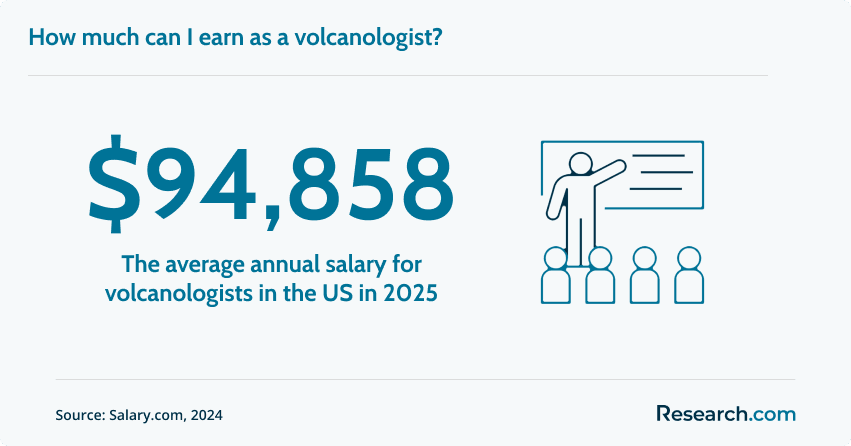
The volcanologist salary range United States typically falls between $83,425 and $107,258 annually, with a median salary of $93,580 per year. These figures provide a useful benchmark, but actual pay depends on the role, employer, location, education level, funding source, and years of experience.
If you are asking how much do volcanologists make per year on average, national estimates are around $93,580 to $98,050. Entry-level volcanologists usually earn about $46,000, while senior-level professionals can earn approximately $121,000. The gap between early-career and senior pay reflects the value of graduate training, research expertise, field experience, leadership responsibility, and specialized technical skills.
Location can also matter. Salaries may be higher in areas with active volcanic monitoring needs, including Hawaii and Alaska, or in organizations with larger research budgets. Government agencies, major research institutions, and some applied geoscience employers may offer more stable compensation than smaller private organizations, though benefits, grant funding, travel demands, and contract length should also be considered.
For career planning, treat salary figures as a range rather than a promise. A volcanologist with a bachelor's degree, limited field experience, and no specialization will usually face different opportunities than a Ph.D.-trained researcher with publications, monitoring experience, and advanced modeling or remote sensing skills.
What is the job outlook for Volcanologists?
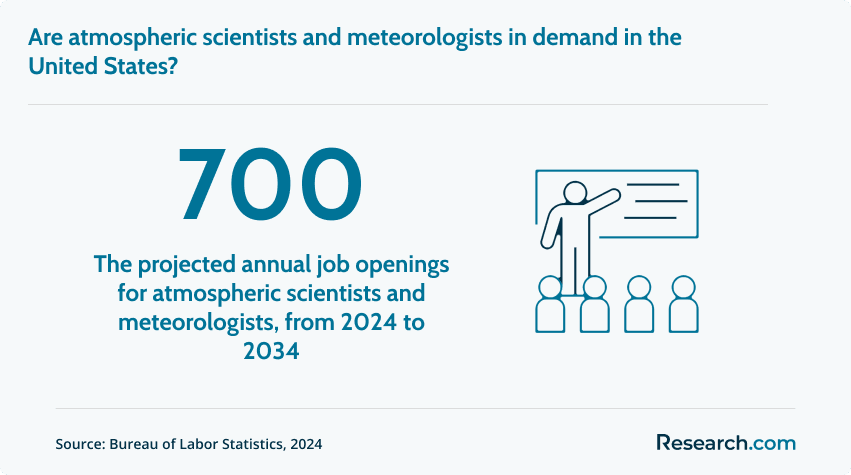
Employment for geoscientists, including volcanologists, is projected to grow 3% from 2024 to 2034, which is close to the average growth rate for all occupations. This points to a stable but competitive labor market rather than a rapidly expanding one. Volcanology is a specialized field, so openings may be limited and may require geographic flexibility.
The Key Factors Shaping the Future Outlook
Demand for volcanologists is tied to public safety, hazard monitoring, infrastructure protection, environmental assessment, aviation risk, and scientific research. Communities near active volcanoes depend on accurate monitoring and clear risk communication, while agencies and researchers need experts who can interpret complex volcanic systems.
Technology is also changing the field. Remote sensing, AI-driven modeling, drones, automated monitoring networks, and improved computational tools are expanding what volcanologists can measure and analyze. These advances create opportunities for candidates with strong data, coding, GIS, and modeling skills, but they also raise expectations beyond traditional field geology alone.
Government funding and research budgets strongly affect hiring, particularly in universities, observatories, and public agencies. Budget shifts can influence the number of available positions, grant-supported roles, and long-term research projects. At the same time, continued attention to natural hazard mitigation and climate-related impacts keeps volcanic risk assessment relevant.
Students comparing education options should look for programs that combine geoscience fundamentals with quantitative and field training. A list of best schools online can help identify flexible options, but prospective volcanologists should confirm that any program provides the lab, field, and research preparation needed for graduate study or geoscience employment.
What is the typical work environment for Volcanologists?
The volcanologist work environment is a mix of field sites, laboratories, offices, observatories, and research facilities. Some professionals spend long periods analyzing data, writing reports, teaching, or building models. Others travel frequently for field campaigns, monitoring work, sample collection, or emergency response.
Common employers include architectural, engineering, and related services, federal government agencies such as the USGS, universities, observatories, and research institutions. The work may involve independent analysis, team-based research, interdisciplinary collaboration, and communication with public officials or communities affected by volcanic hazards.
Fieldwork can be physically demanding. Volcanologists may work at high elevations, in remote areas, near unstable slopes, in hot or ash-covered terrain, or around gases that require protective procedures. Safety planning, appropriate gear, and team protocols are essential. Lab and office work may be more predictable, but it still requires patience, accuracy, and sustained attention to complex datasets.
Do volcanologists work weekends or travel? They can. During routine periods, office or lab schedules may follow regular business hours. During eruptions, unrest, field campaigns, or instrument deployments, work may involve early mornings, long days, travel, irregular hours, and urgent coordination with other teams. Some analysis or writing may be done remotely, but many essential tasks require physical presence in the field, lab, or monitoring facility.
What are the pros and cons of Volcanologist careers?
Volcanology can be deeply meaningful, but it is not a low-stress or high-volume job market. The best fit is usually someone who values scientific discovery, public service, outdoor work, and long-term specialization enough to accept risk, uncertainty, and competitive hiring conditions.
Pros
- Public safety impact: Volcanologists help improve eruption forecasting, hazard preparedness, evacuation planning, and community resilience.
- Intellectual challenge: The work involves complex scientific problems with real-world consequences.
- Field adventure: Professionals may work in dramatic volcanic landscapes that few people ever study up close.
- Interdisciplinary collaboration: The field connects geology, geophysics, chemistry, data science, engineering, emergency management, and public policy.
- Research contribution: Volcanologists can expand scientific understanding of Earth processes and, in some specialties, planetary systems.
Cons
- Safety risks: Active volcanic areas may involve toxic gases, unstable ground, ash, rockfall, heat, and sudden changes in conditions.
- Competitive entry: Professional roles may require graduate degrees, strong research records, and geographic flexibility.
- Irregular schedules: Eruptions, unrest, travel, and field seasons can disrupt standard work routines.
- Uncertainty: Eruption forecasting has limits, and professionals must communicate risk without overstating certainty.
- Funding dependence: Many research and monitoring roles are affected by government budgets, grants, and institutional priorities.
If you need flexibility while building your academic foundation, exploring the most affordable online colleges for working adults may be a practical starting point. Just make sure any online pathway can lead to the in-person lab, field, and graduate-level preparation that volcanology typically requires.
What are the opportunities for advancement for Volcanologists?
Advancement in volcanology usually comes through deeper specialization, stronger research output, leadership experience, and the ability to manage complex monitoring or hazard assessment projects. Because the field is small, career growth often depends on both technical excellence and professional reputation.
Concrete Advancement Paths
- Junior Volcanologist: Early-career professionals support fieldwork, monitoring, sample processing, data cleaning, mapping, literature review, and supervised research projects.
- Volcanologist: Mid-level professionals may lead parts of field campaigns, conduct independent analyses, publish findings, contribute to hazard assessments, and mentor students or junior staff.
- Senior/Lead Volcanologist: Experienced scientists may direct monitoring programs, lead research teams, design new methods, coordinate interagency work, and secure funding for major projects.
- Management/Leadership: Senior leaders may oversee observatories, academic departments, research programs, public hazard strategies, or policy-facing scientific initiatives.
Exploring Emerging Volcanology Specializations
Specialization can make a volcanologist more competitive, especially when it connects traditional field knowledge with modern analytical tools.
- Physical Volcanology: Focuses on eruption dynamics, volcanic deposits, lava flows, pyroclastic processes, and field interpretation of active or ancient volcanoes.
- Volcanic Geochemistry: Uses chemical analysis of rocks, minerals, gases, and fluids to study magma evolution and volcanic system behavior.
- Volcanic Seismology & Geophysics: Interprets seismic, deformation, gravity, magnetic, and other physical signals to monitor magma movement and unrest.
- Remote Sensing & Volcanic Data Science: Applies satellite imagery, drones, thermal data, GIS, and computational tools to track volcanic change over time.
- Hazard Assessment & Mitigation: Develops risk strategies, hazard maps, monitoring plans, and early warning systems for communities and agencies.
- Volcanic Data Science & Machine Learning: Integrates AI, predictive modeling, and real-time data streams to support hazard analysis and monitoring decisions.
- Planetary Volcanology: Studies volcanic processes on other planets and moons, often in collaboration with space science researchers or space agencies.
The strongest advancement strategy is to become known for a specific technical strength while maintaining broad geoscience competence. Volcanologists who can lead fieldwork, publish rigorous research, manage data, and communicate risk are better positioned for senior roles.
What other careers should you consider?
If volcanology interests you but the narrow job market, graduate training, or field risks give you pause, several related careers use similar skills. These alternatives may offer broader hiring options while still allowing you to work with earth systems, hazards, environmental data, or scientific research.
- Geologist: Studies Earth materials, structures, resources, and processes. This path can include field mapping, environmental consulting, natural resources, engineering geology, or research beyond volcanic systems.
- Environmental Scientist: Applies science to pollution, land use, ecosystem protection, environmental risk, and policy. This may suit students who want applied work with clearer links to regulation or sustainability.
- Oceanographer: Investigates marine systems, seafloor processes, ocean chemistry, circulation, and climate-related phenomena. It can appeal to those interested in natural systems and data-heavy research.
- Geochemist: Uses chemistry to understand rocks, minerals, fluids, contamination, resource formation, and Earth processes. This is a strong alternative for students drawn to laboratory analysis and chemical evidence.
To choose among these options, compare your tolerance for field risk, interest in graduate research, preferred work setting, and desired job market flexibility. Volcanology is a compelling path, but related geoscience careers may provide a better fit if you want similar scientific work with more varied employment routes.
Here's What Professionals Say About Their Volcanologist Careers
- Amina: "Every time I step into the field, I am trying to understand what causes a volcano to shift from quiet to restless. Rock samples, gas measurements, and monitoring data all help build that picture. What keeps me committed is knowing that better science can improve eruption forecasts and help protect communities. I also value the outreach side of the work because students and residents need to understand the forces shaping the places where they live."
- Lucas: "The hazards are real. Near an active volcano, conditions can change quickly, and you have to respect the environment at every moment. I have worked in situations where toxic gases, falling material, and sudden activity forced the team to reassess our plans immediately. Those experiences make preparation and teamwork nonnegotiable. The risk is never something to romanticize, but careful field science can produce findings that matter for public safety."
- Naomi: "Standing near a crater, smelling sulfur, and feeling the ground vibrate reminds me why this work is so powerful. Sometimes we are among the first people to document what changed after an eruption, and that responsibility is humbling. The data we collect may help future decisions about evacuations, monitoring, or hazard zones. The work can be tense, but the connection between discovery and public protection makes it worthwhile."
Other Things You Should Know About Volcanologist
In 2027, emerging technologies such as satellite monitoring, AI data analysis, and improved geophysical sensors significantly enhance the precision and scope of volcano monitoring and eruption prediction. These advancements facilitate real-time data collection and risk assessment, improving both safety measures and scientific understanding of volcanic activities.
A master’s degree in geology, geophysics, earth science, or volcanology is the most common entry point, and many research and university jobs require a PhD. Coursework in petrology, geochemistry, seismology, and field methods gives candidates the strongest preparation for monitoring active volcanoes.
In 2027, volcanologists rely on tools like thermal cameras, GPS devices, and seismographs for monitoring volcanic activity. They employ methods like remote sensing and geochemical analysis to study eruptions and mitigate risks. These technologies are vital for predicting eruptions and understanding volcanic behavior effectively.
References
- Geoscientists : Occupational Outlook Handbook: : U.S. Bureau of Labor Statistics https://www.bls.gov/ooh/life-physical-and-social-science/geoscientists.htm
- Volcanologist Finds Confidence in Annuity - Protected Income https://www.protectedincome.org/rosaly-lopes-testimonial/
- What does a volcanologist do? | Volcano World https://volcano.oregonstate.edu/faq/what-does-volcanologist-do
- Geophysicist https://www.careers.govt.nz/jobs-database/science/science/geophysicist/job-opportunities
- Volcanologist - Salary, How to Become, Job Description & Best Schools https://www.onlinedegree.com/careers/life-physical-science/volcanologist/
- Summary of Answers https://volcanologistsoutsideacademia.wordpress.com/summary-of-answers/
- 6 Volcanologist Interview Questions | ABRF https://careers.abrf.org/interview-questions/volcanologist
- What is it like to be a volcanologist? https://www.bbc.com/news/science-environment-18705562
- David https://www.geolsoc.org.uk/Geology-Career-Pathways/Careers/Career-Profiles/Volcanologist-Profile.html
- What kind of school training do you need to become a volcanologist? | U.S. Geological Survey https://www.usgs.gov/faqs/what-kind-school-training-do-you-need-become-a-volcanologist