2027 Fastest Online Stackable Credentials

Co-Founder and Chief Data Scientist
Choosing a short online credential is difficult when "fast" programs may not transfer, meet licensing rules, or lead to the job you want. Stackable credentials solve this by letting learners earn smaller certificates that can build toward a larger certificate or degree.
The U.S. Bureau of Labor Statistics projects total U.S. employment to grow by 5.2 million jobs from 2024 to 2034, making targeted, job-relevant training important. This guide helps working adults compare fast pathways, verify program quality, estimate costs, and choose credentials that support realistic next steps.
Key Things You Should Know
- Fast online stackable credentials can take weeks to about one year, but the fastest credible option depends on whether you need college credit, industry certification preparation, clinical training, or state licensure eligibility.
- Credit-bearing certificates from accredited colleges are usually the strongest choice when you want to apply coursework toward an associate or bachelor's degree; noncredit certificates may be faster but often have limited transfer value.
- Career outcomes vary sharply by field: BLS reports a 2024 median annual wage of $44,200 for medical assistants and $62,350 for electricians, but a certificate alone does not automatically qualify a learner for every role, exam, or license.
Top 10 Fastest Online Stackable Credentials
Popular Trade School Programs
Fast stackable trade pathways often begin with a short certificate in electrical fundamentals, HVAC/R, welding, construction technology, industrial maintenance, or computer-aided drafting. A first certificate may take one or two terms and can lead into an advanced certificate or associate degree. Online coursework works well for safety, code theory, estimating, and blueprint reading, while welding, electrical labs, and HVAC diagnostics normally require campus labs, employer training, or approved local sites. Choose this route when you need practical, employer-recognized skills; choose an apprenticeship when a trade license requires supervised hours.
Healthcare Programs
Healthcare stackable options include medical billing and coding, pharmacy technician, medical assisting, healthcare administration, health information technology, and practical nursing pathways. Fully online formats are most realistic for administrative and coding certificates. Patient-care programs commonly require in-person skills labs, background checks, immunizations, drug screening, and supervised clinical placements. A certificate is educational training; certification, such as a coding or pharmacy credential, is issued separately by an exam provider. Verify that the curriculum meets employer expectations and, where applicable, the requirements for certification exams or state board approval before enrolling.
Criminal Justice / Law Programs
Criminal justice and law-related stackable credentials may cover corrections, public safety, homeland security, legal studies, paralegal studies, victim advocacy, or cybersecurity investigations. Entry certificates can often stack into an associate degree in criminal justice or legal studies. Online delivery suits legal research, report writing, ethics, and policy courses, although internships, agency hiring standards, and background requirements remain separate. A paralegal certificate can build useful skills, but it does not make someone an attorney or guarantee paralegal employment. Applicants should check local employer expectations before selecting a specialization.
Arts & Design Programs
Stackable arts and design programs commonly include graphic design, digital media, web design, UX fundamentals, photography, animation, and video production. Short certificates can build a portfolio quickly, then apply toward a longer diploma or associate degree when the institution awards credit. Online study is well suited to software-based design, critique, and portfolio development, but students should budget for hardware, subscriptions, and project materials. This route fits learners who can show work samples to employers or clients. For regulated teaching or architecture careers, a short design credential is usually not enough.
What are stackable credentials, and how do online programs work for busy adults?
A stackable credential is a smaller, intentionally connected credential that can count toward a later credential, such as a sequence of certificates leading to an associate degree. It may be a credit-bearing college certificate, a noncredit workforce credential, or an employer-aligned microcredential. The key question is not whether the program uses the word "stackable," but whether the school documents exactly what applies to the next level.
For busy adults, online programs commonly use asynchronous modules, scheduled virtual sessions, or a hybrid mix. Asynchronous courses offer the most schedule control, while synchronous meetings provide more structure. Labs, clinicals, internships, and proctored assessments may still require fixed times or local attendance.
A stackable path is most useful when your first credential has standalone value and your longer-term goal may require more education. It is less useful when the provider cannot identify the receiving program, credit amount, expiration policy, or transfer conditions in writing.
How can students compare online vs campus stackable credential formats and learning experience?
Online and campus options can lead to the same credential when the same institution delivers the same curriculum, but the learning experience is not interchangeable. Online study is strongest for theory-heavy fields and adults who can manage deadlines independently. Campus or hybrid delivery is often better for learners who need equipment, instructor demonstrations, peer accountability, or placement support.
The comparison below highlights the practical trade-offs that matter before choosing a format.
| Decision factor | Mostly online format | Campus or hybrid format |
| Schedule | Often flexible for lectures and assignments | Fixed meeting times, especially for labs |
| Hands-on training | May require local practicum, simulation, or short residency | Direct access to labs, equipment, and demonstrations |
| Best fit | Self-directed learners in theory or software-based fields | Clinical, technical, and equipment-intensive training |
| Networking | Virtual career events and instructor contact vary by school | More immediate peer, faculty, and employer interaction |
Ask to see a sample weekly schedule, required live sessions, proctoring rules, and every in-person requirement before applying. Learners comparing broader degree options can also review best online degrees to assess institutional online-learning infrastructure.
What accreditation and state authorization should online stackable credential programs have?
Accreditation matters most for credit-bearing college certificates, degree pathways, federal financial aid eligibility, and professions governed by licensing boards. Institutional accreditation evaluates the college as a whole. Programmatic accreditation evaluates a specific program and can be essential in certain health professions. Neither type automatically means a credential meets every state's licensing requirements.
State authorization is separate. A college generally needs authorization to enroll distance learners residing in a state, and professional programs may need to disclose whether their curriculum meets that state's educational requirements. This is especially important for nursing and other licensed healthcare fields.
Before paying a deposit, confirm the college's institutional accreditation, the status of any required specialized accreditation, authorization for your state of residence, and written confirmation of whether the program meets the educational prerequisites for your intended license or exam. Do not rely on a marketing statement that an online program is "accepted nationwide."
What admission requirements and prior education are needed for stackable certificate pathways?
Admission rules depend on the provider and credential level. A short noncredit workforce program may require only age, identity, and basic technology readiness. A credit-bearing undergraduate certificate commonly requires a high school diploma or equivalent, while advanced certificates may require prior college coursework, a degree, or work experience. Healthcare programs can add health, background, and placement requirements.
Apply only after checking whether your completed credits will be accepted at the next stage. Schools may limit how long credits remain valid, require a minimum grade, or apply only courses from their own institution. For applicants seeking lower-friction enrollment options, free online college applications can help reduce the cost of comparing accredited schools.
Do not assume a GPA, standardized test, or prior degree is required - or irrelevant. Read the program-specific admission page and ask whether acceptance into the initial certificate also guarantees, or merely permits application to, the next credential.
How long do fast online stackable credentials take, and what do they cost?
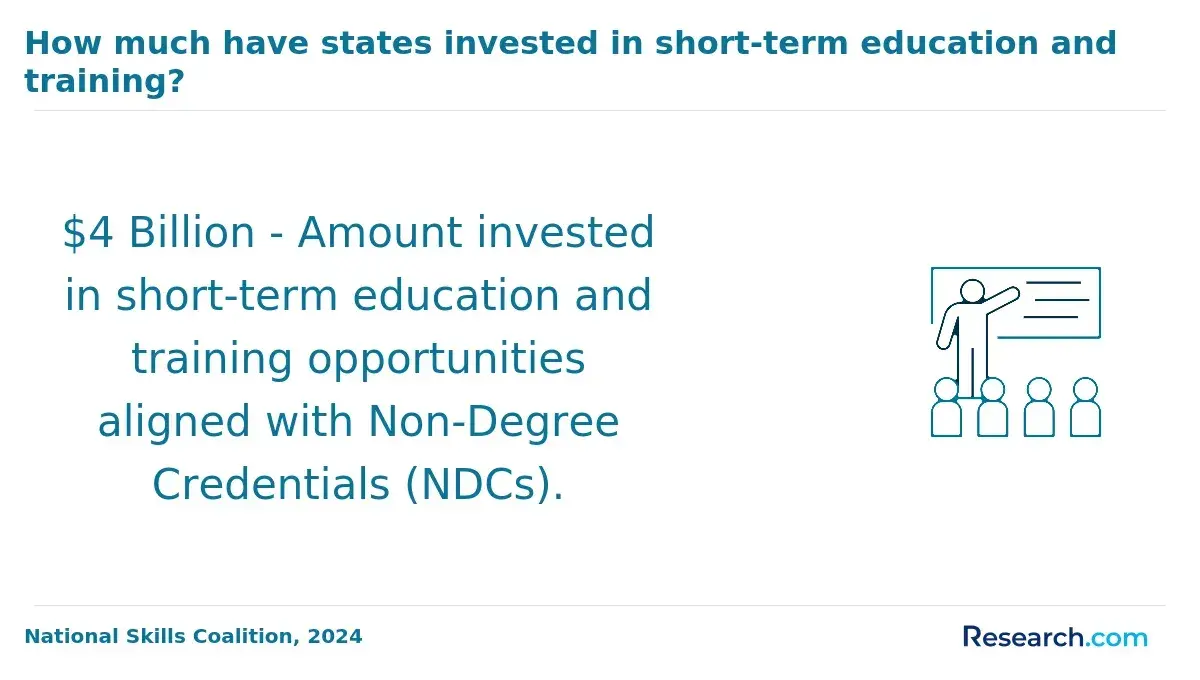
The fastest credible stackable credential is usually one designed as a short first step, not a full program compressed beyond what its clinical, lab, or licensing requirements allow. A noncredit digital-skills credential may take weeks. A college certificate commonly takes one or two semesters full time, while an associate degree pathway generally takes longer. Part-time enrollment extends the calendar time but can make completion more realistic for working adults.
Costs vary by public or private provider, residency, credits, equipment, exam fees, books, software, labs, and clinical compliance requirements. Compare the full pathway cost rather than only the first certificate's tuition. This table identifies cost questions that reveal whether a low advertised price is truly affordable.
| Cost category | Why it matters | What to verify |
| Tuition and fees | Credit prices and mandatory institutional fees can differ | Total charge for every course in the stack |
| Materials and technology | Tools, software, uniforms, and hardware may be required | Current supply list and replacement costs |
| Licensure or certification expenses | Exams, applications, and background checks may be separate | Which costs are included and which are not |
| Lost work time | Labs and clinicals can conflict with paid employment | Required attendance dates before enrollment |
Credit-bearing programs may qualify for aid when the institution and program meet federal eligibility rules, while short noncredit training often does not. Employer tuition assistance and local workforce funding can help. Students evaluating aid-compatible institutions may find online colleges that pay you to attend useful when comparing broader affordability options.
What courses and skills do typical stackable credential curricula cover by field of study?
Stackable curricula should build skills in a deliberate sequence: foundational knowledge first, applied skills next, and advanced specialization or work-based learning later. Review course titles and learning outcomes rather than assuming two similarly named certificates teach the same material.
The following examples show common skill progression by field and help learners identify gaps between a first credential and a target role.
| Field | Early-stack learning | Later-stack learning | Typical evidence of skill |
| Trades | Safety, tools, measurements, codes | Diagnostics, controls, advanced systems | Lab performance or employer evaluation |
| Healthcare administration | Medical terminology, privacy, records | Coding, reimbursement, workflow | Projects and possible certification exam preparation |
| Legal studies | Legal terminology, writing, ethics | Research, litigation support, document management | Case-based assignments and internship work |
| Digital design | Design principles and software basics | UX, branding, motion, portfolio development | Portfolio of completed work |
AI tools are increasingly relevant in office, design, and technical workflows, but a credible curriculum should teach verification, privacy, ethical use, and field-specific judgment rather than treating automated output as a substitute for competence.
What careers and job roles can stackable credentials help students qualify for?
Stackable credentials can help learners enter support roles, demonstrate job-specific skills, or meet a prerequisite for further education. They are most effective when the first credential aligns with an actual local job title and the later credential fills the gap between entry-level work and advancement.
Examples of realistic pathways include the following. Requirements vary by employer, state, and specialization.
- HVAC certificate to installer or technician trainee, followed by advanced refrigeration or controls coursework and employer experience.
- Medical billing certificate to billing or patient-access work, followed by coding coursework and, where useful, preparation for a separate industry certification exam.
- Legal studies certificate to legal assistant or administrative support work, followed by paralegal coursework, supervised experience, and employer-specific software skills.
- Graphic design certificate to junior design, production, or freelance portfolio work, followed by advanced digital media study and stronger project samples.
A certificate may not be the right first investment for roles requiring an apprenticeship, a license, a bachelor's degree, a graduate degree, or substantial supervised practice. Read current job postings in your target area before enrolling and identify the minimum education, software, certification, and experience requirements they repeatedly list.
What salary ranges and advancement opportunities are linked to stackable credentials?
Salary data describes occupations, not a guaranteed return from any certificate. Pay varies by location, experience, employer, schedule, union status, and whether a worker meets additional licensing or certification requirements. Use occupational data to judge a career target, then verify whether the credential is actually accepted for entry.
Recent BLS occupational data provides useful context for several fields commonly connected to stackable training.
| Occupation | 2024 median annual wage | 2024-2034 projected growth | Credential limitation |
| Electricians | $62,350 | 8% | Typically requires apprenticeship training and state licensing |
| Heating, air conditioning, and refrigeration mechanics and installers | $59,810 | 8% | Employer training and refrigerant-related requirements may apply |
| Medical assistants | $44,200 | 12% | Employers may prefer certification; scope rules vary |
| Paralegals and legal assistants | $61,010 | 0% | Education preferences vary; this is not attorney preparation |
| Graphic designers | $61,300 | 2% | Portfolio quality and experience remain central to hiring |
Advancement usually comes from combining education with documented performance, experience, specialized tools, supervisory skills, or a required license or professional certification. A stack can improve progression when each step is recognized by the next employer or educational provider; otherwise, it can add cost without improving eligibility.
How can students choose reputable online stackable programs aligned with licensing or certification?
Choose a reputable program by starting with the job or education destination, then working backward. If your goal is licensed work, verify requirements with the relevant state board before comparing tuition. If your goal is a promotion, ask your employer which credentials, certifications, or degree levels it recognizes.
Use this screening sequence to avoid common enrollment mistakes.
- Identify two or three target job titles and review their current education, experience, and licensing requirements.
- Confirm whether the credential is credit-bearing, noncredit, or preparation for a separate certification exam.
- Get written confirmation of exactly how many credits or courses apply to the next credential and any grade or time limits.
- Verify institutional accreditation, state authorization, specialized approval, and required in-person components.
- Request a complete cost estimate covering tuition, fees, materials, examinations, travel, and clinical or lab expenses.
- Compare completion schedules against your work and caregiving obligations before committing.
Red flags include vague claims about transferability, promises of licensure without state-specific documentation, missing total-cost information, no explanation of hands-on training, and pressure to enroll before you can review policies. Learners who eventually need graduate study should compare affordable online masters only after confirming that their undergraduate pathway will meet future admission requirements.
Other Things You Should Know About
Yes, if the courses are credit-bearing and the institution formally applies them toward a named certificate, diploma, or degree. Ask for the written curriculum map, minimum grade requirements, and any time limit on using prior credits.
Employers generally care more about the issuing institution or industry provider, relevant skills, required licensure or certification, and experience than the online format alone. For hands-on fields, confirm how labs, clinicals, or supervised practice are completed.
Noncredit digital, business, or workforce microcredentials may take only weeks. However, the fastest option is not always the best investment. Regulated healthcare and skilled-trade pathways often take longer because practical training, exams, or supervised hours cannot be skipped.
It may, but eligibility depends on the institution, program length, credit status, and federal aid rules. Credit-bearing certificates at eligible schools are more likely to qualify than short noncredit programs. Ask the financial aid office about the specific program, not just the college.
References
- What Are Stackable Credentials? Clearly Explained | Certifier https://certifier.io/blog/stackable-credentials
- Stackable Credentials: Living Links Between Learning and Work https://www.cael.org/resouces/pathways-blog/stackable-credentials-living-links-between-learning-and-work
- What Are Stackable Credentials in Business? | Empowerly https://empowerly.com/applications/what-are-stackable-credentials-in-business/
- How to Create Stackable Credentials That Will Draw Learners to Your School https://jenzabar.com/blog/how-to-create-stackable-credentials-that-will-draw-learners-to-your-school
- Stackable Credentials | Learn & Work Ecosystem Library https://learnworkecosystemlibrary.com/topics/stackable-credentials/
- Rethinking Credentialing in Higher Education for the 21st Century https://moderncampus.com/blog/rethinking-credentialing-for-the-21st-century.html
- What Are Stackable Credentials and Why Do They Matter? https://www.pltw.org/blog/what-are-stackable-credentials
- Stackable Credentials: How Do You Stack Up? https://www.1stsource.com/advice/stackable-credentials-how-do-you-stack-up/
- SEE MORE https://iticollege.edu/blog/stackable-credentials-how-certificate-programs-can-be-your-fast-track-to-a-degree/
- Stackable Certificates & Credentials - Complete College America https://completecollege.org/our-approach/structure/stackable-certificates-credentials/