2027 Best Online Certificate Programs

Co-Founder and Chief Data Scientist
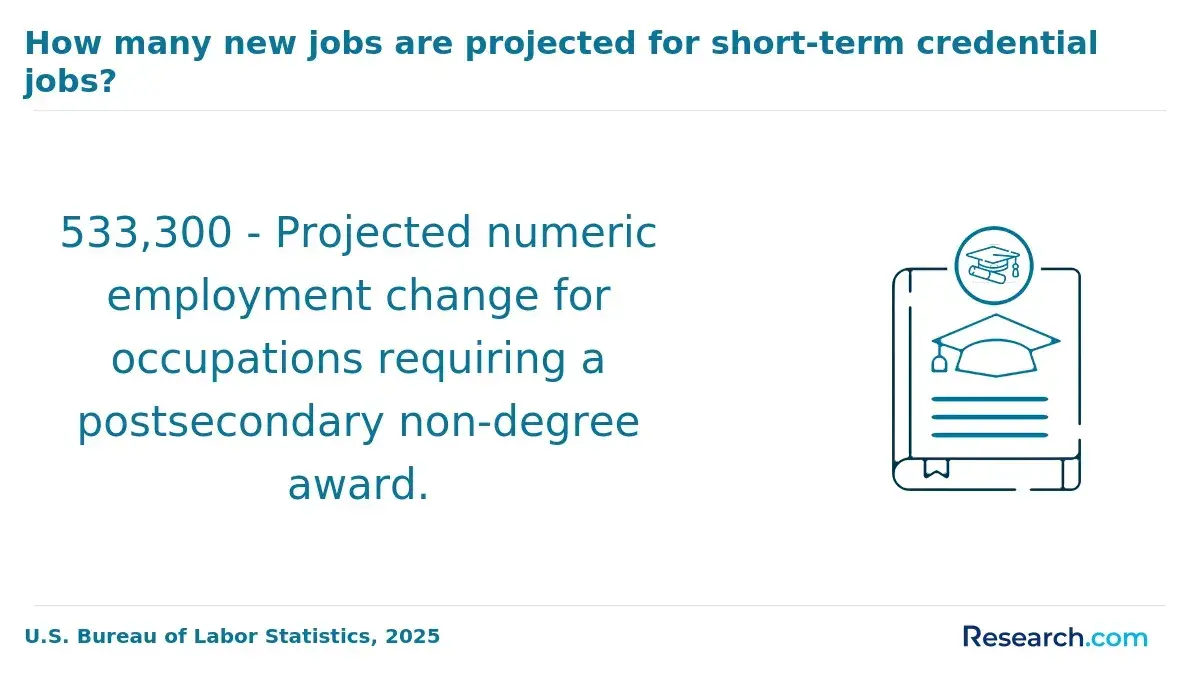
Choosing an online certificate is difficult because programs vary widely in academic credit, employer recognition, licensing value, and cost. This guide is for career changers, working adults, and students seeking focused training without committing immediately to a degree. U.S. Bureau of Labor Statistics projections for 2024-2034 show above-average growth in several certificate-relevant fields, including healthcare support, skilled trades, and digital work. Learn how to compare programs, identify credible providers, estimate total costs, and choose training that fits a specific job goal rather than a vague promise.
Key Things You Should Know
- An online certificate is an educational credential; it is not automatically a professional certification, state license, degree, or guaranteed route to employment.
- Credit-bearing community-college certificates can often take 6-18 months and may stack into an associate degree, while noncredit career certificates may be shorter but usually do not transfer.
- Compare total cost, required in-person training, accreditation, exam eligibility, and local employer demand before enrolling; BLS 2024-2034 projections show growth varies substantially by occupation.
Top 10 Best Online Certificate Programs
Popular Trade School Programs
Online trade certificates work best for theory-heavy coursework paired with required local labs, apprenticeships, or supervised practice. Common options include electrical technology, HVAC/R, welding technology, construction management, automotive service, and industrial maintenance. An associate degree adds general education and broader technical study; a certificate is usually faster for an entry-level skill pathway. Electrician and HVAC work generally require state or local licensing, and fully online instruction alone is rarely sufficient. Confirm lab requirements, apprenticeship connections, tool costs, and whether the curriculum supports the license or industry exam required where you live.
Healthcare Programs
Online healthcare certificates commonly cover medical billing and coding, medical assisting theory, pharmacy technician preparation, health information technology, and medical records. Programs may be credit-bearing college certificates or noncredit workforce training. Clinical roles often require in-person externships, background checks, immunizations, CPR training, or state approval. Medical billing or coding training can prepare learners for a voluntary certification exam, but the program itself does not award that professional certification. Medical records specialist roles are projected by BLS to grow 7% from 2024 to 2034, though employer requirements differ by role and location.
Criminal Justice / Law Programs
Online certificates in criminal justice, legal studies, paralegal studies, cybersecurity law, and corrections introduce legal systems, writing, ethics, evidence, and procedure. A paralegal certificate may be useful for people who already hold a degree or have office experience, but it does not authorize someone to practice law. Associate degrees provide a broader foundation for entry-level justice or public-safety support roles. Before enrolling, check whether local employers prefer a degree, whether a paralegal program meets employer expectations, and whether internships, background standards, or residency requirements apply to your intended role.
Arts & Design Programs
Online arts and design certificates may focus on graphic design, UX design, digital illustration, photography, animation, web production, or interior design fundamentals. Portfolio quality usually matters more to employers than the certificate title alone, so choose programs with project feedback and current software training. An associate degree can be a better fit for students needing a deeper portfolio and general education credits. Some design specialties have voluntary credentials or state-specific practice rules, particularly interior design. Ask whether you retain portfolio rights and whether courses teach accessible, AI-aware, and client-ready design workflows.
What are online certificate programs and how do they differ from degrees?
An online certificate is a focused program of study awarded by a college, university, or training provider after completion of designated coursework. It can be undergraduate, graduate, credit-bearing, noncredit, academic, or career-focused. A professional certification, by contrast, is awarded by an industry body after a person meets its standards, which may include an exam, education, and work experience.
The comparison below helps match the credential to the decision you are making. A certificate is usually best when you need targeted skills; a degree is more appropriate when an occupation requires broad education or a formal academic credential.
| Option | Usually provided by | Best use | Key limitation |
| Academic certificate | Accredited college or university | Focused, often credit-bearing study | May not meet licensing or degree requirements |
| Professional certificate | College, university, or training provider | Job-relevant skills and portfolio development | Recognition depends on the provider and employer |
| Professional certification | Industry certifying organization | Validating competency against a standard | May require an exam, renewal, or experience |
| Associate or bachelor's degree | Accredited college or university | Broader academic and career preparation | Usually requires more time and tuition |
Credit-bearing certificates may be stackable, meaning completed courses can apply toward a later degree under the school's written policy. Noncredit certificates can be useful for immediate skill-building but typically do not carry transferable college credit. Learners who ultimately need advanced academic credentials should compare pathways early, including PhD programs, rather than assuming a short certificate will transfer upward.
How can you compare accredited online certificate programs and avoid diploma mills?
For college-issued certificates, verify institutional accreditation through the U.S. Department of Education or the Council for Higher Education Accreditation directories, then check whether the specific program has specialized approval when a field requires it. Institutional accreditation matters most for academic credit, financial aid eligibility, transfer review, and employer confidence; specialized approval can matter for healthcare, technical, and licensure-track programs.
Use these checks before paying an application fee. They help distinguish a credible program from a provider that relies on vague outcome claims.
- Confirm the legal school name, institutional accreditation, and state authorization for distance education.
- Read the curriculum, faculty credentials, assessment method, and required in-person components.
- Ask whether the credential is credit-bearing, transferable, stackable, and eligible for employer tuition benefits.
- Verify independently whether it meets exam, certification, or licensing prerequisites in your state.
- Request the full price, refund policy, completion expectations, and written career-services description.
Diploma-mill red flags include guaranteed graduation, an unrealistic completion timeline for clinical or hands-on work, degrees awarded mainly for payment or "life experience," pressure to enroll immediately, and claims that an unrecognized accreditor is equivalent to recognized accreditation. A legitimate short program can be accelerated, but it should still explain how learning is assessed and what skills students must demonstrate.
What admission requirements and prerequisites do online certificate programs typically have?
Admission requirements depend on the credential type. Many entry-level noncredit certificates require only an application, payment arrangement, basic technology access, and proof of identity. College credit certificates commonly require a high school diploma or equivalent and placement or prerequisite review. Graduate certificates normally require a bachelor's degree; some technical programs require prior coursework, work experience, or a current professional license.
Applicants should separate requirements for admission from requirements for participation and employment. The table shows common examples that can affect your timeline and budget.
| Program type | Common entry requirement | Possible additional requirement |
| Noncredit technology or business certificate | Application and basic computer skills | Software or device purchase |
| College technical certificate | High school completion or equivalent | Math, reading, or technical prerequisites |
| Healthcare certificate | Academic prerequisites may apply | Background check, immunizations, clinical clearance |
| Graduate certificate | Bachelor's degree | Relevant degree, license, or professional experience |
A GPA may be considered by a college, but it is not a universal requirement for every online certificate. Standardized tests are uncommon for short workforce programs. If prior learning or transfer credit matters, obtain a written evaluation policy before enrolling; do not assume a credential from one provider will be accepted by another.
How long do online certificate programs take and what do they cost?
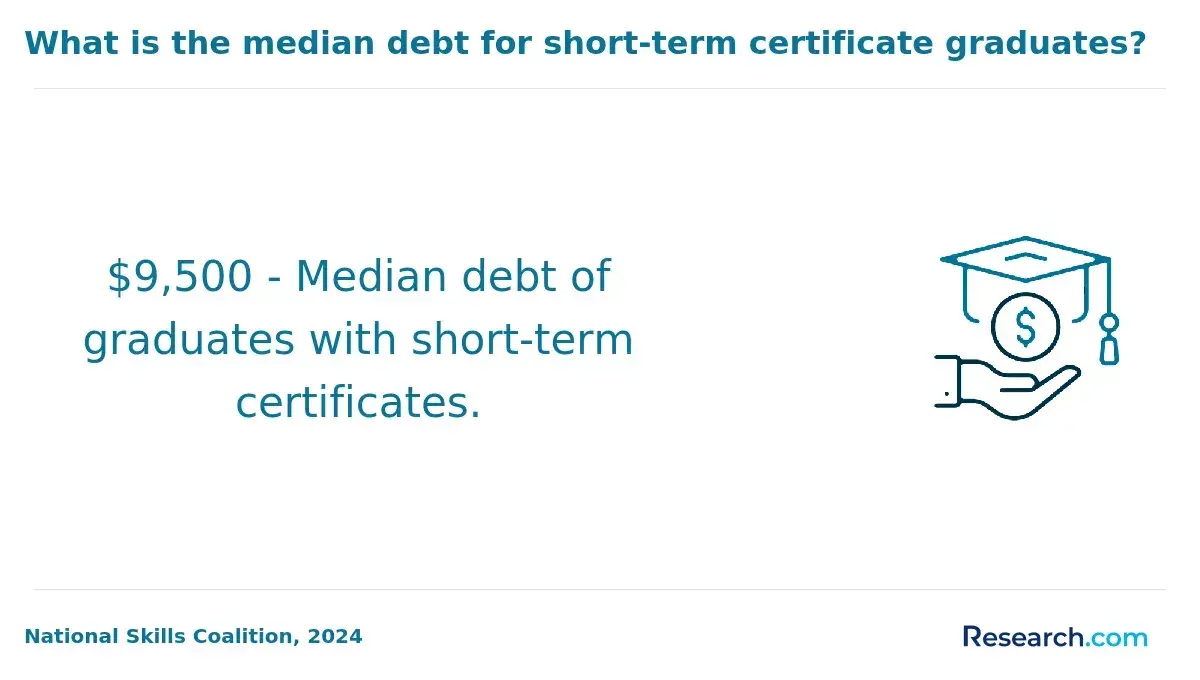
Completion time ranges from a few weeks for a self-paced noncredit program to roughly 6-18 months for many part-time college certificates. Programs requiring clinical practice, lab work, apprenticeships, or a sequence of prerequisites generally take longer. An accelerated schedule can reduce elapsed time, but it does not reduce the amount of work required each week.
Costs should be compared as a total investment, not simply advertised tuition. The following cost categories reveal why two similarly priced programs can have very different final bills.
| Cost category | Often included? | Why it matters |
| Tuition or course fee | Usually | May be charged per credit, course, term, or bundle |
| Technology and software | Sometimes | Can be significant in design, IT, and technical fields |
| Books, tools, uniforms, and supplies | Often separate | Common in trades and healthcare training |
| Exam, background, and clinical fees | Often separate | May be required before certification or placement |
| Travel for labs or testing | Often separate | Fully online coursework may still have local requirements |
Credit-bearing college certificates may qualify for some federal, state, institutional, or workforce assistance when the school and program meet applicable rules; eligibility is not automatic. Employer reimbursement can be valuable if the program aligns with your current role. If your main priority is speed within an academic pathway, compare accelerated college programs as an alternative to a standalone certificate.
How do online and campus certificate program formats and learning experiences differ?
Online certificate formats range from scheduled live classes to fully asynchronous modules. Asynchronous study gives working learners scheduling flexibility, while live classes can provide faster feedback and clearer pacing. Neither format automatically means "self-paced": many online college certificates have weekly deadlines, group projects, proctored exams, and fixed term dates.
The format comparison below can help you choose based on the kind of learning and support your target field requires.
| Format | Best for | Trade-off |
| Asynchronous online | Students balancing changing work schedules | Requires strong time management and self-direction |
| Live online | Learners who want instructor contact and routine | Attendance times may limit flexibility |
| Hybrid | Fields needing labs, clinicals, studios, or equipment | Requires travel and schedule coordination |
| Campus-based | Students needing intensive hands-on access | Usually offers less location flexibility |
Ask how students practice hands-on tasks, receive feedback, access tutoring, complete identity verification, and arrange externships. Learners seeking maximum scheduling control can also evaluate online self paced degrees, though self-paced delivery is not ideal when a program requires cohorts, clinical supervision, or group production.
What curriculum and coursework can you expect in popular online certificate fields?
Coursework should map directly to a job task, portfolio requirement, certification objective, or next academic step. Strong programs explain what learners will be able to do, how that ability is assessed, and which tools or standards are used. Be cautious of curricula that list only broad topics without projects, simulations, supervised practice, or evaluated demonstrations.
Popular fields differ in what meaningful preparation looks like. This comparison identifies the learning experiences worth seeking before choosing a program.
| Field | Typical coursework | Evidence of learning to look for |
| Information technology | Networks, cloud tools, security, scripting, troubleshooting | Labs, documented projects, certification-exam alignment |
| Healthcare administration | Medical terminology, coding systems, privacy, reimbursement | Case exercises and current coding resources |
| Skilled trades | Safety, codes, measurements, systems theory | Lab hours, equipment access, supervised practice |
| Design and digital media | Visual principles, software, UX, production workflow | Reviewed portfolio pieces and client-style briefs |
| Legal studies | Research, writing, procedure, ethics, document preparation | Practical drafting and research assignments |
AI tools are increasingly part of workplace workflows, especially in technology, administration, and design. Choose a program that teaches responsible use, verification, privacy, and original problem-solving rather than treating AI-generated output as a substitute for foundational skills.
What careers and job roles can online certificate programs help you qualify for?
An online certificate can help demonstrate focused preparation for entry-level, support, or career-transition roles, particularly when paired with relevant experience, a portfolio, an internship, or a required industry exam. It may not be enough for occupations that legally require a degree, license, apprenticeship, or extensive supervised practice.
The following examples show realistic role connections, not guarantees of eligibility or hiring. Local employers may set higher standards than the minimum training pathway.
| Certificate focus | Potential related roles | Important qualification note |
| Medical coding or health information | Medical records specialist, billing support worker | Employers may prefer coding certification or experience |
| IT support or cybersecurity fundamentals | Help desk technician, junior support specialist | Hands-on troubleshooting and industry certifications can matter |
| HVAC or electrical technology | Apprentice or technician trainee | Licensing and supervised field experience are commonly required |
| Paralegal studies | Legal assistant, paralegal support role | Does not permit independent legal practice |
| Digital design | Production artist, junior digital designer | Portfolio quality and software capability are central |
If a target role routinely requires a bachelor's or master's degree, a certificate may still help build specialized skills but should not be treated as a replacement. Compare the commitment and tuition of affordable online masters programs when advancement in your field clearly depends on graduate education.
What salary ranges and earning potential are linked to common certificate fields?
Occupational wage data describes workers in an occupation, not what certificate completers earn. Pay varies by state, industry, experience, shift, union status, education, licensure, and employer. Use wage information to judge whether a longer or more expensive program is plausible for your budget, then verify local job postings and entry-level requirements.
According to U.S. Bureau of Labor Statistics May 2024 wage data, the occupations below illustrate the range of earnings associated with fields that may include certificate pathways.
| Occupation | 2024 U.S. median annual wage | Certificate-pathway context |
| Medical records specialists | $50,250 | Some employers accept certificate preparation; requirements vary |
| Heating, air conditioning, and refrigeration mechanics and installers | $59,810 | Postsecondary training, apprenticeships, and credentials are common |
| Electricians | $62,350 | Typically requires apprenticeship and licensing progression |
| Paralegals and legal assistants | $61,010 | Employers may prefer a degree or recognized preparation |
| Web developers | $90,930 | Skills and portfolio matter; education expectations vary |
Higher occupational medians do not establish that a short certificate alone produces higher pay. Compare tuition and lost work time against realistic local entry-level openings, then consider whether a stackable certificate gives you a lower-risk first step toward a degree or credential.
How do licensing and professional certification work after completing an online certificate?
Completing a certificate and obtaining permission to work in a regulated occupation are separate events. Licensing is granted by a government agency and is commonly required for occupations involving public safety, clinical care, or regulated trades. Certification is usually granted by a private professional organization. A school certificate may prepare you for either process, but it does not replace it unless the relevant authority explicitly says so.
Before enrolling in a licensure-track program, take these steps to avoid discovering a mismatch after graduation.
- Identify the state board, licensing agency, or certifying organization for the occupation you want.
- Review its current education, examination, clinical-hour, apprenticeship, background-check, and renewal rules.
- Ask the school in writing whether its online curriculum meets requirements in your state and whether it helps arrange required placements.
- Budget separately for examinations, fingerprinting, applications, continuing education, and credential renewal when applicable.
Licensure rules can change and may differ for residents of another state. For healthcare programs, confirm whether the school is authorized to enroll students in your location and whether clinical placement is available before you accept admission. For voluntary professional certifications, check eligibility directly with the certifying organization rather than relying solely on marketing language.
Other Things You Should Know About
They can be, especially when issued by an accredited college or a recognized provider and when the curriculum matches a role's skills. Employer recognition is strongest when the program includes practical work, current tools, an industry exam pathway, or a portfolio.
Possibly. Some credit-bearing programs at eligible schools may qualify for aid, while many noncredit and third-party certificates do not. Ask the financial-aid office about the specific program, not just the institution.
Some noncredit certificates can be completed in weeks, but the shortest option is not automatically the best value. Programs involving clinical work, labs, apprenticeships, or licensing requirements need more time because supervised competency matters.
Choose a certificate when you need a targeted, lower-commitment skill path and the employer accepts it. Choose an associate degree when you need broader preparation, transferable credits, or a credential that job postings in your field consistently prefer.
References
- Platforms for online courses and training [most popular] - HRcode https://hrcode.io/en/platforms-for-online-courses-and-training-most-popular/
- Student Loan Options for Certificate Programs https://collegefinance.com/student-loans/student-loan-options-for-certificate-programs
- uCertify vs Other Platforms: Best IT Learning 2026 https://www.ucertify.com/blog/ucertify-vs-other-platforms/
- Choosing an Online Certification Course: A Step-by-Step Guide https://www.qahe.org/article/choosing-an-online-certification-course-a-step-by-step-guide/
- The 10 best online course platforms | Zapier https://zapier.com/blog/online-course-platforms/
- Explore Online Certificate Programs Approved by FAFSA https://www.edumed.org/online-schools/fafsa-approved-certificate-programs/
- Course Completion: Boost Rates with 3 Key Insights https://360learning.com/blog/90-course-completion-rates/
- Course Completion Rate Benchmarks: Improve Yours (2026) | Ruzuku https://www.ruzuku.com/learn/articles/course-completion-rates
- Certifications and Microlearning at Work: The Future of Workforce Development https://iawponline.org/news/certifications-and-microlearning-at-work-the-future-of-workforce-development/
- How to Improve Learning Completion Rates: 5 Key Tactics https://www.docebo.com/learning-network/blog/how-to-improve-learning-completion-rates/