2027 Best Online Certificate Programs With No SAT or ACT Requirement

Co-Founder and Chief Data Scientist
Choosing a short online program can be confusing when schools use similar labels but offer very different career value. Online certificate programs with no SAT or ACT requirement can provide a faster route to targeted skills, but test-free admission does not automatically mean a program is low-cost, accredited, transferable, or license-eligible.
The U.S. Bureau of Labor Statistics projects healthcare support occupations to grow 15% from 2023 to 2033, illustrating why career-focused training remains relevant. This guide helps prospective students compare credential types, costs, admission rules, and realistic next steps.
Key Things You Should Know
- No-SAT/ACT admission is common for college certificates, community colleges, and noncredit providers, but applicants may still need a high school diploma, transcripts, placement testing, prerequisite courses, background checks, or immunizations.
- For career-focused options, prioritize the credential's purpose: a credit-bearing certificate may stack into an associate degree, while a noncredit certificate may build job skills but usually has limited transfer value.
- Check career rules before paying: BLS projects 15% growth for healthcare support occupations from 2023 to 2033, but many clinical, legal, and skilled-trade roles also require state approval, supervised practice, an exam, or an employer-recognized certification.
Top 10 Best Online Certificate Programs With No SAT or ACT Requirement
Popular Trade School Programs
Online trade certificates commonly cover construction management basics, HVAC theory, electrical theory, welding safety, CAD drafting, industrial maintenance, logistics, and automotive service fundamentals. They suit learners who need flexible theory instruction, but hands-on trades usually require labs, employer training, apprenticeships, or supervised fieldwork.
A short certificate can be a useful entry point for helper, technician-support, estimator, dispatcher, or drafting roles. Choose a hybrid or local partner program if the occupation requires practical competencies. Confirm whether coursework prepares you for an apprenticeship, an industry exam, or only foundational knowledge.
Healthcare Programs
Common online or hybrid healthcare certificates include medical billing and coding, medical office administration, pharmacy technician preparation, health information support, medical assisting theory, and patient care fundamentals. Clinical programs generally cannot be completed entirely online because employers and state rules may require labs, skills checks, and supervised practicum hours.
Medical coding is often a nonclinical option, while nursing aide, phlebotomy, and medical assisting paths usually need in-person training. Before enrolling, verify whether the program meets requirements for certification exams, clinical placement, background screening, and the state where you intend to work.
Criminal Justice / Law Programs
Online certificates in criminal justice, legal studies, paralegal studies, homeland security, corrections, and cybersecurity can introduce legal systems, report writing, ethics, evidence handling, and policy analysis. These programs may fit current public-safety workers or learners exploring administrative and support roles.
They generally do not replace academy training for sworn law-enforcement positions, state-specific peace officer requirements, or attorney education. Paralegal employers may prefer an approved program or prior legal-office experience. Ask whether the certificate is credit-bearing, whether it includes practical legal research training, and which entry-level roles its curriculum is designed to support.
Arts & Design Programs
Online arts and design certificates may focus on graphic design, digital illustration, UX design foundations, web design, photography, video editing, animation, or digital marketing content. Portfolio quality often matters more to employers than standardized test scores.
Programs can work well for self-directed learners who have reliable software and time to complete projects, critiques, and revisions. Compare required software, portfolio support, instructor feedback, and ownership rights for student work. A certificate may help build skills and samples, but it does not guarantee freelance clients or a design job in a competitive field.
What are online certificate programs with no SAT or ACT, and who are they for?
An online certificate program is a structured, usually shorter course of study that awards a certificate after students complete required classes or training. It is not the same as a professional certification, which is typically awarded by an industry organization after an examination or other eligibility requirements.
"No SAT or ACT" means standardized college entrance scores are not required; it does not mean every applicant is admitted or that no other documentation is needed.
These programs can fit recent high school graduates, working adults, career changers, and people who want targeted skills without starting a full degree. Credit-bearing college certificates may be especially useful when they apply toward a later associate degree. Noncredit career-training certificates can make more sense when a learner needs a specific tool, workflow, or exam-preparation course quickly.
The comparison below distinguishes options that are often described with the same word but serve different goals:
| Option | Usually provided by | Best use | Key limitation |
| Credit-bearing certificate | College or community college | Career entry and possible degree progression | May take longer and have academic prerequisites |
| Noncredit certificate | College continuing education or training provider | Focused job skills or upskilling | Usually does not transfer as college credit |
| Professional certificate | University, platform, or employer training provider | Structured skill development and portfolio work | Employer recognition varies by field |
| Professional certification | Certifying body | Demonstrating competency against industry standards | May require an exam, experience, renewal, or approved education |
How do admission requirements work for online certificate programs without test scores?
Test-optional or test-free certificate admission is usually based on the program's level and provider rather than on a single national rule. Many open-access colleges do not use SAT or ACT scores for certificate applicants. Instead, they may review education history and verify that applicants can meet course or clinical requirements. Some providers use no formal admissions process at all and allow learners to enroll directly.
Before applying, separate general enrollment requirements from requirements that affect eligibility to complete the program. Typical items include:
- A high school diploma, GED, or equivalent for many college-level certificates.
- Official or unofficial transcripts when prerequisite courses must be verified.
- Placement assessment or completion of developmental coursework for college math, writing, or science courses.
- Identity, age, technology, or residency requirements set by the provider.
- Background checks, drug screening, immunizations, CPR training, or health documentation for clinical placements.
A missing SAT or ACT score should not be treated as a shortcut around prerequisites. Ask admissions whether a certificate has selective entry, whether credits transfer, and whether prior learning or transfer credits can reduce the course load. Students comparing application costs can also review best online colleges with no application fee before submitting multiple applications.
How can students verify accreditation and program quality for online certificates?
Accreditation matters most when a certificate is college credit-bearing, will be used for financial aid, may transfer into a degree, or is connected to regulated professional training. Institutional accreditation evaluates the college as a whole.
Programmatic approval or accreditation may be separately required for fields such as nursing, medical assisting, surgical technology, and some technical programs.
Use this screening sequence before you enroll:
- Identify the legal name of the provider and determine whether it is a college, employer-training provider, nonprofit, or private career school.
- For a college program, verify institutional accreditation through the U.S. Department of Education or the Council for Higher Education Accreditation directory.
- Check the relevant state licensing board or certification body if your intended occupation is regulated.
- Ask for the full curriculum, faculty qualifications, required in-person components, completion policies, and total cost in writing.
- Confirm whether the credential is academic credit, continuing education, or a provider-issued completion certificate.
Red flags include vague claims of "national accreditation," pressure to enroll immediately, unclear refund terms, no explanation of practical training, and promises of guaranteed jobs or licenses. Accreditation alone does not prove a program meets a particular state's licensure rules, so verify both.
What are the typical timelines, costs, and financial aid options for these programs?
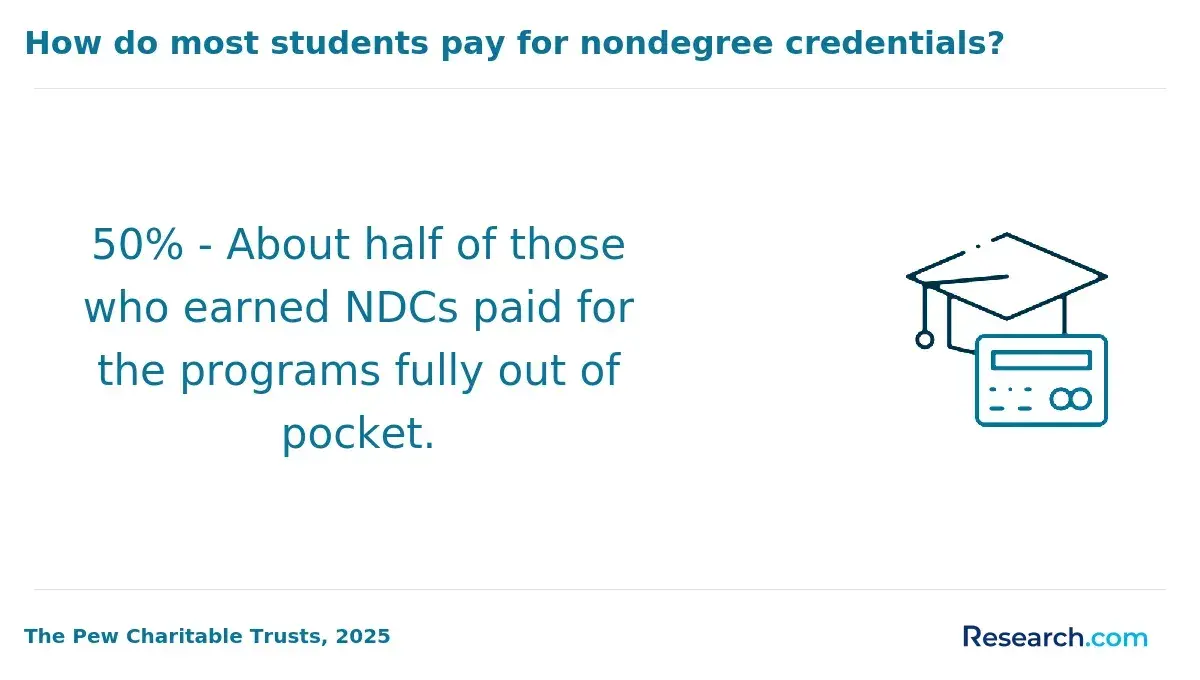
Timelines range from a few weeks for a focused noncredit program to roughly one year for many college certificates. Cost depends on whether tuition is charged per credit, per course, or as a bundled training fee. Learners should include books, equipment, software, proctoring, background checks, uniforms, clinical fees, transportation, exams, and certification fees, not only advertised tuition.
For perspective, the National Center for Education Statistics reported that average published tuition and fees for in-district students at public two-year institutions was $3,990 in the 2022-23 academic year. That is a broad college-sector benchmark rather than the price of a specific online certificate, and local tuition policies can differ substantially.
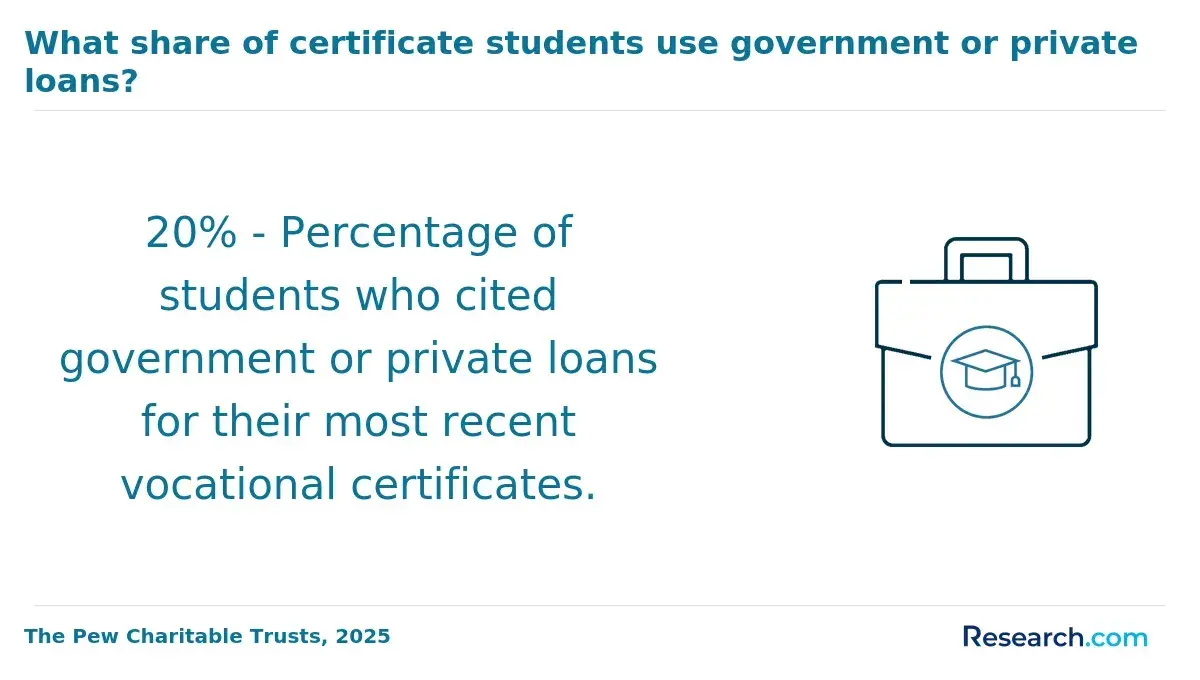
Credit-bearing programs at eligible institutions may allow students to pursue federal aid by filing the FAFSA, subject to program length, enrollment, and student eligibility rules.
Noncredit and third-party certificates often do not qualify for federal student aid, although employer tuition assistance, workforce grants, payment plans, veterans' education benefits, and scholarships may be available. Learners seeking a degree pathway should compare certificate costs with 2 year degrees, especially if they expect to continue studying.
This cost view highlights why the lowest tuition is not always the lowest total investment:
| Cost factor | Why it changes the decision |
| Tuition model | Per-credit pricing can favor students with transfer credit; flat pricing can simplify budgeting. |
| Required materials | Tools, software, textbooks, and home equipment can materially increase the total cost. |
| In-person requirements | Labs and practicums may add travel, parking, childcare, and missed-work expenses. |
| Exam and licensing fees | These may be separate from tuition and are often required for regulated career paths. |
| Transfer or stackability | Applicable academic credit can preserve value if the student later pursues a degree. |
How do online certificate formats compare to campus-based options for flexibility and support?
Online delivery can make certificates more accessible for working adults, caregivers, rural learners, and people who need part-time scheduling. However, "online" may mean fully asynchronous coursework, live virtual classes, hybrid meetings, or online theory plus local labs and clinical placements. Ask for a sample weekly schedule rather than assuming lessons are self-paced.
Online programs generally work best when the curriculum is largely knowledge- or software-based, such as bookkeeping, coding support, health information, project coordination, or digital design. Campus or hybrid delivery is often stronger when students need equipment, direct skill observation, peer practice, clinical supervision, or immediate access to instructors.
Compare the support model as carefully as the format. Strong programs explain faculty response times, tutoring, disability services, career support, technical help, practicum placement responsibilities, and online assessment rules. Learners who want flexible, career-oriented study can compare related online certifications, while remembering that an industry certification and an academic certificate are different credentials.
The following comparison helps match a delivery format to the type of learning required:
| Format | Flexibility | Usually strongest for | Watch for |
| Fully asynchronous online | High | Theory, software, administration, and self-paced study | Limited real-time feedback and proctored exam requirements |
| Live online | Moderate | Discussion-heavy or instructor-led training | Fixed meeting times across time zones |
| Hybrid | Moderate | Programs needing labs, demonstrations, or critiques | Travel and mandatory campus sessions |
| Online coursework with local placement | Variable | Clinical and supervised field training | Whether the school secures placement or students must find it |
What coursework and skills do no-test online certificate programs usually include?
No-test online certificates usually focus on a defined set of workplace competencies rather than broad general education. Coursework may include field terminology, documentation, ethics, customer communication, digital tools, data handling, safety, foundational math, and problem solving.
College certificates may also include credit-bearing introductory courses; noncredit programs often emphasize applied projects or vendor tools.
Review course descriptions for evidence that instruction matches the work you want to do. A credible curriculum should state what students will practice, what software or equipment is needed, how learning is assessed, and whether there is feedback from qualified instructors.
For technical and design programs, ask whether you leave with a portfolio. For healthcare and trade programs, ask how practical competencies are evaluated.
AI tools are increasingly part of workplace workflows, but they do not eliminate the need for judgment, privacy awareness, communication, and field-specific technical knowledge. Prefer programs that teach responsible use of current tools instead of promising that a single platform will secure employment.
What entry-level and mid-career jobs can these certificates help you qualify for?
A certificate can help a candidate demonstrate focused preparation for entry-level work, especially when paired with relevant experience, a portfolio, internship, practicum, apprenticeship, or industry exam. The exact result depends on employer hiring standards, local labor demand, legal requirements, and the learner's prior education.
A certificate alone may not qualify someone for occupations that require a degree, license, academy training, or extensive supervised experience.
These examples show the kinds of roles a relevant certificate may support rather than guaranteed placement outcomes:
| Program area | Potential entry-level direction | Common advancement step |
| Business or office administration | Administrative assistant, customer service representative, scheduler | Specialized software skills, experience, or an associate degree |
| Medical billing and coding | Billing support, records support, coding trainee | Industry certification and experience with payer systems |
| IT support or cybersecurity foundations | Help desk, technical support, junior operations support | Vendor certification, hands-on labs, and experience |
| Digital design | Production assistant, content support, freelance project work | Stronger portfolio and specialized design skills |
| Skilled-trades theory | Trade helper, dispatcher, estimator support, apprentice candidate | Registered apprenticeship, supervised hours, or licensing pathway |
For mid-career professionals, a certificate is most useful when it fills a clearly identified skills gap within an existing field. Someone changing into a regulated profession should first confirm the required degree, training hours, and examination pathway.
What salary ranges and advancement opportunities are realistic with an online certificate?
Salary is tied to an occupation, location, experience, industry, schedule, and employer, not automatically to certificate completion. Use occupational wage data as a market reference, then determine whether the certificate actually meets employers' minimum education expectations.
The BLS reported a 2023 median annual wage of $42,000 for medical assistants and $59,640 for computer user support specialists. Those figures describe all workers in those occupations and do not establish what certificate holders earn.
Advancement is generally more realistic when a certificate connects to a recognized next step: transferable college credit, documented work samples, supervised experience, an apprenticeship, or eligibility for an industry certification. A short program may have weaker return on investment if job postings in your area routinely require an associate or bachelor's degree.
Before enrolling, compare at least 10 local or remote job postings for the role you want. Record the education level, required software, preferred certifications, experience level, schedule, and pay range. Then choose a program that closes the most common gap instead of selecting one based only on speed or marketing claims.
How do licensing, industry certifications, and exam eligibility relate to these programs?
Licensure, certification, and a school certificate are separate concepts. Licensure is government permission to practice a regulated occupation and is usually state-specific. Professional certification is awarded by an independent organization after candidates meet its standards.
A school certificate documents completion of an educational program. One credential may prepare you for another, but completion does not automatically create exam eligibility or a license.
Programs connected to healthcare, trades, teaching, legal services, transportation, and public safety deserve extra scrutiny because rules may vary by state and occupation. Ask the provider to identify the exact exam or license the curriculum is intended to support, the eligibility requirements beyond coursework, pass-rate disclosures if available, and whether those claims apply where you plan to work.
Do not rely on a statement that a program is "certification ready." Confirm requirements directly with the relevant state board or certifying organization before enrollment, particularly if you may move to another state. For unregulated careers such as many business, IT, and design roles, employer recognition and demonstrable skills may matter more than a government license.
Other Things You Should Know About
Many do not, particularly community-college certificates, open-enrollment programs, and noncredit career training. You may still need a diploma or GED, transcripts, prerequisite coursework, placement testing, or program-specific documentation.
Possibly. Eligible credit-bearing programs at approved institutions may qualify for federal aid if the student and program meet applicable rules. Noncredit programs often do not qualify, so ask about employer assistance, workforce funding, payment plans, or scholarships.
Employers typically care most about whether the provider is credible, the curriculum is relevant, and you can demonstrate the required skills. In regulated fields, they may also require approved training, certification, licensure, or supervised experience.
A certificate can be better for a narrow, immediate skill goal or a lower-commitment career exploration step. An associate degree may be better when employers commonly require broader education, when transfer to a bachelor's degree is likely, or when the occupation has substantial general education and clinical requirements.
References
- Which Colleges Are Test Optional in 2025-2026? | Ivy Coach https://www.ivycoach.com/the-ivy-coach-blog/standardized-testing/test-optional-colleges-list/
- Can You Apply to Online College Without SAT/ACT? (2026) https://www.collegetransitions.com/blog/can-you-apply-to-online-college-without-sat-act/
- SAT and ACT Policies and Score Ranges for Popular Colleges and Universities https://www.compassprep.com/college-profiles/
- Online Certificate Programs, Online Certificate Courses https://www.onlinedegrees.com/best-online-certificate-programs/
- Test Blind vs. Test Optional: What's the Difference? https://www.ivywise.com/blog/test-blind-vs-test-optional/
- 10 Quick Certifications That Lead To High-Paying Jobs | Become With Lantern https://www.learnhowtobecome.org/career-resource-center/quick-certifications-that-pay-well/
- Best online certificates for career growth | edX https://www.edx.org/certificates
- Top Online Colleges with the Highest Job Placement Rates 2026 https://www.collegevaluesonline.com/career-services/top-online-colleges-high-job-placement-rates/
- Best Online Colleges with Job Placement Programs for Career Success https://lakewood.edu/best-online-colleges-with-job-placement-programs-for-career-success/
- What We've Learned about Test-Optional and Test-Required Admissions https://www.applerouth.com/blog/what-weve-learned-about-test-optional-and-test-required-admissions