2027 Best Stackable Credentials With Employer Tuition Assistance

Co-Founder and Chief Data Scientist
Choosing training that an employer will fund is harder than simply finding a short program: the credential must fit your job goal, benefit rules, schedule, and future education plans. Employer educational assistance can generally exclude up to $5,250 per employee annually from taxable income under federal rules, making stackable pathways especially practical.
This guide helps working adults compare credit-bearing certificates, industry certifications, and associate-degree routes, identify employer-friendly options, and avoid paying for credentials that do not transfer or support the next career step.
Key Things You Should Know
- Employer tuition assistance may cover eligible tuition, fees, and books, but federal tax-free treatment is generally limited to $5,250 per employee per year; confirm your employer's current plan rules before enrolling.
- The strongest stackable path starts with a credential that has a documented next step, such as a certificate that applies toward an associate degree or a certification sequence tied to a specific job role.
- For occupational context, the U.S. Bureau of Labor Statistics reported a 2024 median annual wage of $65,320 for licensed practical and licensed vocational nurses, but a program alone does not guarantee licensure, employment, or that wage.
Top 10 Best Stackable Credentials With Employer Tuition Assistance
Popular Trade School Programs
Trade pathways often stack fastest when an entry certificate leads to an apprenticeship, license, manufacturer credential, or associate degree. Common options include electrical technology, HVAC/R, welding, industrial maintenance, automotive service, plumbing, and construction management. Choose a credit-bearing certificate when you may pursue an associate degree later; choose manufacturer or safety training when an employer specifically values it. Hands-on trades usually require labs, tools, clinical-style shop hours, or supervised fieldwork, so fully online programs may cover theory but not all required practical training.
Healthcare Programs
Healthcare stackable credentials can begin with nursing assistant, medical billing and coding, pharmacy technician, medical assistant, or practical nursing training and progress into associate-level nursing, health information, or allied-health study. A certificate is education; certifications such as Certified Nursing Assistant status or professional coding credentials may require separate exams, background checks, clinical hours, or state approval. Prioritize programs approved for the occupation and state where you will work. Online coursework can be useful, but patient-care programs generally require in-person labs and clinical placements.
Criminal Justice / Law Programs
Criminal justice, legal studies, paralegal studies, cybersecurity investigations, and public safety certificates can stack into associate degrees or support advancement in administrative and compliance roles. A paralegal certificate may build legal research and writing skills, but it does not authorize independent legal practice or make someone an attorney. For law-enforcement or corrections roles, employer and agency requirements can include background screening, physical standards, academy training, and state-specific rules. Select credit-bearing coursework if transfer into a criminal justice or legal studies associate degree is a priority.
Arts & Design Programs
Graphic design, digital media, UX foundations, web design, photography, animation, and interior design certificates may stack into an associate degree or a portfolio-based career path. Employers often evaluate portfolios alongside credentials, so programs should include projects using current software and clear ownership of student work. Noncredit bootcamps can be efficient for one tool or workflow, while credit-bearing certificates are usually better for learners who may continue into a degree. Check whether software, equipment, portfolio hosting, and studio costs are separate from tuition assistance coverage.
What are stackable credentials with employer tuition assistance and how do they work?
Stackable credentials are intentionally connected learning milestones. Instead of completing unrelated courses, a learner earns a smaller credential - such as a college certificate, digital badge, industry certification, or occupational license preparation - and applies completed learning toward a larger credential or more advanced role. The stack may be academic, employer-designed, or both.
Employer tuition assistance is a workplace benefit that reimburses or directly pays eligible education expenses under the employer's written policy. Some plans pay a school directly; others require employees to pay first, earn a minimum grade, submit receipts, and remain employed through reimbursement. The benefit is not the same as federal student aid, and coverage can be narrower than the program's published price.
A useful pathway has a visible sequence rather than an implied promise. The comparison below shows how common stack designs differ.
| Stack design | Typical first milestone | Possible next step | Best fit |
| Academic credit stack | Undergraduate certificate | Associate degree using specified credits | Learners who may pursue a degree |
| Industry certification stack | Entry-level vendor or professional certification | Advanced certification or specialization | Workers in technology, operations, or regulated fields |
| Employer career pathway | Job-related course or certificate | Promotion training or degree completion | Employees with a defined internal career ladder |
| Hybrid stack | College certificate plus exam preparation | Degree, license, or advanced certification | Fields where education and external validation both matter |
Before accepting a pathway, obtain written confirmation of which courses transfer, whether there is a time limit on transfer credit, and whether a later certification exam has separate eligibility requirements. A certificate can be stackable without automatically preparing you for a certification or license.
Which industries offer the most valuable stackable credentials through tuition assistance?
The most valuable employer-supported stacks are usually tied to persistent operational needs, regulated work, or technologies an employer cannot easily outsource. Healthcare, skilled trades, information technology, logistics, manufacturing, finance operations, and business administration commonly have clear role ladders. Value depends less on the credential's label than on whether the employer recognizes it for hiring, wage progression, internal mobility, or tuition reimbursement.
Labor-market data can help test whether a pathway leads toward a viable occupation. The Bureau of Labor Statistics projects employment for wind turbine service technicians to grow 60% from 2023 to 2033, while information security analysts are projected to grow 33% over that period. These projections describe occupations, not the value of every short program; entry requirements and local hiring demand still differ.
This comparison highlights the decision point for several high-use industries.
| Industry | Useful starting credential | Potential stack | Important caution |
| Healthcare | Medical assistant, coding, or practical nursing certificate | Specialty certification or associate degree | Licensure and clinical requirements vary by role and state |
| Skilled trades | HVAC, welding, electrical, or maintenance certificate | Apprenticeship, license, or associate degree | Verify practical-hour and licensing requirements |
| IT and cybersecurity | Technical support or networking certificate | Vendor certification, security specialization, or degree | Hands-on projects and experience remain important |
| Business and supply chain | Bookkeeping, project coordination, or logistics certificate | Professional certification or business degree | Check whether the employer recognizes the provider |
Workers should favor an employer-sponsored path when it maps to an open or realistic target role. Consider another route when the employer's program funds only courses unrelated to your long-term field, requires an unreasonable repayment commitment, or excludes the lab, exam, and licensing expenses that make the credential usable.
How do accredited stackable credential programs compare across online and campus formats?
Accredited online and campus programs can both support stackable learning, but they solve different problems. Online formats tend to fit employees with variable shifts and reduce commuting time. Campus or hybrid formats are often better for programs requiring equipment, laboratories, clinical placements, studio critiques, or direct skill assessment. Accreditation matters most for credit-bearing education and regulated professions; industry certification providers use different recognition systems.
For learners building toward a degree, compare whether the institution identifies courses as transferable credit and whether the programmatic approval required by a profession applies to the delivery format. Learners seeking an easiest associate degree to get online should still verify that "easy" does not mean less useful for their intended occupation or transfer destination.
The format decision should be based on the learning activity, not marketing language.
| Factor | Online format | Campus or hybrid format |
| Best use | Theory, business, IT, general education, and asynchronous study | Skills requiring equipment, supervised practice, or local networking |
| Schedule control | Often stronger, especially in asynchronous courses | Often fixed meeting times and lab blocks |
| Hands-on learning | May require local placements or intensives | Usually integrated through facilities and labs |
| Employer-benefit fit | Useful for employees across locations | Useful when a local partner school is covered |
| Main risk | Assuming online coursework satisfies clinical or licensing rules | Underestimating commute and missed-shift costs |
A common mistake is enrolling because an online certificate is fast without confirming its credit value. Ask for the catalog number, credit hours, accreditor, transfer policy, required in-person components, and the exact credential printed on completion.
What admission requirements and employer eligibility criteria apply to these programs?
Admission and employer eligibility are separate gates. A college certificate may require a high school diploma or equivalent and placement steps, while a short noncredit course may have few formal admissions requirements. Advanced certificates can require previous coursework, a degree, professional experience, or an active license. Certification exams may impose entirely different requirements set by the certifying organization.
Employer plans commonly require active employment, minimum hours or tenure, manager approval, a job-related program, attendance at an approved school, and a passing grade. Some employers restrict funding to degrees; others include certificates, language learning, certifications, or designated partner schools. Employees comparing low-cost options can also review cheap online colleges that accept FAFSA, but FAFSA eligibility does not establish eligibility for employer reimbursement.
Check these points before the first class starts, because many plans do not reimburse retroactively.
- Read the employer policy for covered expenses, annual limits, grade requirements, preapproval, repayment clauses, and deadlines.
- Ask the school whether the exact credential is credit-bearing, whether courses have prerequisites, and whether credits apply to the intended next credential.
- Confirm any external requirements for clinical placement, background checks, immunizations, tools, licensing, or certification exams.
- Get written approval from the benefit administrator rather than relying only on a manager's verbal approval.
Red flags include vague claims that credits are "widely accepted," programs that cannot identify their accreditor or exam alignment, and an employer plan that reimburses only tuition while the program's required fees consume your budget.
How much do stackable credential programs cost after employer tuition benefits?
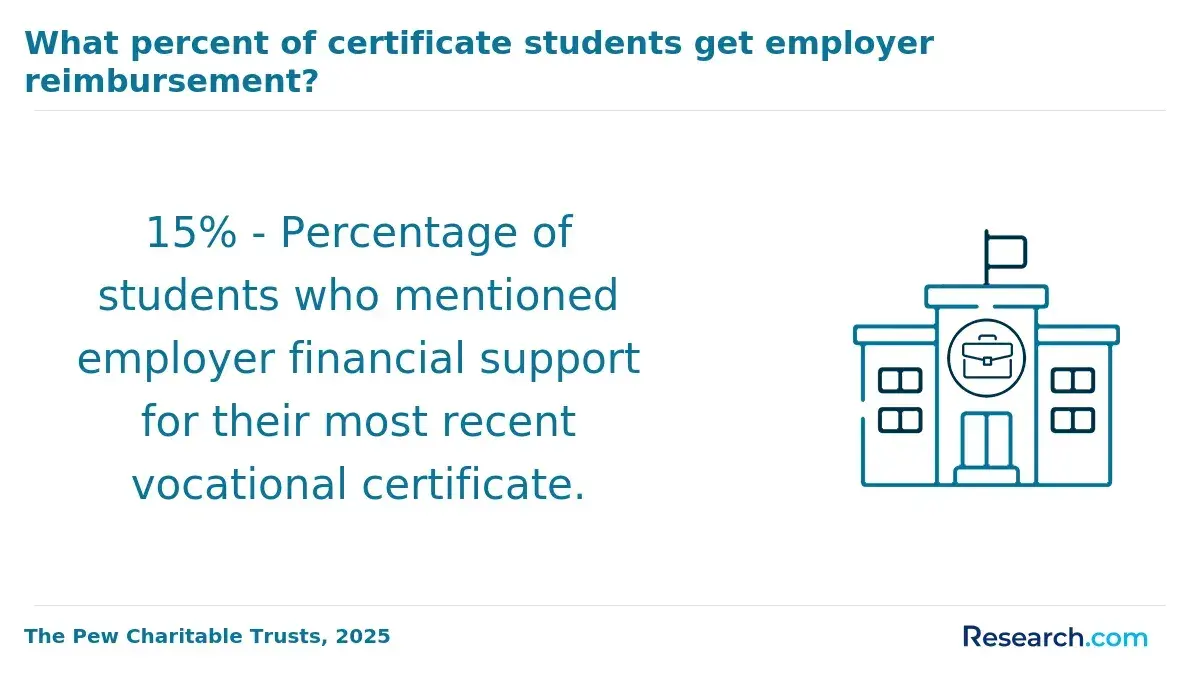
The real cost of a stackable credential is the amount you pay after employer funding, grants or aid where eligible, and any reimbursement delay - not just listed tuition. Under Internal Revenue Code Section 127, an employer can generally provide up to $5,250 in educational assistance annually that is excluded from an employee's taxable income. Employers can set more restrictive plan rules, so treat that amount as a tax benchmark rather than a promise of coverage.
Credit-bearing programs may also have fees, textbooks, digital access charges, lab supplies, uniforms, testing, licensure, travel, and lost-work-time costs. Lower tuition can be a poor bargain if none of the credits transfer or if you need to repeat coursework at the next institution. If your employer benefit is limited, compare it with federal-aid-eligible schools and financing rules; the guide to an cheap online colleges that accept FAFSA can help only if you have not already used that resource elsewhere.
Use this cost worksheet before committing. It separates expenses that may be reimbursed from those that frequently remain out of pocket.
| Cost category | Often covered by tuition assistance? | What to verify |
| Tuition | Often | Annual cap, approved providers, and payment timing |
| Mandatory academic fees | Sometimes | Whether fees are included in the benefit definition |
| Books and digital materials | Sometimes | Receipt and purchase-date requirements |
| Tools, uniforms, and equipment | Less often | Whether these are required and reimbursable |
| Certification or licensure exam | Varies widely | Separate professional-development allowance or exam policy |
| Travel, clinical, or practicum costs | Less often | Site location, parking, and scheduling burden |
Do not take on debt solely because reimbursement is expected. First confirm the grade threshold, employment-status requirement, and whether you can cover expenses until payment arrives. If the benefit is reimbursement-based, a shorter sequence spread across benefit years may be more affordable than enrolling in every course at once.
What curriculum and skill outcomes do leading stackable credential pathways provide?
Leading stackable pathways build skills in layers: foundational knowledge, applied practice, documented assessment, and a next-level specialization. A strong curriculum identifies what students can do at completion, not merely the courses they take. For example, an IT stack might move from troubleshooting and networking fundamentals to cloud or security tools; a healthcare stack might progress from terminology and patient support to specialized clinical or administrative competencies.
For employees who already know the material, a competency based masters degree may be a better later-stage option than repeating lower-level coursework, provided the employer benefit covers it and the degree matches the career requirement. This is generally a degree-completion choice, not a substitute for entry-level licensure or foundational practical training.
The table shows outcomes to look for in a credible pathway.
| Pathway area | Foundational outcome | Advanced outcome | Evidence of learning |
| IT | Support, operating systems, networking basics | Security, cloud, automation, or data specialization | Labs, projects, and certification preparation |
| Healthcare administration | Medical terminology and records workflows | Coding, compliance, revenue cycle, or informatics | Case work and, where relevant, exam preparation |
| Skilled trades | Safety, measurement, tools, and core systems | Diagnostics, controls, or supervisory skills | Shop work, demonstrations, and logged practice |
| Business | Spreadsheets, communication, and process basics | Project, operations, analytics, or leadership skills | Applied projects and workplace artifacts |
Ask for course outcomes, sample assignments, required technology, instructor qualifications, and evidence that curriculum is regularly updated. AI and automation make tool-specific knowledge change quickly; durable skills such as problem solving, documentation, ethics, communication, and quality control add resilience to a short credential.
Which careers and job roles are most aligned with stackable credentials?
Stackable credentials align best with careers that have entry points below a bachelor's degree, clearly defined technical competencies, or recognized intermediate roles. They can help an employee move from customer support to IT support, from warehouse work to logistics coordination, from a nursing assistant role toward licensed nursing, or from production work toward maintenance technician responsibilities. The right first credential depends on the entry role you can realistically access while continuing to work.
The following roles illustrate alignment, not automatic qualification. Employers, states, and certifying bodies may require experience, examinations, licensure, or additional education.
| Target role | Potential stackable starting point | Likely additional requirement |
| IT support specialist | Technical support or networking certificate | Portfolio, experience, or vendor certification may help |
| Medical coder | Medical coding certificate | Employer preferences and certification exam eligibility vary |
| HVAC technician | HVAC/R certificate | Hands-on training and refrigerant-related requirements may apply |
| Paralegal assistant | Legal studies or paralegal certificate | Law-firm hiring standards and state expectations vary |
| Graphic designer | Digital design certificate | Portfolio quality and software proficiency are central |
Choose a different path if your target occupation normally requires a bachelor's degree, graduate degree, or regulated professional license that a short certificate cannot provide. For employees aiming at management, an associate degree can be a useful bridge, while an online master degree may fit experienced professionals who already meet graduate admission requirements and need a higher-level credential.
What salaries and promotion opportunities can stackable credentials realistically support?
Stackable credentials can support promotion when they close a documented skills gap and the employer has roles that use those skills. They are less reliable when purchased as a general signal without projects, experience, or a defined career ladder. Ask your manager or talent team whether the credential is recognized in job descriptions, promotion frameworks, or internal tuition-partner pathways.
Occupational wage data provides useful context but should not be treated as a graduate earnings guarantee. In May 2024, the Bureau of Labor Statistics reported median annual wages of $62,340 for computer user support specialists and $61,890 for paralegals and legal assistants. Individual pay varies by location, experience, industry, schedule, licensure, and employer; neither occupation's median proves that any particular certificate will lead to that role.
To assess return on investment, compare the likely out-of-pocket cost and time commitment with a specific job change or skill outcome. A credential is more defensible when it supports a current job requirement, replaces a recurring skills gap, or applies directly toward a larger funded credential. It is less compelling when a school advertises salary outcomes without identifying job titles, geographic scope, completion rates, or the experience level of reported workers.
Promotion prospects improve when employees document completed projects, request stretch assignments, and connect coursework to measurable workplace needs. The credential creates evidence of learning; performance and available openings determine whether that evidence translates into advancement.
How can students verify program accreditation, certification readiness, and employer recognition?
Verification should happen before enrollment, especially when tuition assistance is limited. Institutional accreditation is relevant for colleges and credit-bearing certificates; programmatic accreditation may matter in fields such as nursing and allied health; industry certifications are validated by the issuing organization's exam and maintenance rules. None of these forms of recognition is interchangeable.
Use the following checks to distinguish a credible stack from an expensive dead end.
- Confirm the school's institutional accreditation through the accreditor named in the college catalog and verify any program-specific approval required for your occupation.
- Ask whether the exact certificate is for-credit or noncredit, how many credits apply to the next credential, and whether a written articulation agreement governs the transfer.
- For certification preparation, identify the separate certifying organization, exam prerequisites, testing cost, renewal requirements, and whether program completion alone confers no certification.
- Compare the curriculum with current job postings and ask your employer whether the provider or credential is recognized for hiring, tuition reimbursement, or promotion.
- Verify state board approval, clinical placement eligibility, background-check rules, and examination requirements before entering any regulated healthcare or trade pathway.
Be cautious when a provider uses phrases such as "nationally recognized" without naming who recognizes it, claims graduates are automatically certified, or will not provide a total-cost estimate. Keep copies of benefit approval, course descriptions, syllabi, receipts, transcripts, and certification records; these documents are useful for reimbursement, transfer reviews, and internal promotion discussions.
Other Things You Should Know About
Sometimes. Plans vary widely: some cover tuition only, while others include exam fees, study materials, or certification renewals. Check the written policy and request approval before paying.
No. Some stacks use academic credits that apply to a certificate or degree; others use noncredit courses, digital badges, licenses, or industry certifications. Only documented credit-transfer policies establish whether coursework will count toward a degree.
Your plan may require repayment if you leave within a stated period, or it may not. Review any repayment agreement before enrolling and calculate whether you could repay the benefit if your employment changes.
It can be, particularly when it comes from a recognized college or certifying organization and demonstrates job-relevant skills. For hands-on or licensed fields, employers may also expect supervised practice, clinical hours, portfolios, or examinations that cannot be completed entirely online.
References
- Talent Studies: Investing in employee education benefits everyone https://www.luminafoundation.org/our-work/talent-investments/
- Frequently asked questions about educational assistance programs | Internal Revenue Service https://www.irs.gov/newsroom/frequently-asked-questions-about-educational-assistance-programs
- Building Stackable Credentials That Truly Deliver Value and Economic Mobility: 7 Steps for Success https://mcacs.talentfirst.net/building-stackable-credentials-that-truly-deliver-value/
- Employer Tuition Assistance Program / Employee Tuition Reimbursement - Finance | Learn & Work Ecosystem Library https://learnworkecosystemlibrary.com/topics/employer-tuition-assistance-program-employee-tuition-reimbursement-finance/
- Employer Tuition Assestance Boosts Student Success, Provides Revenue to Community Colleges http://perspectives.acct.org/stories/employer-tuition-assistance
- Build a Bridge Between Education and Industry with Credentials https://www.nga.org/futureworkforce/pathways/build-a-bridge-between-education-and-industry-with-credentials/
- SEE MORE https://iticollege.edu/blog/stackable-credentials-how-certificate-programs-can-be-your-fast-track-to-a-degree/
- Tuition Reimbursement Programs [A Guide for HR and Employers] https://compt.io/blog/employee-tuition-reimbursement/
- Stackable Credentials: Living Links Between Learning and Work https://www.cael.org/resouces/pathways-blog/stackable-credentials-living-links-between-learning-and-work
- USHE initiative helps students earn meaningful credentials on their way to a degree - Utah System of Higher Education https://ushe.edu/stackable-credentials-help-students-earn-credentials-on-their-way-to-a-degree/